|
Örjan Martinsson
| |
|

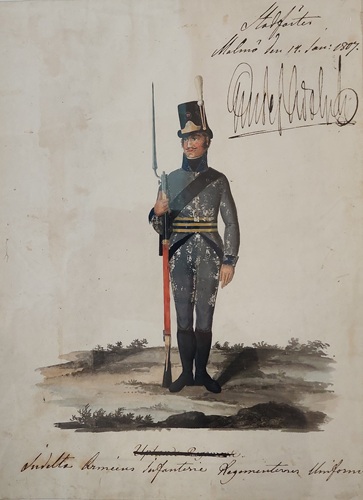
The first decade of the 19th century is the period when the uniform
regulations were changed faster than the uniforms could be issued to the
regiments. Gustav IV Adolf was very interested in the appearance of his army
and frequently made alterations to its uniforms. The changes to his major
uniform regulation from 1802 had been limited until 1806, but after that a
series of changes took place that led to the very different m/1807 seen
above and which was to be worn by the provincial infantry. It was a grey
uniform that was identical for all regiments with much less decoration than
the previous uniform. However, the road to this uniform was not straight and
Gustav IV Adolf's many uniform changes are summarized in the chronology
below.
The grey m/1807 uniform was unpopular and was not in force long enough to be
issued to all regiments before the 1809 coup d’etat resulted in its
abolition. However, this did not mean that the provincial infantry regiments
wore uniforms that were in accordance with the m/1802 regulation during the
Finnish War of 1808-1809. Some changes decided in 1806 were implemented
immediately by re-sewing the old uniforms. By removing the lapels on the
jackets and purchasing grey trousers (trousers were replaced more often than
jackets), the old m/1802 uniforms were transformed into m/1806 uniforms
(i.e. the spring model of m/1806, in the autumn of 1806 the jackets were to
be grey). |
|
Chronology
Model 1806
(spring)
7 February 1806: The
provincial infantry was to wear grey waistcoats and grey trousers with an
inch-wide blue strip along the outer seam, as well as black gaiters that
ended below the knee. The exceptions were the Livregementet’s Grenadier
Battalion and the Livgrenadjärregementet, which were to wear blue waistcoats
and trousers with a red strip. In addition, the lapels are to be removed
from the jackets of the provincial infantry, which will still have two rows
of buttons.
27 February 1806:
Both the Swedish and Finnish infantry and the foot jägers are to have only
one row of buttons on the jackets and the blue strip on the trousers is to
be removed. The cloaks shall now have sleeves and a collar that covers the
shoulders.
Model 1806 (autumn)
30 October 1806:
The Swedish provincial infantry, except for the grenadier units, are to have
grey jackets and also grey cloaks with a blue collar. The regiments are to
be distinguished by different colours on the collar and cuffs of the jacket.
28 November 1806: A
detailed uniform regulation states that the Swedish provincial infantry
regiments are to have dark grey while the Finnish ones are to have light
grey. The shoulder belt and the blue-yellow sash from m/1792 are
reintroduced (they had been replaced with a waist belt in connection with
m/1802).
Model 1807
26 January 1807: All the
infantry, except for the grenadier units, shall have dark grey clothes and
dark blue collar, cuffs and turnbacks on the jacket. The only difference
between the regiments will be a regimental badge on the hat. All regiments
and corps will have brass buttons. The model drawing for this uniform was
already approved on January 14. The Jäger corps will have green collar,
cuffs and turnbacks on the jacket and a green plume and cordon on the hat.
They too will only be distinguished by a regimental badge on the hat.
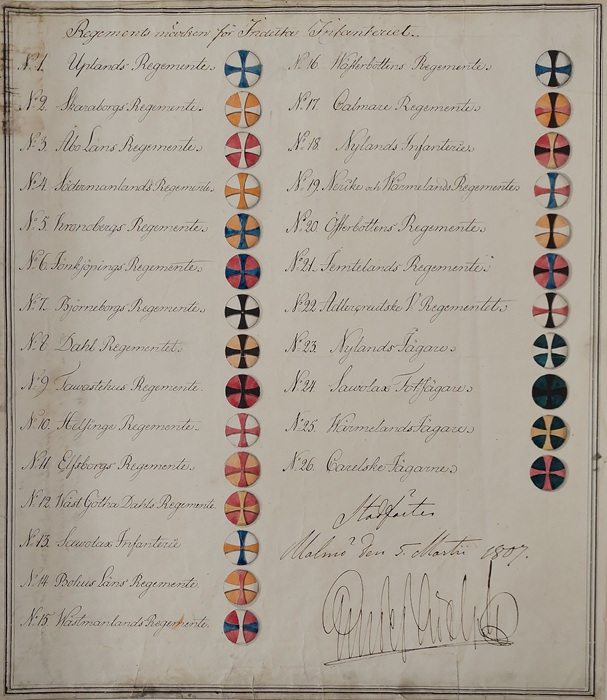
5 March 1807: The
appearance of the regimental badges on the hat is determined.
19 May 1807: The privates
(= in the guard regiments and grenadier units) were to wear a round hat with
a white feather sultan and black horsehair brim. Non-commissioned officers
and drummers were to wear a “tricorne hat” (i.e. "Napoleon hat", not
"Charles XII hat") with silver lace for non-commissioned officers. This
information comes from Bellander (page 396) and he gives the impression that
it applied to the entire army, which cannot reasonably be true.
Model 1807 Abolished
8 June 1809: The white
armband worn by officers since 1772 is abolished.
14 June 1809: The grey
uniform colour is abolished. Jackets are to be blue again while waistcoats,
trousers, cuffs, lapels, collars and linings are to return to the colours
they had before the grey uniforms were introduced. |
|
Model 1806
(spring)
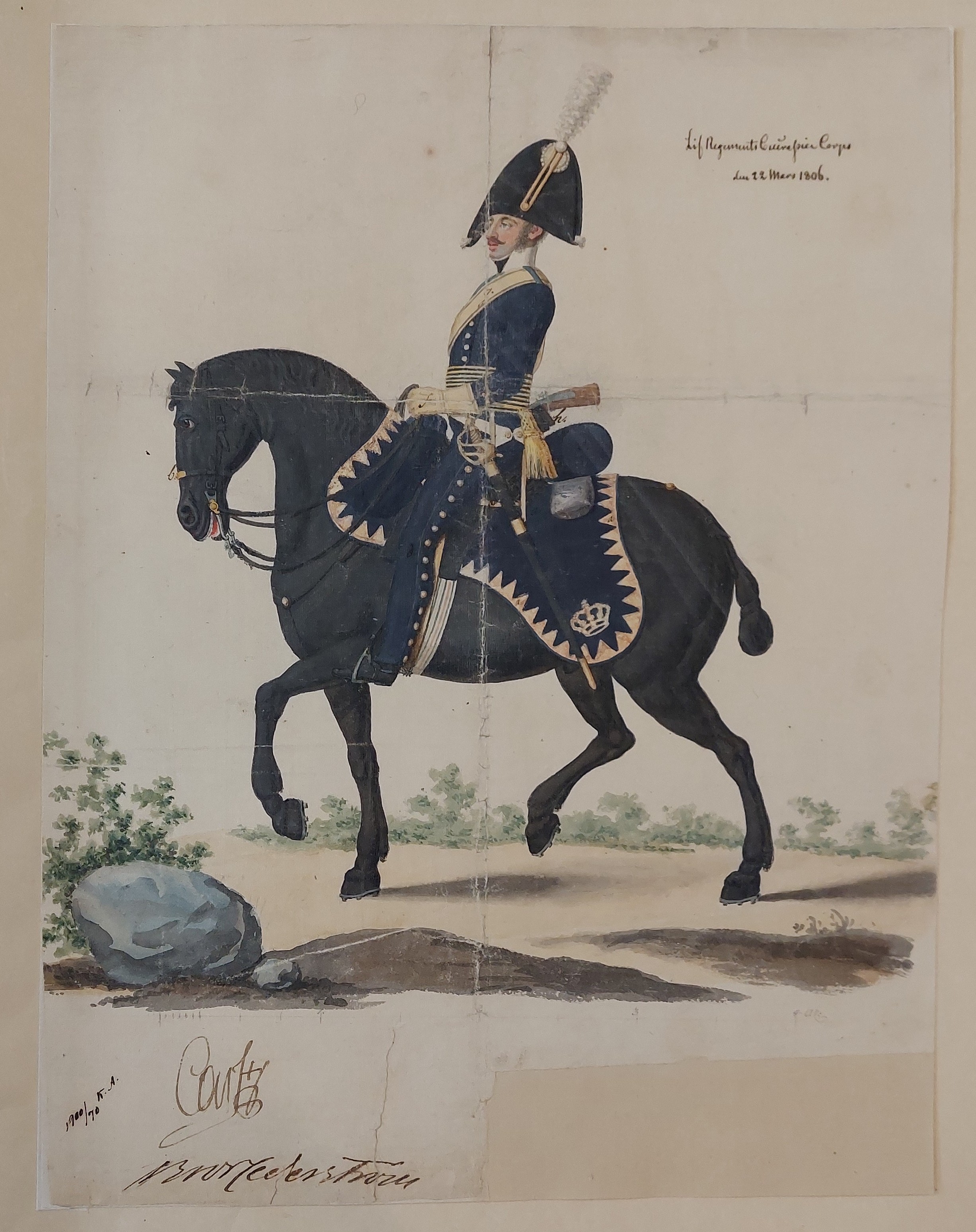
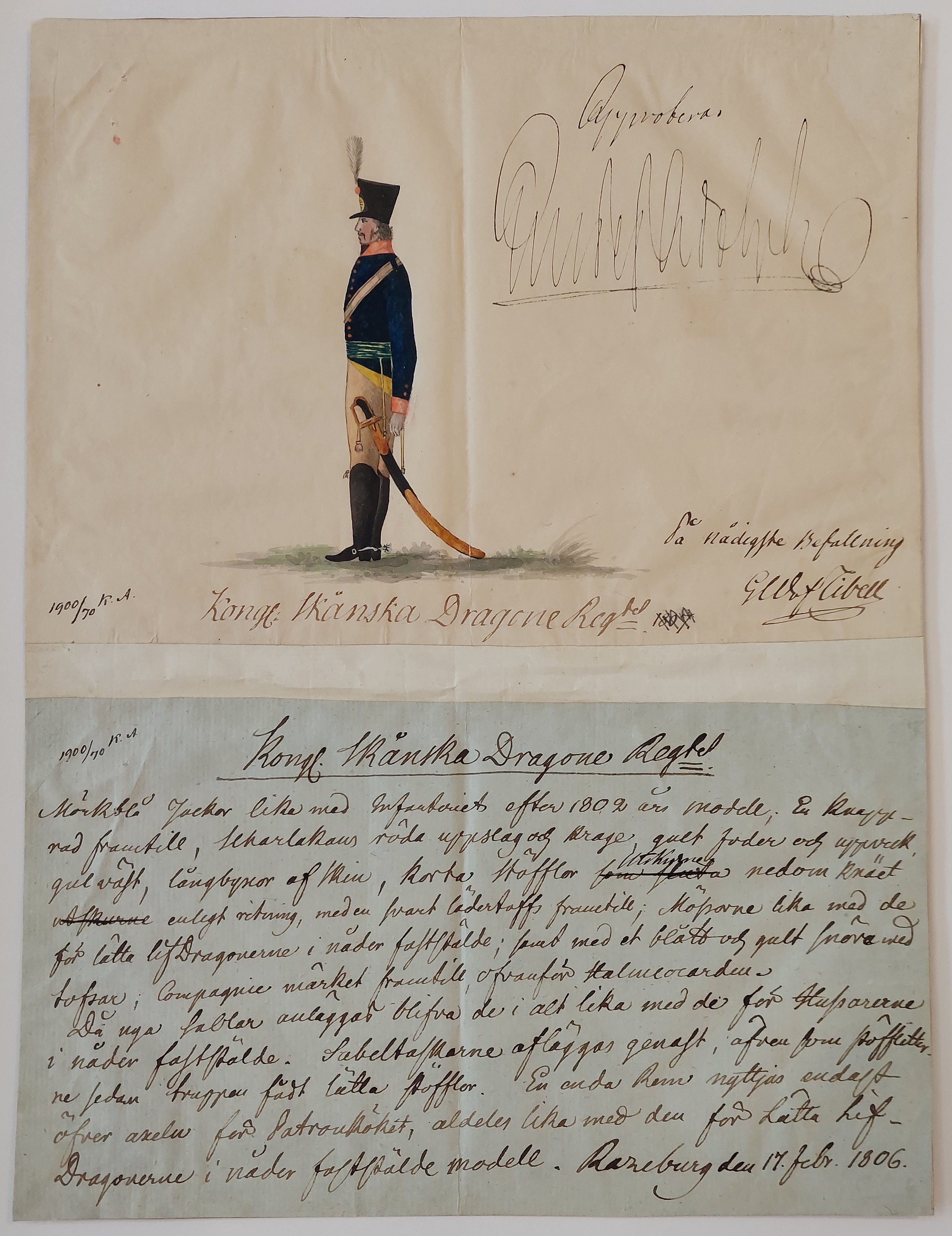
The only model drawings for
uniforms from 1806 that exist in the Swedish War Archives are three drawings
for cavalry regiments, and the cavalry was not affected by Gustav IV Adolf's
austerity to the same extent as the provincial infantry.
|
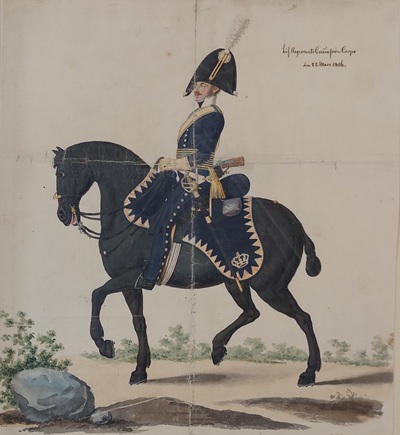
Livregementet's Cuirassier Corps
Decreed 22 March 1806
[SE/KrA/0429/008/15] |
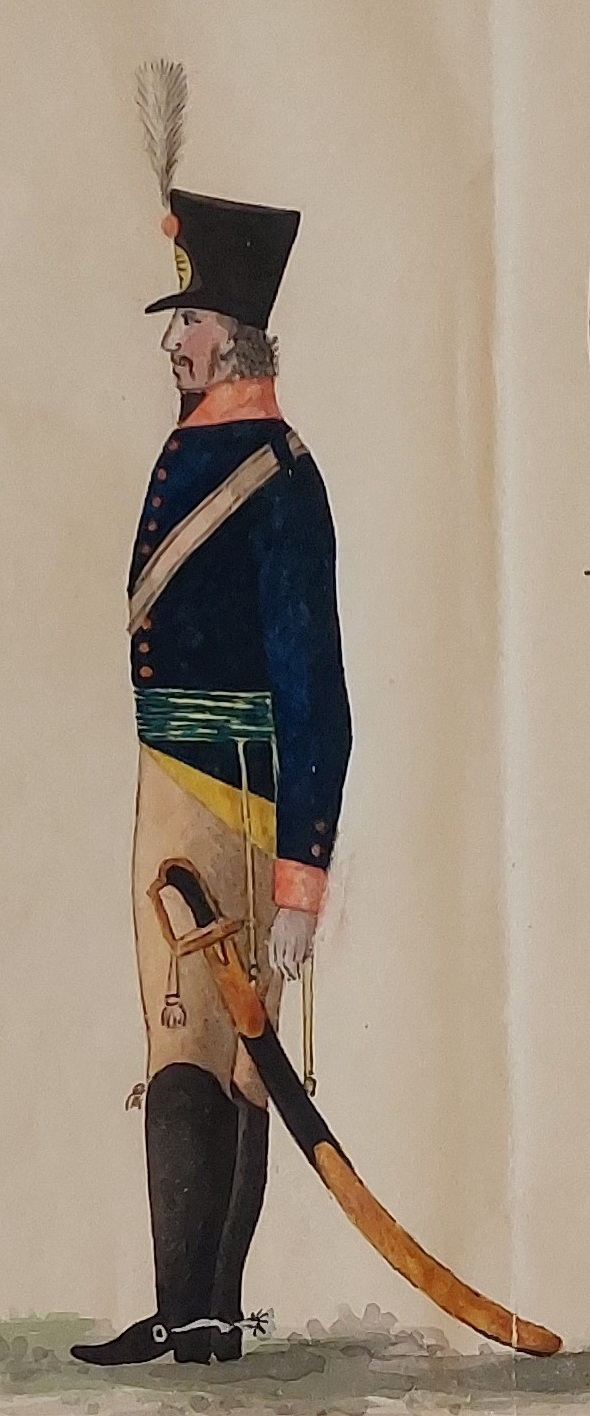
Skånska Dragoon Regiment
Decreed 17 February 1806
[SE/KrA/0429/008/16] |
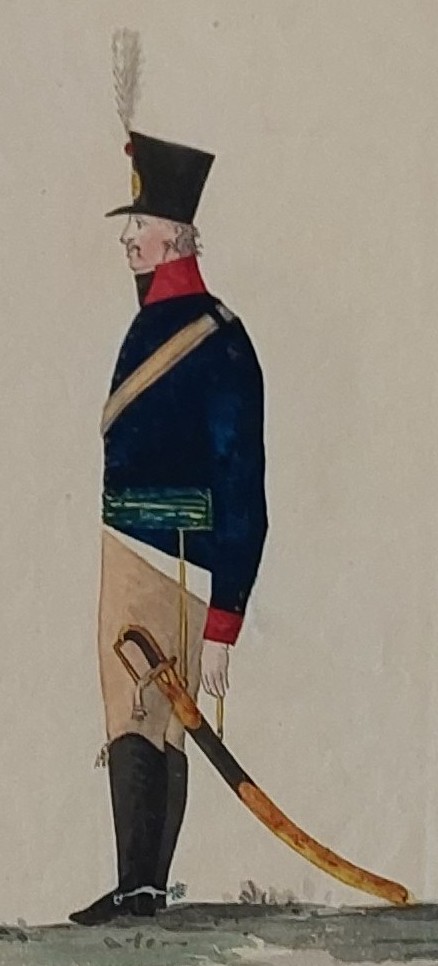
Västgöta
Dragoon Regiment
[SE/KrA/0429/008/45] |
Skånska Dragoon Regiment was
called the Norra Skånska Cavalry Regiment until 1801 and was converted into
the Skånska Hussar Regiment in 1807. Västgöta was also a former cavalry
regiment and was converted into an infantry regiment in 1811. |
|
Model 1806
(autumn)
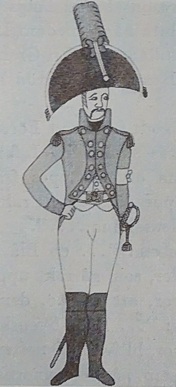
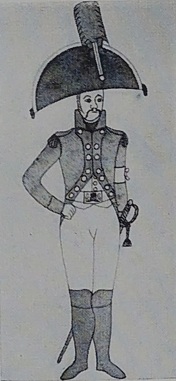
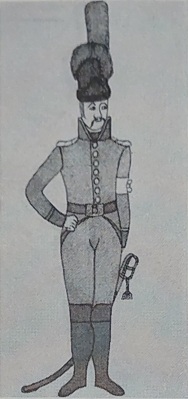
Johan August von Borck
(1787-1845) made 32 coloured drawings of uniforms (24 officer uniforms and 8
civilians) on his own initiative. The uniform images correspond to the
regulations that applied to the provincial infantry from 30 October 1806
until 26 January 1807. The fact that enlisted regiments are also depicted in
grey coats is, however, surprising and may perhaps be due to some
misunderstanding.
16 of these images have been
published in an article by Gun Adler in Meddelanden från Armémuseum 11.
Unfortunately, as black and white photos, but with text descriptions of the
colours on all images, and it is from that article that the information
below comes from. However, Adler wrote in her article that the colours were
faded and some may therefore be uncertain
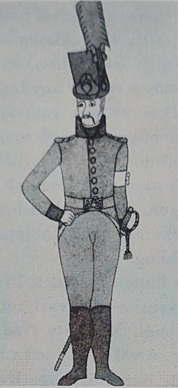
Konungens eget värvade regemente |
Drottningens livregemente |
Engelbrecht's
Regiment |
Värmland
Jäger Battalion |
|
Grey coat with
red collar, red lapels and yellow turnbacks. Gold epaulettes and grey
trousers.
|
Grey coat with
collar, cuffs, lapels, and turnbacks in yellow. White epaulettes,
waistcoat and trousers. |
Grey coat with
collar, cuffs, and lapels in red and gold epaulettes. White waistcoat
and white trousers.
|
Grey coat with
collar, cuffs, and lapels in green and silver epaulettes. Grey trousers. |
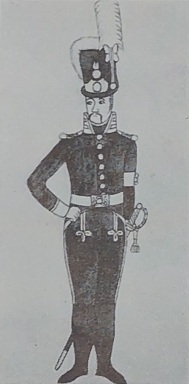
Livgrenadjärregementet |
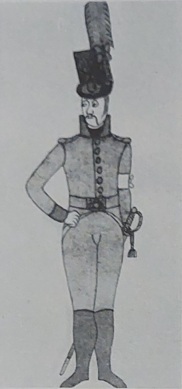
Kalmar |
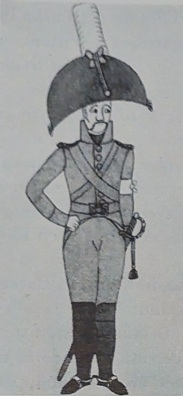
Livdrabant Corps |
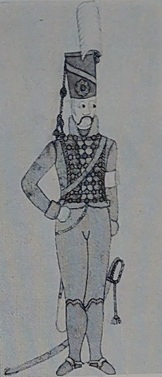
Hussar |
|
Blue coat and
blue trousers. The drawing is unfinished, so other details have not been
filled in.
|
Grey coat with
red collar, red cuffs, white turnbacks and golden epaulettes. Grey
trousers. |
Grey coat with
grey collar and yellow turnbacks. Gold epaulettes and grey trousers. |
According to
Adler's article, a hussar had a black fur coat and yellow trousers.
However, Borck depicted two hussars and perhaps the text describes the
second hussar.
|
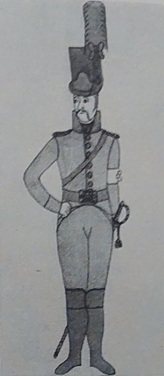
Göta
Artillery Regiment |
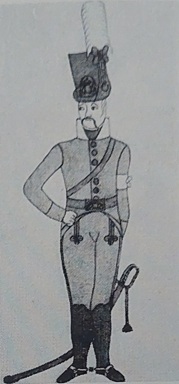
Pomeranian Horse Artillery |
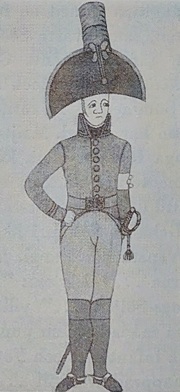
Adjutant General
of the Wing |
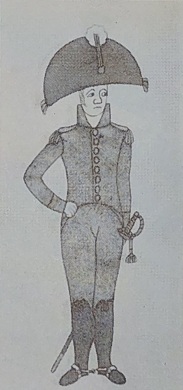
Nobility Uniform |
|
Grey coat with
yellow collar and gold epaulettes. Grey trousers.
|
Grey coat with
white collar and gold epaulettes. Grey trousers with yellow embroidery.
|
Grey coat with
gold lace on collar and cuffs. Gray trousers. |
Grey coat with
gold epaulettes. |
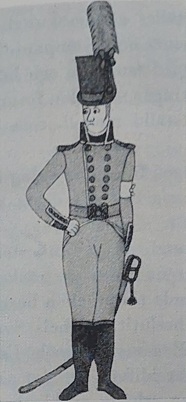
Admiralty |
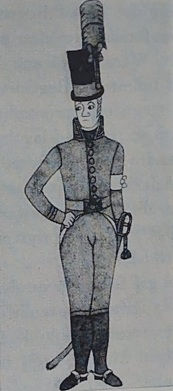
Adjutant General of the Squadron |
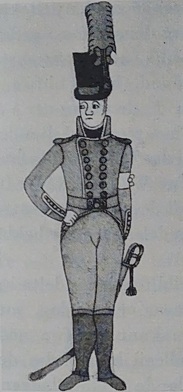
Fleet Construction Corps |
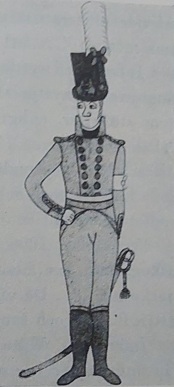
Army Fleet |
|
Grey coat with
blue collar and cuffs and gold epaulettes. Grey trousers. |
Grey coat with
gold lace on collar and cuffs. Grey trousers. |
Grey coat and
grey trousers. |
Grey coat,
gold epaulettes and grey trousers. |
A picture that is supposed to
depict the Svea Artillery Regiment has the same uniform as the Göta
Artillery Regiment above, but with a white collar that was the colour of the
Vendes Artillery Regiment instead of the blue collar of Svea.
Additional pictures that have
not been published in Gun Adler's article depict one more hussar, one
general on horseback and six provincial infantry regiments (Södermanland,
Jönköping, Kronoberg, Älvsborg, Skaraborg and Närke-Värmland). All
provincial officers wear grey coats and grey trousers. The colours of the
collar, cuffs and turnbacks are white for Älvsborg, red for Närke-Värmland
and yellow for Skaraborg and Södermanland (the last three have gold
epaulettes). For Jönköping they are red-red-yellow and the epaulettes are
gold. For Kronoberg they are red-red-white and the epaulettes are silver.
Finally, von Borck's collection
contains seven pictures of civilian uniforms. One of them is a maroon coat
while the other six pictures contain green coats. |
|
Model 1807
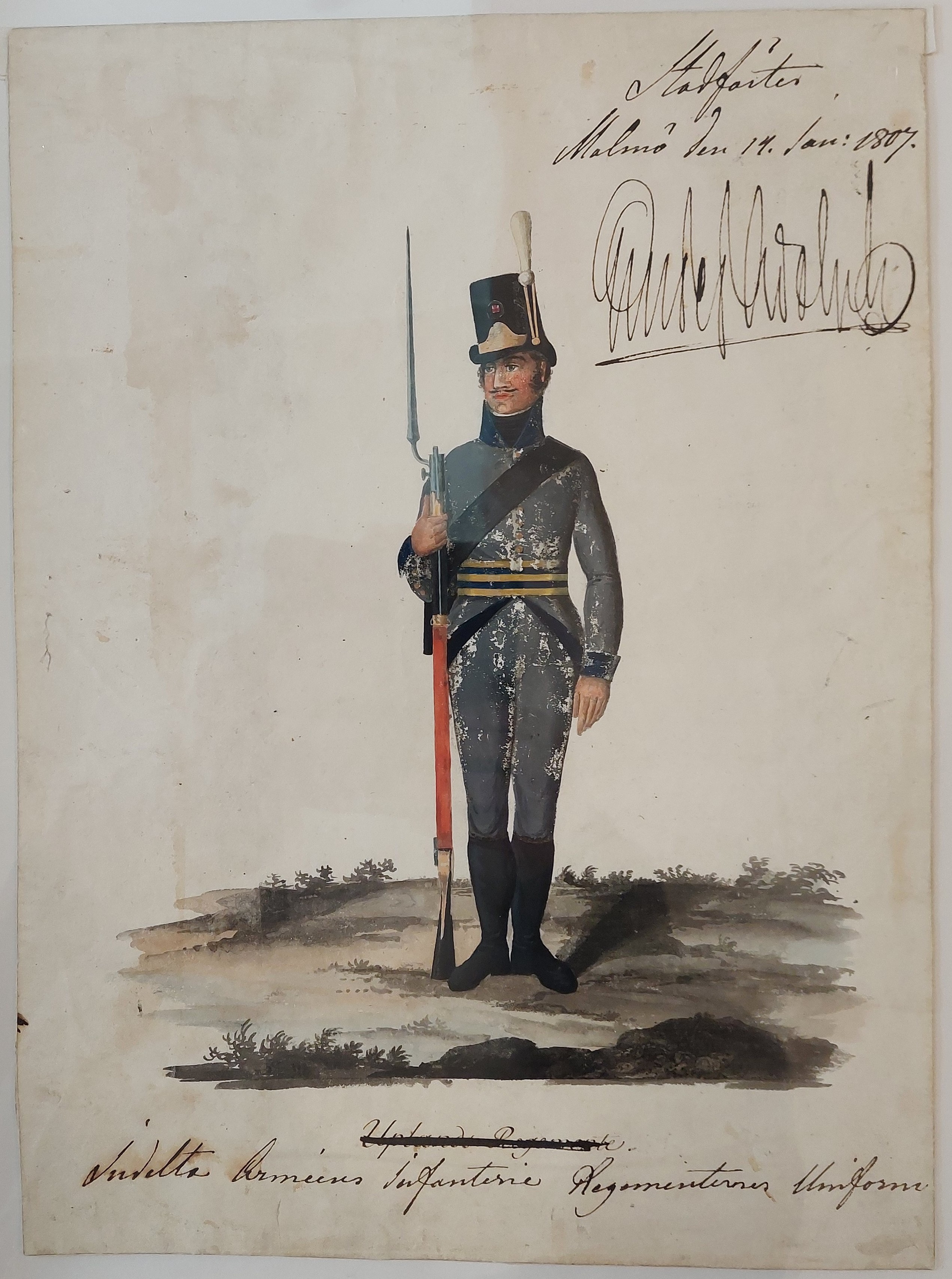
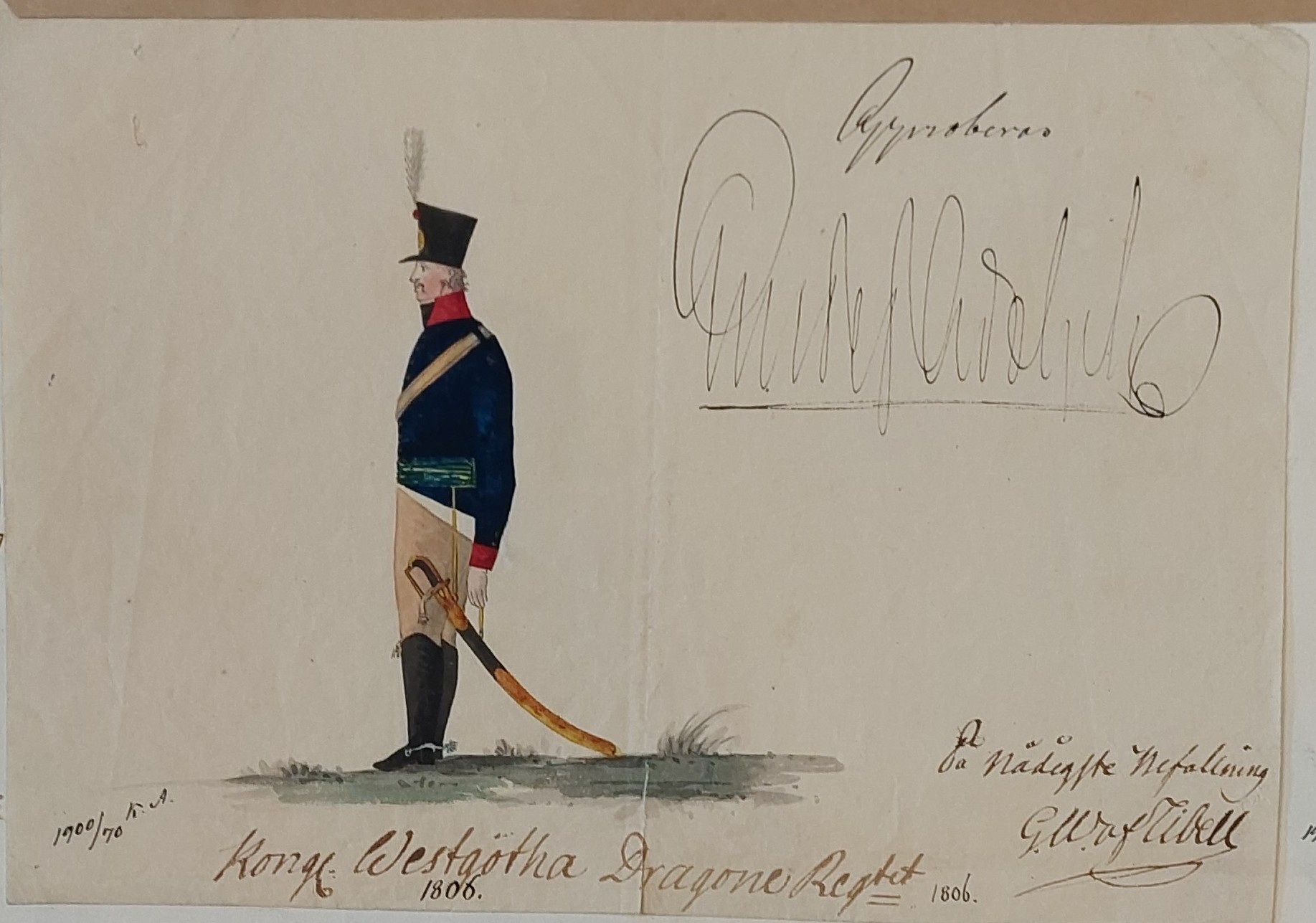
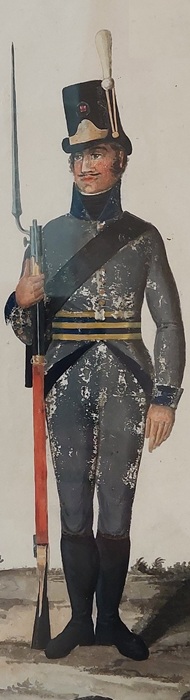
The only official model drawing of the m/1807 that was made was an example
picture of a provincial soldier drawn by Carl Gustaf Gillberg. It depicts
the Hälsinge Regiment and can be seen in its entirety at the top of this
page, and in a cropped format below on the left. Since the only difference
between the provincial infantry regiments was the regimental badge on the
hats, a tableau of these badges was sufficient instead of model drawings for
each regiment. The result can be seen below.
 |
 |
|
[SE/KrA/0429/008/17] |
[SE/KrA/0429/008/19] |
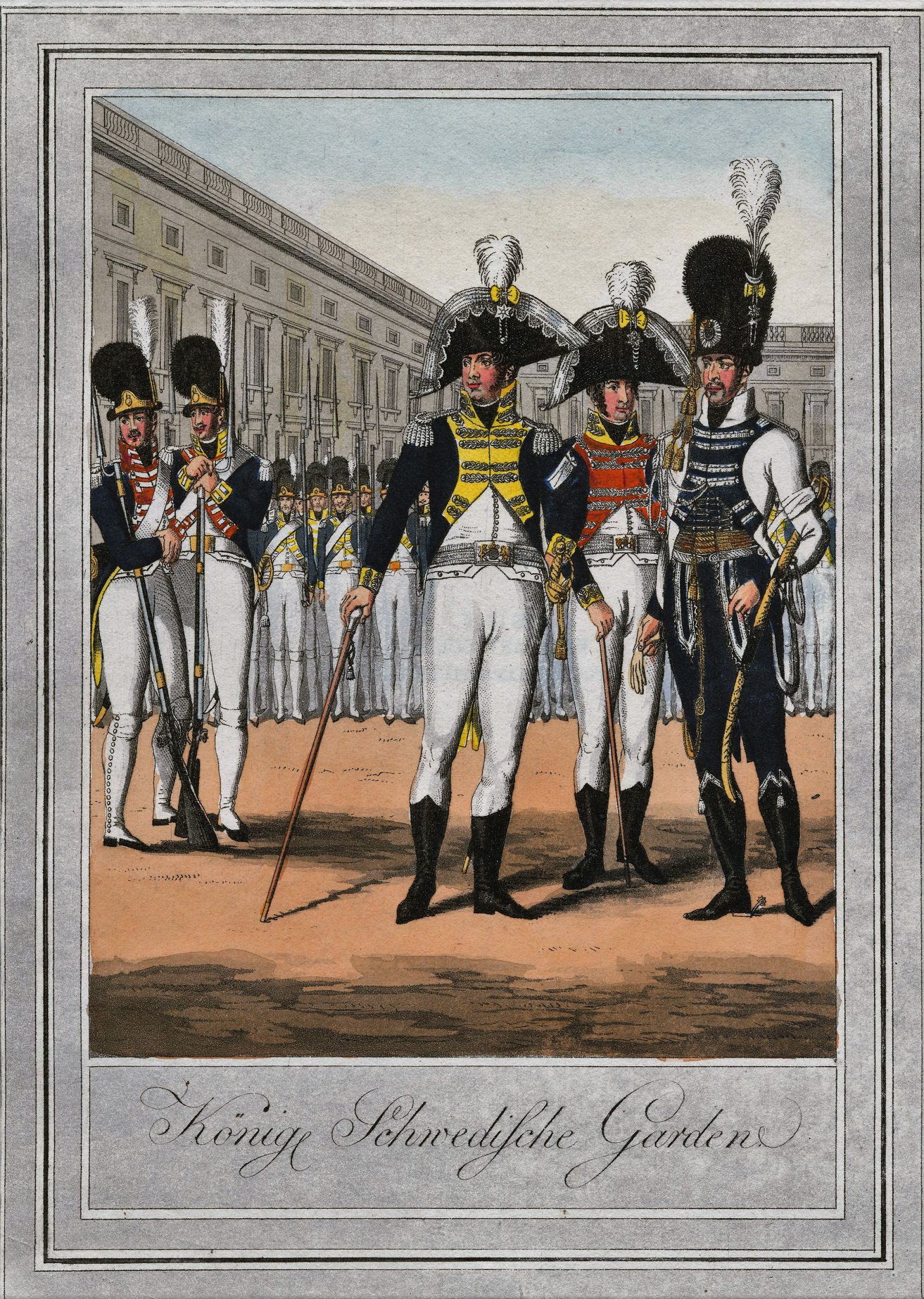
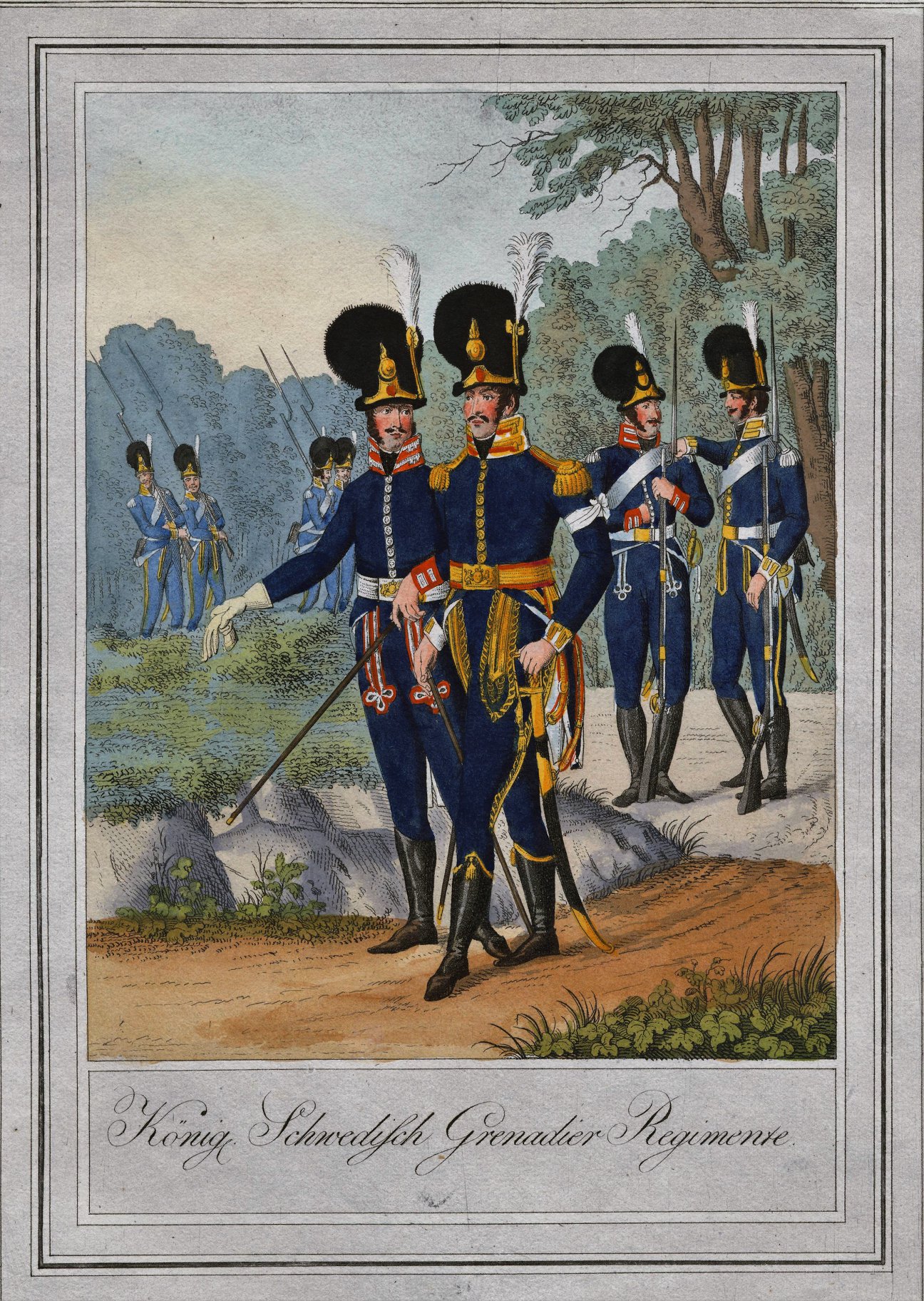
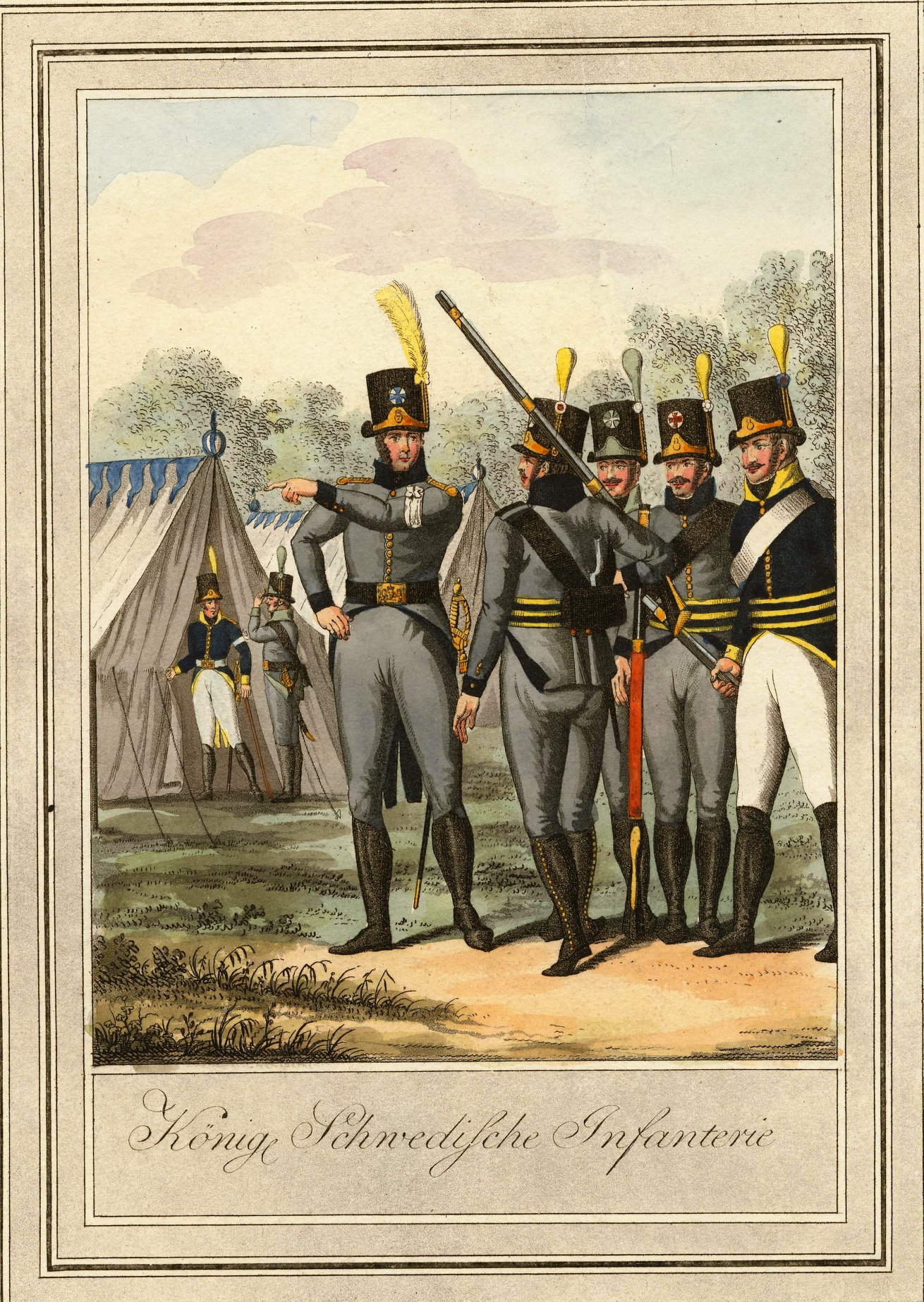
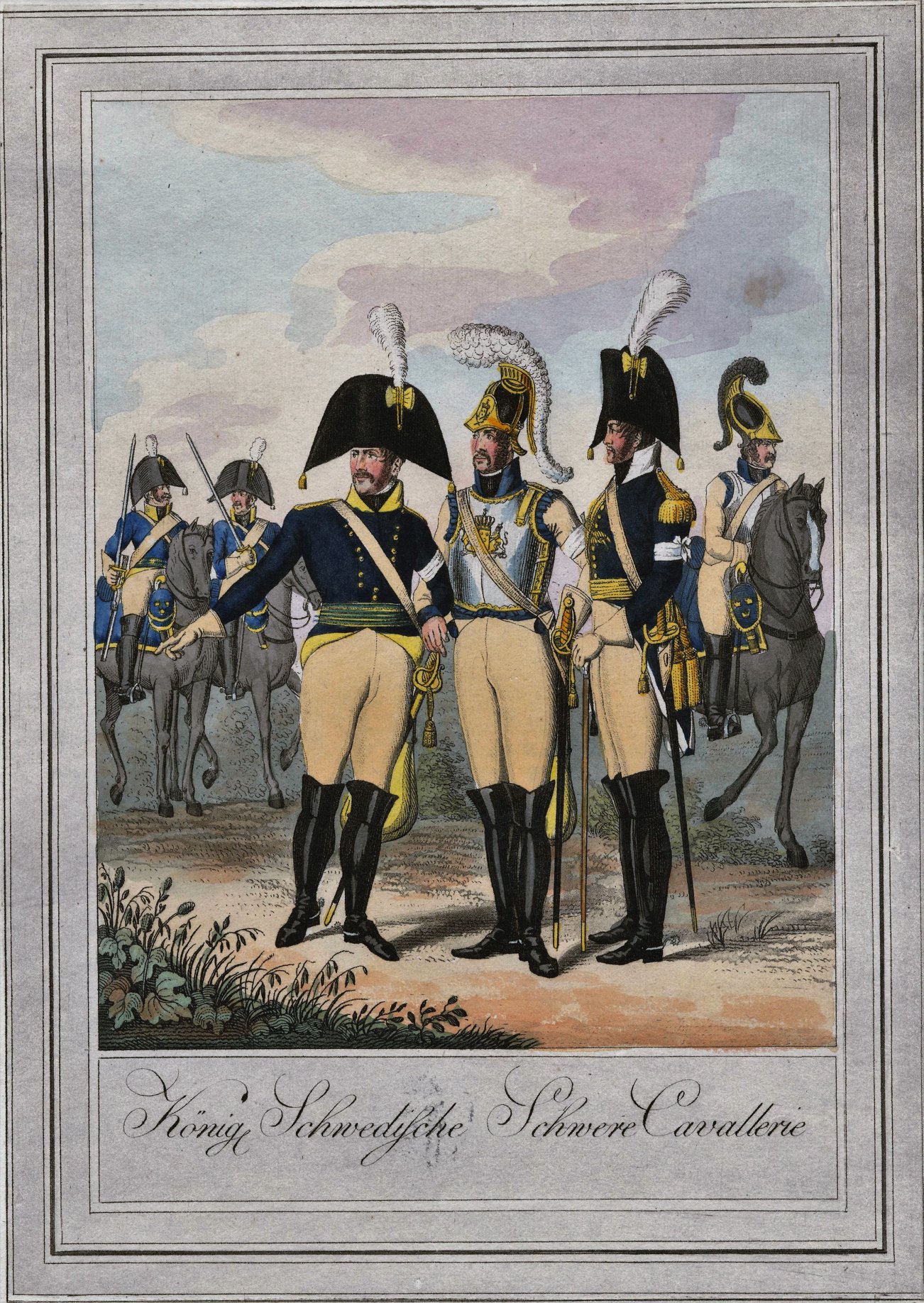
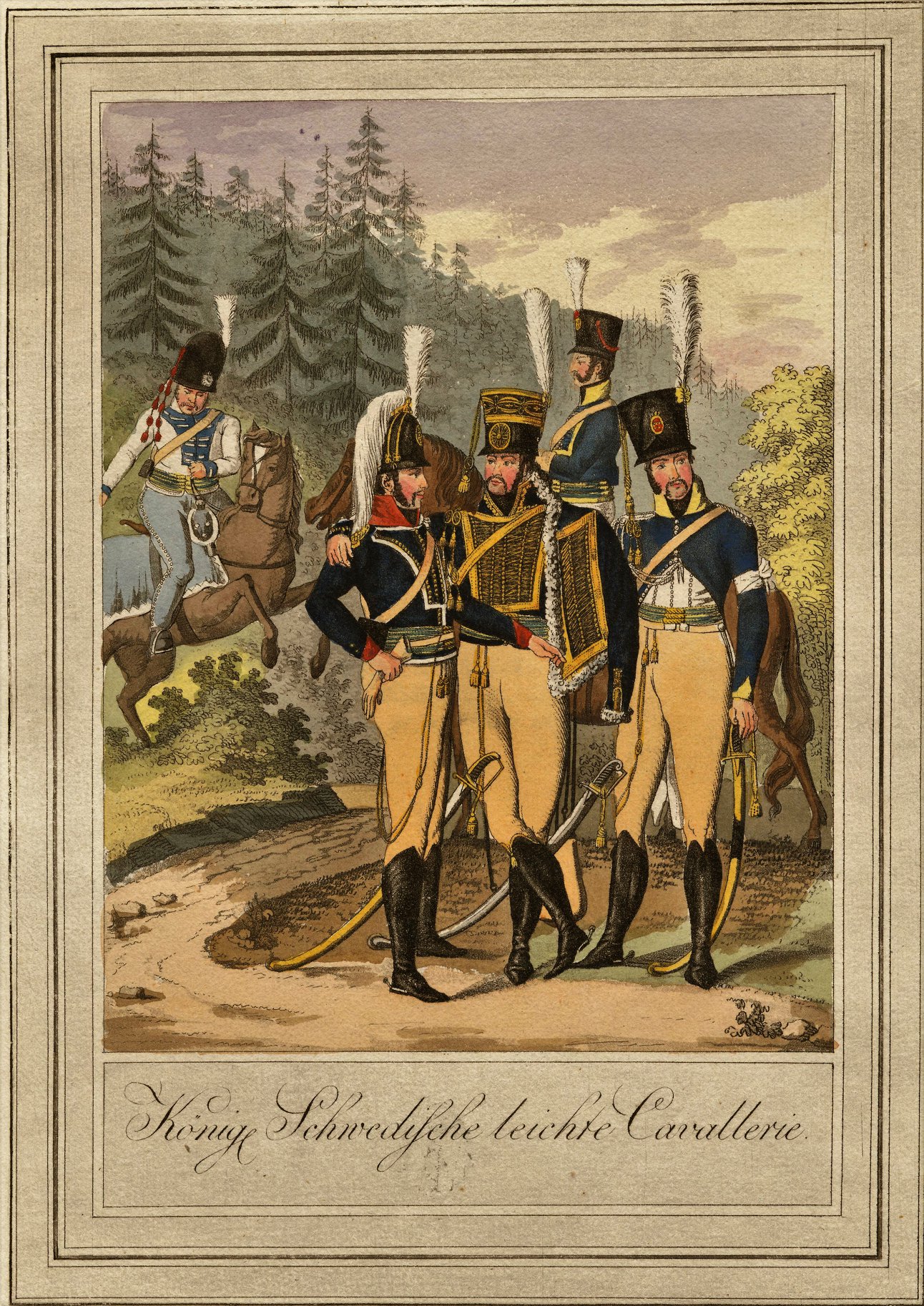
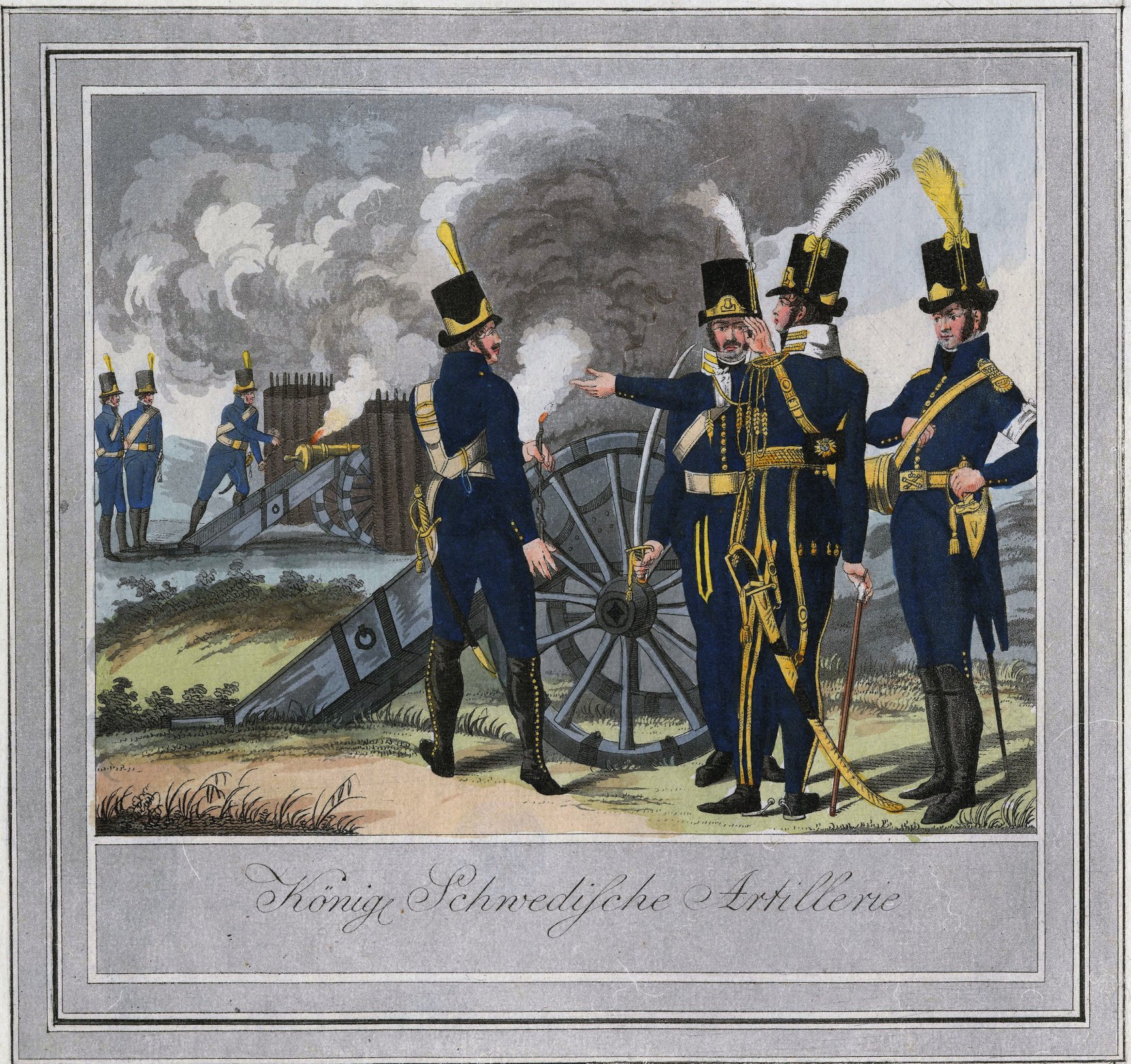
In addition to the above official images, J. B. Schiavonetti published a
series of plates in Berlin around 1808 with the title "Uniformen der
ganzen Königl. Schwedishen Armée". It consisted of six copper
engravings made after drawings by Carl Gustaf Gillberg. Each copper
engraving depicts a troop category without mentioning any regimental
names. The identifications below are therefore my own based on the
uniform drawings for m/1802.
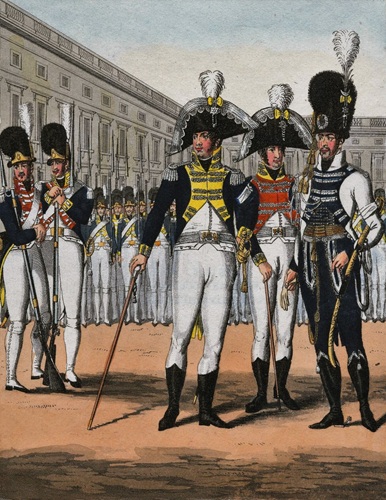
Guard Regiments |
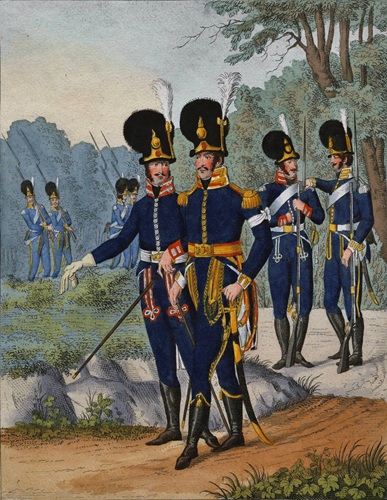
Grenadier Regiments |
|
Soldier from Göta
livgarde (red colour), soldier from the Finnish Guards (yellow
collar and red lapels) and officer from Svea livgarde (yellow
colour) next to officers from the Finnish Guards and the Light
Dragoons. |
Livgrenadjärregementet
in red (allotted in Östergötland) and Livregementet’s Grenadier
Battalion in yellow (allotted in Västmanland and Södermanland. |
|
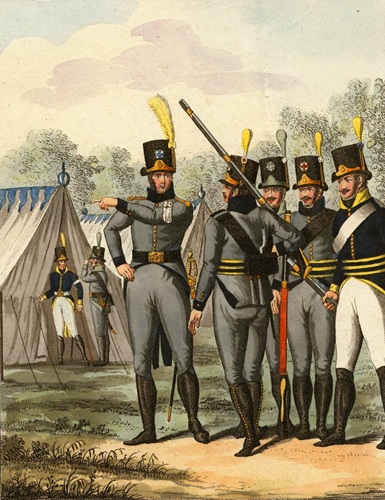
Infantry
|
|
Jägerhorn’s garrison regiment in Sveaborg with blue jackets,
provincial infantry with grey jackets and yellow hat plumes and the
jägers with grey clothes and green hat plumes. The officer in the
middle with a blue cross on his hat belongs to Uppland Regiment. The
jäger with a white cross belongs to the Nyland Corps and the soldier
with a red cross belongs to Hälsinge Regiment.
|
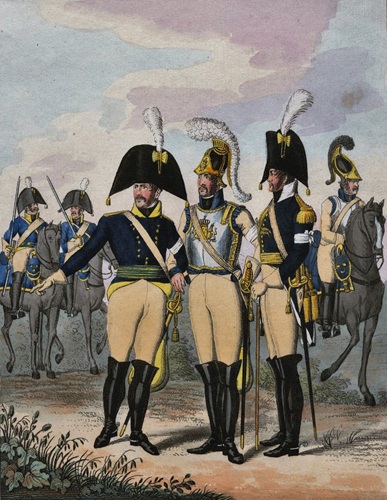
Heavy Cavalry |
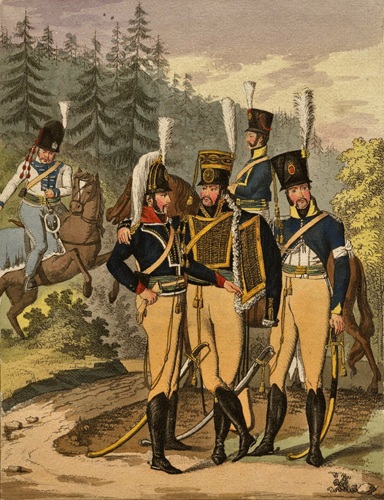
Light Cavalry |
|
On the left in the
foreground an officer from the Skånska Carabineer Regiment (formerly
Södra skånska). On the right in the foreground an officer from the
Livregementet’s Cuirassier Corps and in the middle an officer from
the same regiment with a cuirass. |
Light Dragoons with a
white jacket, Västgöta Dragoon Regiment with red colour, in the
middle a hussar (there were three such regiments: the Hussar
Regiment, Livregementet’s Hussars Corps and former Norra skånska
which in 1807 became Skånska Hussar Regiment), on the right two
dragoons (Småland and Nyland?). |
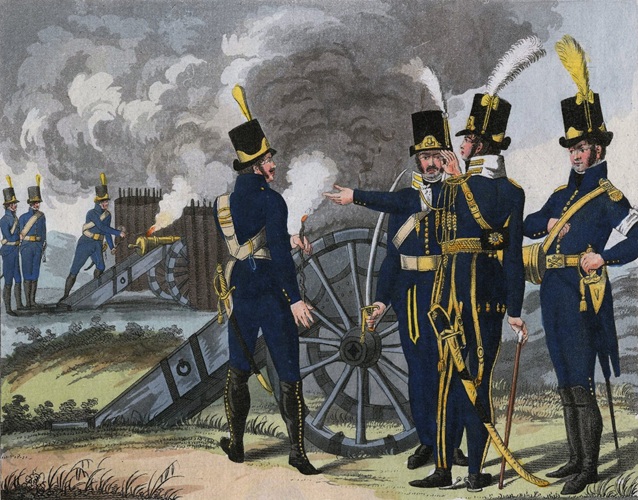
Artillery
Svea Artillery Regiment with blue collar and Horse Artillery with
white collar.
|
|
References
Adler, Gun. 1806–1807 års uniform för det indelta infanteriet.
(article in MAM 11).
Stockholm (1950)
Bellander, Erik. Dräkt och uniform. Stockholm (1973) |
|