|
Örjan Martinsson
| |
|

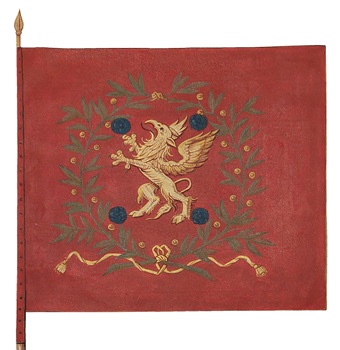
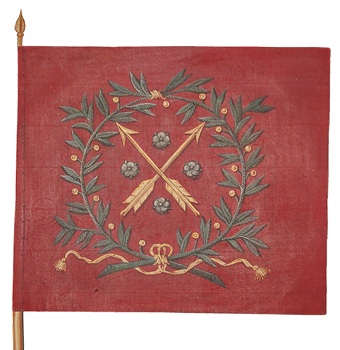
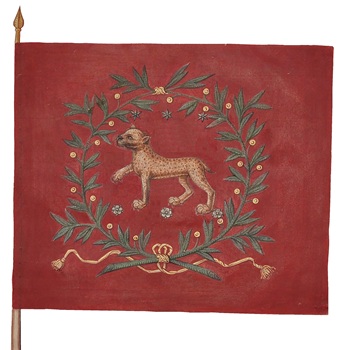
This page presents the colours of the
Livgarde and the regular provincial infantry regiments during the 18th
century. The top images for each regiment are Olof Hoffman's model drawings
of m/1686 (reconstructions in some cases). The bottom images depict
preserved colours that were in use during the 18th century. Where possible,
they are linked to pages in Digitalt Museum that contain even more
images of them. The differences between the different models of colours
(m/1675, m/1686, m/1686B, m/1761 and m/1766) are explained
on this page.
|
|
Livgardet (Life Guards)
(A more detailed description of the colours can be
found on this page) |
 |
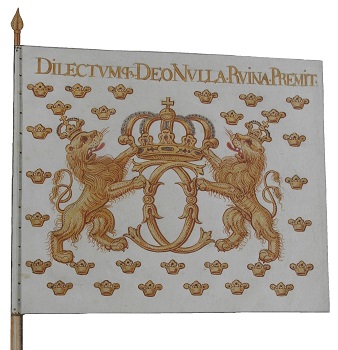 |
For the Livgarde, m/1686
probably did not represent any change compared to how the colours looked
before. However, when the manufacturing technique changed from painting to
embroidery in the 1720s, m/1686 was practically abandoned. In order to
prevent the colours from becoming too heavy, the motto and the lions were
removed. The crowns that were scattered across the entire field were reduced
to only one in each corner and the monogram (or coat of arms) in the middle
was made smaller. Colour sets were issued in 1680, 1690, 1702, 1710, 1720,
1726, 1748, 1762-63, 1771-72, 1786 and 1798.
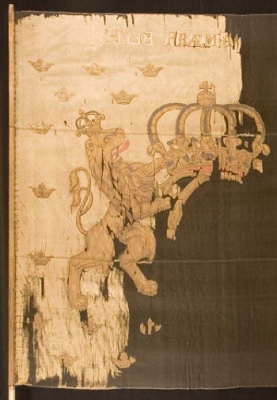
Company colour from 1680 or 1690 |
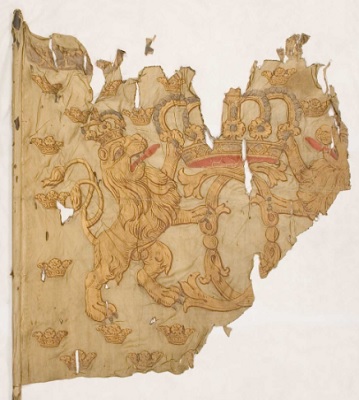
Company colour from 1710 |
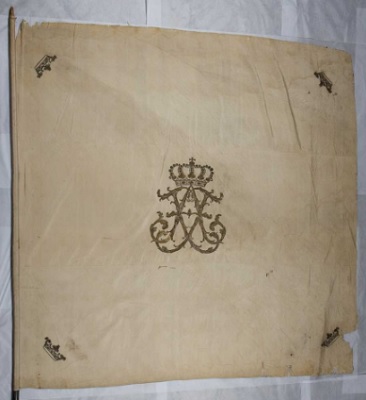
Company colour from 1748, adjusted 1751 |
|
|
Uppland
Regiment
(A more detailed description of the colours can be
found on this page) |
 |
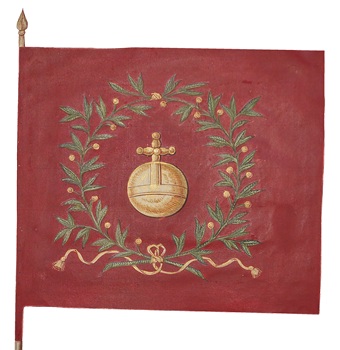 |
Sets of eight colours each were
issued in 1683, 1695, 1710 and 1727. None of these colours have been
preserved except for a company colour from 1727 of which I have no picture.
Possibly half of the colours in the set from 1695 were replaced at an
unknown time during the war. The colours captured at Poltava were in such
different condition that the Russians perceived them as belonging to two
separate regiments. Three company colours were still red but the other four
had become so faded that they were sand-coloured. The set from 1710 was not
delivered in time for the Battle of Helsingborg, so the Uppland regiment
fought without colours. Sets of four colours each were issued in 1741, 1771
and 1796. The set from 1727 was reused in 1744 by the Nyland regiment before
they received their own colours that same year.

1675- 1683?
(Company colour m/1675) |


1741-1771
(Colonel's and company colour m/1686B) |

1771-1796
(Company colour m/1766) |
|
|
Sets of eight colours each were
issued in 1696, 1710, 1717 and 1730. Of the first set, all company colours
were lost in Perevelochna in 1709, while the colonel's colour was possibly
saved and brought to Bender. Of the set from 1710, four colours were lost in
the capitulation at Tönning, and possibly one of them was the colonel's
colour. A set of four colours was issued in 1757 and was in use until 1812.
|

1710-1717
(Company colour m/1686) |


1717-1730
(Colonel's and company colour m/1686) |

1730-1757
(Company colour m/1686) |
|
|
Sets of eight colours each were
issued in 1692, 1710 and 1728. The first two sets were lost in Ukraine in
1709 and Tönning in 1713 respectively. The latter were replaced in 1714 by
only four colours due to cost-saving reasons. The regiment's last set of
colours was issued in 1757 and also consisted of only four colours. The
regiment merged with the Östgöta Cavalry Regiment in 1791 and then formed
the Life Grenadier Regiment, which received its own colours in 1800.

1714-1728
(Company colour m/1686) |

1728-1757
(Company colour m/1686) |

1757-1800
(Company colour m/1686B) |
|
|
The first m/1686 set was issued
in 1704. The colonel's colour and three company colours were lost in 1708 in
the Battle of Malatitze and another seven company colours were lost at
Poltava in 1709. The large number of colours is probably due to the fact
that the old colours from 1684 remained in the regiment and was used to
replace the losses in Malatitze. The old colours should have differed from
the m/1686 colours in that they had flaming grenades in the corners. Another
set of colours was lost when Stralsund fell in 1715. As a provisional
replacement, the regiment received in 1716 three blue company colours that
had previously been used by first Seulenburg's (1707-1709) and then Stöhr's
battalion (1710-1711). A new m/1686 set of eight colours was manufactured in
1717 and was then in use until 1757 when they were replaced by four m/1686B
colours. The 1757 colours were deemed worn out in 1800. However, instead of
manufacturing a completely new set of colours, three of the five 1717
colours that were left in storage were repaired, so that only one colonel's
colour needed to be manufactured. However, in 1812 the regiment received a
newly manufactured set of four m/1766 colours.
|

1710-1715
(Company colour m/1686) |

1716-1717
(Used by enlisted battalions 1707-1711) |
|
|
Sets of eight colours each were
issued in 1693, 1710 and 1720. The set issued in 1710 was not of m/1686. It
had already been manufactured in 1683 but had not been issued at that time.
The company colours were squared in red and yellow and had the coat of arms
of Småland surrounded by a laurel wreath in the middle and flaming grenades
in the corners. The colonel's colour was adorned with the national coat of
arms but lacked the lions holding up the shield.
Neither these colour sets nor the set of four m/1761 colours issued in 1764
have survived. The set from 1693 was lost in Ukraine in 1709 and four
colours from the set from 1720 were lost in 1759 when Demmin capitulated to
the Prussians. The set from 1764 was in use until 1813. |
|
Sets of eight colours each were
issued in 1694, 1710 and 1717. The first set was lost in Ukraine in 1709 and
may have been burned to prevent it from falling into Russian hands in
Perevolotchna. The Russians have not reported any colours from Kronoberg in
their trophy lists. The set from 1710 was not issued in time for the Battle
of Helsingborg and of these, six company colours were later lost when Wismar
capitulated in 1716. The set from 1717 was replaced in 1757 by a set
consisting of four colours. But the new set was lost already in 1759 when
Anklam capitulated to the Prussians. The old set from 1717 was therefore
reused and was in use until 1767 when it was replaced by a set of four
m/1766 colours, which in turn were not replaced until 1813.

1717-1757,
1759-1767
(Company colour m/1686) |
|
Sets of eight colours each were
issued in 1675, 1683 and 1700. The latter set was lost in 1713 at the
capitulation of Tönning and was replaced in 1714 by only four colours due to
cost-saving reasons. It was not until 1733 before the regiment received a
complete set of eight colours. This was replaced again by a set of only four
colours in 1757, which was then the standard allotment. The first m/1766 set
was issued in 1770 and was in use until 1813.
|
|
Sets of eight colours each were
issued in 1676, 1684, 1708 and 1719. The set from 1708 was lost in 1713 at
the capitulation in Tönning and for cost-saving reasons it was
replaced in 1714 by a set of only four colours. In 1739 a set of four
colours was issued. Two of these colours were lost in 1759 when Anklam
capitulated to the Prussians. These were not replaced until 1767 when a new
set of four m/1766 colours was issued which was in use until 1804.
|

1708-1713
(Company colour m/1686) |

1714-1719
(Company colour m/1686) |

1719-1757
(Company colour m/1686) |

1767-1804
(Colonel's colour m/1766) |
|
|
The first m/1686 set was issued
in 1689, replacing eight colours that had been issued in 1674. However, the
colours lost in the Battle of Poltava in 1709 were from a different set that
had been issued at an unknown date. The Poltava colours differed from m/1686
in that the company colours lacked a laurel wreath. The colonel's colour did
not have the national coat of arms but the king's cipher as the main motif
in the middle and also on a smaller scale in three of the corners. The
regimental symbol was placed in the lower inner corner. A new m/1686 set of
eight colours was issued in 1710, and of these, three company colours were
lost in 1716 to the Danes when Wismar capitulated. The last set of eight
colours was issued in 1717, and thereafter only four colours per set were
issued in 1733, 1762. and 1803.


1710-1717
(Colonel's and company colour m/1686) |

1762-1803
(Company colour m/1761) |
|
|
A set of ten colours was issued in 1682 and carried by the four home
companies until 1732. The six field companies last lost their colours in
Ukraine in 1709, but may have replaced them at an earlier date. The 1682
set had flaming grenades in the corners, which are missing from Russian
descriptions of the captured colours. The field companies were issued
new colours that were manufactured in 1709-1710 but lost them already in
1713 at Tönning. These were not replaced until 1717 and it was not until
1732 before the regiment was again issued a complete set of ten colours.
The next set was issued in 1766 and consisted of four colours that were
in use until the regiment was split in two in 1812.

1717-1732
(Company colour m/1686) |

1732-1766
(Company colour m/1686) |

1766-1812
(Company colour m/1766) |
|
|
Sets of eight colours each were
issued in 1684, 1688, 1701, 1710, 1717 and 1730. The set from 1701 was lost
in 1709 at Poltava and Perevolotchna. The set from 1710 was lost at Tönning
in 1713 and was not replaced until 1715 by a set of only four colours, of
which the colonel's colour and a company colour were lost in Norway already
in 1716. Sets of four colours each were issued in 1739 and 1771. The latter
set was replaced in 1804 by five colours. Note that although the appearance
of the colours differs, the sets from 1715, 1717 and 1730 were made by Johan
Wikman and the set from 1710 was made by either Johan Wikman or Daniel
Stawert.
|
|
Sets of eight colours each were
issued in 1677, 1690, 1710 and 1728. Four company colours were made by Olof
Hoffman in 1700 but were not issued until 1714 when three of them, together
with a colonel's colour (originally made for the Östgöta 3-männing
regiment), were used to replace the eight colours lost at Tönning in 1713.
The set from 1728 was replaced in 1741 by a new set consisting of only four
colours. The colonel's colour was lost the same year in the Battle of
Villmanstrand and was replaced in 1742. This colonel's colour and the rest
of the 1741 set were replaced in 1766 with four m/1761 colours that were in
use until 1814.
|

1710-1713
(Company colour m/1686) |

1714-1728
(Company colour m/1686) |

1728-1741
(Company colour m/1686) |

1741-1766
(Company colour m/1686B) |
|
|
Sets of eight colours each were
issued in 1683, 1700, 1706, 1710, 1715 and 1730. The set from 1700 was lost
at Mitau in 1705. As a replacement, they received eight new company colours
in 1706. A colonel's colour was probably also produced at this time, which
differed from m/1686 in that the regimental symbol was inlaid in a globe
that was four-parted in black and white in the same way as the company
colours. This is according to Russian descriptions of the colours they
captured (four company colours at Lesnaya in 1708 and four company colours
and a colonel's colour at Poltava in 1709). The 1710 set was lost at Tönning
in 1713 and was not replaced until 1715 when a set of only four colours was
produced, this time the colonel's colour again differed from m/1686 in that
the regimental symbol was inset in a four-piece shield. A complete set of
eight colours would not be issued to the regiment until 1730. But soon
after, four colours per set became standard and such sets were issued in
1739, 1759 and 1813.
|

1710-1713
(Colonel's colour m/1686) |

1715-1730
(Colonel's colour m/1686) |


1759-1813
(Colonel's and company colour m/1686B) |
|
|
Sets of eight colours each were
issued in 1674, 1683 and 1709. Only four colours were issued in 1736 but
these were in use until 1814. Before m/1686, the company colours were green
instead of blue.

1709-1736
(Company colour m/1686) |

1736-1814
(Colonel's colour m/1686B) |
|
|
Sets of eight colours each were
issued in 1674, 1678, 1692, 1710, 1712 and 1731. The set from 1692 was lost
in Ukraine in 1709, while the set from 1710 was handed over in 1711 to
Österbotten Regiment (5 colours) and Gyllenström's Finnish enlisted
battalion (3 colours). Three colours from the set from 1710 later ended up
in Russian hands. In 1760, a set of four colours was issued and was in use
until 1812.
|

1678-1692
(Company colour m/1675) |

1731-1760
(Company colour m/1686) |

1760-1812
(Company colour m/1686B) |
|
|
A set of ten colours was issued
in 1682, but the four colours that the regiment lost at the Battle of
Hummelshof in 1702 probably belonged to a m/1686 set that had been issued at
an unknown date. In 1703, a set of eight colours was issued, which were lost
at Lesnaya in 1708 (1 company colour), Poltava-Perevolotchna in 1709 (3
company colours) and Riga in 1710 (3 company colours and the colonel's
colour). No new colours were made for Österbotten, and instead they received
in 1711 five colours that had originally been made in 1710 for the
Västerbotten regiment. Three of these ended up in Russian hands, probably
during the fighting in Finland in 1713-1714. Four new colours were issued in
1718, and this was the number of colours that the Österbotten regiment had
from then on. A new set of four colours was issued in 1732 and these were
lost in the capitulation at Helsinki in 1742. The old colours from 1718 were
then reused until a new set of four colours was delivered in 1744, which
were then in use until the regiment was disbanded in 1809.
|

?-1702
(Company colour m/1686) |

1703-1710
(Company colour m/1686) |

1744-1809
(Company colour m/1686B) |
|
|
Sets of eight colours each were
issued in 1679 and 1691. The Colonel's Battalion lost all its colours in the
Battle of Lesnaya in 1708, while the remaining four company colours were
lost in 1709 at Poltava-Perevolochna. The three company colours lost in the
Battle of Lesnaya were described by the Russians as only yellow, while those
taken in the Ukraine were blue-yellow. Since the company colours from 1679
were yellow and not blue-yellow, it is possible that the Björneborg regiment
had lost colours on an earlier occasion and replaced them with older colours
from 1679. When the regiment was restored in 1710, it did not receive new
colours, but instead in 1711 it was allowed to borrow four colours from
Tavastehus Regiment. These were probably lost to the Russians as they were
no longer in existence in 1716 when two older colours were issued that had
been in the arsenal before 1685. It was not until 1725 that the regiment
received a new set of eight colours. Four of these were lost in 1742 in
connection with the capitulation in Helsinki. A new set of four colours was
delivered in 1752 and this set was in use until the regiment was disbanded
in 1809. However, a replacement for company colour that had been lost during
the war of 1788-1790 was issued in 1793. Furthermore, a worn-out company
colour was replaced in 1807 and possibly also the colonel's colour. Another
of the company colours from 1752 and one of the new ones were captured by
the Russians, but the place and date are unknown for both.
|

1752- (1809?)
(Company colour m/1686B) |

From 1793 eller 1807
(Company colour m/1766) |
|
|
Åbo län
Regiment |
 |
 |
Sets of eight colours each were issued in 1683, 1692 and 1705. The set from
1705 was made in Riga and probably had additional decorations similar to the
Nyland colours which were also made in Riga in 1705. These colours were lost
to the Russians when one battalion participated in the Russian campaign of
1708-1709 and the other was garrisoned in Riga which fell in 1710. Older
colours also fell into Russian hands as these were stored in the arsenal in
Riga. When the regiment was restored in 1710-1711 it was allowed to use the
four colours of the double regiment from 1708 which were then lost to the
Russians during the battles in Finland. Despite this, two worn-out colours
are said to have been in the regiment in 1717. A colonel's colour and a
company colour (without a laurel wreath) were produced in 1718. It was not
until 1726 that the regiment received a complete set of eight new colours.
These were replaced in 1744 by a set of four colours that were used until
1804.
|

1718-1726
(Company colour without laurel wreath) |

1726-1745
(Company colour m/1686) |
|
|
Seven red-yellow striped
company colours were issued in 1686, which had been manufactured as early as
1683 and probably had flaming grenades in the corners. It was supplemented
in 1690 with a colonel's colour according to m/1686. This set was replaced
in 1705 by colours that also did not correspond to m/1686. They appear to
have had crowns in the outer corners and flames scattered on the field. The
Riga colours were lost in 1708-10 because one battalion participated in the
battles of Lesnaya and Poltava while the other battalion was part of the
Riga garrison that capitulated in 1710. The regiment probably received
colours during the latter part of the Great Northern War, but information
about them is missing. Perhaps there was a redistribution of colours similar
to the one between Björneborg and Tavastehus. Three old colours are said to
have been with the regiment in 1730 after it had received its first m/1686
set of eight colours in 1729. Some of the m/1686 colours were probably lost
in 1742 in connection with the capitulation in Helsinki, but none are listed
in Russian trophy lists. However, the shortage of colours was so great that
in 1744 they received used colours from the Uppland regiment until four new
m/1686B colours were delivered that same year. The last set of four colours
was issued in 1772 and then lost during the Finnish War of 1808-1809.

1705-1710
(Company colour m/1686 with additional decorations) |

1729-1744
(Company colour m/1686) |

1772-1809?
(Colonel's colour m/1766) |
|
|
Sets of eight colours each were issued in 1689, 1708 and 1728. In 1711, the
regiment handed over four of its colours to Björneborg Regiment, which had
no colours. In the Battle of Pälkäne in 1713, three more colours were lost
and they may have had only one colour until a new set was issued in 1728. In
the Battle of Villmanstrand in 1741, the colonel's colour was damaged and a
replacement colour was made, which was not issued until after the end of the
war in 1743. Prior to this, colours had been lost in 1742 in connection with
the capitulation in Helsinki. However, since Swedish regiments were only to
have two colours per battalion since 1731, it took until 1749 before three
new company colours were made. The set from the 1740s was replaced in 1772
by four m/1766 colours, which were the last set issued before the regiment
was disbanded in 1809. However, somehow a company colour from 1749 is said
to have been captured by the Russians.
|

1708-1728
(Company colour m/1686) |

1728-1749
(Company colour m/1686) |
|
|
Sets of eight colours each were issued in 1683, 1706 and 1725. The colours
from 1706 were probably lost in connection with the fall of Viborg and
Kexholm in 1710. Four provisional colours were therefore issued in 1712
which had originally been made in 1707 for Boye's Saxon battalion (yellow
with the king's monogram surrounded by silver palm leaves and golden corner
flames). According to a Russian source, the regiment lost three colours in
the Battle of Pälkäne but in 1716 the colonel declared that they had "old
colours", possibly not all colours from 1706 had been lost before Pälkäne.
In any case, it was not until 1725 that Savolax again received a complete
m/1686 set. It was replaced in 1737 by four m/1686B colours, which were
however lost already in 1741 in the Battle of Villmanstrand, after which the
old colours from 1725 were possibly reused. Three new company colours are
said to have been issued in 1743 and a colonel's colour was added in 1747.
The Savolax regiment was converted into light infantry in 1775 and would no
longer carry colours on the battlefield. However, the old colours may have
continued to be used in ceremonial contexts and an m/1766 colour was also
issued in 1795 which then became a Russian trophy during the Finnish War of
1808-1809. |
|
Sets of eight colours each were issued in 1685 and 1706. The latter was lost
when Riga capitulated to the Russians in 1710. Since the regiment's
recruiting area was occupied by the Russians in 1710, it was never fully
restored, and the regiment's strength was about one company. In the Peace of
Nystad in 1721, half of the recruiting area was ceded to Russia and the
regiment was re-formed into the Kymmengård Battalion, which consisted of
four companies. The colours were to have the same appearance as the Vyborg
m/1686, but these were not issued until 1729. During the Russian war
1741-1743, the battalion managed to retain all its colours. However, after
the peace, its recruiting area was further reduced, leaving only one company,
which was merged with the Nyland Regiment.
|

1685-1706 |

1706-1710
(black and white photo) |
|
|
References
Törnquist, Leif. Fanorna vid de svenska liv- och hustrupperna
(article in SVSS-NS XXI). Stockholm (2006)
Törnquist, Leif. Fanor och standar vid värvade förband 1686-1815
(article in SVSS-NS XXXVII). Stockholm (2022)
Törnquist, Leif. Infanteriets fanor m/1686
(article in SVSS-NS XXX). Stockholm (2015)
Törnquist, Leif. Infanteriets fanor 1761-1900
(article in SVSS-NS XXXIII). Stockholm (2018)
Wennerholm, J Bertil R. Emporterade troféer. Bohus (2000)
Wernstedt, Folke. Svenska standar och fanor 1654-1686 (article
in Meddelanden från Riksheraldikerämbetet X). Malmö (1945) |
|