|
Örjan Martinsson
| |
|



Grenadiers were introduced into
the Swedish army in 1684 when it was decided that each company should equip
six privates and one corporal as grenadiers. In most armies, grenadiers had
special grenadier caps that made them stand out from the other soldiers. In
the Swedish army, however, such caps do not seem to have been particularly
common. We have written evidence that thirteen regiments at some point
during the Great Northern War had grenadier caps. Then there are five
preserved grenadier caps in Russian custody and brass plates for a grenadier
cap in the Swedish Army Museum's collections. However, not all preserved
caps in Russia are necessarily from the Great Northern War or even from
Sweden. And since the evidence in the written sources and the preserved caps
overlap, a fairly small number of Carolean grenadier caps are known.
The oldest evidence of
grenadier caps in Sweden is from 1691 when the ordinary grenadiers of the
Dal Regiment (but not the corporals) were given such. However, when the
number of grenadiers was increased in 1693 from six to nine, the
Dal Regiment did not acquire any more grenadier caps. A third of the
grenadiers of the Dal Regiment would therefore have worn ordinary karpuses
in 1693. Three more regiments that were recruited in Sweden and Finland have
evidence in the sources that their grenadiers wore grenadier caps at some
point during the Great Northern War. However, the most famous grenadier
formations, such as the Livgarde (Guard) Grenadier Battalion and the
independent Grenadier Battalion from 1717, both had tricorne hats and no
grenadier caps.
On those occasions when a
Swedish regiment is said to have had grenadier caps, these were probably
paid for with the colonel’s own money (or by redistributing the money
allotted to them to purchase uniforms). In support of this interpretation is
a letter from Major General N. Stromberg sent to Charles XII in 1700. In
this letter, he proposed that Swedish grenadiers, like German and Dutch
usage, should have special grenadier caps. However, the proposal was not
approved by the king (Bellander, page 275). The reason for the rejection may
have been Charles XII's spartan taste, but more likely it was a matter of
cost. A regulation from 1752 stated that it was permissible to have
grenadier caps in the regiments, but that they should be acquired "in the
same way from now on, as has been done until now, without the crown being in
any way inconvenienced thereby" (Bellander, page 325). In other words,
colonels were free to equip their grenadiers with caps if it did not entail
any increased cost to the state.
It seems that few colonels in
Sweden and Finland wanted to spend the money required to have grenadier caps.
Only four known examples exist. Five if you count the Saxon Regiment which
had been recruited from Saxon prisoners of war but was stationed in Sweden.
In the overseas provinces, however, grenadier caps seem to have been more
common, as five regiments in the Baltics and four regiments in Germany had
them. Maybe the Södermanland Regiment from Sweden should be included in the
latter category, as their grenadier caps were commissioned when they were
stationed in Germany in 1700-1702.
Given that there was no royal
decree regulating the appearance of the grenadier caps, one cannot expect
any greater uniformity. The few grenadier caps that we know of also have a
varied appearance. However, it is possible to discern certain patterns for
the German and Baltic regiments. Unfortunately, we do not have any
descriptions of caps from Swedish or Finnish regiments that mention more detaila
than the colour. Two German regiments, however, have detailed descriptions:
Riksänkedrottningens (Dowager Queen's) and the Pomeranian Regiment. Both had
caps that were edged with bearskin (apparently from North American black
bears). The front flap was decorated with monograms (the Dowager Queen's and
the King's, respectively). The Pomeranian Regiment's monogram was
embroidered in 1698 but on a brass plate in 1702. Both also had a tassel on
the top of the cap.
Three preserved grenadier caps
can be identified with Baltic regiments. All of these have the name of the
unit embroidered on the back in French spelling, which Charles XII would
hardly have appreciated as he was known for his dislike of the French
language. None of them had bearskin or brass plate. Two of them had a
tassel. The decoration differs, but they had either the king's monogram or
the national coat of arms, with lions, crowns and burning grenades as
additional ornaments.
Unfortunately, the period after
1721 is not as thoroughly researched when it comes to military uniforms.
However, grenadier caps may have become more common in the mid-18th century,
as we know of several regiments that in 1748 received grenadier caps of the
Prussian type (mitre with the front covered by a brass plate). During the
Gustavian era, this type of cap was replaced by bearskin caps, which were
then the fashion. However, their popularity caused the price of bearskin to
increase so much that many new types of grenadier caps were introduced
during the 19th century to reduce the cost. These different types of caps
are illustrated below in a picture taken from Erik Bellander's book "Dräkt
och uniform" (page 561).

The Hälsinge m/1748 cap in the
picture above is not a grenadier cap, however. It is based on five preserved
bearskin caps that were previously considered grenadier caps but which in
fact belonged to the regiment's pioneers. In 1748 they received the same
type of grenadier cap as the Södermanland Regiment.
|
|
Preserved
Carolean Grenadier Caps
|
De la Gardie's Regiment |
Liewen's Regiment |
The five grenadier caps taken
by the Russians that were known in the mid-19th century had, according to
the Russian blog
Oderint dum
probent, the following appearance:
| |
Description |
Identification |
| 1. |
White with blue flaps, and plate decorated with a
star and four crowns (located in the St. Petersburg Artillery Museum
and is now in very poor condition). |
Lars-Eric Höglund has seen this cap, and his
conclusion is that it is of the Prussian type and therefore cannot be
a Carolean grenadier cap. |
| 2. |
Blue with plate decorated with two lions holding
coats of arms with two crosses under a crown and "other decorations" (its
current location is unknown). |
Unknown regiment. With this description alone, it is
not possible to be sure that it is from the Great Northern War or even
a Swedish grenadier cap. |
| 3. |
The cap pictured in the photo above on the left. |
De la Gardie's Regiment
1703-1704 |
| 4. |
Blue with yellow flaps and on the front embroidered
with Charles XII's cipher along with two lions and a crown, all in
gold. The back embroidered with two palm leaves and the text
"GRENADIERS DU COMTE MELIN" under a golden crown. Gold tassel at the
top (unknown where the cap is now). |
Mellin's Regiment
(Officer cap from 1706?) |
| 5. |
The cap pictured in the photo above on the right. |
Liewen's Regiment
(Officer cap from 1703?) |
|
|
|
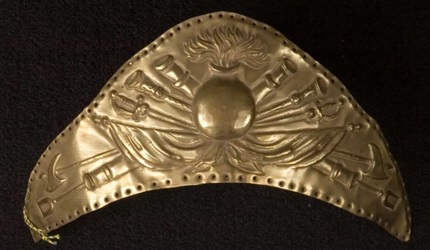
In
addition to the grenadier caps in Russia, the Swedish Army Museum also has a
preserved front plate
and back plate of
brass from Charles XII's reign that was on a grenadier cap (see
pictures on the right). A reconstruction of a grenadier cap with both plates is also shown below. It
is drawn by Göte Göransson and taken from the book "Karoliner".
However, it is not certain that the cap was designed in the way Göransson has drawn it.
It may instead have looked more like the cap from De la Gardie's Regiment.
These plates have been attributed by the Army Museum to the Livgarde,
but since the regiment's grenadiers wore tricornes instead of caps, the
plates must have belonged to another regiment. Höglund puts forward the
Saxon Regiment as a
candidate since it is stated to have had grenadier caps in 1717/18. This is
probably a good guess since the plates do not have a provincial coat of arms
as a motif, which one would have expected for “indelta” regiments.
The motif on the front plate consists of Charles XII's crowned monogram surrounded by
heraldic arms taken from the greater national coat of arms as well as a lion
on either side and colours and a drum at the bottom. The back plate has a burning
grenade in the centre surrounded by colours,
swords and cannon barrels.
|
|
|

|
 |
|
|
Preserved
Liberty Age Grenadier Caps
(click on the images to go to Digitalt Museum
which has more images of these caps
|

Fredrik I's reign
(1720-1751) |
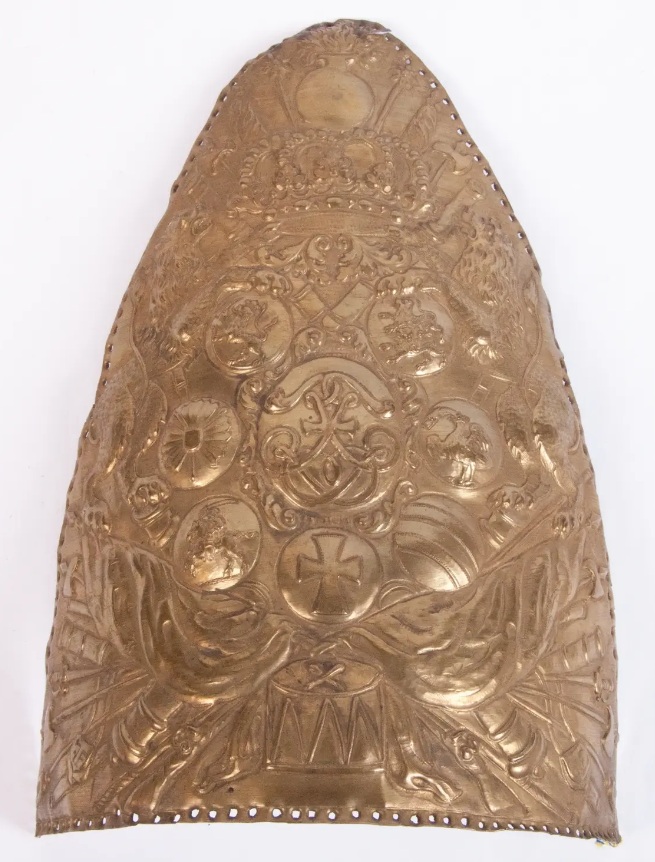
Fredrik I's reign
(1720-1751) |

Adolf Fredrik's reign
(1751-1771) |

Uppland Regiment
1748-1795 |
|
A front plate, probably
worn by an officer in some enlisted regiment in Swedish Pomerania. At
the bottom is Frederick I's monogram, above it the Swedish national
coat of arms including the Hesse-Kassel coat of arms in the centre.
The decorations are in Baroque style with lion mascarons, armour,
trophies and more. |
The motif is almost
identical to the front plate from the time of Charles XII shown above,
but with Frederick I's monogram and national coat of arms (and a
grenade at the top). The Army Museum has attributed both plates to the
Livgarde, perhaps because they are so similar, but the one from Charles
XII's reign is definitely not from the Livgarde. |
Probably made during the
reign of Adolf Fredrik, but the monogram in the middle has been
changed to that of Gustav III. The monogram is surrounded by a laurel
wreath and crown. At the top a star inside a radiant sun. At the
bottom the small Swedish coat of arms flanked by burning grenades. |
In 1748 the king donated
plates to the regiment while the company commanders had to pay for the
rest of the grenadier caps. The plate has a burning grenade at the
top. In the middle is the small Swedish coat of arms in a crowned
shield surrounded by dragon wings, colours and trumpets. At the bottom
is the coat of arms of Uppland. |
|

AM.02182 |
Hälsinge Regiment
1748-1795

AM.021827 |

AM.021828 |
|
Three grenadier caps of
varying condition. All of them seem to have originally had brass
plates on both the front and back. The front plate was decorated with
the Hälsingland coat of arms, colours, musical instruments, dragon
wings, the Swedish national coat of arms and a grenade, and lined with
yellow scallion. The back plate may have been shaped like a burning
grenade, like the Södermanland regiment below.
The caps are made of blue
broadcloth with white lace and tassels. They are reinforced with cardboard
and thin cow horn segments. There is a yellow piping along the flaps.
Inside the cap is an inner cap made of felt. In the 1790s, the caps
were supplemented with a socket for a plume. |
Södermanland Regiment
1748-1795
In 1748, Crown Prince Adolf
Fredrik paid for the plates for grenadier caps for men, musicians and
non-commissioned officers of the Södermanland Regiment. In 1749, the
regiment acquired three grenadier caps for officers at its own expense.
|

Officer |

Musician |

Private |
|
Grenadier cap made of
blue velvet with an openwork plate of gilded
brass. The cap is also decorated with gold lace and a gold tassel. The
front plate's decorations consist of the coat of arms of Södermanland,
colours, musical instruments, dragon wings, the national coat of arms
of Sweden and a grenade. The back plate is shaped like a flaming
grenade. |
Grenadier caps made of
yellow broadcloth (musicians) or blue broadcloth (privates) with blue flaps and
white lace and brass plate. On top is a white tassel and inside the
cap is an inner cap of hat felt. The front plate is lined with yellow
twill woven wool and decorated with a burning grenade at the top, the
small national coat of arms in the middle surrounded by a laurel
wreath, dragon wings, colours and musical instruments. At the bottom
is the coat of arms of Södermanland, the back plate is shaped like a
flaming grenade.
|
Prince's
Caps
1751
These caps were likely made in
1751 and were probably worn by Princes Gustav (born 1746) and Karl (born
1748) when they courted their mother at Drottningholm Palace during some
festive occasion.

Livgardet (crown prince Gustav) |

Drottningens livregemente (Duke Karl) |
|
Yellow broadcloth, lining,
ribbing, silver lace and tassel, silver-plated brass plate. Blue enamel
with gilded letters AFR (Adophus Fredericus Rex). |
Silver lace and tassel.
Cap, white at the top, blue broadcloth at the bottom. Behind the cap plate,
yellow broadcloth at the front. Linen lining. Silver-plated brass plate. Blue
enamel with gilded letters LVR (Lovisa Vlrica Regina). |
|
|
Preserved
Gustavian Grenadier Caps
(click on the images to go to Digitalt Museum
which has more images of these caps)
|
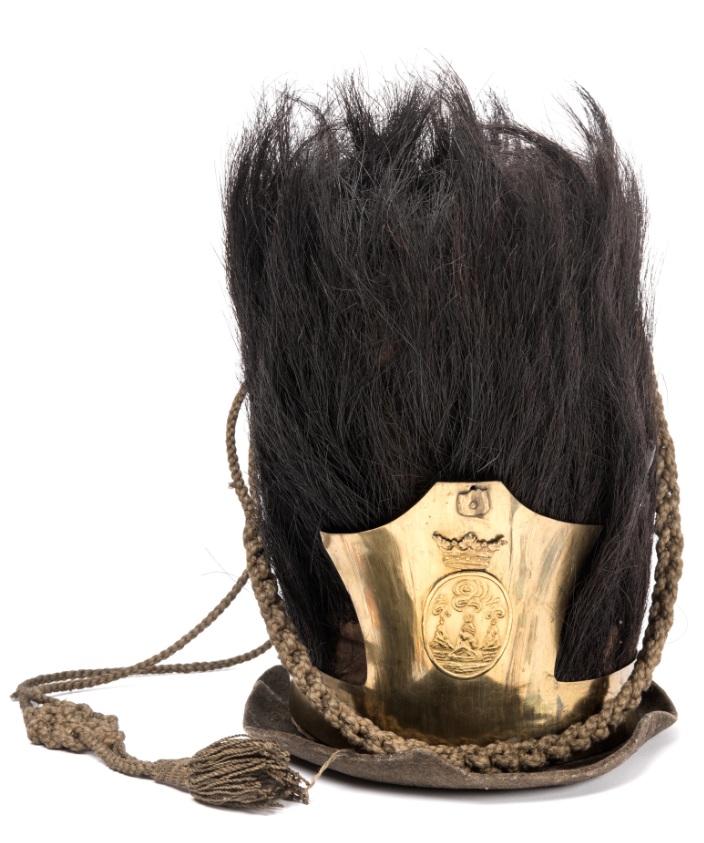
Västmanland
1783-1806 |

Livgrenadjärregementet
1798-181 |

Livgrenadjärregementet
1792-1807 |
|
In 1778, the Crown approved
a request from Prince Fredrik Adolf to pay for 100 grenadier caps for
men and 4 for non-commissioned officers. These had been delivered at
the general muster in 1783.
The yellow cord and brass plate are later additions from the 1790s. After the grenadiers were abolished in 1806, the
cap was worn by pioneers. |
Horsehair cap for the
regimental drummer; in 1798 it had a white goose feather plume. |
Gustav III decided to
introduce bearskin caps for the privates of the Livgrenadjärregemente in 1792, which were also paid for with funds from his estate.
The cap consists of red
broadcloth with white lace and covered with bearskin on the front and all
around. Along the bottom edge there has been a brass cord and there
has probably also been a plate in the middle of the front of the cap
in the shape of a vase (sheaf). The cap also had a plume. |
Kronoberg
Regiment
1783-1805
Duke Karl donated 100 grenadier
caps to the regiment in 1783. Seven caps have been preserved in varying
condition. They have a front of bearskin and a back of originally red but
now brownish fabric (two of them are, however, entirely of bearskin and were
probably non-commissioned officer caps). The skin and fabric were stretched
over a frame of rattan with an inner layer of cardboard, under which was an
inner cap of felt with a visor in the middle of the front. The grenadier
caps were provided with a brass cord around the lower edge and a brass plate
with the letters "K R" in a field of red enamel. On the back there was a red
and white banner.
|
|
Notes on Carolean Grenadiers
The table below provides an overview of the regiment-specific information
available on the equipment of the grenadiers during the Carolean period. The
green-marked boxes are regiments whose caps have more detailed descriptions
than can be found in the table. The equipment of these and the other
regiments is described in more detail below the table.

Brown leather grenade box with Charles XII's monogram on the lid (one
"I" has fallen out.
AM. 015481 |

Grenade box with Charles XII's monogram. AM. 071527 |

Grenade box with Charles XII's
monogram AM. 014279 |

Grenade box with Charles XII's
monogram AM. 014286 |
Södermanland
1702: "96 grenadiers were also awarded grenadier caps, 'according to the
sample sent here and with all the decorations', but unfortunately without a
description!" (Höglund page 68) Since the regiment was stationed in the
German provinces in 1700-1702, the caps may have been similar to those worn
b
Riksänkedrottningen's Life Regiment and
Pomeranian Regiment.
Östergötland 1715: Grenadier belts,
slightly wider than the musketeers' belts with powder horn, grease horn and
3 vent picks. (Larsson page 66)
Kalmar 1701: Grenadier bandolier box. 1721:
Grenadier's box, black leather with two brass rings inside. Buffalo leather
bandolier with a brass ring inside to attach the fuse cover. This was the
same equipment that the musketeers received. (Larsson page 66)
Skaraborg
1700: "The grenadiers were dressed like musketeers and had no special
grenadier caps" (Höglund page 66).
Närke-Värmland 1701: 19 blue caps
sent to Örebro. (Larsson 65). 1705: Grenadier bandolier box. (Larsson page
66). The grenadier caps sent to Örebro should have been part of the
equipment that the home companies sent to the field companies that year. If
they had been distributed to the regiment at the same time as their uniforms
at the time, they should have been from 1691.
Västmanland 1712: Grenadier bandolier
of goatskin. (Larsson page 66)
Dal Regiment In 1691 the private
grenadiers (not the grenadier corporals) received grenadier caps of unknown
design. No new grenadier caps were procured before 1699, so a third of them
must have had karpuses after the number of grenadiers was increased in 1693.
Unlike the musketeers who had shoulder belts for their swords during the
1690s, the grenadiers had not later than 1696 received waist belts instead
(Asker, pages. 80-81).
Hälsinge
1703: "1200 blue karpuses" (Höglund page 73). All soldiers in
the regiment thus received a karpus.
Savolax
1718: "Grenadiers like the rest of the men, but with grenadier
box of yellow leather and as headgear, blue karpus!" The rest of the men had
hats with yellow lace. (Höglund page 75). Note that the word karpus means
cap in general and can also include grenadier caps.
Österbotten
1718: "The grenadiers were equipped and dressed like the
musketeers. Yellow grenade boxes." (Höglund page 79)
Uppland
3-männings 1704: Grenadier box with wide strap. (Larsson page
66)
Småland 3-männings
1718/19: "Grenadiers: Hat, blue coat. Blue coat with yellow
lining and cuffs. Waistcoat and breeches of yellow broadcloth, yellow wool stockings
and black stilettos. Grenadier box of yellow leather." (Höglund page 127).
The uniforms of the rest of the men are not described by Höglund so I
suspect that "Grenadiers:" may be a typo.
Närke-Värmland 3-männings "1700: "The grenadiers were armed
with, among other things, blunderbusses, muskets with bayonets and, as
sidearm, deer catcher."
Riksänkedrottningen's Life
Regiment
For the years 1695/1702, Höglund writes (page 101): "The
grenadiers had 1701 grenadier caps, edged with bearskin. The caps were
probably white, as in 1695, with the Dowager Queen's monogram (HERS) under
the royal crown, in blue." Anders Larsson (page 65) has the following
description for the year 1702: "8 grenadier caps/company of grey-white
broadcloth
with black bearskin decorated. A white tassel was placed on top of the cap.
2 drummers and 5 non-commissioned officers also received this headgear. (Other
authors have the addition: "the text HERS under the royal crown")"
Pomeranian Regiment 1702:
96 grenadier boxes and 96 blue cartridge boxes (Larsson page 66).
Höglund (page 103) describes the grenadier box as blue, with a brass cipher
and crown. The grenadier caps are described most extensively by Larsson, but
Höglund states in the supplement from 2003 (page 57) that the grenadiers
were issued new uniforms in 1698 that were identical to those from 1702 "with
the exception that the grenadier caps had a crown and cipher in embroidery.
Not in stamped brass like in 1702."
Privates: 98 grenadier caps of yellow broadcloth, in front
and behind the large flap ("stütz"), edged with bearskin. In the front a
small blue flap. Above, the royal monogram of cast brass. On top a large
blue camel hair tassel (Larsson 65).
Musicians: 2 grenadier caps that were identical to the
privates'. (Larsson 69)
Non-commissioned officers: 4 grenadier caps of blue
broadcloth, in front and behind the large flap (stütz) edged with bearskin. In
the front a small yellow flap. Above the royal monogram of cast brass. On
top a large yellow camel hair tassel and real gold lace around. (Larsson 28)
Stralsund Garrison Regiment 1698. "144 grenadier caps of
blue broadcloth and beside the name and crown of the King's Majesty, next to
others decorated with orange and other colours with fine camel hair yarn
embroidered and otherwise with black knitted striped linen fabric,
orange-coloured silk lace. Strips and buttons are decorated." (Larsson page
65). 1703: "144 large well-made grenadier bandolier box of strong red
jut
and over the box a beautiful thick lashed buffalo leather flap. Inside a
thick separation made of chamois leather that has a 12-cartridge space.
Place for oil bottle of tin and place for scraper, flints, gunpowder and
bullets. Wide lashed buffalo leather belts with powder horn, brush and snips
attached to their straps." (Larsson page 66)
Stade
Garrison Regiment
Höglund writes for the year 1710 (page 106) that the grenadiers received
blue grenadier caps, as well as new grenade boxes made of yellow leather,
covered with red broadcloth and adorned on the lid with a flaming grenade. For
officers, caps and boxes were sewn in gold and silver embroidery. The
non-commissioned officers had flintlock rifles, coats with real silver
buttons, gloves with silver lace, caps and boxes with silver embroidery. The
men had caps and boxes embroidered with white camel hair yarn. Larsson
writes for the year 1715 (page 65) that they had 8 grenadier caps per
company from the year 1704 that were embroidered with white camel hair lace
"Gantz neu mit Weiss camelhar Brodiert".
De la Gardie's Regiment A blue cap with red flaps. On the front a
large flap with Charles XII's monogram in yellow embroidery and in front of
it a smaller flap with the coat of arms of Estonia. On the back the text
"GRENADIERS DE DANNENFELD" is embroidered. The red flaps are also decorated
with flaming grenades. (A more detailed description is provided
further down)
Mellin's Regiment A cap that probably
belonged to an officer is preserved in Russia. It was blue with yellow flaps
and on the front embroidered with Charles XII's cipher together with two
lions and a crown, all in gold. The back embroidered with two palm leaves
and the text "GRENADIERS DU COMTE MELIN" under a golden crown. Gold tassel
at the top. Larsson (pages 65-66) has the following information. 1703: the
grenadier box must be larger than those for the musketeers and 100
grenadiers receive grenadier caps instead of hats. 1704: 100 grenadier caps
and 100 bandoliers for the grenadiers. (Larsson pages 65-66). According to Höglund (page 110) the regiment had grenadier caps and grenade box made of
yellow leather in 1706.
Stackelberg's Regiment 1703: "100 slightly larger boxes
for the grenadiers than for the 700 musketeers". (Larsson page 66).
Liewen's Regiment
1703: "12 companies of 84 men each. The colonel’s company equipped as
grenadiers." (Höglund page 108). A grenadier cap in Russian custody has the
text "GRENADIERS DE LIVE" on the back and probably belonged to this regiment
(see picture to the right). On the front it says "LA DERNIÈRE RAISON DES
PRINCES" (The princes' last argument), which is a semi-joking expression to
describe how the military is used to settle the princes' disputes. Otherwise,
the decorations consist of the Swedish national arms and flaming grenades.
The colour of the cap is now white, but it may have been an originally
yellow cap that has been bleached. Alternatively, it was originally white
because the grenadiers were part of the colonel’s company that carried a
white colour. The gold embroidery on the cap indicates that it was an
officer's cap. The cap likely had a bag that is not preserved.
30 October 1700, Charles XII
decided that the 30 grenadiers of the colonel’s company should receive red
coats from the arsenal in Reval. (information conveyed to me via email from
Kalle Kroon who refers to: RA, kungliga koncepter, 568).
Nieroth's Regiment 1702: 90 grenadier caps
(Larsson page 65). 1708: 120 grenadier boxes (Höglund page 108)
Schwengeln's Regiment 1704: "116
grenadier caps". (Larsson page 65)
Elbing Garrison Regiment 1709: "64 large
grenadier boxes for the new stock of good Russian leather with a cast brass
grenade on the outside of the cartridge. Strapped belts of good buffalo
leather, and associated fuse holders and gunpowder and grease horns with
strap pins. For the old stock 64 small ones with tin boxes covered with
buffalo leather, the lids of good Russian leather, the straps of good
buffalo leather and brass buckles". (Larsson page 66)
Saxon Regiment
1717/1718: "The grenadier company was uniformed like the musketeers, but the
privates and musicians were dressed in grenadier caps." (Höglund page 112,
he also mentions the possibility that the brass plates in the Swedish Army
Museum belonged to this regiment)
|
|
The Livgarde
Grenadier Battalion
The Livgarde (Life Guards) had
a larger number of grenadiers than the other regiments from the very
beginning. In 1684 they were to have 10 in the two larger companies
and eight in the smaller ones, so that there was a total of 100 Guards
Grenadiers. At the outbreak of war in 1700, this number was doubled, and the
positive experiences at the landing in Humlebæk led to a further expansion
that same year. In September 1700, the Livgarde's 1,800 men were
redistributed so that 12 companies became 18, and that three of these became
grenadier companies. The number of grenadiers was thus 300 men, and they
subsequently formed a separate grenadier battalion. The Livgarde continued
to undergo changes, and in August 1703 the number of grenadiers was doubled
to six companies (out of 24). Since 1701, the Livgarde company size was 108
men, which meant that the grenadier battalion would consist of 648 men until
the Battle of Poltava.
After the reorganisation in the autumn of 1700, there were not enough
colours for the new Guard companies, so six of the Guard colours that had
been replaced in 1692 were requested back. These appear to have arrived
after the battle of Narva, but they were replaced already during the winter
of 1701-1702 when a new set of 18 colours were manufactured and delivered
to the Livgarde. Three of them were intended for the grenadier companies and
had grenades embroidered in the corners. However, it does not appear as if
these were ever issued to the grenadier companies. They did not come into
use until November 1702 when three regular companies were added to the
Livgarde. In a letter written by Charles XII in October 1701, it is stated
that “no colours are used in grenadier companies”. There is no
evidence that the Guard grenadier companies were issued any colours at a
later date.
After the Battle of Poltava,
what remained of the Livgarde surrendered to the Russians. However, Charles
XII decided that it should be restored to its former size (including the
grenadier battalion). But for various reasons, recruitment was very slow and
the organisation remained at 12 companies (none of them grenadier
companies) for a long time with a total strength of just over 1,000 men. It
was only when Charles XII returned to Sweden that more effort was put into
recruitment and the Livgarde' strength was doubled. Although, by the time
of his death in 1718, it had not yet reached full strength and the hastily
decided retreat from Norway in the middle of winter was a disaster for the
Livgarde. Of the 795 men who arrived in Stockholm, half had to be
discarded. The ambition level for the restored Livgarde was lowered to 18
companies (of which three were grenadier companies) with a total strength of
1,800 men.
The Guard grenadiers never had
any grenadier caps during the Great Northern War, and were instead issued
the same tricorne hats as the rest of the men. It is not until 1776 that
there is information about the Livgarde having grenadier caps, and in 1781
its grenadiers were issued 300 bearskin caps.
When the Livgarde ordered new
uniforms in 1716, the private's uniforms were to have the same appearance as
those issued in 1707. That order stated that the lids of the grenadiers'
cartridge boxes were to be adorned with "grenades and other ornaments". They
do not seem to have had palm branches and crowns like the musketeers
(Wernstedt page 636).
|
|
The Independent
Grenadier Battalion
In 1717, Charles XII ordered
the creation of an independent grenadier battalion by taking 64 men each
from eight infantry regiments (Småland and Västgöta 3-männing regiments,
Uppland and Västgöta 5-männing regiments, Östra Skånska, Västra Skånska and
Halland conscripted regiments, and the Berg-regiment). It participated in
the defence of the Swedish west coast in 1717 and the Norwegian campaign in
1718, but was disbanded in the autumn of 1719. A large part of the battalion
was then transferred to the Livgarde, while the rest was returned to
their original regiments.
Like the Guard Grenadier
Battalion, this battalion's eight grenadier companies did not have any
colours or grenadier caps.
|
|
Privates |
Drummers |
Non-commissioned officers |
|
Headgear: |
Black hat with or without lace. |
Hat with lace. |
Hat with silver lace. |
|
Piecoat/cloak: |
Cloak of blue shrunken broadcloth and
double-wide yellow baize yellow broadcloth for the cloak collar which also
had canvas fabric as an intermediate lining. One larger and one smaller
pair of buckles. |
Blue piecoat. |
Blue cloak. |
|
Coat: |
Blue broadcloth with yellow
cuffs and double wide yellow baize for lining and fabric for decoration
and boxes. 19 large buttons and 6 smaller buttons on the sleeves. |
Blue coat with yellow laces. The drummer from Västra Skånska had a
yellow coat with pewter buttons and blue lace. |
Blue |
|
Waistcoat: |
Yellow coarse broadcloth and 24 pewter buttons. |
Yellow waistcoat (Västra Skånska's drummer had blue). |
Blue |
|
Breeches: |
Yellow coarse broadcloth with
three larger buttons. |
Blue breeches (Västra Skånska´s drummers wore leather breeches) |
Blue |
|
Stockings: |
Yellow or white (yellow
and white according to Höglund). |
Yellow |
Blue |
|
Shoes: |
Black with buckles. |
|
|
|
Neckcloth: |
Black |
Black |
|
|
Other equipment: |
Belts with straps and
bandolier with buckles. At least some carried grenadier boxes that
appear to have been yellow. Also a shirt and gloves |
|
|
|
Sources: black text = Stefan Ingesson
(uniform proposition 22 June 1718), red text =
Lars-Eric Höglund |
|
|
De la Gardie's Grenadier Company

The most famous Swedish
grenadier cap belonged to the grenadier company of De la Gardie's Estonian
regiment, which was raised in 1700. The cap is kept in the St. Petersburg
Artillery Museum and is easy to identify because it has the text "GRENADIERS
DE DANNENFELD" on the back (Dannenfeld was a captain lieutenant in the
regiment. It also has the Estonian coat of arms on the smaller flap on the
front. The cap was most likely captured by the Russians during the
siege of Narva in the summer of 1704.
In his book, Höglund has
incorrectly identified the cap as belonging to the Narva garrison regiment.
This is because the red colour of the cap does not match that of the De la
Gardie regiment, which had yellow facings on their uniforms. However,
Höglund has later admitted his mistake and now has a different explanation
for the divergent colour. Part of the De la Gardie regiment (including the
grenadier company) was garrisoned in Narva after the Battle of Hummelshof.
In 1703, a batch of blue broadcloth and red lining was delivered to the Narva
garrison, and it is likely that the soldiers from the De la Gardie's regiment
also received new uniforms with red lining.
Even though the cap is so well
preserved, only one tassel seems to have disappeared, it has given rise to
many incorrect illustrations of Swedish grenadiers in modern times. All this
is because it was depicted with a black and white photo in Erik Bellander's
uniform book from 1973. Illustrators who have used the photo as their source
have chosen incorrect colour schemes, which have then been spread by other
illustrators and figure painters.
 |
 |
 |
|
Erik
Bellander's photo from 1973 with the caption "Blue broadcloth with foldable
flaps in red and monogram in yellow". |
Göte
Göransson's interpretation from the book "Karoliner" (1976). |
David
Rickman's interpretation from the book "Poltava 1709 – Russia comes of
age" (1994). |
It is primarily David Rickman's
illustration that has received wide circulation because it ended up in an
English-language Osprey book. The odd choice of having a cap with red flaps
but yellow on the rest of the uniform has been copied by many unsuspecting
illustrators who thought that was how Swedish grenadiers looked like. The Osprey
book does not specify any regimental affiliation for the grenadier and the
caption is about Swedish grenadiers in general. |
|
Older Conceptions of Carolean Grenadier Caps
 |
 |
|
"Swedish
troops under Charles XII in 1700" (with close-up of the
grenadier cap)
The plate comes from Richard Knötel's "Uniformenkunde" (volume
3). The entire work was published in 18 volumes from 1890-1914. |

Reconstructed cap that was previously (before
1943) on display at the Swedish Army Museum |
In illustrations from the 19th and early 20th centuries, Carolean grenadiers
are depicted with a strange cap with a brass plate and a large hanging bag.
It is unclear to me how this perception of Carolean grenadier caps has
arisen. However, the oldest picture that I know of was made by Adolf Ulrik
Schützercrantz around 1850 and depicts Livgarde uniforms from different
periods. I do not have access to Schützercrantz's picture in a higher
resolution than the one below, but I assume that the brass plate has the
same details as Knötel's picture above since they are otherwise completely
identical.
Knötel has a detailed description of the brass plate's decoration in his
caption, even though it does not match any preserved brass plate. However,
the lower part matches the
back plate of a grenadier cap
in the Swedish Army Museum's collections. The wavy contour of the brass
plate also matches the
front plate in the Army Museum, which also
contains the same details as the upper part in Knötel's picture. It is
probably these plates that are the inspiration for the strange grenadier cap,
even though the original plate contains more details and has a much more
elaborate design than Knötel's cap.
Knötel probably used Schützercrantz as a source because the uniform details
are identical and the grenadier also has almost exactly the same pose.
Schützercrantz may also have been the source of inspiration for the
reconstructed cap with the aforementioned front plate that has been
exhibited at the Army Museum. See the photo on the right which is taken from
"Meddelanden från Armémusei vänner VI" (page 28). However, by the time that
book was printed in 1943, the cap had already been removed from the plate.

Guardsmen
1700, 1765, 1779 (two variants) and 1802
Drawn by Adolf Ulrik Schützercrantz (Svenska krigsmaktens fordna och närvarande
munderingar, 1849-1853)
Schützercrantz's grenadier is
supposed to represent a guardsman, but the Livgarde did not have
grenadier caps during the time of Charles XII, and instead wore tricorne
hats. He has also depicted it with lapels, even though these did not become
part of the Livgarde' uniform until the 1750s (for officers it happened
in 1728). Another detail that is probably not incorrect, but which is still
likely to have confused other illustrators, is that the coat does not have
turnbacks. Since Caroleans soldiers are usually depicted with turnbacks,
many therefore seem to have drawn the incorrect conclusion that the
grenadiers distinguished themselves by letting the coat skirt hang freely.
This detail recurs in several other illustrations even when the other
soldiers are depicted with turnbacks, including David Rickman's images from
the Osprey book about the Battle of Poltava from 1994.
During the first half of the
20th century, Einar von Strokirch (1879-1932) was the illustrator who had
the greatest influence on the general perception of how Carolean uniforms
looked like. He was a very productive illustrator whose main work was "Svenska arméns munderingar 1680–1905"
from 1911. Strokirch's drawings of grenadiers are largely copies of
Schützercrantz. See the image below on the left, which was republished as
late as 1993 in the book "Från Brunkeberg till Nordanvind – 500 år med svenskt
infanteri". Since the image is black and white, the lapels are not easy
to spot, but they are still there.
|

Einar von Strokirch |

Göte Göransson |
After the book "Karoliner" was
published in 1976, it is now Göte Göransson's illustrations and not
Strokirch's that have shaped the image of Charles XII's Caroleans among the
public. His grenadiers have a completely different appearance than their
predecessors. But it is not certain that his grenadier cap is more accurate
since it follows the appearance that dominated during the subsequent Liberty
Age and which may not have been in use during Charles XII's time. |
|
References
Unless otherwise stated, page references to Höglund
refer to his book from 2000. Asker, Björn. Om svenska fotfolkets nybeklädnad
(article in MAM 40).
Stockholm (1983).
Bellander, Erik. Dräkt och uniform. Stockholm
(1973).
Höglund, Lars-Eric – Sallnäs, Åke. Stora nordiska kriget 1700-1721 - Fanor och uniformer. Karlstad (2000).
Höglund, Lars-Eric – Sallnäs, Åke. Stora nordiska kriget 1700-1721, II. Karlstad (2003).
Ingesson, Stefan. Karl XII:s sista elitförband –
Kungliga grenadjärbataljonen 1717-1719.
(article in KFÅ 2024).
Järfälla (2024).
Konstam, Angus. Poltava 1709 - Russia comes of age. London
(1994).
Larsson, Anders. Karolinska uniformer och munderingar åren 1700-1721.
Östersund (2022).
Wernstedt, Folke. Kungl. Svea livgardes historia, band IV.
Stockholm (1954).
Åberg, Alf – Göransson, Göte. Karoliner. Stockholm (1976). |
|