|
Örjan Martinsson
| |
|

(Dal
Regiment)


The Dal Regiment is one of the oldest
regiments in the Swedish army and it participated in all the long wars of
Sweden’s Age of Greatness (1611-1718). During the Scanian War, it fought
both in Germany and in Scania, where it participated in all major battles.
But it had its Heydays during Charles
XII's campaigns of 1700-1709 when the Dal Regiment was considered an elite
regiment. Although it also experienced setbacks and was forced to be
completely restored after both the Battle of Poltava in 1709 and the
capitulation in Tönningen in 1713.
|
|
Organisational History
Like the
other Swedish provincial regiments, the Dal Regiment can trace its origins
to the fänika units that were set up through conscription in the 16th
century. But unlike the others, the Dal Regiment would be “indelt” as
early as 1621, just over sixty years before this reform was fully
implemented in the rest of the country. In exchange for not being
conscripted, the peasants in the province of Dalarna undertook to recruit a
permanent force of 1,400 men on their own. It was the peasants in Dalarna
who put forward the proposal themselves and the reason was that the
conscriptions hit Dalarna harder than in other provinces. Peasants who
worked land owned by the nobility were not conscripted to the same extent as
other peasants, but in Dalarna there was hardly any land owned by the
nobility. In addition, the conscriptions since 1591 were not based on
population but on the number of farms, which disadvantaged Dalarna with its
many small and poor farms. The king agreed to let Dalarna get a special
solution because the dissatisfaction of the common people with the
conscriptions had made them increasingly difficult to implement there. The
fundamental injustice would not be solved with this measure, but the
peasants now had the freedom to choose who would become soldiers and a set
ceiling on how many soldiers the crown could demand from them.
From 1617,
all fänikor from Dalarna were part of Uppland Land Regiment,
which also included men from Västmanland. In total, there were six
fänikor in the regiment, two from Uppland, one from Västmanland and
three from Dalarna. In 1621, the three fänikor from Dalarna had an
effective strength of 345, 485 and 535 men respectively. These were then
reorganised into six companies the same year. In 1623, two new companies
were formed and the following year two more companies were
added so that Dalarna contributed with 10 companies in a regiment with a
total strength of 24 companies. The companies in the large Uppland Land
Regiment were divided into three field regiments, each with eight companies.
From 1628, the field regiments were completely independent units. The
Dalarna companies were part of two regiments, two companies in the
Västmanland Regiment and eight in the Österdalarna Regiment, which was later
renamed the Dal Regiment. In addition, an independent squadron (battalion)
consisting of four companies of additional troops was established in 1629
but was disbanded shortly afterwards and its men transferred to the Dal
Regiment when the Polish War ended. Thereafter, the regimental and company
organisation were stable.
When the
"permanent force" was introduced in 1621 an allotment system was created in
which recruitment districts, called rotar, were created for each
soldier. Initially, this did not include Västerbergsslagen which was
apparently not counted as part of Dalarna at the time. But in 1623 this part
also made an agreement with the crown for a permanent force consisting of 74
men. A renegotiation of Dalarnas’ allotment system in 1633 resulted in Västerbergsslagen's contribution being included in the previously agreed
strength of 1,400 men. To make the distribution of the rotar in the
province fairer, a reorganisation was carried out in 1635 which meant that
Västerbergsslagen and Västerdalarna were divided into 260 rotar which
would belong to the Västmanland regiment. The Dal Regiment's rotar
now numbered 1108 since 32 rotar were to supply labour to the mines
instead of soldiers. The manpower had also been reduced as the 1,400
rotar now also included non-commissioned officers, corporals, drummers and pipers (15 rotar per company).
Despite the
reorganisation, the small and poor farms in upper Dalarna still had a
disproportionately large burden compared to their better-off neighbours in
the south. The governor also reacted to this when he noted in 1662 that the
Kopparberg, Säter and Näsgård bailiffs in the south paid a total of 16,541
daler and 10 öre silver coins in tax but recruited only 401 soldiers. The
bailiff of Österdalarna, on the other hand, paid 14,991 daler and 10 öre
silver coins in tax but recruited almost twice as many soldiers (707
soldiers).
When the
parliament (Riksdag) decided to introduce the allotment system
throughout the country in 1682, it also took the opportunity to implement
changes in Dalarna. The crown wanted the 1,108-man Dal Regiment to become a
full-size regiment with 1,200 men. In a meeting in Falun on 2 October 1682,
an agreement was reached with the peasants to increase the number of
rotar by 88 (all but 6 in lower Dalarna). It was not until the following
year that it was discovered that the total sum did not reach 1,200, but this was
resolved by also reorganising Västmanland Regiment's rotar in Dalarna
that year. The total number of rotar in Dalarna was now 1,405, of
which 205 rotar would belong to Västmanland Regiment. The demarcation
between the regiments was changed so that Västerdalarna's rotar were
transferred to the Dal Regiment, while Västmanland was compensated with
rotar in south-eastern Dalarna. Non-commissioned officers and musicians
were now to be paid for by assigned crown lands and taxes (an indelning)
and not from the rotar. With these changes, the Dal Regiment's
received the organisation shown below which would apply throughout the
18th century.
|
Company |
Parishes
(rotar) |

The map of Dalarna (with 19th century district
boundaries) gives a rough idea of the geographical distribution of the Dal Regiment.
The grey areas were outside the allotment system (Orsa
Finnmark, Falu parish and Garpenberg parish). The white areas were part
of Västmanland's regimental district. |
|
Colonel's |
Husby (63), Hedemora (36), Stora Skedvi
(51) |
Lieutenant Colonel's
(Tuna, Gustaf) |
Stora Tuna (66), Gustaf (31), Torsång
(18), Vika (11), Stora Skedvi (10), Säter (11), ? (3) |
| Gagnef |
Stora Tuna (72), Gagnef (64), Ål (14) |
| Västerdal |
Floda (15), Säfsnäs (3), Nås (14),
Järna (23), Äppelbo (12), Malung (43), Lima (40) |
| Mora |
Mora (93), Rättvik (23), Venjan (12),
Sollerön (22) |
| Orsa |
Ore (11), Orsa (84), Mora (20),
Älvdal (32), Särna (3) |
| Rättvik |
Rättvik (72), Svärdsjö (45), Sundborn
(5), Leksand (7), Bjursås (21) |
Major's
(Leksand) |
Leksand (144), Ål (5), ? (1) |
Folkare & Bergslag
(Västmanland Reg.) |
Folkare: Hedemora (57), Grytnäs
(22), Folkärna (39), By (32). Bergslag: Söderbärke (17),
Norrbärke (22), Grangärde (16) |
|
The towns of Hedemora and Säter recruited 11 and 6 sailors for the navy
during peacetime and double that number in wartime. |
Additional Troops in the
Scanian War
The
Peasants’ agreement with the crown had set a limit on how many soldiers they
should recruit. Despite this each rote was required to raise an
additional soldier in the summer of 1675, when war against
Denmark-Norway was imminent. they were still given an increased burden after the outbreak
of war. These extra soldiers were called "selected men" (utskottfolk)
and were not actually considered part of the military organisation, but were
under the command of the governor of Dalarna as a kind of peasant levy.
The rationale for this was the ancient custom of calling all
able-bodied men for military service in times of emergency. But in order to
have them deployed for a longer period of time, only selected men would
participate. A total of 1,400 men were selected and they were organised into
a regiment that was first divided into twelve companies and in 1677 into
fourteen companies. The weapons consisted of muskets and
axes. The discipline of the selected men left much to be desired and their
military value was very limited.
The selected men were initially deployed in their home province with
one battalion ("brigade") in Älvdalen and one in Lima. As early as
February 1676, they were supposed to participate in a campaign against
Norway via Jämtland. But they were delayed and did not make it longer than
to Hälsingland before returning to their original places of deployment. At the end of
1676, the regiment was first moved to Värmland and then to Dalsland before returning
home to Dalarna in February 1677. In the summer of 1677, they were in
Bohuslän and were involved in fighting there, but that was the last time
they left Dalarna. When peace was concluded in 1679, the regiment was
disbanded.
Additional Troops in the Great Northern War
The same part
of the allotment system that recruited the Dal Regiment was given the task
of raising an additional 400 men in 1700. This was done by bringing the
rotar together into groups of three who would recruit an extra soldier,
a so-called tremänning regiment (three-man regiment). These were then
combined with the 3-männings from Västmanland and Uppland to form the
1,200-man Uppland 3-männing Regiment, whose colonel was the later famous
general Adam Ludvig Lewenhaupt. The recruitment took place in violation of
the allotment system’s contract, but the peasants were promised that the
3-männing regiments would not leave their homeland. However, this promise
was also broken when the 3-männing regiment was transferred to the Baltic
in the spring of 1701. Once there, the regiment was split up when one
battalion accompanied the main army to Poland in 1702 while the other
remained in the Baltic. A reorganisation then took place in 1703 when the
battalion in the main army was incorporated into the Livgarde (Life Guards) while the Uppland 3-männing Regiment was
compensated by receiving a battalion from the disbanded Östgöta-Södermanland
3-männing Regiment. Under Lewenhaupt's command, the latter participated in
the battles of Jakobstadt, Gemäuerthof and Lesnaya. The latter battle
resulted though in such a large loss of equipment that the regiment was
disbanded, and the men transferred to the Livgarde in 1708.
The 3-männing
regiments were however not sufficient for the army's needs and in 1703 the
peasants were ordered to raise 5-männingss by combining the rotar
into groups of five to raise an additional new soldier. The Dal Regiment's
240 five-männing were combined with the 5-männings from Västmanland, Uppland
and Södermanland to form the 960-man Uppland 5-männing Regiment. This
regiment was allowed to remain in their homeland and participated in the
Battle of Helsingborg in 1710 together with its parent regiment. When the
Dal Regiment was to be restored after the capitulation in Tönning, 275
five-männings were transferred in March 1714 (this contingent should have
included the original 41 five-männings belonging to Västmanland’s regimental
district in Dalarna). Already in February 1715 the 5-männings were returned
to Uppland 5-männing Regiment which in 1720 was converted into Stralsund
Garrison Regiment.
The 3- and
5-männing regiments were a one-off recruitment and the peasants did not have
to replace their losses. However, this did not prevent them from being
forced to set up a new 3-männing regiment in 1712 in the same way as the
last time. Although, this time the regiment was allowed to remain in the
homeland until it was disbanded in 1719. The men were then transferred to
the Guard, the Östgöta-Södermanland 3-männing Regiment and others.
Information from Otto Nordensvan (KFÅ 1920) which has been passed on by
Lars-Eric Höglund states that the men in the 3-männing regiment were
temporarily divided between the Dalregementet and Hälsinge in 1714. However,
this is not mentioned by Pihlström and may be a confusion with the
5-männings mentioned above.
Wartime Organisation in the Great Northern War
In September
1700, a temporary reorganisation was carried out so that the men were
divided into twelve companies of 100 men and that the number of officers was
increased so that each company would be fully staffed. In November of the
same year, it was also decided that the three staff companies (Colonel’s,
Lieutenant Colonel's and Major's companies) would each have a captain, and
an additional captain would be appointed to lead the regiment's grenadiers.
In January
1701, the old organisation of eight companies of 150 men was returned.
However, the number of officers did not decrease, instead each company would
now have an extra captain, lieutenant and ensign (so-called double or second
officers). In the spring, double non-commissioned officers were also
introduced, with each company receiving an extra fältväbel, sergeant and
förare. This meant that each company would have eight non-commissioned
officers instead of the normal five. This organisation was maintained until
the Battle of Poltava in 1709. The restored Dal Regiment did not employ
double officers until 1712, in preparation for the upcoming campaign in
Germany.
When the
regiment was restored for the second time in 1714, only an extra captain was
introduced for each staff company. However, when Charles XII returned to
Sweden, he decided in 1716 that all double officers according to the 1701
organisation should be re-introduced. In addition, a second colonel and a
second major were introduced, the latter, however, would also be a company
commander. In 1717, six furirskyttar for each company were to be selected
from the privates (48 in total). The cost of replacing the ranks that became
vacant was to be borne by the crown. In 1718, an extra captain was also
introduced for the 96 grenadiers. Other officers for this temporary
grenadier company were borrowed from the other companies. After Charles
XII's death, a decision was made on 22 May 1719 to return to the
organisation from 1714 with only extra captains in the staff companies.
Note that the
allotment system never changed, so all additional officers during the war
were enlisted and received cash payments instead of indelnings (= crown land +
assigned tax revenue).
Colonels
and Battles
(Green background indicates victories, red background
defeats)
|
|
Uppland Land Regiment
(also included Västmanland and Dalarna) |
|
1613-1622 |
Jesper
Andersson Cruus af Edeby |
|
1622-1628 |
Åke Eriksson Oxenstierna af Eka och Lindö |
|
|
Dal Regiment |
|
1621-1632 |
Åke Eriksson Oxenstierna |
1631 Breitenfeld |
|
1632-1639 |
Johan Yxkull |
1632 Lützen * |
|
1639-1644 |
Carl Gustaf Wrangel |
1642 Leipzig |
|
1644-1650 |
Gustaf Adolf Lewenhaupt |
|
1650-1651 |
Jakob Casimir De la Gardie |
|
1651-1659 |
Johan Bourdon |
|
1659-1673 |
Jakob von Wulfven |
|
1673-1683 |
Hans Abraham Kruse |
1676 Halmstad
1676 Lund
1677 Landskrona |
|
1683-1689 |
Erik Svinhufvud |
|
1689-1696 |
Gustaf Heidenfelt |
|
1696-1698 |
Bernhard von Liewen |
|
1698-1700 |
Gustaf Anrep |
|
1700-1706 |
Magnus Stenbock |
1700 Narva
1701 Düna
1702 Vilnius
1702 Kliszow
1705 Praga |
1706-1709
|
Gustaf Henrik von Siegroth
(killed at Poltava) |
1708 Holowczyn
1708 Malatitze |
|
1709 Poltava |
|
1710-1719 |
Magnus Julius De la Gardie |
1712 Gadebusch |
1713 Tönning
1716 Fredrikshald |
|
1719-1735 |
Carl Fredrik Tegensköld |
|
1735-1740 |
Johan Fredrik Didron |
|
1740-1750 |
Axel Johan Gripenhielm |
1741 Villmanstrand
1742 Helsinki |
|
1750-1768 |
Gustaf Henrik Mannerheim |
|
1768-1777 |
Carl Hierta |
|
1777-1781 |
Johan Beck-Friis |
|
1781-1785 |
Gustaf Duwall |
|
1785-1794 |
Wilhelm Mauritz Klingspor |
|
1794-1801 |
Georg Jonas von Wright |
|
1801-1804 |
Gustaf Gyllengranat |
|
1804-1812 |
Thure Gustaf Cederström |
|
1813-1820 |
Carl Pontus Gahn af Colquhoun |
The Dal Regiment was disbanded in 2000 but was
revived in 2021.
* = Lützen is an official victory name (unlike Breitenfeld) but the Dal men
who participated in the battle constituted just over a third of a combined
regiment under Erik Hand's command, which also included men from
Östergötland, Jönköping, Uppland and Närke-Värmland.
|
|
Scanian War
When the
Scanian War broke out in 1675, the Dal Regiment's colonel’s battalion was in
the home province, while the other battalion had been stationed in Stettin
since 1670. Already at Christmas 1674, the Stettin battalion crossed the
border into Brandenburg as part of an army under Wrangel's command. The
incursion was at the request of France, and Sweden did so to not lose French
subsidies. However, the Swedish army immediately went into winter quarters
in eastern Brandenburg, claiming not to be a belligerent but only to
guarantee the provisions of the Peace of Westphalia. The actual war did not
begin until May 1675 when Brandenburg troops returned from the war against
France. During this time, three Dal soldiers had died on Brandenburg soil.
When the
actual campaign began in early May 1675, the Dal Battalion had a strength of
74 officers and 516 privates. The Dal Battalion did not participate in the
unfortunate Battle of Fehrbellin on 18 June, but as a consequence of this,
they were forced with the rest of the army to carry out an unprepared
retreat to Demmin in Swedish Pomerania where they suffered from a lack of
provisions. Although the Dal Battalion had not been in combat, its losses
were 45 dead, 19 deserters, 2 left behind during the march and 15 wounded or
sick. On 19 July, the battalion had a strength of 62 officers and 451
privates. In October, the Dal Battalion was stationed in Greifswald. In early December and
until mid-January, 185 Dal men were part of a siege corps that attempted to
retake Wolgast. An unsuccessful assault on 5 January resulted in the Dal men
losing 4 officers and 12 privates. On 21 February, the battalion's strength
was 69 officers and 346 privates.
In the summer
of 1676, the Dal men were part of a force that repelled an attempted landing
on Usedom by Brandenburg troops. They then defended Anklam for six weeks
before being forced to surrender. During the siege, the 413 combatants had
reduced their strength by 47 men. After a period of captivity, the survivors
were shipped over to Kalmar, where they arrived in October, but only about
300 men remained. A company of a little more than 100 men was left as a
garrison in Kalmar. The rest joined the main army shortly after the Battle
of Lund after having completed a difficult march during constant battles
against Snapphans.
No recruits
to replace losses had been sent to Germany in 1676, but they had instead
been used to reinforce Skaraborg's regiment in October 1676 before the
remaining 60-70 men could be united with their proper battalion in December.
A small
group of Dal men still remained in Germany (33 men in September 1677) and
they were part of the Stettin garrison that surrendered on 15 December 1677
after a six-month siege.
|
Colonel's Battalion
|
|
The battalion
in Germany
|
|
1675 |
1675 |
|
Jan.-July |
In the home province |
Jan.-April |
Winter quarters in Brandenburg |
|
Aug.-Oct. |
In Stockholm |
May-June |
Campaign in Brandenburg |
|
9-20 Oct. |
Onboard the navy |
July-Sep. |
In Demmin |
|
Okt-Dec. |
In Stockholm |
Oct.-Dec. |
In Greifswald |
1676 |
1676
|
|
Dec.-Jan. |
In the home province |
5 January |
Assault of Wolgast |
|
Feb.-April |
In Vänersborg |
Jan.-May |
In Greifswald |
|
May-June |
In Malmö |
June |
Defending Usedom |
|
July |
In Kristianstad |
7 July-20 Aug. |
Siege of Anklam |
|
July-Aug. |
March Asarum-Växjö-Halmstad |
Aug.-Oct. |
Prisoner of war in Gramzow |
|
17 Aug. |
Battle of Halmstad |
October |
Sea transport Kolberg-Kalmar |
|
Aug.-Dec. |
In Halmstad |
Nov-Dec. |
March to Lund |
|
4 Dec. |
Battle of Lund |
14-30 Dec. |
Siege of Helsingborg |
The
home-based Colonel’s battalion had a strength of 72 officers and 466
privates on 15 February 1675. On 13 August the battalion consisted of 66
officers & drummers and 365 privates. The reduction was because some of the
men had been transferred to serve as non-commissioned officers for the newly
raised "Selected men" regiment which would act as home guards in Dalarna.
The plan was that the Colonel’s battalion would be transferred to Germany,
but the naval expedition was forced to return to Stockholm in October due to
bad weather and illness. 79 recruits who were to replace the German
battalion's losses were probably part of the same naval expedition and
should have subsequently been part of the battalion at home instead (Pihlström,
however, writes that they arrived in Wismar and speculates that they joined
their correct battalion after the fall of Wismar in December).
Shortly
before Christmas, the Colonel’s battalion returned to their home province,
but already at the end of January 1676, it marched towards Vänersborg, where
it remained for two months. The plan was for the main army to defend the
western border against Norwegian attacks, but the threat of a Danish landing
in Scania resulted in a move to Malmö. Once the landing was carried out on
29 June, however, the Swedish army was too inferior and a retreat north via
Kristianstad was carried out under conditions that most closely resembled a
rout. But when the Danish army split up, a successful Swedish
counter-offensive could be carried out, resulting in the Battle of Halmstad
on 17 August. The Dal Battalion's losses in the battle were no more than 5
wounded because it was in the second line, which did not see much of the
fighting. The battalion was then garrisoned in Halmstad. However, the
shrinking main army needed reinforcements and at the end of November one
half of the battalion arrived and participated in the Battle of Lund on 4
December with 225 men (about 200 men were left in Halmstad). Now the Dal men
fought in the first line and their losses were higher although it is unclear
exactly how high they were. A list from 31 December shows that 27 men had
died during December.
After the
Battle of Lund, the army marched to Helsingborg, which was then besieged.
However, the Colonel’s battalion was immediately sent back to Halmstad,
while the Second Battalion was stationed in Malmö after Helsingborg
surrendered on 30 December. Although 54 men from the Second Battalion
remained in the main army and were probably inserted into another regiment.
The 1676
recruits formed their own company that served in the navy from April 1676 to
November. It probably participated in the naval battles of Rügen and Öland
that were fought in May. Of the original strength of 12 officers and 98
privates, on 29 November only 2 officers, 1 corporal, 1 drummer and 13
privates remained.
The "New" Dal Regiment
|
1677 |
1678 |
1679 |
|
April |
Recruitment in Dalarna |
Jan.-Aug. |
Siege of Kristianstad |
Jan.-July |
In Österslöv |
|
May-June |
Stay in Örebro |
22-23 March |
Punitive expedition in Örkened |
July |
March to Helsingborg |
|
July-Aug. |
Campaign in Scania |
June-July |
March to Getinge and back |
August |
March to Halland |
|
14 July |
Battle of Landskrona |
Aug.-Sep. |
In Norra Viddinge |
15 Oct. |
Farewell to the army at Ylleshed |
|
Sep.-Dec. |
Siege of Kristianstad |
Oct.-Dec. |
Winter quarters in Österslöv |
October |
Sea transport Ystad-Pomerania |
On 27 January
1677, the Dal Regiment stated that its total strength in Scania and Halland
was no more than 425 officers and privates. Recruitment to complete the
regiment became difficult due to a lack of fit men and was carried out in
April by partly using men from the "Selected men" Regiment who functioned as
a home guard. The recruits effectively constituted a newly raised regiment
whose total personnel strength on 30 April was 814 men. In Malmö and
Halmstad there were then only 59 and 265 Dal men respectively. This is
according to Pihlström, who however states on another page that the Malmö
garrison on 1 June had 75 Dal men. In any case, they repelled a Danish
assault on 25 June.
The newly
recruited Dal Regiment joined the main army in July and immediately
participated in the Battle of Landskrona with an effective strength of 576
privates, divided into three battalions. The Swedes were victorious after a
hard battle and the Danes retreated to Landskrona fortress, which was
blocked by the Swedish army for a month. In the Dal Regiment, 20 men were
killed during the battle. In August, the Swedish army pursued the Danish
cavalry that had marched to Kristianstad. On 16 August, the Dal Regiment
stormed a bridgehead that the Danes had built to protect the bridge over
Helgeå, which was then burned. The pursuit of the cavalry then continued
while it returned to Landskrona. The Dal Regiment then returned to
Kristianstad and began a siege that resulted in the fortress once again
becoming Swedish a year later.
After the
Battle of Landskrona, most of the Dal men in the Malmö garrison joined its
regiment, and in September the Halmstad garrison also arrived in
Kristianstad. At a muster on 25 October 1677, the regiment had a strength of
144 officers and 1003 privates. Despite this, the need for new recruits was
stated at 530 men on 29 December. These recruits arrived in Kristianstad on
10 May 1678 and eight days later the regiment was mustered, which then had a
strength of 1038 men, of whom 891 were privates.
While the
siege of Kristianstad was going on, the Dal men were also part of the
punitive expedition that was to execute all men between the ages of 15 and
60 in the parish of Örkened. The vast majority managed to escape, but the
villages were burned down.
After a short
break during the summer to try to rescue Helsingborg, which fell to the
Danes, the siege of Kristianstad was resumed, and it capitulated on 4
August. The Dal Regiment was then placed in winter quarters in Österslöv,
northeast of Kristianstad, where it was mustered on 6 November 1678. The
officers and drummers were then at full strength, but only 529 privates were
healthy, 119 were sick. 346 had died and 27 had deserted. To fill the
vacancies, 410 men were recruited during the winter, who began the march to
Kristianstad in mid-March. When the regiment was mustered on 2 June 1679, it
had a strength of 23 officers, 42 non-commissioned officers, 48 corporals,
23 drummers and 899 privates. 70 privates were sick, 11 had deserted and 25
had died.
The 1679
campaign did not begin until mid-July when the army left Kristianstad to
recapture Helsingborg where on 28 July the Dal Regiment had a strength of 25
officers, 45 non-commissioned officers, 48 corporals, 24 drummers and 957
privates (of whom 47 were sick). But the threat of a Norwegian invasion
meant continued marching to Halland and nothing could be accomplished before
an armistice was concluded on 1 September followed by a peace treaty on 26
September. After the entire army gathered on the old Ylleshed battlefield
north of Landskrona for a farewell ceremony, the Dal Regiment was shipped
over to Pomerania where it was to serve as garrison in Stettin. It was not
until the autumn of 1681 that it returned to Dalarna. |
|
Great Northern War
During no other war was the Dal Regiment
as succesful as during Charles XII's campaigns of 1700-1709 when it was considered an elite
regiment that was ranked second only to the Guard in the infantry. With the
famous Magnus Stenbock as colonel, the regiment was victorious in Narva, Düna,
Kliszow and under his successor in Holowczyn. After the disaster at
Poltava, the entire regiment needed to be newly recruited from scratch and
its glory days were over. The new regiment would indeed be victorious at
Gadebusch, but shortly afterwards it was also forced to capitulate in
Tönning. The third incarnation of the Dal Regiment participated in the
Norwegian campaigns of 1716 and 1718 as the defence against the Russian
ravages in the Stockholm area in 1719.
The Heydays of the Dal Regiment 1700-1709
When the war
broke out in 1700, the Dal Regiment was ordered to march to Scania to join
the main army, where it arrived at the end of May. Once there, it had to
wait two months in various locations in Scania before being transferred to
Humlebæk as part of the second round of troops, which due to bad weather did
not arrive until a week after Charles XII's landing. The Dal Regiment was
therefore not involved in any fighting on Zealand, and when peace was
concluded, they were transferred to Karlshamn for further transport to
Pernau in the Baltics, where they arrived on 6 October.
Unlike the
campaign in Zealand, the campaign in Estonia was more difficult with bad
weather and lack of food. It was an almost complete regiment that had been
shipped over, but the regiment counted 200–300 sick already in early
November during a stay in Reval. During this campaign, the regiment was
temporarily divided into twelve companies, but only nine of them
participated in the Battle of Narva on 20 November. Rättvik Company marched
between Reval and Wesenberg on 21 November, while the locations of Gagnef
and Västerdal companies are unknown. The nine companies that participated in
the battle had an effective strength of 594 corporals and privates on 7
November. Of these, 2 corporals and 51 privates fell in battle (along with
the major, a captain and a sergeant). The wounded consisted of 9 officers (including
Magnus Stenbock) and 121 non-commissioned officers, musicians and privates.
A wounded captain later died. The losses had been compounded by the fact
that the Dal Regiment had mistakenly fought against the Guard, believing
them to be Russians. Before the regiment went into winter quarters in
Laisholm outside Dorpat, they also managed to make a foray into Russian
territory in such severe cold that three men froze to death on the night of
30 December.
|
1700 |
1701 |
1702 |
|
April-May |
March to Scania |
Jan.-June |
In Laisholm |
Jan.-26 March |
March to Vilnius |
|
June-July |
In Scania |
17 June-July |
March Dorpat- Riga |
March-5 May |
Stay & battle in Vilnius |
|
31 July-Aug. |
Campaign on Zealand |
9 July |
Battle of Düna |
May-July |
March to & battle in Kliszow |
|
Aug.-Sep. |
March Scania-Karlshamn |
July-Sep. |
March Düna-Grobin |
31 July-Oct. |
Stay in Krakow |
|
Oct.-Dec. |
Campaign in Estonia |
Sep.-Dec. |
In Altenburg |
18 Oct.-Dec. |
Operations in Red Russia |
After resting
in Laisholm for six months, the regiment participated in the Battle of Düna
on 9 July, where at least one corporal was killed. After the battle, the
regiment was in Courland for the rest of the year, and sickness was again
high, with only 740 men healthy on 30 August. The situation was somewhat
better on 28 December, when 885 men were healthy (152 sick and 163 vacancies).
In early
1702, the Polish campaign began, and the Dal Regiment was part of a detached
force under Mörner's command from 18 February to 8 July. It captured Vilnius
where it later held out against a Polish counterattack on 6 April. Of the
Dal Regiment's personnel, 2 officers, 5 non-commissioned officers, 2
corporals, 15 privates and one corporal were killed in that battle. One
corporal and three privates were wounded. Shortly after reuniting with the
main army, the Dal Regiment participated in the Battle of Kliszow on 9 July,
during which not a single Dal soldier was killed or wounded.
A small group
of Dal men participated in the Battle of Hummelshof on 19 July 1702 and
suffered heavy losses. These were men who had been left behind in Livonia
because of illness.
300 men under
Stenbock's command (probably Dal men) took Krakow on 31 July and stayed
there for two months. From 19 October, one battalion was part of a force
under Stenbock's command which until February 1703 exacted war contributions
from unwilling Poles in Red Russia. This force was reunited with the main
army and the other Dal battalion in March in Warsaw.
|
1703 |
1704 |
1705 |
|
Jan.-Feb. |
Operations in Red Russia |
Jan.-June |
Garrison in Elbing |
Jan -19 July |
In Greater Poland |
|
March-May |
March to Thorn |
June-Aug. |
March to Lemberg |
July-1 Aug. |
March to Warsaw |
|
May-Oct. |
Siege of Thorn |
13-26 Sep. |
March to Praga |
Aug.-Oct. |
In Warsaw |
|
November |
March to Elbing |
Sep.-Nov. |
March to Greater Poland |
14 October |
Battle of Praga |
|
December |
Garrison in Elbing |
Nov-Dec. |
Winter quarters in Greater Poland |
Oct.-Dec. |
In Warsaw |
As part of
the main army, the Dal Regiment participated in the siege of Thorn in 1703
and the long marches through Poland until August 1705 when it was again
separated from the main army and stationed in Warsaw for the rest of 1705.
Just outside Warsaw, the Dal Regiment participated in the Battle of Praga on
14 October, where the Swedish troops successfully repelled an attack. The
Dal Regiment's casualties consisted of 3 officers, 2 non-commissioned
officers and 17 corporals and privates. The wounded were 4 officers (two
mortally), 5 non-commissioned officers (1 mortally) and 53 of the privates.
The recruits
that were added to the Dal Regiment annually to replace losses from battles
such as the Battle of Praga as well as illnesses and natural attrition are
reported in the table below. All figures come from Anton Philström's work,
but the red figures, which are reported in a
footnote on page 147, come from a list from the Provincial Administration
archives in Falun that reports "Dal Regiment's recruitment" for each year.
They differ from the figures for arriving recruits reported in Pihlström's
main text. One explanation for the differences could be that not all
recruits were approved upon arrival at the regiment, or that they
disappeared en route or had their arrival delayed.
| |
Recruits |
| Spring 1701 |
270 |
364 |
| November 1702 |
160 |
204 |
| 25 August 1703 |
79 |
81 |
| 8 June 1704 |
254 |
236 |
| 13 August 1705 |
120 |
137 |
| 1706 contingent |
150 (including drivers) |
To illustrate the uncertainty surrounding these figures, we can look more
closely at the year 1705 when the Dal Regiment's recruits amounted to 137
men according to the Provincial Administration's figures. The main text of
Pihlström's book mentions that there were 140 vacancies after the 1704
campaign. 130 men (and 18 drivers) were recruited in the spring of 1705 and
sent to Poland (p. 147). They arrived at the regiment on 13 August "now
amounting to 120 men" and at the same time the regiment's strength was
increased by enlisting 15 drummers, 1 non-commissioned officer, 3 clerks, 1
piper and 1 private (p. 149).
|
1706 |
|
1708 |
|
January |
March to Grodno |
Jan.- Feb. |
March to Smorgon |
|
10 Feb.- 4 April |
In Orla |
Feb.-June |
Stay in Lithuania |
|
April |
March to Pinsk |
4 July |
Battle of Holowczyn |
|
24 April - 23 May |
Stay in Pinsk |
July |
Stay in Mogilev |
|
May-Aug. |
March to Saxony |
31 Aug. |
Battle of Malatitze |
|
Sep.-Dec. |
In Grimma |
Sep.-Dec. |
March to Romny & Veprik |
1707 |
1709 |
|
Jan.- 23 Aug . |
In Grimma |
Jan.-April |
Veprik-Oposhna-Budyshcha |
|
Sep.-Oct. |
Stay near Posen |
May-June |
Siege of Poltava |
|
Oct.-jan |
March to Grodno |
28 June |
Battle of Poltava |
|
The 1706
contingent of recruits left Dalarna in August and Pihlström believes that
they arrived at the regiment later in the autumn. But they probably stayed
in Pomerania for a whole year before joining the Dal Regiment, which had
once again belonged to the main army since the new year 1706. This had
fought the Russian army in Grodno during the winter and then slowly moved
west again and invaded Saxony in August 1706. But although the army spent a
whole year in Saxony in peace and quiet, it was only after it had left
Saxony and marched into Poland that the 1706 and 1707 recruit contingents
joined the main army.
During the
Russian campaign, the Dal Regiment participated in the Battle of Holowczyn,
where one non-commissioned officer and nine privates were killed. The
wounded amounted to 8 officers, 13 non-commissioned officers and 48
privates. In the Battle of Malatitze two months later, two officers were
killed, and three officers were wounded, one mortally. The losses for the
other categories are unknown.
On 19 October
1708, the Hälsinge Regiment was effectively disbanded when it was
incorporated into the Dal Regiment. The reason was that it had left behind
all its heavy equipment when it fled after the Battle of Lesnaya and could
therefore no longer function as an independent unit. The Dal Regiment's
eight companies thus received an addition of just over 50 Hälsinge men each.
The Russian
campaign ended in June 1709 with the catastrophic defeat at the Battle of
Poltava. The Dal Regiment became separated from the main force already in
connection with the battles against the Russian redoubts that blocked the
path of the Swedish army. The redoubt battle resulted in the death of all
three regimental officers along with twelve company officers. In addition,
eight officers were taken prisoner during the retreat to the Guard redoubt
where the remnants of the Dal Regiment surrendered (15 officers, one of whom
was mortally wounded). Eight officers had for various reasons managed to
join the retreating Swedish main force and surrendered instead at
Perevolochna. The losses for non-commissioned officers and men are unknown
but should be similar to the officers' distribution. The entire regiment was
wiped out in Ukraine and now needed to be restored from scratch.
The Second Dal Regiment
1710-1713
|
1710 |
|
Jan.- June |
In the home province |
|
July-Dec. |
Home & Stockholm |
1711 |
|
Jan.-July |
Home & Stockholm |
|
Aug.-dec |
In the home province |
1712 |
|
Jan.- June |
In the home province |
|
June-Aug. |
March to Karlshamn |
|
September |
Sea transport to Rügen |
|
6-21 Oct. |
Stralsund |
|
Oct.-Dec. |
Campaign in Mecklenburg |
|
9 december. |
Battle of Gadebusch |
1713 |
|
Jan.-Feb. |
March to Tönning |
|
April-May |
Siege of Tönning |
|
The new Dal
Regiment was initially ordered to stay at home to defend Dalarna against a
possible Norwegian attack. When this did not materialize, the Colonel’s
battalion was sent to Stockholm in July 1710. The next month, this battalion
was split up so that 100 men each were assigned to Vaxholm and Dalarö. In
addition, 200 men were to be sent to Reval. However, the latter soldiers
were unwilling to do so and mutinied because they wanted the entire regiment
to be together. 75 men were sentenced to death, but the sentence was reduced
to five gauntlets for seven soldiers who were selected by lot from among the
condemned. On 23 August, the 200 Dal soldiers sailed for Reval, but the
fortress had fallen to the Russians before they arrived. Instead, they were
assigned to the fleet operating in Finland.
Due to a
plague epidemic, 225 men had died when the Colonel’s battalion was mustered
on 30 January 1711 and when they returned home in July 1711, only 164 men
remained of the 400 men who had been stationed in Stockholm, Dalarö and
Vaxholm. Of those who were commanded on the fleet, only about 30 men
survived when they returned to Sweden in early 1712. To replace the losses,
390 men were recruited in the spring of 1711.
In early June
1712, the Dal Regiment left their home province and after a long stay in
Kalmar, it arrived in Karlshamn in August. There they joined the field army
that was transferred to Germany under the command of Magnus Stenbock the
following month. During the campaign in Germany, they participated in the
Battle of Gadebusch. The Dal Regiment's fallen in the battle consisted of 5
officers, 3 non-commissioned officers and 80 of the men. Around 150-160 of
the men were wounded.
Instead of
marching to Poland as was the original plan, Stenbock's army advanced into
Holstein at the end of December. On 7 February 1713, the Dal Regiment
marched into the Tönning fortress where they were later besieged and forced
to surrender. When they left Tönning on 11 May, the badly degraded Dal
Regiment counted only 145 healthy men who marched into captivity. The number
of sick men who remained in the fortress and who were also taken prisoner is
unknown. Many prisoners of war escaped back to Sweden and in the spring of
1714 only 168 men remained in captivity. A list from November 1713 that does
not include prisoners of war states that the regiment had lost 694 men since
they left home in 1712.
172 Dal men
had escaped the capitulation in Tönning because they were wounded or sick
when the army marched into Holstein and were therefore left behind in
Wismar. When they recovered, they were then part of a combined regiment that
included similar contingents from other regiments. They remained in Germany
until the fall of Stralsund in 1715, when they too became prisoners of war.
According to the muster roll from 1718, 83 men were captured in Stralsund.
The Third Dal Regiment
1714-1721
|
1714 |
|
Jan.-Aug. |
In the home province |
|
Aug.-Oct. |
Sätuna outside Norrtälje |
|
Nov.-Dec. |
Stockholm, Uppsala & Enköping |
1715 |
|
Jan.-.Feb. |
Stockholm, Uppsala & Enköping |
|
March |
Stockholm |
|
April-Autumn |
Around Öregrund & Östhammar |
|
Autumn-Dec. |
The area around Uppsala |
1716 |
|
Jan.-March |
In the home province |
|
March |
March to Norway |
|
April-June |
Campaign in Norway |
|
June-Nov. |
Bohuslän |
|
Nov.-Dec. |
Älvsborg county at Göta älv |
1717 |
In the home province |
1718 |
|
Jan.-Sep. |
In the home province |
|
October |
March to Värmland |
|
Nov.-Dec. |
Campaign in Norway |
|
December |
March to Dalarna |
1719 |
|
Jan-May |
In the home province |
|
June |
Uppsala |
|
July-Sep. |
Södertörn |
|
Sep.-Nov. |
Stockholm |
|
December |
In the home province |
1720 |
|
Jan-March |
In the home province |
|
April-June |
Gävle |
|
June-July |
In the home province |
|
Aug.-Nov. |
Gävle |
|
December |
In the home province |
1720 |
|
Jan-March |
In the home province |
|
April-Sep. |
Älvkarleby |
|
Oct.-Dec. |
In the home province |
|
The peasants
in Dalarna now had to restore the entire regiment for the second time in
just four years. To ease the burden, the government in Stockholm decided in
March 1714 that 275 men would be transferred to the Dal Regiment from the
Uppland 5-männing Regiment (which had been partly recruited from Dalarna).
With this addition, only 114 vacancies remained at the end of April 1714.
But the 5-männings did not last long because, on the orders of Charles XII,
the 5-männings returned to their original regiment in February 1715 and the
peasants in Dalarna had to replace these soldiers as well.
On 16 June
1714, while the 5-männings were still in the Dal Regiment, the number of
vacancies had dropped to 85 and by then 80 men were also commandeered to the
navy and 166 men remained in Wismar. During the late summer, the rest of the
regiment was transferred to Uppland where they remained throughout 1715.
Those serving with the navy, however, had to return home to Dalarna during
the winter while the rest of the regiment was deployed with five companies
in Stockholm, two outside Uppsala and one outside Enköping. The men were
considered to be “good and capable people” but very poorly clothed.
In the summer
of 1715, the Dal Regiment again contributed with men to the navy, and these
participated in the Battle of Rügen on 28 July 1715. One of the ships
carrying the Dal men ("Gottland") was badly damaged and the men from Dalarna
had to return to their regiment in Uppsala shortly after the battle.
According to the roll from 1718, 35 men died during this naval assignment.
1716 began
with a few months of rest at home before it was time for this incarnation of
the Dal Regiment to participate in its first campaign. They crossed the
border into Norway on 30 March and arrived in Kristiania (today's Oslo) on 7
April. They left this city on the night of 19 April and arrived in
Frederikshald at the end of April. There they were stationed near the
Sponvika redoubt, which was taken and destroyed on 23 May. An attempt to
take Fredriksten fortress by surprise failed on the night of 23 June. Of an
advance party consisting of 58 Dal men, all but seven men were killed. In
total, 2 officers, 4 non-commissioned officers, 7 corporals and 55 privates
of the Dal Regiment were killed. The wounded consisted of 5 officers, 3
non-commissioned officers and about 80 corporals and privates. 2 officers
and about 70 of the men were taken prisoner, most of whom were wounded.
On 28 June
the army left Norway, and the Dal Regiment was stationed in northern
Bohuslän (Nordby). It was moved to the area of Uddevalla at the end of
September. In early November the regiment was moved to Älvsborg County along
the Göta River due to high level of sickness in the Bohuslän corps which
meant that the troops had to be dispersed. In mid-December they began a
march back to Dalarna. A total of 104 corporals and privates died during the
period July-December 1716. At a muster in Vänersborg on 22 December 1716 the
regiment had a strength of 823 men.
The Dal
Regiment also participated in the 1718 campaign, but this time they were not
part of the main force that besieged Fredriksten Fortress. Instead, they
were part of a detachment that spent the month-long campaign blocking Blaker
redoubt 120 km north of Fredrikshald. Only a few Dal men died during the
campaign itself, but after the death of Charles XII, an unplanned retreat
was carried out in bad weather in December, which made many sick and several
of them died in January 1719.
For the rest
of the Great Northern War, the Dal Regiment was alternately at home in
Dalarna or stationed on the east coast to defend Sweden against Russian
raids. The most memorable event during this period was the Battle of Stäket
on 13 August 1719. The Dal Regiment was sent there as reinforcements but did
not arrive until after the battle had already been decided. On 30 September
1721, the Dal Regiment's service in the Great Northern War ended when a
general muster was held in Gävle before they were sent home to Dalarna. The
muster master's assessment was: "That the regiment was well disciplined
and the men were good and capable and provided with weapons, but the
uniforms were completely worn out and unfit". |
|
Dal Regiment Uniforms
 |
|
 |
 |
|
Charles X Gustav's War |
Scanian War |
Great Northern War |
Seven Years' War |
The appearance of the Dal Regiment's uniforms has been known since 1655,
when the oldest Swedish uniform regulation was issued. However, the
regulation only applied to the mobilisation before Charles X Gustav's
invasion of Poland and the red-green colour combination is only mentioned on
this occasion. The Dal Regiment's traditional colours are blue and yellow,
which is the colour combination that their provincial coat of arms has. The
first blue-yellow uniform was issued in 1670, but during the Scanian War
they temporarily changed to a blue-red uniform before they took back the
blue-yellow colour combination towards the end of the war. The Dal Regiment
then continued to have blue-yellow uniforms until the mid-18th century, when
a transition from yellow to white was initiated and fully implemented in
1774.
Dal Regiment's
Oldest Uniforms
1655 |

1666 |

1670-1676 |
1675-1677 |

1679-1690 |
Apart from notices of black broadcloth for stockings in 1628 and complaints in
1645 about new soldiers in peasant clothes and old soldiers who are "soon
naked", it is not until 1655 that we have any information about the uniforms
of the Dal Regiment. According to a uniform regulation for the Swedish army from that
year, the Dal Regiment was to have red jackets and green breeches. At this time,
the privates wore "storm hats" (helmets), which fell out of use after 1660 and were completely replaced by
the also existing grey felt hats.
The next
uniform note comes from a specification from 1666 when four of the Dal
Regiment's companies were were allocated broadcloth for three different
categories. The officers received 136 ells of grey broadcloth, the
non-commissioned officers received 373 ells of blue and grey broadcloth,
and the privates received 2429 ells of blue broadcloth. I assume that these
companies formed the battalion that in 1666-1667 was stationed as a garrison
first in Riga and then in Reval.
In 1670, a
battalion again left the home province for garrison service, this time in
Stettin, where it remained until the outbreak of the Scanian War. This
battalion was provided with blue coats with yellow cuffs, hats with yellow
lace, and probably leather breeches. Their uniforms were in poor condition
throughout the time they fought in Germany. Höglund mentions a request from
1674 to receive uniform blue coats with yellow cuffs, as the soldiers were
now wearing black, brown, and grey. Pihlström refers to a letter from
17 November 1674 in which the colonel complains that his battalion had not
received broadcloth for a whole year and lacked both clothes and shoes.
New recruits to this battalion had not received uniforms in September 1676
and were dressed in their own white "kruss
jackets" due to the poverty of the peasants. However, they did not join
their battalion until December when it arrived in Scania.
On 17
December 1674 the king decided that the Dal Regiment should have blue clothes
with red cuffs, which was confirmed in a uniform regulation from 15 March
1675 when red edges on the uniform were also mentioned. However, an undated
list from this time mentions yellow on the cuffs and edges. It is unclear
whether this was a working draft of the regulation or a later proposed
amendment. In any case, the battalion at home received blue coats with red
cuffs & edges and pewter buttons in the early summer of 1675 as well as
leather breeches and a black hat with yellow lace (according
to the regulation they should actually have had a karpus). In addition, they
received woollen stockings, shoes and a round-cut wadmal cloak of unknown
colours. The shade of blue may have been bleumerant (pale blue) because
the Dal Regiment's colours (flags) of m/1675 and m/1682 were supposed to have
that shade and it is likely that it matched the uniforms.
Höglund
mentions, without giving the context, that the uniform in 1675 consisted of
a blue coat with yellow cuffs. And in the same way he states for 1676: "hat,
blue coat with red cuffs, blue breeches". If the information from 1675 does
not refers to the undated list mentioned above, Höglund's information
probably refers to two different battalions and should therefore not be seen
as a change in the uniform colours.

A battalion of the Dal Regiment standing behind the Livgarde (Guard) during the Battle of
Halmstad on 17 August 1676.
Detail from a battle painting by Johan Philip Lemke around 1684.
A contingent
of recruits that almost constituted a completely newly formed Dal Regiment
(725 privates) received their uniforms during their stay in Örebro in
May-June 1677. For this year, Höglund states that the Dal Regiment's
uniforms consisted of a hat, blue coat with red cuffs & edges, and blue
breeches.
The 1678
recruits arrived at the regiment in Kristianstad on 10 May and brought new
clothes for the older men. Höglund has a note for this year that 3933 ells
of broadcloth of "various colours" were delivered. Recruits also arrived in the
spring of 1679 and brought clothes for the rest of their regiment. Höglund
states for this year: "blue coat with yellow cuffs and lining, grey and
white stockings".
The Dal
Regiment received new uniforms in 1681, which was to be worn until the first
Carolean uniform was issued in 1690. A list of the Swedish regiments'
uniform colours from 1683 states that the Dal Regiment had blue clothes with
yellow cuffs.
Before a
general muster in 1687, the colonel ordered that the officers should wear
blue coats with aurora-coloured cuffs and a black hat with silver lace and
blue & aurora-coloured ribbons (sword knots?). The non-commissioned officers
were to wear grey coats with blue cuffs and blue lining. The
non-commissioned officer uniform follows a standard in the Swedish army that
seems to have been in effect since at least 1666. It was only with the
Carolean uniform that the non-commissioned officers' uniforms became
completely blue. The officer uniform was also grey in 1666 and grey coats
were used by them in regular service during the rest of the 17th century.
The blue coat mentioned here was the parade coat. Björn Asker has
interpreted the aurora colour on the cuffs as in line with the privates’
uniform because he perceives aurora as a golden yellow colour. According to
the Swedish Academy's historical dictionary (SAOB), however, aurora is a
reddish-yellow colour that resembles the colour of the sky at sunrise. And
when the colour aurora appears in Danish uniforms in the 18th century, it is
obvious that it is used as a synonym for orange. The colours of the officer
uniform thus seem to deviate from the privates’ uniform. However, it cannot
be completely ruled out that yellow, red and aurora on the Dal Regiment's
uniforms may refer to the same orange colour. Orange was not a basic colour
in the 17th century, and what we call orange today could then be considered
a yellow or red shade.
Dal Regiment's Carolean
Uniforms
|

1690-
Narva, Düna, Kliszow |

-1709
Holowczyn, Poltava |
1710-1713
Gadebusch |

1716-1727
Frederikshald |
The Dal Regiment's first Carolean uniform had been issued when it was
mustered on 18 July 1690. The very same uniform was still in use according
to a royal letter from 24 July 1701. This uniform was probably replaced in
the autumn of 1702, which in its turn was replaced during the stay in Saxony
in 1706-1707. For the restorations of the Dal Regiment in 1710 and 1714, new
uniforms were to be issued, but lack of money meant that the delivery of
these uniforms had not been completed until the campaigns of 1712 and 1716.
Further partial replacements were made for the Norwegian campaign of 1718,
but by the time the Great Northern War ended, the uniforms were in a very
poor condition.
First Carolean Uniform 1690-1702
The first Carolean uniform from 1690 differed from the other regiments in
that the Dal Regiment's coats had four dozen buttons instead of the normal
three. It also had a collar, which may have been unusual at the time. This
set of uniforms also has the oldest record (1691) of grenadier caps in the
Swedish army. From the same year, the Dal Regiment also has the only known
record of a Swedish regiment that equipped its pikes with flags.
|
|
Privates |
Drummers |
NCOs |
Lieutenants |
Captains |
|
Hat, karpus: |
Blue karpus, probably identical to the drummers'. The grenadier caps are
described at the bottom. |
Karpus of blue broadcloth and yellow baize. |
Black hat with silver lace. |
Hat with gold and silver lace. (only gold 1697) |
Hat with gold lace. |
|
The above was valid in 1688. "According to later orders,
officers and non-commissioned officers were also to have blue-lined
karpuses, the former, like other personnel, blue stockings and shoes."
(Pihlström page 37). The regulations from 1697 specify hats. |
|
Piecoat, Cloak: |
Grey piecoat, probably with blue cuffs and lace. Blue
cloaks were first issued in 1701. |
Grey piecoat made of wadmal. |
Had 1696 blue cloaks with blue lining. |
|
|
|
Coat: |
4 ells of blue broadcloth for the coat and
4 ells of yellow baize for the lining and ⅜ ell of yellow
broadcloth for the
collar, cuffs and strumpsvicklor (= some kind of "wedges"). Four
dozen brass buttons. Ticking for the pockets among other things. |
Blue with yellow lining and lace.
According to a cost estimate from 1688, they were to have 31 ells of
lace and five dozen camel hair buttons (it is not known whether this was
done). |
Blue coat with blue lining and cuffs. Pewter buttons (possibly 8 dozen).
Silver buttonholes 1698.
(Silver lace on cuffs and pocket flaps according to the
1697 regulations) |
4 ½ ells of blue broadcloth and 4 ells of blue lining. 8 dozen plain blue
silk buttons. 2 ½ ells of blue silk.
(Gilded buttons & buttonholes and gold lace on the collar
according to the 1697 regulations) |
4 ½ ells of blue broadcloth and 4 ells of blue lining. 8 dozen gilded brass
buttons. Gold buttonholes.
(The regulations from 1697 specify gold lace on the cuffs
and pocket flaps.) |
|
Belts: |
In 1690, all soldiers had shoulder belts (for attaching
the sword) and waist belts (for keeping the shoulder belt in place).
Grenadiers had their swords attached to the waist belt not later than 1696.
The colonel received permission in 1698 to replace the shoulder belts
for all other soldiers with the same belts as the grenadiers had. |
Swords attached to waist belts from at least 1696. |
Waist belt (for sword) made by moose skin in 1696. |
7 ells of gold and silver lace for gloves and belt.
(Only gold lace 1697) |
7 ells of gold lace for gloves and belt. |
|
Waistcoat (camisole): |
Leather, brass buttons. |
Leather, brass buttons. |
Moose skin buff coat. |
Long leather camisole with 4 dozen gilded brass buttons. |
Long leather camisole with 4 dozen small gilded brass buttons. Decorated
with 3 ½ ells of gold lace 2 ½ fingers wide and 2 ½ ells of narrow gold
lace for the buttonholes. |
|
Breeches: |
Leather. |
Leather. |
Leather. |
|
|
|
Stockings: |
"Parade stockings" of yellow wool
with wedges of yellow broadcloth and with knee straps. In addition, had been
provided with white "marching stockings" of wool not later than 1696 |
Blue wool stockings with knee straps |
Blue knitted stockings. |
Blue (according to regulation from 1697) |
Blue (according to regulation from 1697) |
|
Shoes: |
New "marching shoes", "German shoes" apparently already
existed. |
Leather ("Rijsledhers") shoes with brass buckles. |
Leather ("vaxläder") shoes with brass buckles |
Long boots. |
Boots. |
Neckcloth:
(neckcloth ribbons fell out of use after 1697). |
Two white neckcloths with a blue
ribbon. |
White neckcloth with blue and yellow ribbon |
White neckcloths with red ribbon. |
"1 double neckcloth ribbon". |
"1 neckcloth ribbon 3 double". |
|
Hair bag: |
All companies had hair bags, but in 1689 the soldiers
of one company had been forced to obtain velvet hair bags, which had
displeased Charles XI. |
Hair bag. |
Hair bag made of black taffeta. |
|
|
|
Gloves: |
Moose skin. Two companies lacked
gloves in 1691. |
Gloves |
Moose skin gloves. |
Gloves with gold lace on the collar. |
Gloves with gold lace on the collar. |
|
Grenadier cap: |
In 1691, the private grenadiers (not the
corporals) received caps of unknown design. No new grenadier caps were
purchased before 1699, so a third of them must have had karpuses after
the number of grenadiers was increased in 1693. |
Sword and sword knot:
The privates had sword knots of blue-white-red
wool (Larsson page 53). |
Swords with polished iron hilts and blue silk sword knots. |
Gilded sword with gold and silver handle. Sword knot of gold, silver &
blue silk. |
Gilded sword with a gold and silver sword knot. |
|
Gorget: |
|
Silver plated with the king's cipher in gold. |
Gilded with the king's cipher in blue enamel. |
The description of the
lieutenants' and captains' uniforms follows a cost estimate from 1688
and the regulations from 1697. However, officers were to buy their own
uniforms, and it seems that these were too expensive in the difficult
economic conditions that prevailed in the 1690s. They were therefore
allowed in 1698 to have less expensive uniforms for the time being. This
meant that the officers' coats could be without gold lace and that
lieutenants and ensigns did not have to have gold buttons either but
were allowed to have blue (silk) buttons. Hats, collars and gloves,
however, would continue to have gold lace. The non-commissioned
officers' uniform was also specified as a blue coat with silver
buttonholes and silver lace on the hat, so the 1697 regulations'
requirement for lace on the coat was probably also waived.
In early 1697, non-commissioned
officers and men were ordered to let their moustaches grow until May, when a
field surgeon assistant would travel around to shave and trim them. Officers
who could grow them were urged to do the same.
Uniforms 1702-1713
At the
beginning of 1701, the officers received new uniforms at the expense of the
crown, which probably meant that they now met the requirements of the
regulations from 1697. In any case, everyone now had gold buttons on their
coats and the officers were also to obtain gilded swords themselves.
The privates'
uniforms were worn out after the Battle of Narva, especially the stockings
and shoes. The 270 recruits who arrived in the spring of 1701 were also
dressed in grey wadmal coats. New uniforms were ordered and made in Dalarna
in 1701 and were sent to the Baltics in the spring of 1702 together with
that year's recruits. However, the uniforms never reached the regiment, but
were left behind in Riga, where they were later issued to other regiments.
It is very likely that the Dal Regiment instead received new uniforms made
in Poland in the autumn of 1702. Its colonel, Magnus Stenbock, was appointed
director of the General War Commissariat in August of that year. As such, he
was responsible for collecting contributions from the Poles and on 25
December he sent a consignment of broadcloth to Charles XII with the request that
priority be given to "the cousins of the Dal men, the Östgöta cavalry"
(Östgöta cavalry and the Dal Regiment had earlier in the year fought
together as part of a force under Mörner's command). It stands to reason
that Stenbock had replaced his own regiment's twelve-year-old uniforms
before sending off broadcloth to other regiments. These unknown uniforms probably
had the same appearance as those Stenbock had ordered in 1701.
After the 1704 campaign, the Dal Regiment was placed in winter quarters in
Oloboch south of Kalisz on 15 November. Worn-out equipment (shirts, breeches,
stockings and shoes) was then replaced with funds raised from the local
population. Later, the Dal Regiment received completely new uniforms during
its stay in Saxony in 1706-1707. These uniforms are completely unknown, but
a clue to their appearance is the uniforms worn by the recruits of 1707.
|
|

Uniform ordered in 1701
Issued in the fall autumn of 1702? |

Recruits 1707 |
18 May 1712
Granted replacement material to the Colonel’s Battalion |
|
Hat, karpus: |
Blue karpus with yellow facings “as is customary in Sweden". |
Black hat |
Karpus after the previous model.
Höglund mentions a hat for the year 1710, but the
absence of details means that it cannot be ruled out that it was a
karpus that was intended. |
Piecoat,
Cloak: |
Cloaks were delivered at the end of 1701
(blue with yellow collar). The 1702
recruits wore piecoats made of wadmal. |
Blue cloak with yellow lining. |
Piecoat of blue broadcloth.
1710: Piecoat. |
|
Coat: |
Blue coat with flat brass buttons,
small yellow cuffs and "kersey with yellow baize and lining".
According to the order, it was to be "cut and made with buttons and
cuffs like those at the Guard ". |
Blue coat with
brass buttons, yellow lining and cuffs. |
Blue broadcloth.
1710: Blue coat with yellow lining and cuffs. |
|
Waistcoat: |
1200 leather waistcoats with brass
buttons (the corporals' were slightly longer than the
privates'). The recruits of 1702 had leather waistcoats and blue
waistcoats. |
Blue waistcoat. |
Leather shirt.
1710: Waistcoat made of leather or yellow
broadcloth. |
|
Breeches: |
Leather. |
1704: 1000
pairs of leather breeches and yellow broadcloth breeches. |
Leather breeches with pockets.
1710: Breeches made of leather or yellow
broadcloth. |
|
Stockings: |
A pair of yellow and a pair of white (marching)
stockings. |
|
Yellow stockings with yellow knee straps made of ox leather with buckles.
1710: Yellow stockings. |
|
Shoes: |
A pair of German shoes with three
pairs of soles. |
|
Soldier shoes with brass buckles. |
|
Neckcloth: |
|
|
Black (also 1710) |
|
Other: |
|
|
Gloves with ox leather collar. Ox leather belt with
buckle. Bandolier of ox leather with rings. Powder horn. Ox leather
powder pouch with measure. Vent picks. Fuse cover. Black leather
knapsack with all accessories. Copper flask of the previous model with
black strap and buckles. Black leather musket strap. Black leather
musket holster after the previous model. Black leather sword knot,
Grease horn. |
|
Sources: black text = Pihlström (in the
previous table also Asker),
red text = Höglund,
blue text: Erik Bellander (page 221). |
After the Battle of
Poltava, the regiment was restored in its entirety. But as of 1712, not
all the equipment ordered in 1710 had been paid for and nothing could be
obtained on credit. In addition, the Colonel’s battalion had suffered
such heavy losses during its year-long service outside Dalarna in
1710-1711 that it practically had to be restored again. At the last
moment, the Dal Regiment was granted funds so that it could be made
ready for the upcoming campaign in Germany in 1712, where it
unfortunately was lost once again.
Uniforms 1714-1727
 When
the regiment was once again restored in 1714, lack of money meant that
it would take two years before it received proper uniforms. The 275
five-männings that were part of the regiment until February 1715 did
indeed have new blue-yellow uniforms (even their hats had blue-yellow
lace). But according to the government, the newly recruited men did not
need to be "as neatly and properly dressed as they were before",
but had to make do with good wadmal coats and wadmal piecoats so that
they were protected against the cold. It was not until the Norwegian
campaign in 1716 that the uniforms, which had long been ready and
waiting for payment, could be delivered by the manufacturers. This
uniform would then be worn for the rest of the war, although replacement
items were delivered between the Norwegian campaigns so that the
uniforms were still in good condition in 1718. Towards the end of the
war, however, the uniforms became increasingly worn out and the
assessment at the muster on 30 September 1721 was that "the uniforms
were completely worn out and useless". However, it would be another
six years before they were replaced.
The officers acquired new
uniforms in 1717 which were originally supposed to have had silver lace
and solid silver buttons. But since these would be too expensive and
also resembled the non-commissioned officers of the Guard, this was
changed to gold lace and gilded brass buttons. The idea was also that
they would have yellow fabric ("chamoij") for lining, cuffs,
waistcoat and
breeches. But a lack of such fabric meant that the uniforms became
completely blue.
|
|
Privates |
Drummers |
Non-commissioned officers |
|
Hat: |
Hat with lace. |
Hat with silver lace. |
Hat with silver lace. |
Piecoat,
Cloak: |
Blue cloak. |
Piecoat (the hautboists wore blue piecoats with yellow lining). |
Blue cloak. |
|
Coat: |
Blue (the furirskyttar had old
blue coats with yellow lining).
1721: 21 large and 6 small pewter buttons. |
Coat with
pewter buttons and white lace (the hautboists had a yellow coat with
blue lining and silver lace around the collar,
cuffs and pocket flaps, as well as silver-plated buttons). |
Blue coat, probably with silver lace. |
|
Waistcoat: |
Yellow shirts.
1721: Camisole made of 6 ell yarn ("blaggarn") och 24
pewter buttons. |
Leather (Höglund writes yellow
broadcloth breeches but leather for hautboists) |
Yellow waistcoat (Höglund writes blue waistcoat). |
|
Breeches: |
Yellow (yellow
broadcloth breeches or leather breeches).
1721: Breeches made of 4 ells of yarn ("blaggarn")
and 3 pewter buttons |
Leather
(Höglund writes yellow breeches but leather for hautboists) |
Yellow breeches (Höglund writes leather breeches). |
|
Stockings: |
Yellow stockings
1714: A pair of white double-knit wool stockings to be
dyed yellow. 1718: White stockings to be dyed yellow for livery
stockings and foot socks. Gaiters are missing but were procured by the
soldiers. |
Blue stockings. |
Blue |
|
Shoes: |
1717:
Marching shoes with massive pitch stitching on the sides and under the
bottom. |
|
|
|
Neckcloth: |
Black.
1718: Two white for each man. |
|
|
|
Other: |
1714: Musket holster of black leather and grease
horn.
1714 & 1718: Knapsack of napped calf skin.
1715: Two shirts of ticking and one knitted shirt for each man. |
1717: ”Whole cut waist belts for the
drummers could not be obtained. They can be content with the same as the
hautboists”. |
Waist belt with silver lace
and of ox leather instead of elkskin due to the
shortage of elkskin in the country. The regimental provost
had a staff with a silver-plated brass button with the king's monogram
and a coat with the king's crowned monogram embroidered in silver on the
back and chest. |
|
Sources: black text = Pihlström,
red text = Höglund, purple text =
Larsson. |
Höglund also mentions descriptions of three runaway recruits in May 1718: 1)
Black hat, light grey wadmal coat with pewter buttons, red waistcoat,
leather breeches and white wool stockings. 2) Black hat, light grey
wadmal coat with pewter buttons, striped bodice, leather breeches and
white wool stockings. 3) Black hat with brass button, black wadmal
coat with hooks, leather breeches and grey wadmal stockings.
Liberty Age Uniforms
|
1714-1727 |

1728-? |
1755-1774 |
Except for
the cloaks, the uniform from 1716-1718 was replaced by a new uniform in
1727-1728. This was largely identical to the previous uniform. However, the
hat is stated to have had white lace with yellow stripes. It is unclear
whether this type of hat lace was a new thing or whether the older uniform
also had such lace. Information about the Dal Regiment's hats from 1757 and
1770, however, only mentions white colour on the lace.
The next set
of uniform was issued in 1740-1741 before the Russian War of the Hats (again
no new cloaks). These uniforms were tight and of poor quality, so they wore
out quickly. Already in 1743 many of them were discarded. Wadmal coats,
waistcoats and leather breeches were therefore issued as replacements
together with new cloaks so that the equipment was complete. The following
year, stockings, shoes, shirts and neckclothes were considered worn out.
Discarded clothes continued to be used, however, and at the general muster
in 1748 all uniforms were discarded so that new uniforms had to be procured.
In connection with this, a decision was made in 1749 that the corporals'
coats would look the same as the privates' and no longer have decorative
buttonholes. The money thus saved would instead be used for better hat lace
"with a little silver in them".
During this
time, the officers still wore the all-blue uniform that had been established
in 1717. This changed when in 1754 they requested uniform colours similar to
the privates' uniform (yellow or "chamoij") and buttons with the provincial
coat of arms. The Royal Majesty approved their proposal in 1755 but determined
that all personnel in the regiment would have white waistcoats and breeches.
The collar and cuffs of the coat would, however, be in the traditional
yellow colour. The white waistcoats and breeches were issued to the
rank-and-file already the same year because their uniforms had been worn out
while building fortifications in Finland. It was this uniform that was then
worn during the Seven Years’ War, even though m/1756 stipulated that all
infantry regiments should have the same blue-yellow uniform. During the war
that lasted 1756-1762, replacements for worn-out uniform items and equipment
were issued.
The development towards white
facing colour for the Dal Regiment was
completed when the m/1765 was introduced and the collar, cuffs and lining of
the coat also became white. The old uniforms were discarded at the general
muster in 1767 (the grenadier caps were in good condition, however) but they
were not replaced until 1774 when the first and only m/1765 uniform was
issued to the Dal Regiment. At that time the old grenadier caps were
unusable.
|
|
Uniforms issued in
1728 |
 |
 |
 |
 |
Rank-and-File
Ordered in 1724, issued in 1727-1728. |
Drummers
Ordered & issued in 1728 |
NCOs
Ordered & issued in 1728 |
Officers
Description
from 1733 |
|
Hat: |
Hat with lace and pewter button. The lace was
white with yellow stripes. In addition, a white woollen band ran around
the hat and a black leather sweatband. |
Hat with lace and pewter button and hat band. |
Hat with silver lace. |
Hat with gold lace. |
|
Coat: |
Blue broadcloth with collar and cuffs of yellow broadcloth. Yellow lining of baize
and fabric (“väv”) in the sleeves. Pewter
buttons. The corporals had embroidered buttonholes of cut out yellow
broadcloth and sewn on with camel yarn. |
Blue broadcloth with lace, yellow lining of baize and pewter buttons. |
Blue broadcloth with chamois-coloured lining of double “friserad”
(= surface made uneven) baize and pewter buttons. |
Fine blue broadcloth and gilded brass buttons. Blue lining. |
|
Waistcoat: |
Yellow broadcloth
with pewter buttons and lined with fabric. |
Yellow broadcloth with lace on the front,
pewter buttons and lined with fabric. |
Chamois-coloured broadcloth with pewter
buttons. Lined with chamois-coloured baize under the skirt and fabric
under the body. |
Camisole made of fine blue broadcloth and
gilded brass buttons. Blue lining. |
|
Waist belt: |
Ox leather belt with buckles. |
Ox leather belt with lace and drum
belt with lace. |
Whole-cut elkskin belt with silver-plated buckles. |
Whole-cut elkskin belt. |
|
Breeches: |
Two pairs of
leather breeches made of buckskin and
reindeer skin. |
Leather breeches. |
Buckskin breeches. |
Fine blue broadcloth. |
|
Stockings: |
Yellow with leather knee straps (ordered in 1728 according to Pihlström,
Ericson gives the impression that yellow wool
stockings were ordered in 1724). |
|
|
Gaiters of fine white ticking. (everything except the
gaiters is said to have been "made in our Swedish manner”). |
|
Shoes: |
"Leverie” shoes". Regular
shoes March 1727. |
|
|
|
|
Cloak: |
Old blue cloaks from 1716 that were repaired in 1725. |
|
|
|
|
Gloves: |
Ox leather collar with buckskin grip. |
Ox leather collar with buckskin grip. |
Elkskin collar with a grip of reindeer leather. |
"Appropriate gloves". |
|
Other: |
1197 sets of musket belts with black iron buckles,
grease horns, powder horns and 3-pronged vent pick. 1101 bandoleers. 96
grenadier bandoleers with brass rings and grenadier bags with fuse
rings. |
The uniform procured for the provosts was the same
as that of the drummers, except that the coat, waistcoat and waist belt
did not have “snören”, instead, their coat had "Litzor"
(both are types of lace). |
|
Sword with gilt brass hilt and gilt silver grip. All officers of the
rank of captain or above were to be armed with two short muskets each.
Lieutenants and ensigns were to have one short musket each. |
|
Sources: black and
blue text = Anton Pihlström,
purple text = Lars Ericson. |
During the winter of
1739-1740, five companies stationed in Finland were provided with new
breeches made of wadmal from the storehouse in Fredrikshamn, as
well as stockings, shoes and gloves to protect themselves from the cold.
Model
1756
After the new uniform
regulations were established on 12 July 1756, model uniforms were made for
each regiment. These were to be kept in a chest at the colonel's home and
used as a model when the regiments acquired new uniforms. The model uniform
sent to the Dal Regiment the following year was described as follows:
|

1755-1774
The Dal Regiment was supposed to have yellow breeches and
waistcoat according to m/1756. |
Cloak of the middle type or
No. 2 of blue broadcloth, yellow collar and yellow lining and a pair of large and
a pair of small brass buckles.
Coat, also of No. 2: of
blue broadcloth, yellow collar and cuffs, pewter buttons. Lining of yellow baize,
with fabric in the sleeves.
Waistcoat:, also of No. 2:
of yellow broadcloth with fabric lining and pewter buttons.
The waistcoats that were issued were white.
Breeches of yellow
broadcloth,
fabric lining and pewter buttons. The breeches that
were issued were white.
Hat, with white thread lace
and pewter button.
Shirts: two of them – one
of Hälsinge and one of Västgöta fabric.
Stockings: One pair of white
wool.
Neckcloth of black wool
crepe.
Shoes: one pair made of
Swedish waxed leather with round brass buckles
Sword belt of yellow leather
with a brass buckle and pin. Waist belt m/1757 was
made of white leather.
Deer catcher belt made of
the same leather with a large brass buckle on the back for both grenadiers
and musketeers.
Black leather strap for the drinking
bottle fitted with iron buckles.
Knap sack of furry calfskin
lined with fabric ("väv").
Musket belt of black
leather with loose straps at the ends.
Bandoleer of yellow leather
with a large brass buckle on the back for both grenadiers and musketeers.
Cartridge box:
made of black leather, for both grenadiers and musketeers, with a cartridge
case of tinned iron sheet for six cartridges inside, and room at one end for
the powder horn and at the other end for the grease horn along with the
bundle of bent picks, which three items are also found in the box.
Drum belt of yellow leather
with a large brass buckle and a carbine hook for the drum.
The hairstyle was also to be
uniform and in 1753 it had been decided that the soldiers would have long
hair in the shape of a pig tail and curls around the ears. The hair was also
to be powdered, and the men were ordered, under threat of flogging, not to
shave their moustaches.
The belts, as described above,
consisted mostly of yellow leather. However, a regimental order from 1770
urges officers to ensure, among other things, that the men's belts and hat
lace were always white and chalked. This order also confirms the earlier
regulations regarding the men's hairstyle.
In the summer of 1758, 400 men
were transferred to Pomerania together with recruits to the battalion
already there. The troop contingent's equipment consisted of new, and old
worn, cloaks, old coats, new white breeches and waistcoats (from 1755), worn
neckcloths and shirts, stockings, shoes, gloves, repaired belts and
bandoleers, mostly new knapsacks, old-model muskets and old swords. At the
end of 1758, the regiment was issued new shoes, stockings and breeches as
well as one shirt per man and some new coats. Additional breeches and coats
were issued in May and July 1759. At the general muster in November 1759,
coats and breeches were assessed to be serviceable, cloaks to be repairable,
while waistcoats, shoes, stockings and shirts were unusable. According to
Pihlström, the belts and weapons were in fairly good condition at this
general muster, but Markelius mentions that most soldiers lacked swords at a
muster in 1759 (and that they were still lacking them in 1767). When the regiment
was mustered in November 1760, the uniforms were considered to be almost
completely worn out. However, new shoes and stockings were issued as early
as December, and in the spring of 1761 the regiment was issued new coats and
hats. These were the last uniforms issued before a new uniform regulation
came into force in 1765. They were still worn at the general muster in 1767
when, except for the grenadier caps, they were deemed unusable. However,
this did not apply to the officers who had been ordered to acquire new
uniforms (which included white gaiters) prior to the muster.
 |
 |
 |
|
Captain Arvid von Göben who served in the Dal
Regiment 1764-1765. |
Anders Ihlström, lieutenant in the Dal Regiment 1765-1769. He was the
father of Per Samuel. |
Per
Samuel Ihlström, volunteer in the Dal Regiment 1763-1772. |
When the 1765 uniform
regulation came into effect, most regiments were to have double-breasted
coats, and the Dal Regiment was one of them. But the portrait of Arvid von
Göben suggests that at least the officers may have had double-breasted coats
even before m/1765 was introduced. All three portraits above also have the
Dalarna coat of arms on the buttons, which the Dal Regiment was allowed to
have from 1755.
The literature disagrees about
the date for the first m/1765 uniforms (see the model drawings below).
According to Pihlström, new uniforms of this model were issued to the
rank-and-file during the spring and in August 1769. Markelius, on the other
hand, writes that it was not until the general muster in 1774 that the first
m/1765 uniform was issued. Pihlström might perhaps have misunderstood
replacements to the existing uniform as a new uniform.
|

Non-commissioned officer and musketeer with uniform
m/1765
(drawn by Jacob Gillberg 1765) |
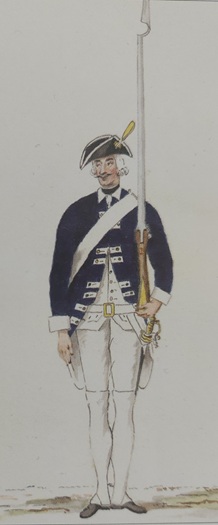
Musketeer in uniform m/1765
(drawn by an unknown artist circa 1778) |
The pictures above show two
variations of gaiters. The black ones were used in the field while the white
ones were intended for parades. Also note the differences in the hats, which
show how fashion changed during the 1770s. The front of the tricorne hats
became flatter as part of a development towards the bicorne hat. During the
1770s, a yellow plume was also added to the hat as a characteristic of the
Swedish army.
Gustavian Uniforms
|

Officer and musketeer in uniform m/1779
|

Grenadier uniform m/1792
(the jacket was never issued) |
|
The Gustavian Age is notable as a period when uniforms were frequently
changed, and their cut underwent drastic changes. When Gustav III began the
period with his coup d'état in 1772, the Dal Regiment was still wearing
m/1756 uniforms that differed very little from those worn during the reign
of Charles XII more than half a century earlier. But in 1774, the Dal
Regiment finally received a m/1765 uniform that was more reminiscent of
Frederick the Great's Prussian uniforms. Soon, however, Gustav III would
implement a drastic change in the cut of the Swedish army uniform so that it
did not resemble any other uniform. The result was m/1779 and since it was
only the cut and not the colours that changed, the king did not want to wait
until the old uniforms were worn out. Instead, the old uniforms were re-sewn
around 1780 so that they would comply with the new uniform regulation as
quickly as possible. |

Jacket belonging to Adjutant General Gustaf
Wachtmeister (with the rank of colonel) who was shot in the arm at the
Battle of Valkeala in 1790 (AM.008811) |
However, the
re-sewn uniforms were deemed to be unusable condition at the muster in 1783
and were replaced by a completely new set of m/1779 uniforms in September
1785. These were still in good condition at the outbreak of war in 1788 and
were supplemented with new belts before the departure for Finland in the
summer. However, the war increased wear and tear, and at the general muster
in January 1789 the breeches were considered worn out while the jackets and
waistcoats needed repair. After the peace in 1790 the regiment received
replacements for worn out equipment and at the general muster in 1792 the
uniforms were complete except for shoes and cloaks that had not been issued.
Only half the regiment had received cloaks in 1788 and the previous cloaks
issued during the Seven Years' War had been completely worn out already in
1778.
A new uniform
regulation came into force in 1792, but no new jackets would be issued until
1803, by which time the new regulation had been replaced by another uniform
regulation in 1802. The only change that was made to the privates' uniforms
was therefore the legwear. Instead of the charivades and boots of the m/1779
uniform, the shoes and gaiters that had been part of the m/1765 uniform were
reintroduced. However, the officers added epaulettes with rank insignia to
their old jackets, which replaced the gorgets. They were also allowed to
wear the new longer m/1792 jackets when they were not on duty. All officers
also received blue-yellow sashes.
Classic Gustavian Uniform 1780-1803
|
|
Rank-and-File |
Musicians |
NCOs |
Officers |
|
Same as privates unless
otherwise stated. |
|
Hat: |
6 inches high and flat at the top with a 2-inch-wide brim, fastened with
a button on the left side and provided with a hat band of white yarn. In
addition, a blue and yellow "sultan" (plume) and a plume tilted over the
hat which was of blue and white camel yarn for privates. and of white
rooster feathers for corporals and vice-corporals. The latter two would
also have "half silver lace" around the hat. The rank-and-file’s
sultans were to be made of wool yarn in 1787 and have yellow colour in
1791. |
|
The hatband was probably made of silver, and the plume would have been
made of blue and white rooster feathers. |
The hatband was made of silver, and the plume would consist of three
yellow flowers made of feathers. |
|
The original m/1779 hat had a round crown and
lacked both kinds of plumes. The hat model described in this table was
established in 1781. According to
Markelius, grenadier caps were not issued in 1785, and the previous ones
had been deemed unusable as early as 1774.
According to Pihlström, the regiment's own purchased grenadier caps had
been discarded in 1787, after which caps were not mentioned until 1802
when the Dal Regiment took over 96 caps from the Livregemente’s infantry
battalion. In addition to these, two officer caps with gilded plates and
covered with blue velvet and gold lace were delivered. All caps
disappeared in 1806 when the grenadiers were replaced by jägers. |
|
Cloak/ Surtout: |
Blue cloak without sleeves. Corporals and lance
corporals, like officers, NCOs and drummers, were allowed to wear a
surtout. At the outbreak of war, the privates were issued a overcoat made of
“buldan”. |
Blue double-breasted surtout with lapels, stand-up collar and blue open
cuffs with two buttons, as well as white lace in the seams and around
the shoulder decorations. The surtout was required for drummers and was
allowed to be worn by officers and NCOs. |
|
Jacket: |
Blue with white lining,
white stand-up collar and white sleeve cuffs, shoulder decorations, blue
lapels, white pipings or cords along the front edge of the jacket, along
the outer edges of the lapels, the shoulder decorations and the inner
sleeve seams and a row of yellow buttons of the model previously used by
the regiment (smooth buttons according to a letter from 1773).
Corporals and lance corporals were to wear a 2-inch-wide white shoulder
strap on the right shoulder. The corporals also had a tassel at the
lower end. |
White lace or "litzer". |
Smooth buttons with ring. |
Buttons with the provincial coat of arms. Also a white armband on the
left sleeve in memory of the 1772 coup d'état.
Epaulettes on the shoulders replaced the gorget as a rank insignia in
1792. |
|
Sash: |
Blue and yellow broadcloth sash from
1792. |
Blue and yellow silk sash with ribbon bow
on the left side. |
|
Sword knot: |
Blue and white camel yarn. |
Gold |
|
Waistcoat: |
White with blue collar and blue cuffs. |
The uniform regulations also included the appearance of the privates'
hairstyle. In 1782 it was to be arranged in curls on thin lead plates at
the ears (the curls were abolished in 1787). At the neck there was to be
a 6-inch long triple braided pig tail consisting of the soldier's own
hair or hair extensions, knotted and wrapped with black Paduan band so
that the hair was visible one inch above and one inch below the
wrapping. The pig tail was to be tied so loosely that it remained
between the shoulders when the head was bent and have the thickness of a
double penny. The hair would be powdered and the grenadiers would also
have well-blackened and waxed moustaches.
From the time of m/1792 onwards, the men would
braid their hair at the ears. |
|
Breeches: |
First white. During the Russian War,
blue breeches were issued and these became permanent in 1791. |
|
Legwear: |
Dark blue charivades (replaced by
gaiters with m/1792). |
|
Shoes: |
Boots with white trim
(replaced by shoes with m/1792). |
|
Neckcloth: |
Black. |
|
Sources: black text = Pihlström
(m/1779), purple text = Pihlström (m/1792),
blue text = Martin Markelius. |
|

Non-commissioned officer and two musketeers in
uniform m/1802
|

Officer's uniform m/1802
|
A completely
new set of uniforms was issued in 1803. The colours of the Dal Regiment were
slightly changed with this m/1802 uniform by making the collar and cuffs
red. This uniform was then adjusted when m/1806 came into effect by removing
the lapels and issuing completely new grey waistcoats and trousers. The
grenadiers were abolished the same year and replaced by jägers who received
green uniforms.
Another
uniform regulation was introduced in 1807, but no such uniforms were issued
to the Dal Regiment before it was repealed in 1809. However, the Dal
Regiment's old uniforms from 1803 were completely worn out after the Finnish
War of 1808-1809, and the soldiers were therefore forced to wear their
släpmundering (= work clothes) before a new regular uniform was issued
in 1811. This was similar to m/1802 and became the last uniform that the Dal
Regiment wore during wartime.
Late Gustavian Uniforms 1803-1815
|
|
Rank-and-File, Musicians & NCOs |
Officers |
Regimental staff
(surgeon,
judge-advocate & clerk) |
|
Hat: |
8 inches high with a 2 ½ inch wide brim, fitted with a thin brass plate
hatband and a yellow plume attached on the left side under the fold.
Small fatigue caps for use in the camp and minor service had been
introduced no later than 1805. The musicians
received a yellow plume with med m/1810. |
Same as the rank-and-file but with a gold lace hatband instead of brass plate.
According to m/1810 a brass hatband with the provincial
coat of arms or a shiny black leather strap and plate with the provincial
coat of arms like the rank-and-file. |
Tricorne "provincie hat" with black cockade. |
|
Neckcloth: |
Black. |
|
|
|
Jacket or tailcoat: |
Dark blue jacket with white lapels
and double row of buttons. In addition, white turnbacks and a red high
slanted collar and red cuffs. Epaulettes for officers and NCOs.
With m/1806 the lapels disappeared and were
replaced by a single row of buttons. The musicians was to have
epaulettes and "equilets".
Lapels and double rows of buttons returned with
m/1810. Red epaulettes for officers and NCOs. |
Same as the rank-and-file but tailcoat instead of jacket as well as
epaulettes and white armband (the latter was abolished in 1809).
Yellow turnbacks with m/1810 when the epaulettes got red carpets without
fringes for company officers and with bouillons for regimental officers. |
Dark blue tailcoat with white lining
and white turnbacks. red double collar (stand up collar with turn-down
collar outside), red cuffs and a row of buttons of the regimental model. |
|
Waistcoat: |
White waistcoat which was
replaced by a grey
waistcoat with m/1806. |
White |
White |
|
Belt: |
Waist belt was replaced by shoulder belt in 1806
and the rank-and-file were then allowed to wear sashes.
In 1813, cummerbunds were issued to them. |
Ordered to get black belts in 1807 (page 155).
|
|
|
Breeches or trousers: |
Breeches made of white broadcloth.
Grey trousers according to m/1806, but wore white
trousers made of ticking in July 1807 (page 166), summer clothes?. New
grey trousers issued in the spring of 1809 (page 221).
Red piping around the flap and leather
lining in the crotch on the m/1810 trousers. The rank-and-file had to
pay for white linen trousers for summer use. |
White, dark blue or black breeches. Staff officers had white leather breeches
that were used in all duties except parade. Had
white and grey trousers but were ordered in 1807 to get blue riding breeches, and
were then in the autumn allowed to use grey trousers on all occasions (page 155).
Same m/1810 trousers as the rank-and-file, but white trousers
for parade. Blue trousers were allowed for both officers and non-commissioned officers. |
White breeches for all major occasions, otherwise dark blue or black. |
|
Legwear: |
Black gaiters and shoes.
Provided in the spring of 1807 with 500 pairs of
shoes that had been taken by the French |
Collared boots instead of gaiters. Gaiters and
shoes, but half boots for parade with m/1810. |
Same as the officers. |
|
Cloak: |
Grey "kapotter" of
broadcloth
(cloaks with sleeves and a large turn-down collar) were issued in 1808,
which was the first time since 1788 that cloaks were issued. Additional kapotter were issued in 1811 and 1814. The
musicians received with m/1810 buttonholes of red ribbons on the collar. |
Since 1801, all rank-and-file were to have blackened moustaches and the
following year instructions were also given for how they should care for
their sideburns. In 1805, it was decided that the hairstyle of the
rank-and-file, musicians and non-commissioned officers would only be one
inch long around the head. The exception was a tassel at each ear that
would hang down over the (blackened) sideburns. |
|
Source: Anton Pihlström – black text =
m/1802 (issued 1803), purple text = m/1806.
red text = m/1810 (issued 1811). |
With m/1802,
company badges were introduced on the hats. The colours on these were in
1805 white for the colonel’s company, red for the lieutenant colonel's, blue
for the first major's, yellow for the second major's (old Gagnef), red-white
for Västerdal, blue-yellow for Rättvik, red-yellow for Mora and blue-red for
Orsa company. The company badges used during the war of 1814 consisted of
tin plates that were white for the colonel’s battalion, red for the second
battalion and red-white for the third battalion, and had painted numbers to
distinguish the individual companies.
When jägers
were introduced in 1806, they were given a green plume on their hats as a
distinguishing feature in addition to green uniforms. Non-commissioned
officers and corporals also had hat cords with green lace and buttons.

The Dal Regiment's m/1810 uniform depicted in
Pihlström's regimental history work. |
The uniform
issued in 1803 had hats that were too small and were therefore discarded the
next year, after which they were replaced with new ones. The jackets,
however, were worn until 1809, albeit with adjustments made to make them
comply with the new uniform regulation from 1806, which abolished the lapels
and had a single row of buttons. In accordance with m/1806, the white small
clothes (waistcoat & trousers) were also replaced with a grey one, but white
linen/leather trousers were still worn in the summer. The grey m/1807
jackets were never issued to the Dal Regimen and after campaigns in
Pomerania and Norway, the old jackets were worn out. After the coup d'état
in 1809, the Dal Regiment was paraded in Stockholm in the spring. To look
good, they were issued with new grey trousers, and repairs were made to the
jackets (new red collars, among other things). But the condition of the
uniform was still so bad that the regiment wore the “släpmundering”
from 1809 to 1811. The appearance of the släpmundering was the same
as in 1802, but with white trousers and short gaiters.
A completely
new uniform model was established in November 1810, which was again to be
blue with red distinction and have double rows of buttons. However, the
trousers remained grey, and the privates were only allowed to use white
trousers purchased by themselves during the summer. The new uniform was
ready for the regimental meetings in 1811 and further uniforms of this type
were issued to the reinforcements of the Dal Regiment in 1812 and 1813.
However, at the muster in the latter year, 930 of the regular soldiers'
jackets and 305 of the reinforcements' jackets were discarded. The regular
soldiers’ trousers were also in very poor condition. Despite this, the Dal
Regiment participated in the Norwegian campaign of 1814. During the
campaign, however, 621 “kapotter” (cloaks), 1146 trousers and about 1400
sets of shirts, stockings and shoes were delivered. Immediately before the
regiment returned to Sweden, another 1000 sets of shirts, stockings and
shoes were taken from the storehouse in Fredrikstad, Norway.
The uniform
that replaced the m/1810 was the m/1816 and it introduced the shako, so
characteristic of the armies of the Napoleonic era, as a new headgear
(equipped with the provincial coat of arms). The so-called "Swedish hat",
which was the last remnant of Gustav III's uniform regulation, was thus
history. |
|
Dal Regiment Colours

Olof Hoffman's model drawings of the Dal Regiment's
m/1686 colonel's and company colours
The oldest
known colours of the Dal Regiment were issued 14 May 1622. According
to Pihlström, the appearance of these eight colours are unknown and we only
know how much material was used to make them. Namely white and blue taffeta
(worth 16 dalers each) as well as yellow taffeta (worth 10 dalers) and 8
lots of silk. However, Höglund has in his book from 2012 (page 71) a
depiction of its colour which consists of a yellow saltire on a
field with six horizontal white-blue stripes. Höglund also has information
about blue-white colours for a fänika from Dalarna in 1617 and for "Västmanlanders-Dal men"
in 1621 (page 78). In a description of the Swedish army's order of march on
3 September, 1631, the colours of unnamed regiments are described, and
Höglund has identified a set of one white and seven blue colours as
belonging to the Dal Regiment (pages 79 & 108).
After that,
it was not until the war preparations in 1655 that we have more information
about the colours of the Dal Regiment. At that time, eight colours were made
for the Dal Regiment and Pihlström believes that one of these could be a
colour that was kept in Stora Tuna Church in 1740. It was then almost
decayed and was "of mixed red and white silk fabric in
four sections with olive branches and a gilded key in the middle, decorated,
and surrounded with an incomplete Latin inscription on both sides: Stationen
in qvo ... suam qva Miles locatus est armatus". The colour was also
stated to include Dalarna’s provincial coat of arms and to have been brought
back from Stettin "some time ago". A newly raised company received a
blue colour on 24 June 1656 and three more newly raised companies that were
to serve on the fleet received blue and yellow colours in 1657.
After peace
was concluded in 1660, it was not until 1670 before new colours were issued.
Then the battalion being sent to Stettin received four crimson colours. This
information also comes from Pihlström, who obviously does not believe that
the colour in Stora Tuna belong to this set.
The
uncertainty surrounding the appearance of Dal Regiment colours disappeared in
1673 when Sweden received its first colour regulation, which determined what
each regiment's colours would look like. According to this, the regular
company colours were to have the same appearance as the provincial coat of
arms, which for Dalarna was a blue field with two crossed arrows and a crown
in gold. The colour of the colonel’s company was to be white with the same
symbol surrounded by palm leaves or a laurel wreath.
In 1674 the
entire Dal Regiment received a set of eight m/1673 colours. The seven
company colours were then bleumerant (pale blue) and all colours had only
the Dalarna provincial coat of arms as a motif. But whether the colonel's
colour had palm leaves or a laurel wreath around the provincial coat of arms
is not mentioned in the painter Baltzar Friedrich's liquidation. Another
blue colour was made by him in the spring of 1676 for a newly formed company
that would serve in the navy. No details about the motif are mentioned, but
if it followed the new regulation from 1675, the provincial coat of arms
would be surrounded by a laurel wreath and each corner would have a flaming
grenade. During the Battle of Lund three colours were lost, but two of them
were recaptured during the same battle and only one was permanently lost to
the Danes.
On 12 May
1677, a set of eight m/1675 colours, painted by Baltzar Friedrich, was
issued. The finials were made of silver-plated iron. The company colours
should have had both a laurel wreath around the coat of arms and flaming
grenade in the corners, but only the laurel wreath is mentioned in the
liquidation. The regulation from 1675 was replaced by a new regulation in
1686. According to this, the seven company colours would no longer have
grenades in the corners and the motif would now only consist of the
provincial coat of arms surrounded by a green laurel wreath. The Colonel's
colour would have the Swedish national coat of arms in the middle and the
coat of arms of Dalarna in the upper inner corner. As an aid to the
acquisition of new colours, a series of model drawings were made (see images
above).
The
regulation from 1675 was replaced by a new regulation in 1686. According to
this, the seven company colours would no longer have grenades in the corners
and the motif would now only consist of the provincial coat of arms
surrounded by a green laurel wreath. The Colonel's colour would have the
Swedish national coat of arms in the middle and the coat of arms of Dalarna
in the upper inner corner. As an aid to the acquisition of new colours, a
series of model drawings were made (see images above).
The first m/1686 colours were issued in 1690 and were painted by the same
Olof Hoffman who had made the model drawings for m/1686. These colours are
said to have been carried until the Battle of Poltava when four or possibly
five of them were taken by the Russians. What happened to the other colours
is unclear. However, an ensign in the Dal Regiment, Isac Pommerijn, said
that he tore off his colour and hid it under his coat upon surrender. He was
probably not alone in doing so, as this would explain why only half of the
Dal Regiment's colours were reported as trophies by the Russians. A year
later, Pommerijn burned his colour because he was afraid of being discovered.
The same fate happened to the colours taken by the Russians when the
Kremlin burned down in 1737. In the Russian descriptions, the colours had a
spruce staff and a gilded iron finial.


Colonel's and company colour in use 1710-1713
When the Swedish army was restored in 1709-1710, Daniel Stawert and Johan
Wikman were commissioned to paint the regiments' colours. The division of
labour between them is not known, but the style of the Dal Regiment's
colours suggests that they were made by Wikman. The colonel's colour's
crowns have red outlines and the knot on the company colours' laurel
wreaths has only one loop, which are details that are characteristic of
him. However, this set of colours did not last long, as the
capitulation in Tönning meant that the Russians once again captured four of
the Dal Regiment's colours. The colonel's colour and two company colours
fell to the Danes. The last colour was probably awarded to the Saxons,
but none of the colours they took have survived today.

Company colour in use 1714-1728
When the Dal
Regiment was to be restored for the second time in 1713, cost-saving
measures were taken. The number of colours per regiment was reduced from
eight to four and the storages were searched to find older colours that
could be used. For the Dal Regiment, there were four company colours in
storage that Olof Hoffman had made in 1700-1701. These had been intended for
a reorganisation of the Dal Regiment from eight to twelve companies
that was very short-lived. But in 1714, three of these were issued to
the Dal Regiment together with a newly made colonel's colour by Johan Wikman
that had actually been intended for the Uppland 3-männing Regiment. The
colonel's colour for this 3-männing regiment, which was also recruited in
Dalarna and Västmanland, should have been white with Charles XII's cipher as
the central motif and small images of the provincial coat of arms in the
corners.
Hoffman's
colours appear to have had an original height of about 196 cm and a width of
220 cm. The staffs were 356 cm long of blue-grey painted pine.

Company colour in use 1728-1741
It was not until 1728 that the Dal Regiment once again received a full set
of eight colours. This time painted by Johan Wikman. But it would also be
the last time each company received its own colour, as from 1733 only four
colours were issued per regiment. The preserved company colours' staffs are
made of brown-painted pine and the colours themselves were originally 170 cm
high and 216 cm wide.


Colonel's colour in use 1741 and Company colour in
use 1741-1766
The next set consisting of only four colours was embroidered by Tobias Leij
the Elder in 1741. The change in manufacturing technique from painting to
embroidery resulted in the motif being made smaller so that the colour would
not be too heavy. The brand new colonel's colour was lost to the Russians
already in the Battle of Villmanstrand on 23 August 1741. Tobias Leij
was therefore commissioned to embroider a new colonel's colour in 1742. This
was the last m/1686 set for the Dal Regiment as the next set issued in 1766
was of the short-lived m/1761. During this time the colonel's colours had
crowns in the corners. The colonel's colour kept in Russia is said
to have a white-painted staff while the company colours' staffs are painted
brown.

Colonel's colour in use 1766-1814 |

Model drawing of the Dal Regiment's m/1761 company colour
(colours like this were in use 1766-1814 |
In 1761, the appearance of Swedish company colours was changed so that
the laurel wreath was replaced with a frame consisting of seashells and a
crown in gold. However, this change was not popular, and the frame was
described as "wooden", so already in 1766 the seashells were replaced with
palm leaves. But even though m/1761 was short-lived, the Dal
Regiment's colours of this type were long-lived. Christoffer Sergel
embroidered four colours in 1766, one of which was a colonel's colour that
unusually had the provincial coat of arms in a crowned shield. These colours were
still considered in good enough condition in 1808 to be repairable.

Unknown colonel's colour from the reign of Charles XIII
All regiments' colonel's colours were identical at that time |

Company colour in use 1814-1820 |
The Dal Regiment finally received its first m/1766 colours in 1814. The colonel's
colour was then made by Anette Berger and the company colours by Abigael Ulrika
Rahmn. At this time, the colonels colours no longer had the provincial coat of
arms in the upper inner corner and instead had closed crowns in each corner,
which meant that all regiments had identical colonel's colours. This set was
replaced by m/1819 colours already in 1820.
|
|
Other Equipment
In 1696, it
was decided that the regiments would store their uniforms in leather bags
instead of chests.
According to
the regulations from 1697, all officers were to have five ell long
half-pikes with brown shafts. They were also to have a musket ("glatt
bössa") for field use of the same calibre as the musketeers. The
non-commissioned officers were to have 3 ½ ell long halberd with unpainted
shafts.
At the
outbreak of war, the men's weapons were old and in poor condition. The
muskets that had been issued in 1683 were two-thirds matchlock muskets (only
the senior and junior filemaster in each file had a flintlock musket) and
the musket barrels were so bad that they could not withstand a full charge.
But during the march to Scania, the old muskets were replaced in Örebro so
that all musketeers had a flintlock musket and bayonet.
The pikes
were provided with flags in 1691, which may have been unique to the Dal
Regiment. These flags were in use until at least 1699.
When the
regiment was restored in 1709-10, as usual, one third of the men were armed
with pikes. However, since it was to remain in Dalarna and defend the Falu
mine against possible Norwegian attacks, colonel Magnus Julius De la Gardie
requested that the pikes be replaced with muskets, with the following
justification:
"as the
defence will seem much better than with pikes in these mountainous places,
especially since the regiment then has a third more shot and also bayonets
instead of pikes for counter-attack, which by experience have had better
effect on many occasions."
The War
College granted this request and the Dal Regiment first received 400 dragoon
muskets in 1710 before exchanging them for regular flintlock muskets the
same year. This armament was retained during Stenbock's campaign in 1712-13
and was also issued when the regiment was restored in 1714. However, Charles
XII was a supporter of the pike and after his return to Sweden he decided
that one third of the men in each regiment should once again be armed with
pikes. It did not help that De la Gardie emphasized how effective muskets
with bayonets had been in the Battle of Gadebusch. When the Dal Regiment
participated in the Norwegian campaigns of 1716 and 1718 it was therefore
armed with pikes.
After the
death of Charles XII, however, the pikes were exchanged for muskets again
when the regiment passed Stockholm in July 1719. Although, already on 24
November 1719, a royal resolution was issued that determined that all
infantry regiments should have pikes. But now the proportion of pikemen
would only be a quarter. Despite the resolution, it was not until early 1722
that the Dal Regiment was again provided with pikes. In order to be able to
practice the men until they received real pikes, the company commanders had
been ordered in 1720 to procure wooden pikes (only the shafts?).
No tents were
brought to the Norwegian campaign in 1716, as these had been left behind in
Wismar in 1712. Instead, they had to sleep in “cabin camps”. New tents were
delivered in 1717. Overall, the regiment’s equipment was in good condition
for the Norwegian campaign in 1718, thanks to the emergency coins. New
baggage trains had been purchased in the spring of 1718.
An inventory
of the colonel’s company's equipment from 1699 mentions that each soldier
had a copper drinking bottle. In 1709, copper bottles with three half-stops
volume (1.95 litres) each are mentioned. In 1714, a copper bottle with a
strap is mentioned. In 1718, the same company had wooden bottles (33),
copper bottles (27) and bottles made of tin (90). |
|
References
Asker, Björn. Om svenska fotfolkets nybeklädnad (article in MAM 40). Stockholm (1983)
Asker, Björn. Svenska uniformsförteckningar 1655-1683 (article in MAM 37). Stockholm (1978)
Bellander, Erik. Dräkt och uniform. Stockholm (1973)
Cederström, Rudolf. Svenska kungliga hufvudbanér. Stockholm (1900)
Ericson, Lars. Fastställda uniformsmodeller för svenska armén under 1720-talet (article in MAM 45-46). Stockholm (1986)
Grill, C. Statistiskt sammandrag af svenska indelningsverket. (Facsimile
edition 1988)
Höglund, Lars-Eric. Skånska kriget1675-79 - Fanor och uniformer. Karlstad (1999)
Höglund, Lars-Eric – Sallnäs, Åke. Stora nordiska kriget 1700-1721 - Fanor och uniformer. Karlstad (2000)
Larsson, Anders. Karolinska uniformer och munderingar åren 1700-1721. Östersund (2022)
Markelius, Martin. Gustav III:s armé. Stockholm (2020)
Pihlström, Anton. Kungl. Dalregementets historia. Stockholm (1902-1911)
Törnquist, Leif. Infanteriets fanor m/1686 (article in SVSS-NS XXX). Stockholm (2015)
Törnquist, Leif. Infanteriets fanor 1761-1900 (article in SVSS-NS XXXIII). Stockholm (2018)
Wennerholm, J Bertil R. Emporterade troféer. Bohus (2000)
Wernstedt, Folke. Svenska standar och fanor 1654-1686 (article in Meddelanden från Riksheraldikerämbetet X). Malmö (1945) |
|