|
Örjan Martinsson
| |
|

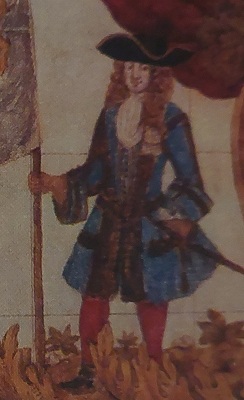
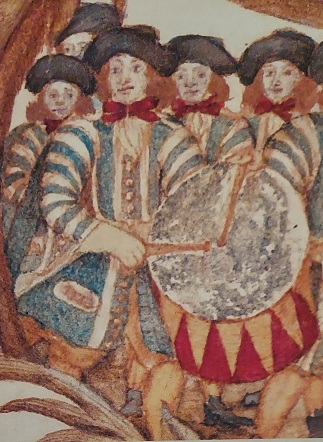
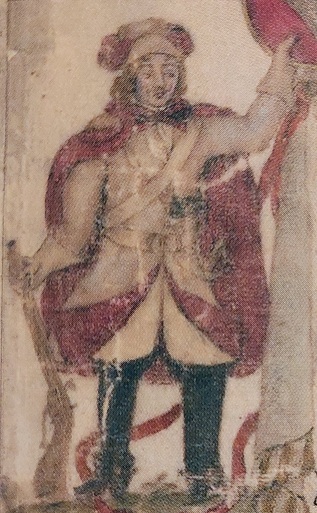
The pictures are from "Geographisk Charta Anno 1696" and depict an
officer from Tavastehus Regiment, drummers from Nyland Infantry Regiment
and a cavalryman from Nyland and Tavastehus Cavalry Regiment.
My information about uniforms on this page comes almost
exclusively from Lars-Eric Höglund’s book "Stora nordiska kriget
1700-1721 - Fanor and uniformer" but I have also added information
about the early infantry uniforms from Gunnar Brolin’s article in Karolinska
förbundet’s yearbook 2013.
For many regiments, particularly during the period after
the battle of Poltava, the uniforms are stated to have been made of “wadmal”
(= coarse wool) without mentioning any colours. Wadmal clothes were usually
grey (undyed wool), but that was not always case and even if they were grey
the lining and cuffs could still be of a different colour (such as blue or
yellow).
|
|
Österbotten Infantry Regiment |
|

1688-1703 |

1703-1710 |

1710-1718 |

1718-1720 |
|
Colour on the waistcoat and the karpus’ facing unknown. |
Had karpus in 1712 as well as
coat and breeches made of wadmal. |
Colour on hat lace and buttons as well as the cloak’s
lining and collar is not mentioned. |
|
|
Björneborg
Infantry Regiment |
|

1696-1704
Waistcoat not mentioned. |
1704-1710 |

ca 1712 |

1716-1720 |
|
Colour on the waistcoat, buttons and the karpus’ facing
unknown. |
Wadmal coat, no colours on it is mentioned. The hat lace
colour is also unknown but the only hat lace colour that is mentioned
for Finnish regiments at this time is yellow. |
Anders Larsson states that they in 1713 had 204 blue
coats with yellow lining as well as blue collar and cuffs edged with
yellow. Furthermore, a shoulder strap in blue and yellow, yellow button
holes, pewter buttons and yellow breeches. |
|
|
Åbo Län Infantry
Regiment |
|
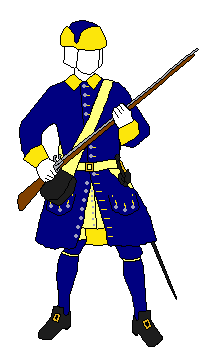
1697-1704 |
1704-1710 |

ca 1712 |

1718-1720 |
|
The facing colour on the karpus is not mentioned. |
Colour on waistcoat, buttons and karpus unknown. |
Wadmal coat, no colours on it are mentioned. But its double
regiment had in 1709 yellow cuffs and collar and pewter buttons. The hat lace
colour is also unknown but it was yellow in 1716 when the coat was still
of wadmal. |
Hat lace and button colour unknown, had however yellow
lace in 1716. |
|
|
Nyland Infantry
Regiment |
|

1696-1702 |
1702-1710 |

ca 1712 |

1718- |
|
Waistcoat not mentioned. |
Waistcoat and facing on the karpus not mentioned. |
Had both grey and yellow stockings. Button colour unknown. |
Colour on hat lace and buttons as well as the cloak’s
lining and collar is not mentioned. |
|
|
Tavastehus
Infantry Regiment |
|

1690-1702 |
1702-1710 |

ca 1712 |

1716- |
|
Höglund claims that a uniform with red facings (instead
of yellow) as ”likely” and has no information about colour on waistcoat and
buttons. But according to Brolin, blue broadcloth to coats and yellow
broadcloth
and baize to cuffs and lining were ordered in 1689 and transported to
the regiment. |
Yellow and grey stockings,
Colour on waistcoat, buttons and the karpus’ facings unknown. |
Piecoat and coat of wadmal, no colours on them are
mentioned. The hat lace colour is also unknown. Breeches made of wadmal
or leather as well as both yellow and grey stockings. |
Colour on hat lace and buttons as well as the cloak’s
lining and
Collar is not mentioned. |
|
|
Savolax Infantry
Regiment |
|

1691-1702 |
1708-1710 |

ca 1712 |

1718- |
|
Höglund states that the stockings were "possibly" blue in
1696. Received new coats with pewter buttons 1in 702 as well as hats and
blue breeches in 1705. |
Had blue and yellow breeches, Colour on waistcoat, buttons and
facings on the karpus unknown. |
Same uniform was also worn in 1715. Colour on cuffs,
lining and buttons not mentioned, but its double regiment had in 1707/08
pewter buttons, yellow cuffs and collar. |
Button colour unknown. Lining and cuffs on the cloak not
mentioned. In 1716 the waistcoat, breeches, stockings and hat lace were yellow while
the cloak is not mentioned. |
According to Gunnar Brolin (KFÅ 2013) the regiment should have
received new uniforms at the regimental drill in 1691, consisting of
blue broadcloth to coats, yellow broadcloth to cuffs, yellow baize to lining,
fabric to karpuses, brass buttons and leather breeches. In the
supplement to part 2 of Höglund’s uniform trilogy it is mentioned that
captain Myrman’s company in 1699 received a new outfit consisting of
blue karpus, blue coat with three dozen pewter buttons, blue cuffs and
yellow lining, leather breeches, and white wool stockings which were
intended to be dyed yellow. |
|
Viborg Infantry
Regiment |
|

1684-1701 |

1702-1710 |

?-1715 |

1716-
Button colour unknown. |
|
According to Höglund they had leather breeches or blue
broadcloth breeches. |
Waistcoat not mentioned. Had hat or blue karpus 1708/09 (facing
colour on the karpus is not mentioned). In 1701 they had blue karpus
with yellow facings as well as brass buttons on the coat. The uniform
issued in 1702-1703 had pewter buttons but the headgear is not mentioned. |
Dressed in wadmal and grey wool stockings. No colours
apart from the stockings are mentioned. |
Gunnar Brolin writes in KFÅ 2013 that the regiment went to war with
uniforms that had been issued in 1683 or 1684. These were in such poor
condition that many soldiers had replaced them with grey wadmal coats
and other items which gave the regiment a motley impression ("old
wadmal coats, grey, white, black as the peasants could afford to give
them, one have a karpus the other have a hat”). |
|
3-männing Regiments on Foot |
|

Åbo, Björneborg &
Nyland
1700-1702 |

Åbo, Björneborg &
Nyland
1702-1706 |

Åbo, Björneborg &
Nyland
1706-1708 |
Tavastehus, Viborg
& Savolax
1702-1704 |
|
Höglund mention only grey wadmal clothes and grey
stockings.
Compare the double regiments which were raised at the same time.
|
Blue coat with yellow lining and cuffs, yellow breeches
and yellow stockings.
Headgear is not mentioned but with yellow lace was common
among regiments in the Baltic provinces. |
Hat, blue coat
with yellow lining and cuffs, leather waistcoat, blue breeches and yellow
stockings. Had in 1708 karpus or hat.
Was disbanded after the battle of Lesnaya in 1708. |
Blue coat with
brass buttons, yellow lining and cuffs as well as blue breeches.
Was disbanded after the fall of Narva in 1704. Probably had the same uniform
as Åbo, Björnborg and Nyland in 1700-1702. |
|
|
All regiments
1702 |
Double Regiments on Foot
When the war broke out in
1700, the Finnish indelta regiments were transferred to Livonia. In
their place, Finland was to be defended by newly raised 3-männing
regiments. But these were also transferred to the Baltic provinces in the autumn
of 1700. To ensure Finland's defence, the double regiments were
therefore raised, which, unlike Swedish männing units, were not a one-time
recruitment, but had their losses were replaced in the same way as the
indelta regiments. Each rote would therefore be responsible for
one soldier to the regular regiment and one extra soldier. As 3-männings
regiments had already been created, the strength of the double regiments was
only two-thirds that of the regular regiment. But as the 3-männing
regiments disappeared as independent units, the corresponding double
regiments came to attain the same strength as the regular regiments.
Then when the regular regiments were lost in 1709-1710, the double
regiments came to replace them as regular indelta regiments.
Note that it was only the
six southern provinces that set up double regiments. Österbotten
had not introduced the "indelningsverk" and was instead recruited
through conscription.
Höglund does not describe
Tavastehus and Nyland's uniforms separately, but only states that they
looked the same as Björneborg's. |
|
Grey wadmal coat with yellow cuffs and wadmal breeches
(compare the 3-männing uniforms in the same time period).
|
|

Åbo Län
1709 |
Björneborg
1706 |
Savolax
1707/1708 |
Viborg
1707 |
|
Höglund mentions
that they had both grey wadmal coat with pewter buttons, yellow cuffs and collar
as well as blue broadcloth coats. They also had leather waistcoats and leather breeches.
Stockings and headgear are not mentioned. |
The only
details that are mentioned are: "Hat, blue coat, waistcoat, breeches and stockings".
In 1703 they received 463 blue karpuses and 105 red breeches. |
Hat, grey wadmal coat with pewter buttons, yellow cuffs and collar,
lather waistcoat, leather breeches and yellow stockings. |
Hat, grey pie coat
with pewter buttons, yellow cuffs and collar, wadmal breeches and grey stockings. |
|
|
Enlisted Regiments
|
|
Ingermanland Infantry Regiment
1703 |

Finnish Enlisted Battalion
1711-1719 |

Ingermanland Dragoon Regiment
1702-1712 |
|
In 1702/03
the coat was blue with yellow lining and cuffs. Breeches were blue.
In 1707 they had blue coat, leather waistcoat, leather breeches and
yellow stockings. |
Blue coat. Cuffs and lining were yellow in 1702 and
the breeches were likely blue. In 1708 they had both karpus and hat
with lace (colours not mentioned but drummers had silver lace on their hats). |
The two Ingermanland
regiments were raised in 1700 in Ingermanland and Kexholm county by Otto
Vellingk, who was governor-general of these two Finnish-speaking
provinces. The infantry regiment was to consist of 1,000 men (of which
700 from Kexholm county). It was captured by the Russians when Viborg
capitulated in 1710, but some escaped capture (76 men) and together with
remnants from regiments in the Baltic formed the Finnish Enlisted
Battalion in 1711. Narva's garrison regiment which was also a mainly
Finnish-speaking unit contributed 145 men (this regiment is however
presented among the Baltic regiments). In total, the Enlisted battalion
consisted of 395 men in 1712. |
|
Åbo & Björneborg
Cavalry Regiment
|
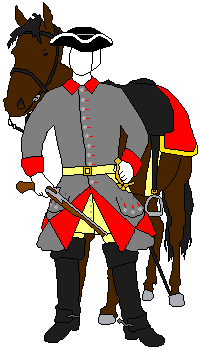
?-1702 |

1702-? |

ca 1708 |

ca 1712 |
|
"Likely" uniform according to Höglund who does not
mention anything about hat lace, button colour and edge on the shabraque.
|
Also had hats. The shabraques are not mentioned but I have guessed that they were just
made of black leather since the rest of the uniform appear to have been the result of a tight budget. |
Höglund mention only "hat, blue coat". Could possibly
have had yellow cuffs and hat lace and blue shabraques if the regiments in Lewenhaupt’s corps were uniformly dressed. |
No colours are mentioned
besides of "wadmal". In 1718-1719 they had uniforms of both
wadmal and
blue broadcloth but these were in poor condition. |
|
|
Nyland Cavalry
Regiment
|
1696-1702 |
1702-1704 |

1707-1709 |
ca 1712 |
|
Colour of the hat is not mentioned by Höglund, but his
description appears to be based on an illustration from 1696 (see at the
top of this page) where the hat has the same colour as the coat and red
lace. |
Also had hats. The shabraques are not mentioned but I
have guessed that they were just made of black leather since the rest of
the uniform appear to have been the result of a tight budget. Received
uniforms in 1704 which have not been described by the sources. |
The information comes from
Bengt Nilsson.
The hat is not mentioned but the pistol covers were of white leather. |
Had both blue and grey cloaks.
Had in 1718 blue coat instead of wadmal coat. Colour on hat lace,
buttons, cuffs, lining and shabraques unknown. But this regiment is
identical with the double regiment before 1710 and that had yellow facings.
|
|
|
Karelska Cavalry Regiment
(Viborg)
|
1694-1702 |

1702-? |
ca 1708 |

1713- |
|
Shall according to Höglund have had the same uniform as
Åbo & Björneborg (that is grey coat with cuffs and shabraque in the
regimental colour). |
|
Höglund mention only "hat or karpus, blue coat".
Could possibly have had yellow cuffs and hat lace and blue shabraques if the regiments in Lewenhaupt’s corps were uniformly dressed. |
Button colour and cuffs/lining
not mentioned. 1710-1712 the karpus, cloak and coat were of wadmal. |
|
|
Karelska Dragoons
|
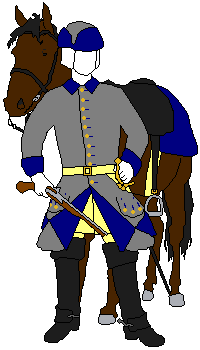
1695-?
Shabraques unknown. |
ca 1708 |
ca 1712 |

1716 |
|
Höglund only mention that they received blue coats during
the period 1704-1708. Could possibly have had yellow cuffs and hat lace
and blue shabraques if the regiments in Lewenhaupt’s corps were uniformly dressed. |
Dressed entirely in wadmal.
Apart from the yellow hat lace, no colours are mentioned. |
The only colours that are
mentioned is a blue coat and leather breeches.
|
|
|
Other Finnish Cavalry
Regiments
|

Åbo, Nyland & Viborg
3-männings
1700-1701 |

Åbo Län
Double Regiment
1707 |

Nyland
Double Regiment
1707 |

Karelska
Double Regiment
1701 |
|
"Likely" uniform according to
Höglund who does not mention hat lace. |
Only mentioned that they had hat,
blue coat, leather waistcoat and leather breeches. |
Hat lace not mentioned. |
Only mentioned that they had hat, grey
wadmal coat with blue cuffs. The description of the uniform in 1707 is identical
with Åbo Län Double Regiment. |
According to Höglund all temporary Finnish mounted units had blue shabraques with an edge made of black leather.
Note that the double regiments were transformed into the regular indelta
regiments when these were restored after the battle of Poltava. The
uniforms of the Finnish Stånd Dragoons
are completely unknown. |
|
References
Brolin, Gunnar. Införandet av den blå enhetsuniformen vid de finska
regementena
(article in KFÅ 2013). Västerås (2013)
Höglund, Lars-Eric – Sallnäs, Åke. Stora nordiska kriget 1700-1721 - Fanor och uniformer. Karlstad (2000).
Höglund, Lars-Eric – Sallnäs, Åke. Stora nordiska kriget 1700-1721, II. Karlstad (2003). |
|