|
Örjan Martinsson
| |
|



Västmanland was a regiment that was used
extensively during the campaigns in Sweden’s Age of Greatness. Since its
recruiting area was not a border region, it did not need to be left behind
in the homeland and was instead an obvious choice to serve in the field
armies that fought on the other side of the Baltic Sea. During the Great
Northern War, Västmanland was considered one of the best regiments. It
distinguished itself as the only regiment that participated in all major
battles in that war.
|
|
Organisational History
Västmanland
Regiment can trace its origins to the fänika that was set up in
Västmanland in the mid-16th century and which was recruited through
conscription. For a long time, there was only one Västmanland fänika,
but at the beginning of the 17th century several more were raised. At the
same time, their size decreased, and they were renamed companies. From 1613
onwards, the companies were combined into a larger regiment that also
included companies from Uppland and Dalarna. This regiment was from 1617
called the Uppland Land Regiment, and was later organised into three
field regiments. In 1628 the field regiment from Västmanland became an
independent regiment consisting of eight companies (of these, however,
Dalarna and Uppland contributed two companies each). In 1641, a decision was
made to expand the regiment to twelve companies, but it probably never
reached more than ten companies before it returned to the old organisation
in 1645.
The
Västmanland regiment, like the previous fänika, was recruited mainly
through conscription until 1682. The exception was the part that was
recruited in Dalarna because this province had concluded an agreement with
the crown to introduce a "permanent force". This meant that the peasants
were exempted from conscription in exchange for themselves recruiting and
maintaining a certain number of soldiers. From 1635 onwards, Dalarna's
contribution to the Västmanland regiment amounted to 260 men and this
remained unchanged until 27 October 1682 when the peasants of Uppland and
Västmanland also agreed to introduce the permanent force (or the allotment
system as it is most often called). The reorganisation that followed the
following year when the contracts with the peasants were to be implemented
meant that Dalarna's contribution to the Västmanland regiment was reduced to
205 rotar (each rote was responsible for one soldier). The
geographical distribution of Dalarna's contributions also changed from
having constituted western Dalarna to instead coming from southern Dalarna.
In Västmanland itself, 733 rotar were organised and in the parts of
Uppland and Södermanland that belonged to Västmanland County, a further 244
and 5 rotar were organised respectively, so that the total became a
1200-man strong Västmanland regiment divided into 8 companies of 150 men.
From 1690
onwards, the companies were given geographical names instead of being named
after the company commanders as before. Thus, the regiment had the following
organisation, which it would retain throughout the 18th century.
|
Company |
Districts (rotar) |

The map above has the borders of the province of
Västmanland in red while the borders of the districts that were part of
Västmanland County are black. It gives a rough idea of the
geographical spread of the regiment. The grey area was exempt from
recruiting soldiers in peacetime. |
|
Colonel’s |
Yttertjurbo (29), Siende (57), Norrbo
(54), Vagnsbro (10) |
| Västerås |
Norrbo (9), Tuhundra (61), Snevringe
(80) |
| Strömsholm |
Snevringe (80), Åkerbo (70) |
| Kungsör |
Åkerbo (95), Fellingsbro (55) |
| Bergslag |
Vagnsbro (32), Norberg (37),
Skinnskatteberg (26), Söderbärke (17), Norrbärke (22), Grangärde (16) |
|
Lieutenant Colonel's (Folkares) |
Folkare (93), Hedemora (57) |
| Major's (Väsby) |
Simtuna (88), Övertjurbo (51),
Torstuna (6), Yttertjurbo (5) |
|
Salberg |
Simtuna (9), Våla (61), Torstuna (80) |
The towns in Västmanland recruited sailors for the navy. Their contribution
in peacetime were as follows: Västerås (24), Arboga, (16), Köping (13),
Lindesberg (6). Nora (8). In wartime those numbers were doubled.
Additional Troops in the Scanian War
During
wartime, the need for men increased and the government tried in various ways
to increase the size of the army. For the part of the Västmanland regimental
area that was recruited through conscription, this was not a major problem
since there was no limit on how many could be conscripted. During the
Scanian War, so-called sexmänningar (six-men-ings) were therefore added
through an extra conscription. They got their name because Västmanland was
divided into groups consisting of six men each and one of these was
conscripted. A total of two companies with 150 men each were raised, and
they were mustered in Västerås in January 1677. That same year, they were
part of a force that reconquered Blekinge in February-March and then fought
the Snapphans in northern Scania. In 1678, they were used as garrison troops
in Karlshamn, Kristianopel and Kalmar.
For the
Dalarna part of Västmanland Regiment, a different method had to be used to
raise manpower. Dalarna had a contract with the crown that limited the
number of soldiers they had to recruit to 1,400 men (of which 260 belonged to
the Västmanland regiment). This contract was circumvented, however, by each
rote being ordered to select one person to a peasant levy under the
command of Dalarna’s governor. These men formed a regiment called “Utskottsfolket”
(selected people). Read more about them in the article about the
Dal Regiment.
Additional Troops in the Great Northern War
The same part
of the allotment system that recruited the Västmanland regiment was given
the task of raising an additional 400 men in 1700. This was done by bringing
the rotar together into groups of three who would recruit an extra
soldier, a so-called tremänning (“three man-ing”). These were then
combined with the 3-männings from Uppland and the Dal Regiment to form the
1,200-man Uppland 3-männing Regiment, whose colonel would become the famous
general Adam Ludvig Lewenhaupt. The recruitment took place in violation of
the allotment office contract, but the peasants were promised that the
3-männings would not leave the homeland. However, this promise was also
broken when the 3-männing regiment was transferred to the Baltic in April
1701. Once there, the regiment was split up when one battalion accompanied
the main army to Poland in 1702 while the other remained in the Baltic. A
reorganisation then took place in 1703 when the battalion in the main army
was incorporated into the Livgarde (Life Guards) while the Uppland 3-männing Regiment was
compensated by receiving a battalion from the disbanded Östgöta-Södermanland
3-männing Regiment. Under Lewenhaupt's command, the latter participated in
the battles of Jakobstadt, Gemäuerthof and Lesnaya. The latter battle
resulted though in such a large loss of equipment that the regiment was
disbanded, and the men transferred to the Livgarde in 1708.
However, the
3-männing regiments were not sufficient for the army's needs and in 1703 the
peasants were ordered to set up 5-männing combining the rotar into
groups of five to provide an additional soldier. Uppland's 240 five-männings
were combined with the 5-männings from Västmanland, Dalarna and Södermanland
to form the 960-man Uppland 5-männing Regiment. This regiment was allowed to
remain in the homeland and participated in the Battle of Helsingborg in 1710
together with its parent regiment. It was converted into the Stralsund
Garrison Regiment in 1720.
The 3- and
5-männing regiments were a one-off recruitment and the peasants did not have
to replace their losses. However, this did not prevent them from being
forced to set up a new 3-männing regiment in 1712 in the same way as the
last time. However, this time the regiment was allowed to remain in the
homeland until it was disbanded in 1719. The men were then transferred to
the Guard, the Östgöta-Södermanland 3-männing Regiment and others.
Wartime Organisation
in the Great Northern War
Temporary deviations from the colour organisation of the allotment system
took place during the Great Northern War, when extra personnel were
recruited through enlistment. When the regiment went on campaign in 1700, a
reorganisation was carried out so that the men were divided into twelve
companies of 100 men and that the number of officers was increased so that
each company would be fully staffed. In November of the same year, it was
also decided that the staff companies (Colonel's, Lieutenant Colonel's and
Major's companies) would each have a captain, and an additional captain
would be appointed to lead the regiment's grenadiers.
On 18 January 1701, the old organisation of eight companies of 150 men was
restored. However, the number of officers did not decrease, but each company
would now have an extra captain, lieutenant and ensign (so-called double or
second officers). In the spring, double non-commissioned officers were also
introduced, with each company getting an extra fältväbel, sergeant
and förare. This meant that each company would have eight
non-commissioned officers instead of the normal five. In 1708, however,
there were usually nine non-commissioned officers in each company.
The regimental staff was at least occasionally supplemented by a regimental
adjutant, a regimental Judge-advocate and a regimental commissar. In 1718,
there was also a field surgeon assistant in each company.
Colonels
and Battles
(Green background indicates victories, red background
defeats)
|
Västmanland Fänika |
|
(1552) -1565 |
Långe Bengt |
|
(1557) |
(Reinhold von Stockholm) |
|
1566-1567 |
Lasse Olsson |
|
1567-1568 |
Nils Larsson |
|
1568-1572 |
Mats Olsson |
|
1573-1590 |
Heden Jonsson |
|
1590-1597 |
Olof Jonsson |
|
1597-1608 |
Olof Andersson |
|
1609-1612 |
O. Olofsson |
From 1602 onwards there were several fänikor
from Västmanland.
One of them became the colonel’s company in the regiment below in
1613.
Uppland Land Regiment
(included Västmanland and Dalarna) |
|
1613-1622 |
Jesper
Andersson Cruus af Edeby |
|
1622-1628 |
Åke Eriksson Oxenstierna af Eka och Lindö |
Västmanland Regiment |
|
(1626 )-1630 |
Bengt Bagge |
|
1631-1634 |
Johan Lilliehöök |
|
1634-1645 |
Erik Stenbock |
|
1645-1658 |
Wellam Philip |
|
1658-1660 |
Hieronymus de la Coutiere |
|
1660-1667 |
Gabriel Kurck |
|
1667-1668 |
Erik Leijonhielm |
1668-1677
|
Thomas van der Noot
(killed at Stettin) |
1676 Öland
1676 Demmin
1677 Køge Bay |
|
1678-1699 |
Peter Creimer |
1678 Rügen |
|
1678 Stralsund |
|
1699-1716 |
Axel Sparre
(in Bender 1709-1714 &
in Germany 1714-1719)
(the following colonels
were acting colonels) |
1700 Narva
1701 Düna
1702 Kliszow
1706 Fraustadt
1718 Holowczyn |
|
1709 Poltava |
|
1710 |
Gustaf Johan Tunderfelt
(killed at Helsingborg) |
1710 Helsingborg |
|
1712-1716 |
Melker Falkenberg
(captured at Tönningen)
(mortally wounded at Moss) |
1712 Gadebusch |
1713 Tönningen
1716 Moss |
|
1714 |
Carl Breitholtz |
|
1716-1720 |
Bernhard Reinhold von Delwig |
|
1720-1728 |
Axel Sparre (second time) |
|
1728-1739 |
Gustaf Fredrik von Rosen |
|
1739-1747 |
Otto Christian von der Pahlen |
1742 Helsinki |
|
1747-1770 |
Samuel Gustaf Stierneld |
|
1770-1771 |
Gustaf Adolf von Siegroth |
|
1771-1773 |
Jonas Cronstedt |
|
1773-1780 |
Fredrik Arvidsson Posse (on leave from 1775) |
|
(1775) -1803 |
Duke Fredrik Adolf |
1790 Valkeala |
|
Feb.-March 1804 |
Lars Stiernstam (executive officer 1790-1804) |
|
1804-1810 |
Adam Ludvig von Friesendorff |
1808 Oravais |
|
1810-1815 |
Pehr Brändström |
|
1816-1820 |
Carl Albrecht Leijonflycht |
Västmanland Regiment was disbanded
in 1927 |
|
Scanian War
During the Scanian War, the
regiment was never deployed in one single place. Some fought in Germany
while others were mainly commandeered to the navy. The troops in Germany
were cut off from their homeland early on because the Danish navy achieved
naval supremacy. Without hope of reinforcements, they had to defend a
shrinking territory in Pomerania against an overwhelming enemy coalition. In
the autumn of 1678, they were forced to give up their last stronghold in
Germany (Stralsund) in exchange for safe passage to Sweden. However, the
transport fleet ran aground at Bornholm and the Västmanlanders became Danish
prisoners of war.
The original intention was to
send the entire regiment to Pomerania in 1674, but a lack of men meant that
only six companies were sent there. The regency council’s poor
administration in 1660-1672 meant that it was common that wages were not
paid and soldiers had to starve in the camps. The result was widespread
desertion and many absentees from the regiment's rolls. At the muster in
Västerås on 18 June 1674, the regiment's eight companies had only 550
privates. When the regiment departed on 13 July, however, the strength had
increased to 711 men who had been distributed among only six companies. The
cadres of the other two companies remained in Sweden to continue recruiting
more men. The strength at home increased over time because no recruits could
be sent to Germany. However, they never deployed as a field unit. Instead,
they were commandeered to the navy or used as garrison troop.
The
Campaign in Germany
Västmanland regiment was
transferred to Pomerania in 1674, where three companies were stationed in
Demmin and at least two in Greifswald (August-October). At the end of the
year, the regiment crossed the border into Brandenburg, after which it was
immediately assigned to winter quarters. The actual campaign did not begin
until May 1675. The Västmanlanders did not participate in the Battle of
Fehrbellin on 18 June, but the consequence of the defeat was that they and
the rest of the army returned to Swedish Pomerania already at the end of
June. On 30 April, Västmanland Regiment had mustered a force consisting of
107 officers & NCOs and 679 privates. In July, a force consisting of 106
officers & NCOs and 608 privates was reported. The losses consisted of 16
deserters, 14 dead, 16 wounded & sick, 23 left behind during the march home
and 3 captured.
In September, Swedish Pomerania was invaded and the Swedish troops retreated
to the fortresses. Västmanland Regiment probably ended up in Stralsund.
Västmanland men participated in a relief corps to Wismar that was sent from
Stralsund. However, this was not successful and on the way back, 16 files of
the regiment were left behind as a garrison in Ribnitz. Danish cavalry
attacked Ribnitz on 13 December and forced the garrison to surrender, with
90 Västmanland men being taken prisoner.
At the beginning of 1676, Västmanland Regiment was stationed in Demmin and
the enemy coalition began a siege of this fortress in August. Since the
garrison ultimately had only 480 men fit for service, they chose to
surrender in exchange for safe passage to Stralsund on 10 October. Upon
arrival in Stralsund, Västmanland Regiment had a strength of around 400 men.
The Västmanland men remained in Stralsund while their colonel, who was
skilled in fortress warfare, was loaned to the Stettin garrison which was
besieged in the second half of 1677. However, he was killed in August.
In September 1677, the enemy coalition captured all of Rügen, except for the
redoubt at Neue Fähre, which was defended by 550 men, of whom about 100 were
Västmanlanders. When the Swedish general Königsmarck counterattacked after
the turn of the year, Västmanland Regiment was part of his field army and on
8 January 1678 they were victorious in the Battle of Rügen, after which the
entire island was recaptured. The Västmanlanders' losses in the battle
consisted of only 1 ensign and 5 privates who were wounded. The success in
Rügen was followed up in March with a month-long raid into Mecklenburg in
which 2 captains and 208 men from the Västmanland regiment participated.
During the same month, the regiment's total strength was 507 men fit for
service and 61 sick. But by the summer of 1678 it had dropped to 370 men.
Some Västmanlanders had been captured in a skirmish at Löcknitz on 4 June.
In September 1678 the regiment reported 170 men in the field on Rügen and 25
men garrisoning the redoubt at Neue Fähr, while 276 men remained in
Stralsund. These could not prevent the enemy coalition from retaking Rügen
that month. The Swedish force on Rügen carried out an evacuation to
Stralsund but more than half of the infantry was lost. A garrison of 250 men
had been left in Neue Fähr, the majority of which, however, consisted of
former prisoners of war who had been recruited to the Swedish army. They
were unwilling to continue fighting and mutinied against the officers who
barricaded themselves in one of the bastions together with 25 loyal
Västmanlanders. The officers realised that it was pointless to continue the
fight under these circumstances and they agreed to surrender on 16
September.
At the end of September
– early October it was reported that 128 Västmanlanders with officers had returned from Rügen, which meant that 76
men had been lost during the fighting on Rügen. The same report stated that
27 men were commandeered to Damgarten, 32 were sick and the remaining 210
men fit for service remained in Stralsund.
At the end of September, Brandenburg began a siege of Stralsund and the
situation quickly became untenable for the small garrison, which also faced
resistance from the civilian population who wanted the city to surrender. On
15 October, the garrison, which at that time had a strength of 2,543 men, of
whom 234 were Västmanlanders, surrendered. They were granted safe passage to
Sweden with all their equipment (colours, cannons and horses, etc.). Denmark
disapproved of these conditions and delayed the transport to Sweden so that
it did not begin until 4 December. When most of the transport fleet ran
aground at Bornholm, the Danes also chose to take the Swedish force as
prisoners (this included the Västmanland men).
Of the 6 standards and 22 colours taken at Bornholm, four can possibly be
identified with Västmanland. The captured men (including 301 officers and
NCOs) did not return to Sweden until the summer of 1680. The march home went
via the duchy of Bremen that had been returned to Sweden, and the
embarkation of the ships for Sweden took place in Lübeck.
The Companies in Sweden
A cadre of two companies was left in the homeland in 1674 to complete the
recruitment of the regiment in 1674. In July 1675, however, only 59 men had
been recruited for these companies and the plan was that they would be
transferred to Germany in October. However, the sea transport did not get
further than to Gotland and was forced to turn back due to bad weather and
very high levels of sickness.
In April 1676, the home-based part of Västmanland Regiment had reached a
strength of 213 privates, and these were commandeered to the navy. They then
participated in the unfortunate battle of Öland on 1 June. It is unclear how
many Västmanland men died. But on 27 June only 185 men remained of the
regiment, which meant that the strength had been reduced by around 60.
The Västmanland men were commandeered to the navy in 1677 too, and in June
their contingent consisted of 6 officers and 277 men who were organised in
three companies. But the Swedes continued to suffer defeats against the
Danish navy. This time at Køge Bay on 1 July.
During 1678, the Västmanland men were used as a garrison troop and after a
muster in Asarum in October they were stationed in various locations. 140
men were placed in Karlshamn, 75 men in Varberg and about 70 were placed in
Mörrum and Nymölle redoubts and several other locations. 171 men were sick,
and these were quartered in Kalmar, Ronneby, Lyckeby and Asarum. In total,
the home-based part of the regiment then consisted of 439 corporals and
privates. |
|
Great Northern War
Västmanland
is notable as the regiment that participated in the most battles during the
Great Northern War (Narva, Düna, Kliszow, Fraustadt, Holowczyn, Poltava,
Helsingborg and Gadebusch). During the course of the war, the entire
regiment was restored twice after capitulating at Perevolochna in 1709 and
Tönning in 1713. Half the regiment was restored a third time after the
Colonel’s Battalion surrounded to a superior Norwegian force in Moss in
1716. It returned to Norway in 1718 and participated in the siege of
Fredriksten Fortress when Charles XII fell. The Västmanlanders ended the war
by defending Stockholm against Russian pillaging in 1719-1721.
1700-1709
After the
outbreak of war, Västmanland's two battalions were ordered to go to Kalmar
and Karlskrona, respectively, where they stayed for two months. Four days
after Charles XII's landing at Humlebæk, the regiment was ordered to quickly
go to Landskrona. The idea was that the Västmanlanders would also be shipped
over to Zealand, but this did not happen before the peace was concluded.
However, some books incorrectly state that Västmanland was with the main
army in Denmark in 1700. Instead of Denmark, they marched back to Blekinge,
from where they were shipped over to Pernau at the end of October and
participated in the campaign against the Russians.
In the Battle
of Narva on 20 November, Västmanland had an effective strength of only 556
men, who were nevertheless formed into three small battalions. One ensign
and 92 non-commissioned officers and privates fell in the battle. Two of the
battalion commanders (Feilitzen and Kurck) were wounded along with two other
officers and 197 non-commissioned officers and privates.
At the end of
December, 200 Västmanlanders participated in a raid on Russian territory
under the command of Magnus Stenbock. But in the following years, the
Västmanland regiment was part of the main army and followed its movements.
|
1700 |
1701 |
1702 |
|
April-May |
March to Kalmar & Karlskrona |
Jan.-June |
In Lais north of Dorpat |
Jan.-June |
March through Poland |
|
June-July |
Stay in Kalmar & Karlskrona |
17 June-July |
March Dorpat- Riga |
9 July |
Battle of Kliszow |
|
28 July |
March to Landskrona |
9 July |
Battle of Düna |
July |
March to Krakow |
|
Sep.-Oct. |
Stay in Karlshamn |
July-Sep. |
March Düna-Grobin |
31 July-Oct. |
Stay in Krakow |
|
Oct.-Dec. |
Campaign in Estonia |
Oct.-Dec. |
In Telsen outside Grobin |
2 Oct.-Dec. |
March to Lublin |
No recruits
to cover losses from the previous campaign appear to have arrived in the
spring of 1701. On 24 August the regiment had 165 vacancies, which had
increased to 194 a month later and to 198 on 10 January 1702. The first
batch of recruits (160 men) were sent off in the spring of 1702 and should
have joined the regiment in the autumn. In October 1703 a loss of 177 men
since January was reported. At the beginning of June 1704, the number of
vacancies was 206 but this was reduced to 20 when recruits arrived to the
regiment. At the end of 1704 there were 58 vacancies but 27 of them were
then filled by recruitment from the drivers. On these occasions, a varying
number of soldiers were also sick and these are obviously not included in
the strength reports below (up to and including 1704), which come from
Torsten Holm's book. The information from this paragraph comes from
Nordensvan page 132.
In the Battle
of Düna on 9 July 1701, the regiment was 859 strong. The Swedish army
counted around 100 dead after the battle, but Västmanland likely suffered
very few casualties. Its lieutenant colonel was seriously wounded and sent
home.
When the 1702
campaign began in January, the Västmanland regiment had 825 men. Six months
later, the regiment participated in the Battle of Kliszow where it suffered
no casualties whatsoever. After the battle, a battalion was temporarily left
in Pinczow to protect wounded men from less fortunate regiments.
|
1703 |
1704 |
1705-1707 |
|
Jan.-Feb. |
Winter quarters in the Lublin area |
Jan.-May |
Winter quarters in West Prussia |
Jan -05 to Aug -06 |
In Greater Poland |
|
Feb.-May |
March to Thorn |
June-Aug. |
March to Lemberg |
3 February 1706 |
Battle of Fraustadt |
|
May-Oct. |
Siege of Thorn |
Sep.-Nov. |
March to Greater Poland |
August |
March to Saxony |
|
Oct.-Dec. |
Winter quarters in West Prussia |
Nov-Dec. |
Winter quarters in Greater Poland |
Aug -06 to Aug -07 |
In Saxony |
During the
siege of Thorn in 1703, the Västmanland regiment was stationed 60 kilometres
northeast of the fortress in the city of Strassburg to secure the supply
route. After the fall of Thorn, the regiment was placed in winter quarters
in Schöneck (40 kilometres southeast of Danzig). After participating in the
main army's long marches in 1704, Västmanland was left behind in Greater
Poland during the 1705 campaign season and was part of Rehnsköld's army from
27 July 1705 to 6 August 1706.
Under
Rehnsköld's command, Västmanland participated in the Battle of Fraustadt on
3 February 1706, where one of their battalion commanders was killed (Major
von Snoilsky). 34 men were killed during the battle, while another 15
wounded died before the end of February.
When the
Västmanlanders were reunited with the main army, they crossed the border
into Saxony on 26 August and began an occupation of that country that would
last a whole year. They were then stationed in Annaberg near the border with
Bohemia until Charles XII's departure on 22 August 1707. Together with the
main army, the Västmanlanders marched to present-day Belarus where they in
1708 stayed for four months (February-May). Västmanland regiment was at that
time located in Volozin (between Smorgon and Minsk) from where they later
marched towards Holowczyn.
| 1704 |
Strength (effective?) |
Place |
|
1708 |
Total strength |
Rank-and-File |
|
1 January |
763 |
Schöneck |
5 January |
1274 |
|
1128 |
|
| End of
February |
529 |
Schöneck |
15 January |
1271 |
-3 |
1127 |
-1 |
|
24 June |
761 |
Thorn |
25 January |
1268 |
-3 |
1124 |
-3 |
| 12 August |
923 |
Jaroslav |
4 February |
1267 |
-1 |
1123 |
-1 |
|
16 September |
836 |
Magierov |
14 February |
1261 |
-6 |
1117 |
-6 |
|
The strength reports for the year 1704 (and for
the previous years) are taken from Torsten Holm's book. He does not
mention any details about them, but I assume they refer to the
effective strength of the regiment, and that these figures therefore
do not include sick or commandeered men.
The total strength reports for 1708 refer to all
personnel categories except for officers, although civilian personnel such as
drivers are included. The “rank-and-file” refers to
corporals and privates. The changes that occur during the year are not
only due to soldiers dying but also to some of them being promoted (corporals
to non-commissioned officers and non-commissioned officers to officers
who are not included in the table). The fact that the rank-and-file strength
increased on two occasions is probably due to recruitment
from the drivers. A total of 34 Polish drivers were added in May-June.
During the period of August-October, Folke
Wernstedt has calculated that the total strength decreased by 85 men. |
25 February |
1259 |
-2 |
1115 |
-2 |
|
March |
1250 |
-9 |
1109 |
-6 |
| April |
1255 |
+5 |
1113 |
+4 |
|
16 May |
1245 |
-10 |
1103 |
-10 |
| 26 May |
1272 |
+27 |
1101 |
-2 |
|
6 June |
1275 |
+3 |
1102 |
+1 |
|
16 June |
1263 |
-12 |
1096 |
-6 |
|
26 June |
1252 |
-11 |
1093 |
-3 |
|
6 July |
1246 |
-6 |
1090 |
-3 |
|
16 July |
1229 |
-17 |
1080 |
-10 |
|
Sum: |
|
-45 |
|
-48 |
In the Battle
of Holowczyn on 4 July 1708, the losses of the privates were two killed and
13 wounded. The losses of the officers consisted of only two wounded,
Lieutenant Colonel Wrangel and a lieutenant (according to Pihlström's diary).
Västmanland did not participate in the Battle of Lesnaya on 29 September,
but as a result of this battle, the regiment was reinforced with Finnish
soldiers whose previous regiments had lost all their heavier equipment and
therefore could not function as independent units. The Finns came from Åbo
Regiment (140 men) and Björneborg Regiment (420 men). Possibly 311 men from
the Nyland Regiment were also included (this according to Petre's diary,
while von Weihe's diary states that they were instead transferred to the
Närke-Värmland Regiment). The reinforced Västmanland Regiment then crossed
the Desna River at Mezyn on 1 November with a force consisting of 200
Västmanlanders and a Björneborg battalion. 200 men from Västerbotten and 400
from the Dal Regiment were also included in the Swedish force, which
suffered losses of about 50 killed and 100 wounded. The Västmanland and
Västerbotten men are said to have taken most of these losses.
At the end of
April 1709, Västmanland Regiment arrived in Poltava and Västmanlanders were
part of the force that dug the first trenches when the siege began on 1 May.
Two months later, the Battle of Poltava was fought, in which seven officers
(including the lieutenant colonel), nine non-commissioned officers and 17
corporals were killed. Torsten Holm writes that "the number of
non-commissioned officers and privates killed was about 200", but unlike
the previous information, he does not cite any source for this claim. A
captain from Åbo Regiment who served in the regiment also died in the battle.
The remainder
of the regiment surrendered three days later at Perevolochna on 1 July.
However, the colonel Axel Sparre and a non-commissioned officer managed to
get to Bender with the king. The person responsible for the regimental
personnel during the captivity was therefore Major Gustav Reuter, who in a
letter home to Sweden sent a list of the prisoners of war who were alive in
March 1710 and asked for financial assistance for them.
Prisoners of War 22 March 1710
| |
Officers |
NCOs |
Rank-and-File |
Other |
|
Colonel’s |
4 |
6 |
46 |
1 |
| Lieutenant
Colonel's |
5 |
6 |
18 |
1 |
|
Major's |
5 |
8 |
34 |
2 |
| Strömsholm |
5 |
5 |
19 |
0 |
|
Väsby |
3 |
5 |
28 |
1 |
| Berg |
3 |
4 |
17 |
0 |
|
Salberg |
5 |
3 |
17 |
0 |
|
Kungsör |
4 |
4 |
31 |
0 |
|
Sum |
34 |
41 |
210 |
5 |
|
Nominal strength |
53 |
64 |
1200 |
|
Vacancies among officers were usually filled quickly through promotions
during ongoing campaigns and on 12 June 1709 there were only 4 or 5 officer
vacancies in Västmanland Regiment. The fact that the captured officers
constituted two-thirds of the full strength indicates that they suffered
relatively light losses compared to the rest of the army. This was probably
because the Västmanland regiment had fallen behind and had not had time to
take their place in the first line in time for the main battle. But it is
strange that the men in Russian captivity in 1710 only amounted to 210 men
according to the major's report. The total strength in the battle, which
admittedly included Finnish soldiers, was at least 1100 men (Bertil
Wennerholm has estimated it at 1246 men). If the number of corporals at the
time of the battle was complete, their killed (17) should also have
constituted a third of the total. It should be noted though that the
Russians kept officers and privates separated during captivity.
1710-1721
The recruitment to the restored regiment was almost fully completed in
October 1709 and it began the march to Danish-occupied Scania on 14 January
1710. Its two battalions arrived at Osby on 3 and 4 February respectively.
It participated in the Battle of Helsingborg on 28 February with an
effective strength of 937 men (including officers). During the battle, the
colonel and 9 of the men were killed. The wounded included the lieutenant
colonel and two lieutenants and 13 of the privates. The care of the wounded
was made more difficult by the fact that the regiment did not yet have any
field surgeons or field surgeon assistants. After the Scanian campaign had
ended, the regiment was stationed in the Ljunit and Herrestad districts (the
area around Ystad).
In the autumn
of 1711, Västmanland Regiment was part of a force that was transferred to
Pomerania to relieve Stralsund, which was besieged by a Danish-Saxon army.
The enemy withdrew, but the Västmanlanders remained in Pomerania for a whole
year. 57 recruits arrived on 14 September 1712 on Rügen, and at the same
time 688 men were garrisoned in Stralsund. The entire 904-strong Västmanland
regiment participated in Magnus Stenbock's campaign in Mecklenburg, which
began on 21 October 1712. After a month-long pause at the Warnow River from
4 November, the Battle of Gadebusch was fought on 9 December. There, 2
Västmanlanders were killed and 6 were wounded. At the end of December, the
Swedish army advanced into Schleswig-Holstein. On 18 January, the regiment
was 800 strong and on 8 February it marched into the Tönning fortress, which
was later besieged by the enemy coalition. In May, the fortress surrendered,
and the second incarnation of Västmanland Regiment also became prisoners of
war.
Västmanland
Regiment, restored for the second time, participated in the Norwegian
campaign in the spring of 1716 with its 600-man Colonel’s Battalion. The
second battalion was left behind in the home province because it was not
fully recruited until September. The Colonel’s Battalion was part of the
force that, under the king's command, crossed the border into Norway from
Holmedal in Värmland on 26 February and marched into Kristiania on 12 March.
On 19 March, the Västmanland battalion captured the city of Moss, where it
remained until 13 April, when the Norwegians counterattacked. Despite a
stubborn defence in which its colonel was mortally wounded, the surrounded
Västmanlanders were forced to surrender. 510 men, including the lieutenant
colonel and ten other officers, were taken prisoner. Approximately 100
Swedes were killed (500 cavalrymen also participated in the battle).
The remaining
battalion was ordered in July 1716 to march to the Småland border and was in
Scania on 23 September with a force of 586 men and officers. In November,
parts of this force returned to their home province.
Once again,
Västmanland Regiment, two battalions strong, participated in the 1718
Norwegian campaign. This time too, they were part of the force led by the
king, but now they assembled in Västra Ed in Dalsland. At the end of October,
the border was crossed. The Västmanlanders then participated in the siege of
Fredriksten fortress, which was interrupted by the king's death on 30
November. The unplanned return to their home province was difficult,
resulting in many becoming sick. The Västmanland Regiment reported on 3
December that it had 301 sick, 43 wounded and 47 vacancies.
During the
rest of the war, the Västmanlanders were tasked with defending the east
coast against Russian raids. They arrived in Stockholm on 1 June 1719 and
were sent as reinforcements to the Battle of Stäket on 13 August, which was
over when they arrived. On 15 December, they were back in their home
province with a force of 961 men. The following year, they were again in the
Stockholm area from 7 April to 11 November. In 1721, the regiment was in
Stockholm (Södermalm) from 29 April until peace was concluded with Russia on
30 August, after which the Västmanlanders returned home. |
|
Västmanland Uniforms

Charles X Gustav's War |
Scanian War |
Great Northern War |

Seven Years' War |
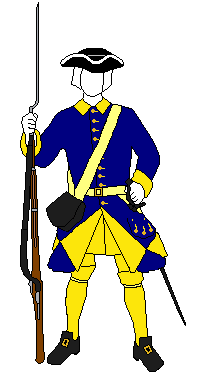
During the 17th century, Västmanland often seems to have had green uniforms.
This colour was worn both before and after the Scanian War, although it is
uncertain whether it was worn during this war as the Västmanlanders seem to
have had a blue-red uniform instead. When the Carolean uniform was
introduced in 1690, they, like most Swedish regiments, received a
blue-yellow uniform. The blue-yellow colour combination was then retained by
Västmanland Regiment throughout the 18th century.
Västmanland's
Oldest Uniforms
The first
time the colour of Västmanland’s uniforms is mentioned was just before the
wedding of Charles X Gustav on 24-26 October 1654 when four companies from
the Västmanland regiment participated in a troop parade. These companies had
for this occasion received new uniforms consisting of green broadcloth. They were
also said to have had a different colour on the cuffs, edges and lining but
it is unknown which one. A few months later, Sweden's first uniform
regulation was issued and in this the green colour for Västmanland Regiment
was confirmed. More specifically, it stated that the Västmanland men should
have sea green jackets and breeches. A shift to blue uniforms may have taken
place as early as the late 1650s, as a newly raised company received a blue
colour in 1656, and this was followed by three more blue colours in 1657
when more men were conscripted.
The next time
Västmanland's uniforms were mentioned was when the colonel’s battalion was to
be equipped for garrison duty in Riga in 1666-1667. At that time, officers
and non-commissioned officers received grey broadcloth for their uniforms while
corporals, sergeants, and privates received blue broadcloth. The type of
broadcloth
used for the uniforms varied for each category. The officers received
English broadcloth, the non-commissioned officers' broadcloth was called "packlaken",
the privates received "gemet piuk" and the others received "kiör
piuk".
However, the
blue colour in 1666 seems to have been temporary, because during drills
in the summer of 1672, 300 soldiers from Västmanland are reported to have had
uniforms consisting of green broadcloth and light green baize. Västmanland having
a green uniform colour was also stated in an undated letter from the War
College (from 1672 or 1673). We get more detailed information in the uniform
regulation issued on 15 March 1675, when Västmanland was to have green clothes
with red cuffs and edges. It was probably not a sea green shade this time.
According to m/1675 and m/1682, the colours (flags) of Västmanland were to have a
grass green shade and it probably matched the colour of the uniforms.
Höglund
confirms the green colour for Västmanland in 1674. But for the year 1676 he
states a blue coat with red cuffs and edges as well as a hat and blue
breeches. The field regiment also had blue coats in 1678 (the
non-commissioned officers' uniform was, however, grey). The companies that
were commandeered to the navy received grey broadcloth and new waist belts and
shoes that same year.
The colour of
the stockings is not mentioned at any time. However, Höglund mentions that
Västmanland's six-men (extra conscripts) had blue stockings in 1676. Their uniform was
otherwise identical to that of the parent regiment from the same year.
In a list of
the existing uniform colours from 1683, Västmanland is stated to have green
clothes with red cuffs. It is unknown when this uniform was issued. However,
buff coats for the non-commissioned officers were purchased in 1686.
Västmanland's Carolean Uniforms
|

1690-
Narva, Düna, Kliszow, Fraustadt |

-1709
Holowczyn, Poltava |
1710-
Helsingborg, Gadebusch |

-1721 |
Västmanland's
first Carolean uniform was issued on 20 May 1690. These were replaced not
later than in August 1705, but they probably received new uniforms as early
as 1702 thanks to the contributions that were demanded from the Poles after
the Battle of Kliszow. However, there is a complete lack of sources about
this and the only indication that this may have happened is that the
Västmanland regiment is not included among the regiments that Charles XII
mentioned as poorly clothed in a letter to Magnus Stenbock in November 1702.
The extent of the new uniform in 1705 is also unknown as details about this
are missing except that everyone received new waistcoats and breeches of leather.
Another set of new uniforms was issued during the stay in Saxony in
1706-1707, but there are also no details except that the waistcoats and breeches
now seem to have been made of broadcloth. A clue to what the uniforms may have
looked like at that time is the description of the recruits' uniforms from
1707 (who, however, had leather waistcoats and breeches).
When the
regiment was restored after Poltava, new uniforms were made in Gothenburg.
However, these were not delivered until the regiment was just north of the
Scanian border. The march to Scania in January was therefore done while
wearing peasant clothes. The uniforms from 1710 were then worn until the
capitulation at Tönning in 1713, and parts of the regiment that escaped
captivity had them even longer, even though they were worn out by then. The
newly raised men wore grey wadmal coats in 1714/1715. New uniforms should
have been issued before the Norwegian campaigns of 1716 and 1718, but
details about them are only known from the last year of the war.
Privates'
Uniforms 1690-1721
A royal letter from 27 February 1704 ordered the governor of Västmanland to
urgently procure 1200 pairs of breeches and 1200 leather waistcoats. These were
to be transferred to Poland together with that year's recruits. However,
only half were delivered in Stockholm on 23 May and the other half not until
the following year. Both Carl Gustaf Rehnsköld's and Joachim Lyth's diaries
mention the delivery of uniforms to the regiment in August 1705.
In 1706, a karpus consisting of black hat felt with a flap of blue
broadcloth and
yellow lining was ordered (Bellander, page 206). However, Höglund states
yellow lace instead of yellow lining. In any case, these karpuses were not
issued. According to a royal order from May 1707, a delivery of 1200
karpuses, 1200 pairs of stockings and 1241 coats was sent back to Stockholm.
A representative from Västmanland Regiment also did not want to receive
leather waistcoats and leather breeches because the king had in Saxony “provided
for breeches of broadcloth and waistcoats for the entire regiment" (the
information was provided to me by
Bengt
Nilsson).
At the muster in August 1710, the men were missing 100 leather waistcoats,
137 leather breeches, 734 shirts, 445 pairs of shoes, and 235 pairs of
gloves (Bellander, page 235).
In 1715, colonel Melker Falkenberg wrote that both
veterans and recruits wore thin grey wadmal coats that they had
received from the rote peasants. The soldiers who remained from the restored
regiment in 1709 still had the uniforms that had been issued in
February and April 1710, and which were now completely worn out.
Falkenberg therefore stated that a campaign with existing clothing
would be disastrous for the regiment (Klaesson, page 43).
|
|
1690 |
1707 |
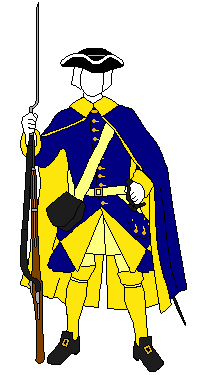
1710 |
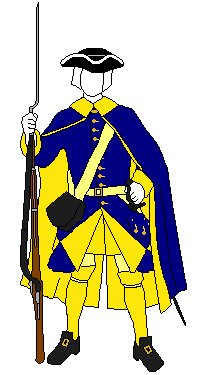
1721 |
|
Headgear: |
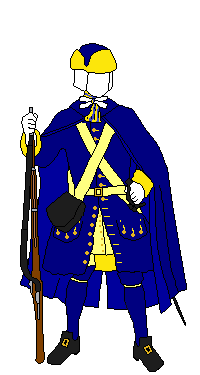
Karpus of blue broadcloth with yellow lining. |
Recruits wore hats. |
Hat with camel hair lace. |
Hat with wide white
lace around the brim and hat band, as well as a large pewter button on
the side. |
Piecoat,
Cloak: |
"Raincoat" of wadmal with blue baize cuff and
blue lace. Cloaks were issued in 1694 (blue with
blue lining). |
|
Blue cloak with yellow lining and cuffs and brass
buckle. |
Old cloaks |
|
Coat: |
Blue with yellow lining and brass
buttons. |
Recruits wore
blue coats with yellow lining and cuffs, and brass buttons. |
Blue coat with yellow lining, cuffs and collar,
and buttonholes sewn with yellow thread.
|
Both old and new coats, some of which were
half-worn. |
|
Belt: |
Shoulder belt for the sword. |
|
Waist belt of ox skin with buckle. Yellow
bandolier strap and grenadier strap of goatskin 3 vent picks. |
1104 yellow bandolier straps were requested in
1715 (Holm page 163) |
|
Waistcoat: |
Leather (issued before
1690). |
Leather waistcoat for recruits.
Waistcoats (broadcloth?) were made for the entire
regiment in Saxony |
Leather |
Yellow
waistcoat of
broadcloth, 5 ells of lining , ¼ ell of canvas under buttons and buttonholes
and 1 ½ dozen small pewter buttons. |
|
Breeches: |
Leather |
Leather breeches for recruits.
Broadcloth breeches were made for the entire
regiment in Saxony |
Leather |
Leather |
|
Strumpor: |
Blue broadcloth. |
Yellow for recruits. |
Yellow |
Yellow |
|
Shoes: |
Shoes from 1688, had buckles in 1690. |
|
|
1½ year old shoes. |
|
Neckcloth: |
A motley neckcloth tied together with
a ribbon (the ribbon fell out of use after 1697). |
|
|
|
|
Gloves: |
Only the pikemen received gloves in 1690. The
musketeers received gloves before 1694. |
|
|
New gloves. |
|
Sources: black text = Asker,
green text =
Bengt Nilsson,
blue text = Erik Bellander,
red text = Höglund,
purple text = Larsson.,
pink text = Holm |
Other Uniforms 1690-1721
Charles XI expressed his pleasure with the non-commissioned officers'
uniforms in 1690. But the same uniforms received complaints from him in 1694
for having too large cuffs: "although, you should discard, the large and
wide cuffs used by them, because I find them completely inconvenient for a
soldier". The king also noted that the coats were not the same, as some
had the "former " and some others had blue buttons. He therefore ordered
that all should be "equally uniformed and dressed" (quotes from
Bellander, page 193). Otherwise, however, the first Carolean uniforms of the
non-commissioned officers are unknown according to Björn Asker. Although
Höglund mentions that in 1700 they had karpuses with silver lace.
When the regiment was restored
in 1709/1710, according to Höglund, the non-commissioned officers' uniforms
consisted of a hat with silver lace, blue piecoat, blue coat with blue
lining and cuffs, and brass buttons, leather waistcoat, leather breeches and blue
stockings. Anders Larsson also mentions that the premier non-commissioned
officers in 1712 had polished iron hilts on their swords while the double
officers had ordinary soldier swords. At the same time, the gloves were made
of leather (moose skin collar and buckskin grip). For 1721, Larsson mentions
that they had blue knitted stockings. In the muster roll for 1721, the
non-commissioned officers' garments are described in several cases as
completely worn out.
The drummers' and pipers'
uniforms are first described at the restoration in 1709/1710 when, according
to Höglund, they were to have a hat with a camel hair lace, a blue piecoat,
a blue coat with yellow lining, cuffs, and collar as well as buttonholes
sewn with yellow thread and brass buttons, a blue waistcoat, blue breeches and
yellow stockings. Larsson mentions that in 1712 the neckcloth was made of
black ticking, the gloves were made of goatskin with cowhide collars and the
drum straps were made of yellow buffalo hide. In 1721 their uniforms were in
good condition as new garments had been issued in the years 1719-1721. Among
other things, hats with white lace (1719), blue coats and waistcoats, yellow
breeches and stockings (knee straps made of cowhide with buckles) and gloves.
In 1709/1710, the train drivers
had a blue karpus, piecoat, grey wadmal coat with blue cuffs, black
neckcloth, leather waistcoat, leather breeches and boots. This is according to Höglund. Anders Larsson states for the year 1712 that the coat was made of
blue wadmal. He also states that they had a pair of Swedish shoes and
"A pair of boots, but instead a pair of snow socks of broadcloth and a pair of
German shoes".
Liberty Age Uniforms
|

m/1756 |
Since Torsten
Holm, who wrote the Västmanland regimental history, was not particularly
interested in the subject of uniforms, I have little information about its
uniforms during the Age of Liberty (1719-1772). He does, however, mention
that grenadier caps were introduced during von Rosen's time as colonel
(1728-1739).
In 1729, it
was decided a that Västmanland's uniform was to consist of a hat with white
lace and a pewter button, a blue coat with yellow collar, cuffs and lining
and pewter buttons. The small clothes were to consist of a waistcoat and breeches
made of yellow broadcloth and white wool stockings. Furthermore, a black neckcloth,
pair of shoes and a pair of gloves. The drummers were to have a yellow lining
and laces on their coats. It is not mentioned in my source (Ericson) when
this uniform was issued, but it may have happened a couple of years later.
Interestingly, it is identical to the uniform that all Swedish regiments were
to have according to the regulation from 1756. The only thing that is not
mentioned here is a blue cloak with a yellow collar and brass buckles that was
also part of the m/1756 uniform.
Västmanland
regiment received new uniforms in 1756 and these were completely worn out
when the regiment was mustered in 1768. New uniforms were needed and since
1765 a new uniform regulation had come into force. Västmanland would
continue to have blue-yellow uniforms, but unlike the classic Carolean
uniform, this would have an unbuttoned coat with yellow lapels and an
upright collar. In addition, during the Age of Liberty, gaiters had been
standard, which according to m/1765 were to be black.
The material
for Västmanland's first and only m/1765 uniforms was delivered in December
1770 and the regiment was mustered for the first time with the new uniforms
in 1773. However, the cloaks were missing and had still not been delivered
four years later. The grenadier caps had been worn out during the Seven Years’
War, but were still in use until 1778.

Non-commissioned officer, musketeer and drummer
with uniform m/1765 (drawn by Jacob Gillberg in 1765)
Gustavian Uniforms
|


Grenadier and musketeer with uniform m/1765
(drawn by an unknown artist around 1778) |
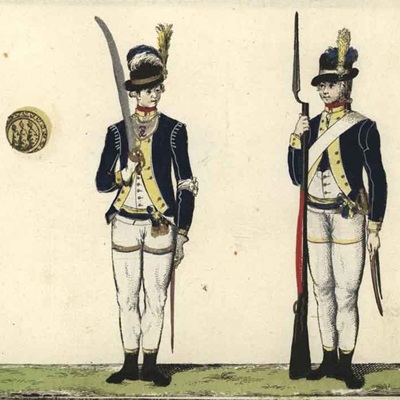
Officer and musketeer with uniform m/1779
(drawn by Carl Gustaf Roos 1783) |
When the Gustavian Age began in 1772, Västmanland Regiment had just received
its first m/1765 uniforms. Minor changes took place during the 1770s,
however, as can be seen if you compare the pictures above from 1765 and
1778. White gaiters were introduced for parade use alongside the black
gaiters that would continue to be used in the field. The hat was also
provided with yellow plumes, which became a characteristic of the Swedish
army. Changes in fashion also meant that the front of the tricorne hat
became increasingly flatter, so that by the end of the 18th century it had
transformed into a bicorne. Something that was not common for the Swedish
army but a distinctive feature of Västmanland Regiment, however, was the
introduction of a red neckcloth.
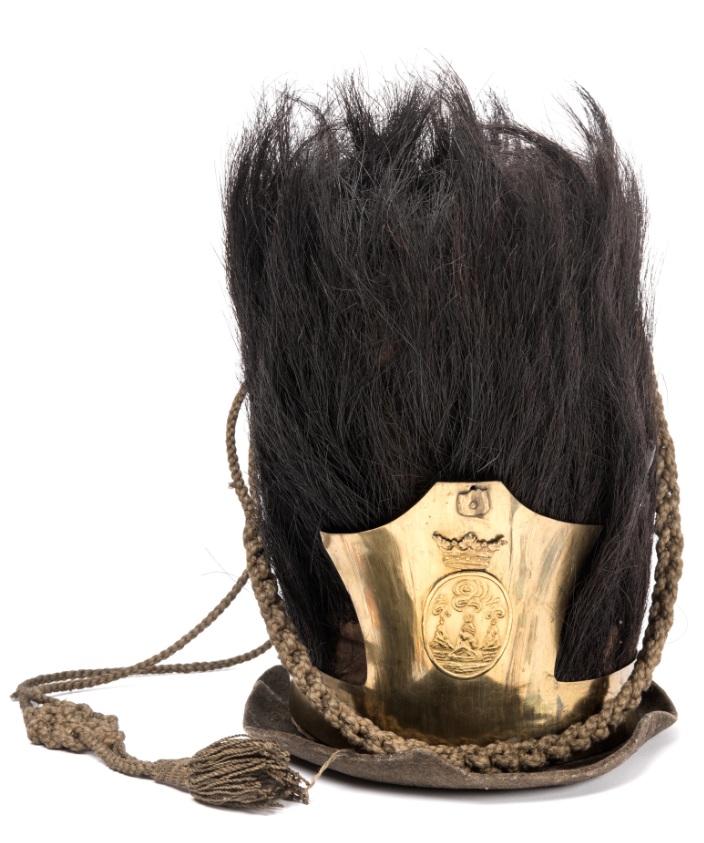
Grenadier cap from around 1780, which was used by
grenadiers until 1806 and then by pioneers. Instead of bearskin,
horsehair was used to reduce the cost. The original brass plate was
replaced in the 1790s when the braided wool cord was also added. |
However, the
really big change came on 28 April 1778 when Gustav III introduced the
so-called "national costume" that he wanted Swedes to wear instead of
following foreign fashion. This dress officially replaced the m/1765 only
when a new uniform regulation was decreed on 6 October 1779. But Gustav III
was clear from the very beginning about his desire that the uniforms be
changed to the match the national costume as soon as possible. Västmanland’s
colonel and the king's brother, Fredrik Adolf, was therefore instructed to
ensure that the regiment's officers and non-commissioned officers wore the
national costume from the start on 28 April 1778. For the privates, most
regiments chose to re-sew their old m/1765 uniforms so that they would match
the m/1779, but Fredrik Adolf found a different solution. In May 1778, he
requested that the privates’ new “släpmundering” (work clothes),
which the rote peasants were obliged to pay for, be made of broadcloth and
instead become the regiment's new regular uniform. The switch would then be
completed by making the old m/1765 uniform the new släpmundering.
This was approved by the king, who had also approved a request earlier that
year that the crown would pay for new grenadier caps (4 NCO caps and 100
privates caps). However, Fredrik Adolf himself paid for new parade uniforms
for the musicians that were sewn with his colours, scarlet and light blue.
Although the
cut of the m/1779 uniforms was radically different, the colours were largely
the same as m/1765. The jacket was dark blue with a yellow baize lining and
provided with yellow lapels, cuffs, collar and piping. The only difference
was that the waistcoat and breeches became white. This change was all the
more noticeable because Västmanland, unlike most other regiments, retained
the curved opening on the jacket that the m/1765 coat had had, making the
waistcoat visible. The waistcoat would also have blue cuffs and collar while
the boots would have yellow trims.
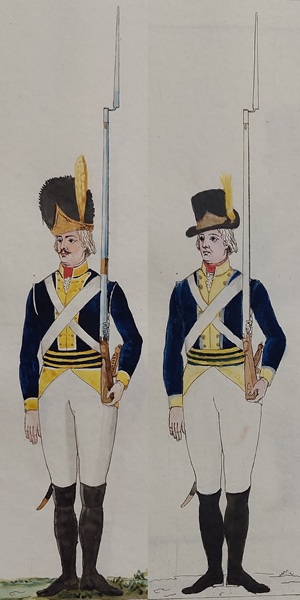
Grenadier and musketeer with uniform m/1792. |
Strangely
enough, the new uniform was already deemed unfit at the general muster in
1783. However, it may be that they were actually referring to the old
uniform that was now being used as a släpmundering. When it became
necessary to obtain a new släpmundering a couple of years later, the
previous procedure was repeated. The rote peasants paid for a new uniform
and the old uniform then became the släpmundering.
The new
uniforms were issued in time for the war against Russia that broke out in
the summer of 1788. That same year, the regiment had also been issued new
cloaks and belts. Apparently, they received more than 200 cloaks, which was
the usual allocation at the time, and after the war, the regiment was urged
to use them sparingly. These cloaks and belts, as well as the grenadier
caps, had been deemed to be still in usable condition six months into the
war. This did not apply to the rest of the uniform, which was considered
worn out at the muster in January 1789. The following year, the
non-commissioned officers, musicians and provosts had not yet had time to
acquire new uniforms, but the rank-and-file then received new uniforms paid
for by the crown. These were donated to the rank-and-file in 1791, who were
then allowed to use them privately. After the peace, the rote peasants
continued to pay for regular uniforms instead of släpmunderingar.
A new uniform
model came into force in 1792, which made the jacket longer with yellow
turnbacks at the bottom and introduced a blue-yellow sash instead of the
waist belt, which was replaced by a shoulder belt. In addition, black
gaiters and shoes were reintroduced. It was intended to issue Västmanland's
first m/1792 uniforms in 1798, but it was delayed until 1800. At that time
the red neckcloths were also reintroduced according to Martin Markelius
(however, it is not clear when they disappeared).
|
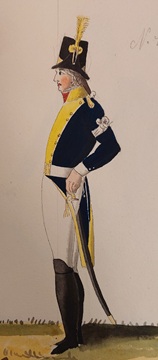
Officer uniform m/1802 |

NCO and two musketeers with uniform m/1802
(never issued but possibly the m/1792 uniform was re-sewn into it) |
The next
uniform regulation came in 1802 but there is no information in the sources
about whether Västmanland's uniforms were re-sewn to match m/1802. However,
we have such information when m/1806 (spring) came into force. On 20 August
1806, new uniforms were requested for the NCOs because it would be too
difficult to re-sew their old jackets. But there was no money for this, so
the request was rejected. On 15 December of the same year, the uniforms had
apparently been re-sewn, as complaints were received that the privates'
jackets were too tight and had to be spliced when they were re-sewn. The
technique used when sewing the uniforms was to temporarily separate the
lining and then turn the jacket inside out so that the inside became the new
outside while the old worn outside was covered by the lining that was sewn
on again.
Apart from
jackets that had been re-sewn at least once, Västmanland regiment had in
1806 complete uniforms and equipment except for the bandoleers and that they
only had 923 cloaks. The blue-yellow sashes that were abolished with m/1802
were now again worn by the regiment. In addition, Västmanland had "overcoats
and trousers of "buldan" for 600 men, which was a type of work
clothes intended for camp service.
|

Uniform m/1807
(issued autumn 1808) |
A battalion
served in Pomerania in 1807 and at a general muster held in Stralsund in
June it was noted that uniform items for about 160 men were missing. On this
occasion it also seems that the old cloaks were re-sewn into “kapotter”,
which meant that they were provided with sleeves.
In the summer
of 1807, 968 yellow bandoleers were sent to Västmanland Regiment and in
April the following year another 135 of the same colour arrived. The m/1806
was supposed to have white bandoleers, but the new m/1807 uniform with grey
jackets was supposed to have black bandoleers. Västmanland may have received
undyed yellow bandoleers because the intention was that they would be dyed
black once they received the m/1807 uniform. Along with the latter
bandoleers, 135 cartridge boxes of the new smaller model were also
delivered, as well as 311 furred knapsacks, 229 copper bottles (29
repaired), 60 haversacks, 138 yellow musket belts and 40 yellow waist belts
"without brass clasps and plates", the latter intended for non-commissioned
officers.
When the
Finnish War began in 1808, Västmanland Regiment still had re-sewn jackets
from 1800 that were now so worn and faded so that they had acquired a
blue-grey colour (and now only had one row of buttons and no lapels). The
trousers were still white, and the hats had an appearance that differed from
most other provincial regiment. The brim's fold on the left side was shorter
and fastened further down. In addition, the hat's brass plate had a design
that was typical of artillery.
New m/1807
uniforms had been manufactured but they did not arrive to the regiment
before it marched to the Norwegian border. Delivery problems then led to the
uniforms being stuck in Karlstad. The Colonel’s Battalion, which was sent to
Finland in August 1808, had to fight in Finland wearing the old blue
uniforms until the second battalion arrived in early October with the new
grey uniforms. According to m/1807, the hats were to have regimental badges
but these were not in place until the return home the following year.
Västmanland's regimental symbol was a blue and white cross on a round red
background (blue on the vertical part of the cross and white on the
horizontal part on top of it).
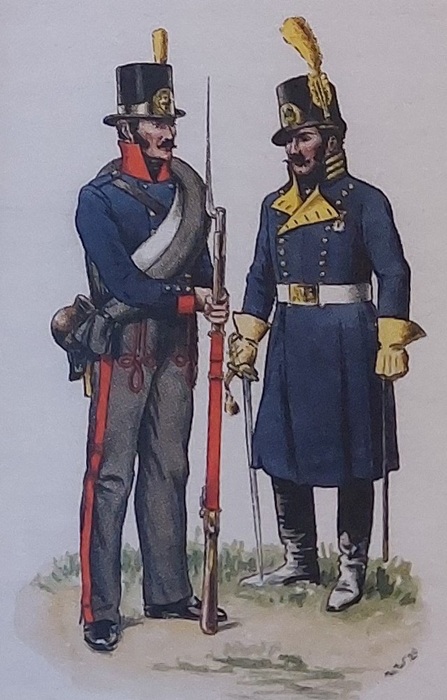 |
After the deposition of Gustav IV Adolf in 1809, the m/1807 was abolished
and the old uniform colours were reintroduced throughout the army. Torsten
Holm's regimental history work is not clear, but it seems that Västmanland
received new uniforms in 1810. Holm briefly describes the new uniform as
consisting of a tail coat-style jacket, wide trousers and a high hat. He also
writes that due to French influence it was changed during the reign of Charles
XIV Johan by having a red collar and red cuffs, and a shako as a headgear.
The modern illustration on the left, however, shows a private
Västmanland soldier who had already received red cuffs in 1810.
The shako was officially introduced as a headgear in the Swedish army
only in 1815. However, the troops that participated in the campaign in
Germany in 1813-1814 had largely replaced the "Swedish hat" with the shako
after the Battle of Leipzig when French shakos became Swedish spoils of
war. Västmanland was one of the regiments that participated in the campaign.
The picture on the left is a modern watercolour by Helge Werner. It depicts a
private and a captain from 1810. |
|
Västmanland
Colours

Olof Hoffman's model drawings of Västmanland's m/1686
colonel’s and company colour
The oldest
known colours for the Västmanland regiment may have been those that were
issued to Åke Oxenstierna's regiment on 14 May 1622. His regiment was a
field regiment that recruited men from the entire Uppland Land Regiment’s
recruitment area, namely six companies from Dalarna and two each from
Västmanland and Uppland. But apparently only the companies from Dalarna and
Västmanland received colours on this occasion. The pattern of these eight
colours is unknown since we only know how much material was used to make
them. Namely white and blue taffeta (worth 16 daler each) as well as yellow
taffeta (worth 10 daler) and 8 lodes of silk. However, Höglund has in his
book from 2012 (page 71) a depiction of this banner that consists of a
yellow St. Andrew's Cross over six horizontal white-blue stripes. Höglund
also has information about blue and white colours for "Västmanlanders-Dal
men" in 1621 (page 78).
During the
Thirty Years' War, the regiment's colours are said to have contained Latin
mottos such as "Gustavus Adolphus rex Sueciae defensor fidei" (Gustav
Adolf, King of Sweden, defender of the faith).
The battalion
that participated in the First Bremen War in 1654 received four colours of "Couleur
Tafft" issued by the War College. Their colour is not mentioned, but was
apparently determined by the War College, while the regiment was to provide
decorations on them on its own. In the same year, the colonel’s battalion
paraded at the wedding of Charles X Gustav and they also received four
colours, of which the colonel’s colour had the royal and national coat of
arms. In 1655, four more colours were issued to the regiment and since it
had recently received sea green uniforms, it is possible that these had the
same colour. But they could also have been blue. A newly raised company
received a blue colour on 11 July 1656, which later ended up in a storage.
When even more men were conscripted in 1657, the governor of Västmanland
asked to use this blue colour and receive three more colours. The War
College replied that they would send three colours and one more colour from
elsewhere. The governor was instructed to choose the colours that best
matched each other and send back the excess colour.
Taffeta for
ten new colours was issued to the troop force that paraded at the funeral of
Charles X Gustav in 1660. Four companies from Västmanland were included in
this, along with contingents from Uppland, Södermanland and Östergötland.
The colours of the different regiments are not described separately, but in
total there were 7 ells of bleumorant (pale blue), 21 ells of blue, 7 ells
of green, 14 ells of white and 21 ells of yellow taffeta. Holm, but not
Wernstedt, mentions that the other four Västmanland companies possibly
received new colours in 1661.
The Colonel’s
Battalion was assigned to garrison duty in Riga in 1666-1667 and received
for that purpose a white colonel’s colour and three blue (bleumorant)
company colours. The finials were made of silver-plated iron. Another white
colonel’s colour and three blue company colours were issued in connection
with Charles XI's accession to the throne in 1672.
The motifs of
the Västmanland colours are largely unknown until 1673, when a colour
regulation determined that they should contain the coat of arms of
Västmanland (three burning mountains). The colonel’s colour would continue
to be white while the company colours would now be grass green. In practice,
the company colours continued to be blue because in 1674 Baltzar Friedrich
delivered one white and 5 blue colours to the part of the Västmanland
regiment that was sent to Germany. In 1675 Baltzar Friedrich made three more
blue colours that were also provided with laurel wreaths and burning
grenades in the corners.
The three
companies at home that were commandeered to the navy received in 1678
unpainted colours of green silk that were provided with smooth finials of
polished iron. These may have been lost to the Danes in the same year
because three originally green colours without decorations are in Danish
custody. However, the finial on them are said to have been gilded.
A further six
green company colours and a white colonel’s colour were issued in 1679-1680
and these had smooth silvered finials. The colours had been painted in
Hamburg in 1658 by Peter Blohm and had been intended for other regiments.
The motif on the colonel’s colour which was originally intended for
Kronoberg Regiment, consisted of the Swedish national coat of arms in a
laurel wreath and the king's crowned monogram in each corner. The company
colours were originally intended for Närke-Värmland and Västgöta-Dal, but
the distribution between them is unclear. At least one Västgöta-Dal colour
was issued and it was grass green with a motif consisting of two guard bowls
with a sword between them and the motto "Sit iusta Deus" (May the
scales be fair, O God). Two more Västgöta-Dals colours may have been issued
to Västmanland Regiment. One of them had on one side a triumphal column with
the text "Spartam orna" (Honour Sparta) and on the other side two
golden crowns. The motif of the second company colour was the royal monogram
in a laurel wreath. The company colours of Närke-Värmland are described
below in blue text.
|

Västmanland company colour 1679-1680? |
Närke-Värmland’s Parrot Green Colours
(made in 1658 but not issued)
Number four and some of the others were issued to
Västmanland Regiment in 1679-1680.
- A golden lion holding two swords and the text "Numquam bella
bonis, nunquan discrim[ina] desunt" (Never are the mighty wars
lacking, strife never tires them).
- A cornucopia on both sides and the text "Fortes fortuna iuvat"
(Fortune favours the brave).
- An armoured arm holding a sword and the text "Si deus pro nobis,
quis contra nos" (If God is for us, who can stand against us).
- A lion on each side with its paw on a crown and the text "Respice
mens Christum, nam his est arbiter pacis" (Look to Christ in your
mind, for he is the arbiter of peace for these.)
- Lacks motif and motto.
- Lacks motif and motto.
- Lacks motif and motto.
In addition to the descriptions above, all colours probably had a basic
motif consisting of a laurel wreath and Charles X Gustav's monogram in the
corners (see image on the left).
|
The colours from 1658 were provisional and already in 1684, a new set made
by Baltzar Friedrich was issued. The new company colours were also grass
green, but their motif was now the coat of arms of Västmanland in a laurel
wreath and burning grenades in the corners. The colonel’s colour consisted
of the Swedish national coat of arms in the middle and the coat of arms of
Västmanland in the upper inner corner.
When a new colour regulation came into force in 1686, it was determined that
the seven company colours would be white and decorated with the coat of arms
of Västmanland (three blue-grey burning mountains) in the middle and blue
flames from each corner and side. The colonel’s company would, as before,
have a white colour with the Swedish national coat of arms in the middle and
the coat of arms of Västmanland in the upper inner corner. But m/1686 also
added two lions holding up the national coat of arms.
Västmanland
was supposed to be the first regiment to receive m/1686 colours, but a delay
in production meant that it was not until 20 July 1689 that the regiment was
issued a set of colours painted by Olof Hoffman (the same man who painted
the model drawings above). These were then replaced in 1701 with a new set
of colours, again painted by Olof Hoffman, and carried by the regiment until
the Battle of Poltava. Västmanland's colours seem to have stood out in the
eyes of the Russians by being worn out. At least one colour was so worn that
the painting was unrecognisable. The staffs were, according to the
same descriptions, made of spruce. None of Olof Hoffman's Västmanland
colours have been preserved. Those that the Russians took were destroyed
when the Kremlin burned down in 1737.


Company colours in use 1710-1713 and now kept in Denmark and Russia respectively
When Västmanland Regiment was restored in 1710, they received a new set
painted by either Daniel Stawert or Johan Wikman. This was already lost in
1713 because of the capitulation in Tönning. The victors divided the spoils
so that the Russians received five company colours (one of which is depicted
above) and the Danes received the remaining two company colours. The
colonel’s colour was probably given to the Saxons, but it has not been
preserved. The colours kept in Denmark have blue-painted staffs.

Company colour in use 1715-1717
When the regiment was restored for the second time, it was not until 1715
that they received any colours, and then only four (painted by Johan
Wikman). The colonel’s colour and a company colour were then lost in the
battle of Moss during the Norwegian campaign of 1716. The preserved company
colour in the picture above has a blue-painted staff that is 3.56 meters long
while the colour itself is 178 cm high and 216 cm wide.


Colonel’s and company colour in use 1717-1730
A new set of eight colours were issued in 1717, which were made in intarsia
by Johan Wikman. These were described in 1727 as "old but still usable
" and two years later as "completely worn and useless". The colours
are about 170 cm high and just over 2 meters wide. The company colours were
equipped with 320 cm long blue-painted pine staffs. The colonel’s colour
today has a brown-painted staff, but it is not original.


Colonel’s and company colour in use 1730-1739
A new set of eight colours made by Johan Wikman, was issued in 1730. However,
the colours were made of taffeta which was obviously of inferior quality
since the colonel complained in the same year that the painting on several
colours was broken and peeling. In 1736, the War College stated that the
colours were so worn that they were only suitable for drills and musters but
not for a campaign. The colours originally had a height of about 154 cm and
a width of 220 cm. The staffs were about 334 cm long and were made of
brown-painted pine.
 
Colonel’s and company colour in use 1739-1771
|

M/1766 company colour in use 1771-1804 |
The set from
1730 was replaced in 1739 by four colours embroidered by Tobias Leij the
Elder. The colonel’s colour was originally provided with open crowns in the
outer and lower corners, but the one in the lower outer corner has
apparently been replaced with a closed crown and the upper outer corner
lacks a crown altogether. The pole is of white-painted pine while the
company colour has a brown-painted pole. The colours in this set seem to
have originally been about 180 cm high and 213 cm wide.
Tobias Leij
the Elder's set was in turn replaced in 1771 by four colours embroidered by
his son Tobias Leij the Younger. At that time, the colour regulation from
1686 had been replaced by the regulation of 1766, which meant that
Västmanland colours would have a shield outline around the Västmanland
provincial coat of arms consisting of palm leaves and a crown in gold. This
set was then worn by the regiment until 1804 when it was replaced by five
m/1766 colours made by Frans Oldenburg. In 1814, the regiment received
another m/1766 company colour, this time embroidered by Ann Marie Fellborg.
All m/1766
colours were replaced in 1820 when the regiment received two m/1819 battalion
colours. The appearance of these were identical for all regiments. It consisted
of a Swedish flag that contained the small national coat of arms in the
middle of the cross. It was not until 1859, when the 1820 colours were replaced
by m/1849 colours, that the Västmanland colours once again were adorned with
the provincial coat of arms.


Colonel’s and company colour in use 1804-1820
|

M/1849 battalion colour |
Colour Sheet

Free-to-use m/1686 colour sheet for those who want to
paint miniatures |
Links to Preserved Colours
|
|
Other Equipment
At the muster
in 1694, it was noted that the uniforms "had been damaged to some extent
by rats and vermin". Therefore, these were to be stored in chests "which
are tight, having feet that are half an ell high from the floor"
(Bellander, page 215).
A proposal
for a baggage train from 24 September 1701 states that the baggage train
would consist of 137 officer's servants, 72 company train boys, 290
officer's horses, 72 company train horses and 32 canteen horses
(Nordensvan page 127).
Höglund
states that the regiment was armed with 1200 muskets when it was restored in
1709/1710. According to Holm, not everyone had received swords in time for
the Scanian campaign and the baggage train was completely missing (which
included tents).
According to the Danish General Staff (Tuxen volume 4, page 181), one third
of Västmanland Regiment was armed with pikes at the Battle of Gadebusch.
However, Melker Falkenberg, who was colonel from 1710 to 1716, requested in
1715 muskets for the entire regiment, which needed new equipment after the
capitulation at Tönning (Holm page 163). It seems strange that the regiment,
which according to Höglund only had muskets in 1710, would have switched to
pikes and then returned to muskets despite having the same colonel during
that period. In any case, Charles XII decided in 1716 that all regiments
should consist of one third pikemen. In the summer of 1719, a temporary
rearmament of pikemen took place in the regiments that protected the coast
against Russian raids so that they received muskets instead. The pikemen
were soon to be reintroduced, but at that time they only constituted a
quarter of the men.
In 1712,
according to Anders Larsson, Västmanland had 226 regular infantry tents made
of canvas with iron-studded poles and leather reinforced corners. He also
states that in 1721 they had 20 new painted drums with sheet metal. |
|
References
Asker, Björn. Om svenska fotfolkets nybeklädnad (article in MAM 40). Stockholm (1983)
Bellander, Erik. Dräkt och uniform. Stockholm (1973)
Cederström, Rudolf. Svenska kungliga hufvudbanér. Stockholm (1900)
Ericson, Lars. Fastställda uniformsmodeller för svenska armén under 1720-talet (article in MAM 45-46). Stockholm (1986)
Generalstaben (red. Carl Bennedich). Karl XII på slagfältet. Stockholm (1919)
Grill, C. Statistiskt sammandrag af svenska indelningsverket. (Facsimile
edition 1988)
Holm, Torsten. Kungl. Västmanlands regementes historia. Stockholm (1929-1938)
Höglund, Lars-Eric. Från Karl Knutsson till Kristina. Karlstad (2012)
Höglund, Lars-Eric. Skånska kriget 1675-79 - Fanor och uniformer. Karlstad (1999)
Höglund, Lars-Eric – Sallnäs, Åke. Stora nordiska kriget 1700-1721 - Fanor och uniformer. Karlstad (2000)
Larsson, Anders. Karolinska uniformer och munderingar åren 1700-1721. Östersund (2022)
Klaesson, Ivan. "Soldat dödh, Encian fattigh" (artikel
i "I krig & fred – Berättelser om försvaret i Västmanland"). Västerås
(2018)
Markelius, Martin. Bestämmelser och verklighet – uniformeringen i von Vegesacks kår (article in MAM 69). Stockholm (2010)
Markelius, Martin. Gustav III:s armé. Stockholm (2020)
Nordensvan, Otto. Svenska armén åren 1700–1709. (article in KFÅ 1916). Lund (1917)
Sjöström, Oskar. Fraustadt 1706 – Ett fält färgat rött. Lund (2008)
Stille, Arthur. Kriget i Skåne 1709-1710. Stockholm (1903)
Tuxen, A. P. - With-Seidelin C. L. Bidrag til den store nordiske krigs historie. Copenhagen (1899-1934)
Törnquist, Leif. Infanteriets fanor m/1686 (article in SVSS-NS XXX). Stockholm (2015)
Törnquist, Leif. Infanteriets fanor 1761-1900 (article
in SVSS-NS XXXIII). Stockholm (2018)
Wennerholm, J Bertil R. Emporterade troféer. Bohus (2000)
Wernstedt, Folke. Bidrag till kännedomen om den svenska huvudarméns styrka under fälttåget mot Ryssland. (article in KFÅ 1931). Lund (1932)
Wernstedt, Folke. Svenska standar och fanor 1654-1686 (article in Meddelanden från Riksheraldikerämbetet X). Malmö (1945) |
|