|

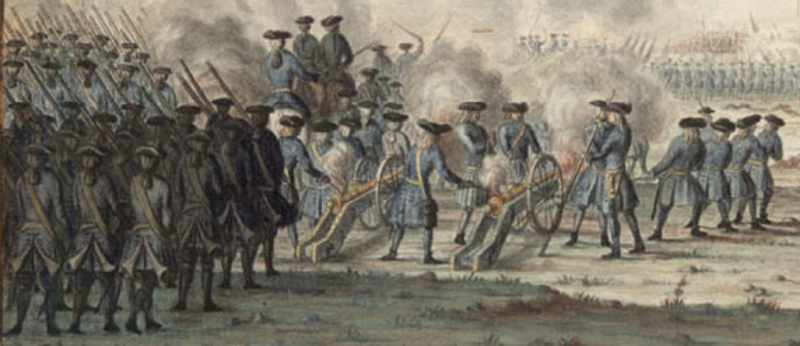
A detail from an illustration of the battle of Gadebusch 1712 which was made by Magnus
Rommel who participated in the battle as Swedish quartermaster general.
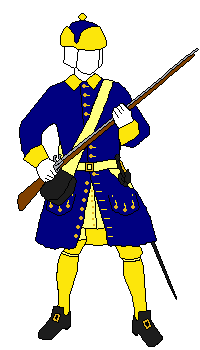
In the beginning of the war the Swedish infantry mainly wore the karpus on their heads.
This would, however, soon be replaced by the tricorne even though the karpus would not disappear completely in the
Swedish army. It was in particular the northern regiments which kept the karpus since it was
warmer than the hat.
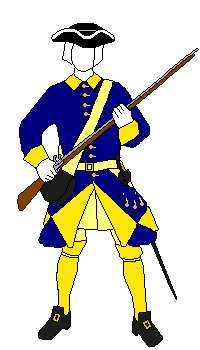
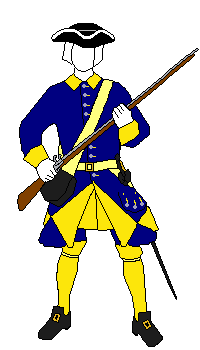
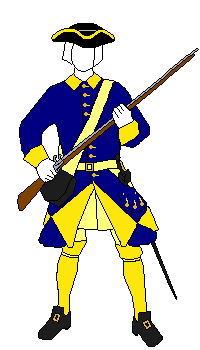
On this page the first image for each regiment shows an older appearance of the uniform
while the others have a younger appearance. But exactly when the hat became a tricorne and
turnbacks were introduced is unclear and that is discussed on the page covering the
cavalry uniforms.
A more detailed article about the evolution of the Swedish uniform is also available.
Information about the colour of the neck cloths is scarce and in uncertain cases
I have depicted them as white without explanation (this despite the fact that the most common
colour was black). However, an overview of what is known about the neckcloth colours can be found on
this page.
Note that the Finnish regiments are described on a
separate page.
|
|
Uppland Regiment
(A more detailed description of its uniforms is available
on this page) |
|

1691-1701
Humlebæk |

1701-
Düna, Kliszow |

-1709
Holowczyn, Poltava |

1710-1716
Helsingborg |
|
|
Södermanland
Regiment |
|
1700-1702 |
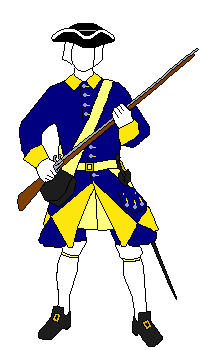
1702-? |

1710-1715 |

1718- |
|
Hat lace colour not mentioned.
|
Uniform issued 1715 had blue karpus, breeches and
stockings. |
Received new uniforms in 1704 but these have no been described in the
sources. Recruits had yellow stockings in 1707. |
|
Östergötland
Regiment |
|
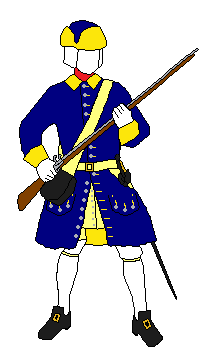
1692-1701 |

1701-? |
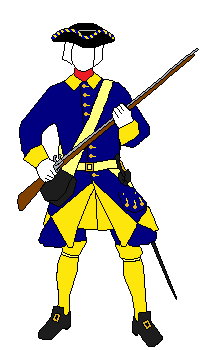
1707-1709 |

1710-1716 |
|
Button colour not mentioned. |
Hat lace not mentioned but button holes had white seam. |
Instead of the blue and yellow hat lace and red neckcloths from 1707, which Höglund states the regiment wore,
recruits in 1708 had green hat lace and motley neckcloths according to Bengt Nilsson. |
White hat lace in 1715 according to Anders Larsson and it
was also white 1720 when white stockings were issued. Received in 1710
both yellow and grey stockings. Had in 1716-1720 yellow waistcoats and
breeches of broadcloth. |
|
|
Jönköping Regiment |
|

1700-1702 |

1702-1709 |

1710-1715 |

1718 |
|
Button colour unknown. |
Button colour and stockings unknown. |
Did not receive uniforms when it was restored in 1716 and
wore in Norway 1718 a grey wadmal coat with red cuffs (lining and button
colour is not mentioned) as well as white or grey stockings. Blue coats
with red cuffs and lining were issued in 1719. |
|
The colour of the
neckcloth is only mentioned two times. It was red in the 1690s (Bellander page 197) and black
in 1718 according to Höglund. |
|
|
Kalmar Regiment |
|

1700-? |

Recruits in 1708 |

1710-1711 |

1712- |
|
The blue and white hat lace and the button colour is only
mentioned in 1700.
The colour of the neckcloth is only mentioned in 1708 when 27 recruits wore
red neckcloths as well as hats with wide white lace and yellow stockings (according to Bengt Nilsson).
A royal letter from 1704 states that Kalmar had always
had blue cuffs on its coats and should continue to have them
(however, Höglund has stated yellow cuffs for the year 1700). |
Both blue and grey stockings were issued in 1710. Was supposed to have black neckcloth but had none in 1711. Hat lace colour unknown. |
I interpret from Anders Larsson that hat lace was blue
and white in 1718 (when the buttons are reported to have been made of
brass). Had both grey and yellow stockings in 1718. |
|
|
Kronoberg Regiment |
|

1700-1702 |

1702-? |

Recruits in 1707
|
1710- |
|
Button and hat lace colour unknown. |
Hat lace colour unknown. New uniforms issued
in 1704 but without description in the sources. |
Button and hat lace colour unknown while the colour on
cuffs and lining is mentioned first in 1716. Blue breeches in 1714
according to Anders Larsson.
|
|
A Danish spy report from 1711
describes a grey coat with pewter buttons and yellow cuffs and lining.
This was probably the ”släpmundering” which they wore to avoid wear and
tear on the regular “livmundering”. |
|
|
Älvsborg Regiment |
|
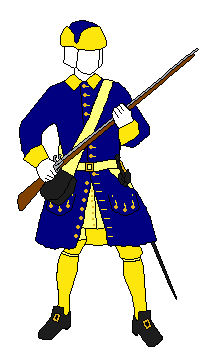
1687-1708 |
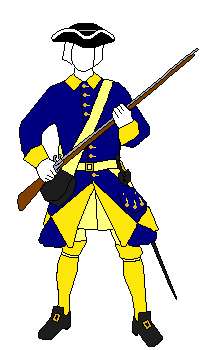
1708-1713 |

1714-1717 |

1717- |
|
Also received white stockings
when new uniforms were issued in 1710. |
Höglund only mention that the restored regiment had "old
karpuses, blue cloaks and coats”. |
Hat lace colour unknown. |
|
|
Västgöta-Dal Regiment |
|
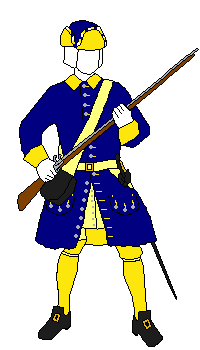
1694-1708 |

1708-1713 |

1714 |
1714-
Button colour unknown. |
|
Apart from the blue-white-yellow lace, the karpus also
had seven small buttons (Bellander page 206). The
neckcloth was striped until 1708 when it became white. |
Provisional uniform for the restored regiment. Headgear
as well as colour on cuffs, lining and buttons unknown. |
|
|
Skaraborg Regiment |
|
1700-1701 |
1701-1709 |
1712-1716
|

1719- |
|
The karpus had a tassel which
could suggest it had a hanging bag (like Santa Claus). |
Hat lace not mentioned. The
restored regiment wore in 1710 a grey wadmal outfit. |
Grey or white stockings. Two companies had blue waistcoats and
breeches. In 1717 the regiment’s breeches and waistcoats were yellow. |
|
|
Närke-Värmland Regiment
(A more detailed description of its uniforms is available
on this page) |
|

1691-1704
Narva, Düna, Kliszow |

1705-1706
Fraustadt |

1707-1709
Malatitze, Poltava |

1710-1713
Gadebusch |
The Närke-Värmland regiment was in practice split into two parts during
the war. A field regiment consisting of six companies (988 men) whose
uniforms are shown above and four companies (686 men) who stayed at home
to guard the Norwegian border. The home companies received new uniforms
in 1704 which they then wore throughout the war. They differed
from the field regiment by having blue-red karpuses and blue breeches.
|
|
Västmanland Regiment
(A more detailed description of its uniforms is available
on this page) |
|

1690-
Narva, Düna, Kliszow, Fraustadt |

-1709
Holowczyn, Poltava |

1710-
Helsingborg, Gadebusch |

-1721 |
|
|
Dal Regiment
(A more detailed description of its uniforms is available
on this page) |
|

1690-
Narva, Düna, Kliszow |

-1709
Holowczyn, Poltava |

1710-1713
Gadebusch |

1716-1727
Frederikshald |
|
|
Hälsinge Regiment |
|

1695-? |

?-1709 |
1715 |

1716- |
|
The karpus had yellow lining 1701-1702. On other
occasions it is only described as blue without mentioning the lining
even when the coat’s lining is mentioned. |
Received blue cloaks 1702. Waistcoat and button colour not
mentioned. The uniform of the restored regiment in 1710 is unknown. |
Only ”släpmundering”. Hat lace and colour on cuffs,
lining and buttons unknown. Most of the regiment was dressed in their
”släpmundering” already during Stenbock’s campaign in 1712. |
Button colour unknown. Also had grey stockings. |
|
|
Jämtland Dragoon Regiment
(Partially mounted during the war) |
|

1683-1708 |

1709-1721 |
|
Button colour, waistcoat and breeches unknown. Also had a (grey) piecoat with yellow cuffs and lining. |
Brass buttons in 1710 according to Anders Larsson. Had
both piecoats and cloaks during the Norwegian campaign 1718-19. Probably
wore wadmal coats after the campaign. |
|
|
Västerbotten
Regiment |
|

1694-? |

?-1709 |

June 1712 |

1712-1725 |
|
The uniform data here is from 1694, but 633 karpuses (appearance
not described in the source) were delivered in November 1706 according
to Bengt Nilsson.
In 1694 the neckcloth was white with blue stripes and tied with a black ribbon. In 1702 it was blue with white stripes (no ribbon). |
Headgear, stockings and button colour unknown. Colours on
the wadmal coat not mentioned either but they also had a grey piecoat
with white cuffs and collar. Were well dressed in Reval in 1710. |
Button colour unknown. Also had a blue cloak. |
|
|
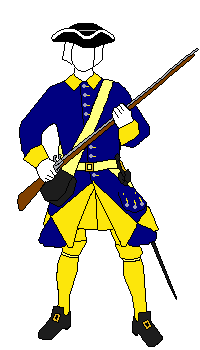
Uppland 3-männing Regiment
(Existed 1700-1708 and 1712-1719, included soldiers from Dalarna and Västmanland) |
|

1701 |
1703 |

1705-1708 |
1718 |
|
Only described as wearing wadmal coats but I guess that
they had the same uniform as Östgöta-Södermanland 3-männings at this
time. The battalion that was a part of the main army received red
Saxon coats after the battle of Kliszow. |
Colour of stockings and buttons not mentioned. Also had
grey piecoat with yellow lining and cuffs. Blue breeches in 1704. |
Had breeches of leather and blue broadcloth. Waistcoat and colour of the karpus'
facing is not mentioned. |
Hat lace and buttons not mentioned. |
|
|
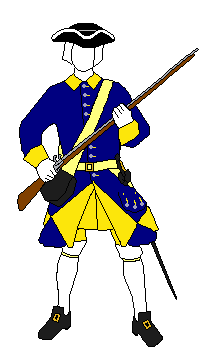
Östgöta-Södermanland 3-männing Regiment
(Existed 1700-1703 and 1712-1721, temporary disbanded in 1714) |
|
1701 |
1713 |
1718 |
|
Hat lace, button colour and edges on pocket flaps not mentioned. The battalion
that was a part of the main army received red Saxon coats after the
battle of Kliszow. |
Only mentioned that they had hat, grey wadmal coat, leather
waistcoat and leather breeches.
They appear to have had the same clothes in 1715. |
|
|
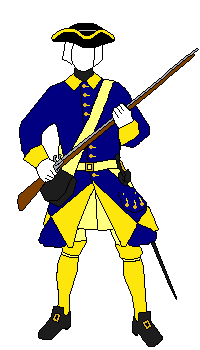
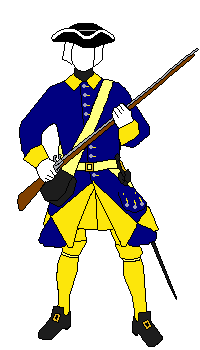
Småland 3-männing Regiment
(Existed 1700-1708 and restored in 1712) |
|
1704 |
1714 |
1718/1719 |
|
Had breeches of leather or blue broadcloth. Blue and black neckcloths.
Waistcoat not mentioned. |
No details are mentioned, but they were: "provided with excessively bad
clothing so that with the onset of winter they cannot possibly be conserved!". |
Hat lace and buttons as well as the lining and collar of the
cloak are not mentioned. Also had black gaiters. |
|
|
Västgöta 3-männing Regiment |
|
1701 |
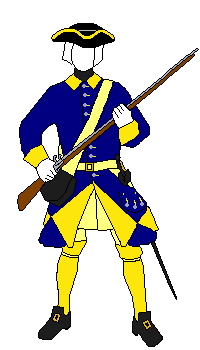
1710-1717 |
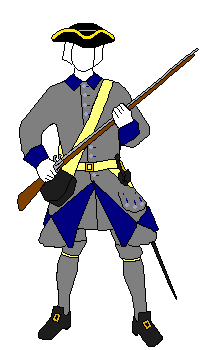
1718 |
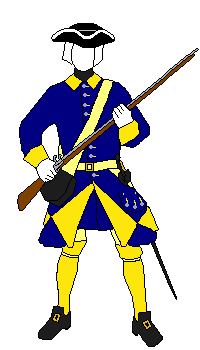
1720 |
|
Only mentioned that they had hat, grey piecoat with blue and yellow lace,
grey wadmal coat with blue cuffs and lace. However, compare the other Swedish 3-männings
because I suspect that they all received the same uniform when they were raised in 1700. |
Only thing that is mentioned
are: 1710/173 hat, piecoat, blue coat, leather waistcoat and leather breeches. Received in
1715 new blue coats with pewter buttons, yellow lining and cuffs, hat with yellow lace. |
Only mentioned
that the coat and breeches were of grey wadmal. In 1719, however, the hat
had yellow lace (and then the coat was blue). |
|
|
|
Närke-Värmland 3-männing Regiment
(Existed 1700-1708 and 1712-1720, the first regiment also included conscripted men from Bergslagen) |
|
1700 |

1705-1708 |
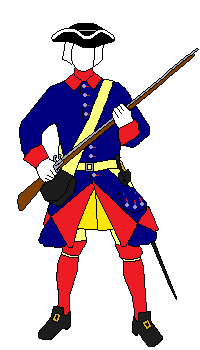
1714/1715 |
1718/1719 |
|
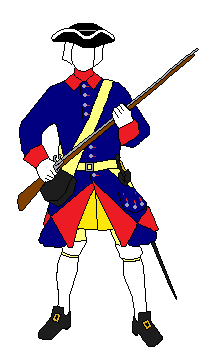
The 3-männings had hats with blue and yellow lace, grey
wadmal coat with pewter buttons, blue cuffs and edge. The men from Bergslagen
had grey piecoat and blue coat with yellow lining and cuffs as well as leather
waistcoat, leather breeches and wool stockings. |
Button colour and waistcoat unknown. Colour of the karpus
facing is not mentioned. |
New uniform that
replaced earlier grey wadmal clothes and black bandoleer belt. |
Only mentioned:
New blue coats, yellow waistcoats, leather breeches, shoes, gloves, neckcloths
and white wool stockings. |
|
|
Other Männing Regiments |
|
Hälsinge-Gästrike
3- & 5-männings
1717-1719 |

Västgöta
4- & 5-männings
1703/1704 |

Småland (and Östgöta)
5-männings
1710-1719 |

Uppland
5-männings
1710-1719 |
|
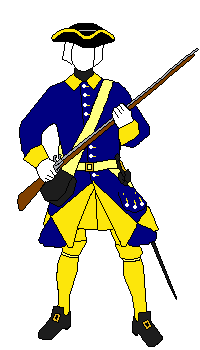
Had
buttons made of horn. Waistcoat as well as the lining and collar of the cloak not mentioned.
Had until 1716 hat, grey wadmal coat with yellow cuffs, leather
waistcoat and leather breeches. |
Grey piecoat
with yellow and blue lace, grey wadmal coat with yellow cuffs, leather
waistcoat and
leather breeches. In 1711 hats as well as white and grey stockings were issued. In 1713/1714
they received blue coats with yellow lining and cuffs. |
Had leather breeches in 1708 (the waistcoat was not mentioned
at that time). |
Höglund writes that they had yellow hat lace in 1710 and
received identical uniforms in 1713, but Anders Larsson states that they
in 1713 had "yellow lace around with blue in it” on the hat. |
The uniforms of Västerbotten's 3-männings are completely
unknown. The first unit was transferred to Livonia in 1702 and merged with the
parent regiment. The second incarnation was transferred to Finland, but what
happened to it after that is unknown.
Even though it was only Närke-Värmland's 3-männings who explicitly
received such in 1700, and later perhaps also Uppland's 5-männings, I
suspect that it was standard for all männing units to have blue-yellow lace
on their hats. |
|
Combined regiments
|

Per Banér's regiment
1709-1710 |
Buddenbrock's regiment
1709-1710 |
Wrangel's regiment
1713-1715 |
|
Consisted of
879 Scanians, 70 men from Jönköping, 77 men from Kronoberg and 95 men
from Kalmar |
Consisted of
455 men from Hallland and Närke-Värmland's 3-männings, 101 men from Uppland, 90 men
from Västergötland, 87 men from Östergötland, 63 men from Närke-Värmland's regiment, 80
men from Västmanland, 60 men from Södermanland and 154 men from Västerbotten |
Consisted of
78 men from Södermanland, 141 from Västmanland, 139 from Älvsborg, 172 from Dalarna, 70
from Västgöta-Dal, 183 from Hälsinge regiment, 83 from Närke-Värmland.
and 85 men from Östergötland. |
These regiments were formed by merging contingents of soldiers who had
been separated from their units. The soldiers who were part of these
regiments probably did not have any standardised uniforms, but were
instead dressed in grey wadmal clothes or the uniforms of their parent
regiments.
In Riga, two such regiments were formed in October 1709 from recruits
who had not been able to join their regiments in the main army and from
soldiers who fled to Riga after the Battle of Ljesna. These regiments
were then disbanded when all national Swedish personnel were sent back
to Sweden in 1710.
In Wismar, in 1713, a combined regiment was formed of men who, for
various reasons, had been left there by Magnus Stenbock when he marched
towards Tönningen (mainly soldiers who had been wounded in the battle of
Gadebusch). The regiment was first led by Henrik Klingstedt, but in the
fall of 1714 it seems to have become two independent battalions under the
command of lieutenant colonels Wrangel and Numers. From June 1715,
Numers is no longer mentioned and all the men were now under Wrangel's
command. |
|
Estonian Land
Regiments |
|

Harrien
1704-1706 |

Harrien
1707-1710 |

Wierland
1701 |
Jerwen
1704-1706 |
|
The colour of
the hat lace and the waistcoat are not mentioned at any point (nor is
the lining of the grey uniform), however, compare Ösel land battalion below.
According to Höglund, the coat was blue with yellow lining and cuffs in
1702 when they also had a hat and leather breeches. However, Höglund
does not mention a grey uniform in 1704-1706, while Kalle Kroon does not
mention a blue uniform before 1707 |
Stockings,
buttons and the colour of the hat lace are not mentioned. |
Hat lace
colour, waistcoat and lining not mentioned, however, compare Ösel land battalion below. |
The uniform of Wiek Land
Regiment, which existed in 1701-1704,
is completely unknown. |
|
Livonian Land Battalions |
|

Pernau (1701) |

Fellin (1701) |

Ösel (1702) |

Ösel (1704-1708) |
|
Had both grey and white
wadmal coats because of insufficient supply
of grey wadmal. |
It is only mentioned that they had a brown
coat with blue collar, cuffs and lace (for buttonholes?) and
pewter buttons. |
Had yellow
lace (for buttonholes?). Also a fur coat for winter use.
The colour of the lining, stockings and breeches is not mentioned but Ösel
was to have the same uniform as the Estonian land regiments. |
|

Oberphalen (1701),
Dorpat (1701)
&
Nüggen (1701) |

Wenden (1702)
&
Tirsen (1702)
|
Sagnitz,
Walk,
Wolmar, Treyden,
Kokenhusen &
Marienburg |
|
It is only
mentioned that they wore grey wadmal coats with 12 pewter buttons and
cuffs and collar in "coleur kirsy", which Kroon interprets as deep red. |
According to Höglund: grey karpus
with yellow lining, grey wadmal coat with buttons covered with yellow
baize and cuffs, lace (= for buttonholes?) and lining in yellow, leather
breeches and yellow stockings. |
|
|
Danish sources are said to
have described captured soldiers from these regiments as dressed in
simple peasant clothing. As there is no evidence that uniforms were
issued to them, it is likely that they never had any. |
|
Swedish Conscripted Regiments |

Bergsregementet
1705-1722 |

Östra Skånska
1711-1721 |
Västra Skånska
1711-1717 |
Halland
1711-1721 |
|
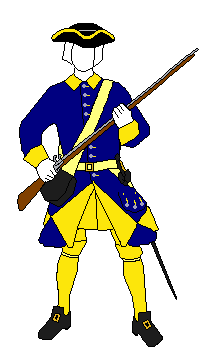
Hat lace colour not mentioned. Black neckcloths were issued in 1719.
Merged with another Berg battalion in 1705 that hade
blue breeches (waistcoat and stockings not mentioned). Both battalions kept their old
uniforms throughout the war. |
Had a grey
wadmal
piecoat
with blue cuffs and pewter buttons. |
The neckcloth was
white in 1714-1715 and black in 1717-1720. Had a grey wadmal piecoat
with blue broadcloth cuffs and pewter buttons. |
Colour of
hat lace and neckcloth not mentioned. |
|
|
Livgardet (Life Guards)
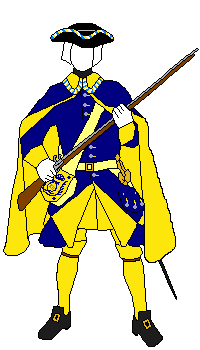
(A more detailed description of its uniforms is available
on this page) |
|

1695-1704
Narva, Düna, Kliszow |

1704-1707 |

1707-1709
Holowczyn, Poltava |
1710-1718 |
|
|
Other Swedish Enlisted Regiments |
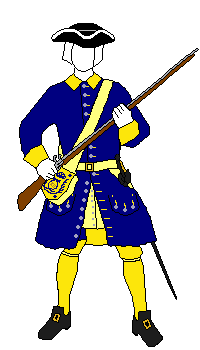
Svenska Livregementet (Swedish Life Regiment)
1702-1709 |
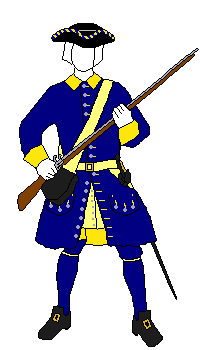
Tyska livregementet (German Life Regiment)
1698/1701, 1702 and 1703 |

Malmö
Garrison Regiment
1696 and 1702 |
The Grenadier Battalion
1717-1719 |
|
Hat lace and
waistcoat not mentioned, but had these colours before 1702. |
Waistcoat not mentioned. |
Hat lace and button colour not
mentioned. Had both white and yellow stockings. |
|
|
German Enlisted Regiments |

Riksänkedrottningen's
(Dowager Queen's)
Life Regiment on Foot
1695 and 1702
Waistcoat not mentioned. Was a garrison regiment in Stettin and other towns. |

Pomeranian Regiment
1698 and 1702 |

Stralsund Garrison Regiment
1702 and 1703 |

Breitholtz' Regiment
1706-1709 |
|
Waistcoat not mentioned. According to Höglund they likely had
the same uniform in 1710 which was then in good condition. |
Waistcoat not mentioned. The uniform colour is stated as
"Hoch Orange", which according to Höglund was closest to "cinnober" red
(vermilion). |
|

Wismar
Governor's Regiment
1699 |

Wismar
Governor's Regiment
1713 |

Wismar
Garrison Regiment
1703 and 1706 |

Wismar
Garrison Regiment
1713 |
|
Hat lace, cloak, buttons and facing colours not mentioned,
but they had these colours in 1704 (when the breeches were made of leather and the
waistcoat was not mentioned) |
Waistcoat not mentioned. |
Colour on hat lace, buttons and stockings not mentioned,
but they probably received the same uniform as the Governor's regiment
in 1713. |
|

Bremen Regiment
1702-? |

Stade
Garrison Regiment
1695 |

Stade
Garrison Regiment
1704-1712 |

Elbing
Garrison Regiment
1706-1715 |
|
Waistcoat not mentioned. The buttonholes were not mentioned either but I have
guessed that they were white. |
Also had gaiters. Colours of the hat lace unknown.
The buttonholes are also not mentioned, but the provost had white
buttonholes and a hat with red and white lace. |
Waistcoat not mentioned. Pewter buttons according to Lars-Eric Höglund, brass buttons according to Anders Larsson. |
The
uniform of the Rhineland Regiment that
existed from 1712 to 1715 is unknown. That regiment had previously been in
British service and was transferred to the Swedish army in 1712. It was
disbanded when Stralsund capitulated in 1715. |
|
Baltic Enlisted Regiments |
|

Riga
Governor's Regiment
1694 |

Riga
Garrison Regiment
1699 |

Skytte's Regiment
1703 |

Narva
Garrison Regiment
1694 |
|
Corporals are mentioned to have had buttonholes sewn in red so
probably the rest of rank and file did not have it. Received a new uniform in
1701 which was the same except for blue waistcoats with buttonholes sewn
in red for corporals. |
In 1698, they also had a blue karpus, blue breeches and grey stockings.
Received a new uniform in 1701, which was identical with the one from 1698. |
Hat lace, button colour and waistcoat unknown. Received hats
with silver lace in 1699 and had brass buttons in 1698 (when breeches
and hat lace were yellow). |
Also had hats with blue lace. |
|

Stackelberg's Regiment
1703 |

Grenadier Company in
De la Gardie's Regiment
1703-1704 |

De la Gardie's Regiment
ca 1707
|

Liewen's Regiment
1703-1708 |
|
Waistcoat not mentioned. |
Only the cap is known.
De la Gardie’s regimental colour was actually yellow but the grenadier
company was part of the Narva garrison and may have received
uniforms with the same colours as its garrison regiment in 1703. |
Waistcoat and breeches are not mentioned but breeches were
blue in 1705. The tassel on the karpus might suggest that the crown was of
a similar design as the grenadier cap. |
Hat lace and
waistcoat not mentioned. Were probably dressed in grey wadmal before 1703. |
|
Zöge's Battalion
1700-1704 |

Nieroth's Regiment
1701-1710 |

Mellin's Regiment
1703 |

Mellin's Regiment
1706 |
|
Also had blue
stockings |
Waistcoat not mentioned. |
Hat lace and waistcoat not mentioned. |
|
Mengden's Regiment
1704-1710 |
Schwengelns regemente
1703-1710 |
Bechern's Regiment
1704-1710 |

Reval Staff Major's Battalion
1708
Facings and waistcoat not mentioned. |
|
Colour of
hat lace, buttons and waistcoat not mentioned. |
Hat lace and
waistcoat not mentioned. |
Waistcoat not mentioned. |
|
|
Enlisted
POWs |
|
Bavarian, French and Swiss
1706-1706
Three units raised from prisoners of war taken in the battle
of Fraustadt. The uniform colours were blue, red and aurora (= orange).
But it is not known which regiment had which colour.
Stöhr's Battalion
1710-1712
Unknown uniform |

Saxon Regiment
1707-1720
&
Boije's Battalion
1707-1709
Colour of the hat lace not mentioned. |

Straelborns bataljon
1707-1710
&
Seulenborg's Battalion
1707-1709
The facings of the karpus is not mentioned. |
|
|


When the Great Northern War began, the artillerymen were supposed to have
grey coats with blue cuffs, but during the course of the war they
transitioned to all blue coats. Already in 1696 had the colonel of the
Artillery Regiment requested that the artillerymen should wear blue coats
just like the rest of the army, but this was denied by the King. Despite of
that decision there are early cases of blue artillery coats from Dalarö
(1702), Narva (1703, with grey stockings), Dorpat & Pernau (1704, with grey
stockings), Vaxholm (1704, with yellow cuffs and white stockings) and
Landskrona & Varberg (1709). From 1711 and onwards the coats were always
blue.
During the transition phase there are known cases of grey coats for the
artillery in Livonia and Courland (1702), Bremen-Verden (1703), Jönköping
(1707 & 1708) and Stenbock’s army (1709).
When the colour of the hat lace is mentioned, it is always yellow for the
grey clad artillerymen: Riga & Kobron (1697), Livonia & Courland (1702) and
Jönköping (1707 & 1708). Artillery constables in Bremen-Verden had gold lace
in 1703. Likewise do the grey clad artillerymen appear to always have had
brass buttons, leather breeches, leather waistcoats and blue stockings when these
details are mentioned.
For the blue clad artillerymen there are three cases when the hat lace
colour was mentioned and each time it was white (Finland 1711, Wismar 1715
and Karlshamn 1717). There is one case where the button colour was mentioned
and it was pewter (Wismar 1715). Waistcoat, breeches and stockings were
consistently blue from 1711 and onwards, but before that year there were
several exceptions.

See also the Finnish regiment's uniforms and Cavalry regiment's
uniforms |
|
References
The information from Kalle Kroon comes from an e-mail he has sent me, but I have
published it on my blog.
Bellander, Erik. Dräkt och uniform. Stockholm (1973).
Höglund, Lars-Eric – Sallnäs, Åke. Stora nordiska kriget 1700-1721 - Fanor och uniformer. Karlstad (2000).
Höglund, Lars-Eric – Sallnäs, Åke. Stora nordiska kriget 1700-1721, II. Karlstad (2003).
Larsson, Anders. Karolinska uniformer och munderingar åren 1700-1721. Östersund (2022) |