|
Örjan Martinsson
| |
|

Ever since Gustav Vasa's rebellion in 1521, there has been a Swedish royal bodyguard. These were called drabants and in
peacetime they guarded Stockholm Castle and the members of the royal family.
In wartime from 1598 to 1721 they also functioned as a combat unit, either
as an independent corps or as part of a larger regiment. In the latter case,
they maintained their distinctiveness by having more expensive uniforms than
the other soldiers.
Under the Vasa kings, the drabants fought on
foot, but under the House of Palatinate-Zweibrücken they were a cavalry
unit. The corps' heyday came during the reign of Charles XII when all
drabants had officer rank and constituted the foremost elite unit of the
Swedish army. After his death, however, the corps once again became a pure
palace guard whose sole task was to protect the king until the corps was
completely disbanded in 1821. |
|
Organisational History
The Drabant
Corps can trace its origins to the 16 men from Dalarna who were appointed as
Gustav Vasa's bodyguards in January 1521. For a long time, the Drabant Corps
was exclusively a palace guard that was supposed to protect the members of
the royal house, although drabants were often appointed as commanders of
temporarily raised combat units. It was only in connection with Charles IX's
rebellion against Sigismund in 1598 that the Drabant Corps, with the name
Drabantfänikan, became a fighting military unit. The Drabant Corps then
continued to serve in these dual roles throughout Sweden’s Age of Greatness.
From 1618, the Drabant Corps formed a company in Hovregementet (= The Court
Regiment, later called the Yellow Regiment). The Drabant Company also came
to be called the Livgarde (Life Guards), which later became the name of the
entire regiment.
Until 1655,
the drabants fought on foot, but in that year, they were transformed into an
independent cavalry unit called Garde de Corps. However, in 1657 they were
again subordinate to the Livgarde and after the death of Charles X Gustav in
1660, the Garde du Corps was disbanded. The drabants then returned to the
organisation that existed in 1655, that is, a division of foot soldiers that
was part of the Colonel’s Company of the Livgarde. From 1665 onwards,
however, the Drabant Corps received horses so that they could escort the
king on horseback if necessary. When the Scanian War broke out in 1675, the
Drabant Corps was reorganised so that it once again became a cavalry unit.
However, the drabants continued to be part of the Livgarde until 1700, when
they finally became a completely independent unit. In connection with the
latter reorganisation, all drabants also received the rank of officer. After
the peace in 1721, they once again became a pure palace guard until its
dissolution in 1821 when the drabants instead became commanders in the newly
established Livbeväring Regiment.
The Vasa
Age Drabant Corps
The Drabant
Corps was formed when Gustav Vasa was appointed as the leader of the
rebellion in Dalarna in January 1521 and was then given a 16 men strong
bodyguard. When he became the regent of Sweden in August of the same year,
he added an additional 18 men from Arvid Västgöte's people. This gave his
bodyguard a more national composition, which at the latest in 1523, when
Gustav Vasa was elected king, came to be referred to as the drabants.
However, the Swedish drabants had probably already begun to be replaced by
professional soldiers from Germany the year before. The German dominance
lasted until 1538 and during that period there were only a couple of
drabants each year who were Swedes. But in 1538 the ethnic composition
changed drastically so that only two out of 35 drabants were German. From
then on, the Drabant Corps would consist mainly of Swedes.
|
Strength of the Drabant Corps
1521-1592

It is not possible to determine how many
drabants the queen and princesses (pink staples) had during the reign of Johan III, so for
the years for which information is available, they have been combined with
Johan III's drabants, whose strength in the table therefore fluctuates more
than it perhaps did in reality. |
The Drabant
Corps consisted of 24 men in 1522 and around 30 men from 1527. This number
then increased steadily during the mid-16th century. The growth was largely
due to the royal family gaining more members who would have their own
drabants. This brought about organisational changes to the extent that from
1540 the Drabant Corps was led by an appointed commander. Previously, the
corps had a more informal leadership exercised by one of its members.
The regime
changes during the 16th century affected the Drabant Corps in such a way
that the part of the corps that protected Gustav Vasa was largely dissolved
after his death in 1560, since Erik XIV already had more drabants than his
father before his accession to the throne. Erik XIV's Drabant Corps was in
turn dissolved when his brother Johan III seized power in 1568 and then
created a completely new royal Drabant Corps. His old ducal Drabant Corps
had been dissolved by Erik XIV in 1563. However, no such changes took place
after Johan III's death in 1592. The royal Drabant Corps then came to be
controlled in practice by the future Charles XI, who ruled Sweden during
Sigismund's long stays in Poland. During the civil war in 1598 between
Sigismund and Charles, the king's official bodyguard was therefore loyal to
the man who rebelled against the king.
With Charles
IX's accession to power in 1598, a new phase began in the history of the
Drabant Corps, as it was then transformed into a combat unit called the
Drabantfänika. However, for a “fänika”, its size was quite small, and the
new role as a combat unit made the Drabant Corps' profession much riskier.
It therefore became more difficult to maintain the strength of the corps. In
the disastrous Battle of Kirkholm on 17 September 1605, the Drabant Corps
consisted of around 150 men, of whom both the captain and the ensign as well
as 108 Drabants were killed. These losses were almost completely replaced by
new recruitment, but gradually the strength decreased again, so that the
corps was very weak when Charles IX died on 30 October 1611. Although, what
followed were extensive reforms and enlargements by his son Gustav II Adolf.
|
The Drabant Fänika |
Hovregementet’s Drabant Companies |
Hovregementet's Colonels Company
(The Livgarde) |
|
1600 |
128 |
1608 |
137 |
1618 okt. |
287 + 183 |
1621 June |
148 |
1628 Oct. |
183 |
|
1601 |
129 |
1611 June |
127 |
1619 June |
262 + 170 |
1622 March |
79 |
1629 June |
291 |
|
1602 |
99 |
1612 |
ca 60 |
1620 juli |
271 + 212 |
1622 Oct. |
153 |
1629 Sep. |
168 |
|
1603 |
138 |
1614 May |
174 |
1621 april |
271 + 194 |
1625 June |
159 |
1630 May |
148 |
|
1604 |
156 |
1615 June |
276 |
The first number refers to the
Colonel’s Company while the second number refers to the Second Drabant
Company which was the former Drabant Fänika. |
1626 Sep. |
177 |
1631 April |
143 |
|
1605 Sep. |
ca 150 |
1616 May |
145 |
1626 Nov. |
148 |
1632 Nov. |
95 |
|
1605 Oct. |
ca 40 |
1616 Aug. |
280 |
1627 Sep. |
173 |
1633 May |
138 |
|
1607 |
141 |
1617 Aug. |
254 |
In 1626 there was a company of 139
"blue coats" |
Gustav II Adolf's
Drabants and
Hovregemente
The new king
Gustav II Adolf wanted not only to reconstruct his father's Drabant Fänika
but also to make it larger than ever before. On 14 December 1613, an
organisation of 304 men was established for the "Livgarde" (the first time
this alternative name for the Drabant Fänika was used). However, this size
was not reached before the next reorganisation. In 1615 the drabants
consisted of 276 men, but after participating in the campaign against Pskov,
only 145 drabants remained upon their return to Stockholm in the spring of
1616. New recruitment during the summer resulted in a force of 280 men and
among them there was a new category of drabants, namely 30 “adelsdrabants”
who were recruited from the nobility and intended to be trained for future
service as army officers.
The Drabant
Fänika was practically split into two companies when part of it was sent to
Livonia in 1617 and another part remained in Stockholm. This division into
two drabant companies became official in 1618 when the part that remained at
home was expanded to a new company and both became part of the newly formed
Hovregemente (= Court Regiment) which also included five regular enlisted
companies consisting of Germans. The Hovregemente was also called the
Drabant Regiment but is perhaps best known as the Yellow Regiment (after the
colour of its uniforms). Together, the Drabant companies then consisted of
almost 500 men, which was the largest number of drabants ever. However, the
number dropped drastically during a reorganisation in 1621 when the
Hovregemente was divided into eight companies of 148 men each, and of these,
only the Colonel’s Company (also called the Livgarde Company) consisted of
drabants. There were still 24 adelsdrabants who served as pikemen in the
Colonel’s Company.
The special
role of the Livgarde Company, however, meant that the organisation of the
Hovregemente was not particularly stable. Every time Gustav II Adolf
returned to Sweden, he took the Livgarde Company with him while the rest of
the regiment remained in the theatre of war. This happened as early as 1622,
and back home in Sweden, the Livgarde Company was united in 1624 with seven
newly recruited companies to form a new Hovregemente. The other companies in
the old Hovregemente that remained in Riga were then converted into a
regular enlisted regiment. History seemed to repeat itself when, after
another temporary stay in Stockholm, the Livgarde once again formed a new
unit, the Guards Squadron, which then participated in the campaign in
Prussia in 1626 while the other seven companies of the new Hovregemente
remained in Livonia. In addition to the Livgarde, the Guards Squadron
consisted of another company of drabants (called "blue coats") and two
regular companies. But the Guards Squadron was soon merged with the rest of
the Hovregemente when that was transferred to the field army in Prussia that
same year. In connection with the merger, the number of regular companies
was increased to eight so that the Hovregemente would have the normal
organisation of eight companies even when the Livgarde Company was home in
Sweden. After this merger, the Livgarde came to be a de facto wholly
independent unit until the end of 1630 when it became the thirteenth company
in the Hovregemente.
Various
circumstances meant that the number of regular companies in the Hovregemente
varied between 7 and 11 between 1626 and 1630. After the Hovregemente was
transferred to Germany in 1630, the then 10-company regiment was
strengthened to 12 and was then reunited with the Livgarde Company. Four
more companies were added in 1632. Throughout this period, the Livgarde
Company had a different organisation and was for a long time substantially
larger than a regular company, at most consisting of almost 300 men. These
were usually made up of Swedes, unlike the rest of the Hovregemente, which
consisted mostly of Germans. Losses during the campaigns, however, meant
that even the strength of the Livgarde Company fell below the official
Swedish company size of 148 men. In April 1631, the Livgarde Company
consisted of only 143 men, of whom 40 were surplus officers serving as
privates, and 12 "students" also serving as privates. The latter category
reflected the Livgarde' continued role as an officer training school.
Kristina's
Drabants and
Hovregemente
|
The strength
of the Livgarde |
|
1634 |
144 |
| 1635 |
139 |
|
1636 |
149 |
| 1637 |
155 |
|
1638 |
142 |
| 1639 |
148 |
|
1640 |
156 |
| 1641 |
188 |
|
1642 |
257 |
|
1643 |
295 |
|
1645 |
169 |
|
1650 |
274 |
|
1651 |
201 |
|
1652 |
198 |
|
1653 |
112 |
|
1654 |
125 |
The death of
Gustav II Adolf in the Battle of Lützen on 6 November 1632 was a turning
point for both the Livgarde Company and the Hovregemente. The Livgarde
Company's primary task was to protect the regent and she was in Stockholm,
so it left the main army and began a slow return to Sweden. It guarded
Gustav II Adolf's body in the Pomeranian town of Wolgast throughout the
first half of 1633. In August of that year, the body was taken to Nyköping
Castle in Sweden where it, along with half of the Livgarde, remained for
almost a year while the other half of the Livgarde served at Kristina’s
court in Stockholm. It was not until midsummer 1634 that Gustav II Adolf's
funeral took place and the Livgarde Company was thus gathered in Stockholm
and remained there until 1655.
The
Hovregemente continued to fight in Germany until it was disbanded in
connection with the peace of 1648. Although from 1635 it was in French
service after it, together with the rest of Bernhard of Weimar's army,
defected and changed paymaster. The Swedish government's attitude after 1635
was constantly to re-establish the Hovregemente, but the attempts were not
successful until the Torstensson War of 1643-1645. At most four companies
had been recruited in 1638 (out of twelve planned) but these are not
mentioned after 1641 and were probably assigned to other regiments.
When the
Hovregemente was finally re-established, it was after the Livgarde Company
had gradually increased to almost 300 men. This was then divided into three
companies in the autumn of 1643, and two of them participated in the Scanian
campaign of 1644. In the autumn of 1644, recruitment of additional companies
was carried out, and the plan was to re-establish the Hovregemente to a
strength of 12 companies. This was changed to 20 companies in January 1645
when a decision was made to merge an existing regiment (Hugo Hamilton's).
But even though a newly recruited company could be sent to Värmland already
at the turn of the year (transferred to Scania in the summer of 1645),
recruitment was slow as usual. In May 1645, there were only 10 companies
(928 men) in Scania, and these consisted of the two companies that had been
sent there the previous year and the merged regiment. During the summer,
additional companies arrived, bringing the Hovregemente to 16 companies
(1,409 men) in Skåne. The Livgarde Company remained in Stockholm and was
joined by three more newly recruited companies at the end of 1645, bringing
the Hovregemente to its established strength of 20 companies. By then,
however, the Torstensson War had ended with the peace of Brömsebro.
After the
peace of Brömsebro, the field regiment was garrisoned in the recently
conquered Halland. These 16 companies, together with a newly recruited
dragoon company, were transferred to Germany in the summer of 1646. They
were used as garrison troops there too and it was not until 1648 that they
saw combat in connection with the siege of Prague. That year, three more
companies had been transferred to Germany, so that only the Livgarde Company
remained in Sweden.
After the
Peace of Westphalia, the Hovregemente was reduced to 12 companies. Four were
to be in Stockholm and eight in Riga, where they arrived in November 1649.
Once in Riga, the Hovregemente was expanded again with a dragoon company,
and a redistribution of the men resulted in a ninth infantry company in
1650, which formed the garrison in Riga Castle. Only the Livgarde Company
was permanently in Stockholm, while the other three companies were usually
scattered in central Swedish towns during the winter months. However, from
November 1652 to May 1653, they were in Riga.
Since 1638,
the Livgarde Company had once again had an increasing number of
Adelsdrabants (ten until 1640 and thirty in 1646). These came to be included
in a 74-man strong Nobility Company (Adelskompani) that was formed in the
spring of 1653 (also called the "Garde du Corps"). In addition to nobles,
commoners were also allowed to be included if they had reached the rank of
captain. The Nobility Company took over the Livgarde Company's role as
ceremonial bodyguard to the queen, so that it was then transformed into an
ordinary company and its soldiers ceased to be referred to as drabants. The
Noblility Company was formally an independent unit from the Livgarde/Hovregemente,
but its commanders (Lorenz von der Linde until October and then Klas Åkesson
Tott) were in practice commanders of the part of the Livgarde/Hovregemente
that was in Stockholm, while the actual colonel only had command of the Riga
part. However, this would only become a parenthesis in the history of the
Livgarde, as Charles X Gustav became king the following year. He had no need
for a ceremonial palace guard and was only interested in combat units.
Charles X Gustav's
Drabants and
Livgarde
Kristina
abdicated on 6 June 1654, but the incoming king had not wasted any time and
ensured that the then 88-man Nobility Company was disbanded already at the
end of May. Only one corporal and 35 privates were retained for service as
the royal bodyguard, and these became part of the Livgarde's Colonel’s
Company. Later in the summer, the Drabant Corps was expanded to 60 men, as
his wedding to Hedvig Eleonora was imminent and the queen would also need a
bodyguard.
The four
companies of the Livgarde in Stockholm were also reformed upon Charles X
Gustav's accession to the throne. One of them was disbanded to make the
others full-strength, and two of them were sent to Bremen to participate in
the First Bremen War. In connection with the armistice in early 1655, the
companies in Bremen were merged with other regiments (one of them the newly
formed Queen's Life Regiment), whereby they ceased to be part of the
Livgarde.
The Colonel’s
Company, which at the time of the accession to the throne had consisted of
125 men (excluding 36 drabants), had in August 1654 a strength of 17
officers, 194 corporals and privates and 60 drabants. Continued recruitment
resulted in a strength of 18 officers and 252 corporals and privates in
March 1655. The drabants had been separated that same month to form an
independent cavalry unit. The following month the Colonel’s Company was
divided into two companies that would form the backbone of a new field
regiment on foot, which was planned to consist of 16 companies, but only
half of them were raised.
The 60
drabants formed the core of the 139-man Garde du Corps (19 officers and 120
privates) which was fully recruited in June. Of these, however, only 115 men
went into the field, as a corporal and 24 private drabants were left in
Stockholm to protect the queen. When the crown prince was born in 1656, a
further 12 drabants were recruited in Stockholm. Alongside the Garde de
Corps, a Livgarde on Horse was also raised in Germany, which initially also
consisted of only one company (from February 1657 there were occasionally
additional companies). These two units were completely independent but were
often confused with each other in accounts of Charles X Gustav's campaigns.
Both units were led by a lieutenant colonel and their position in relation
to the Livgarde on Foot is unclear, but they were subordinate to its colonel
at least from November 1657.
After the
Colonel’s Company was divided into two companies, two new Livgarde companies
were formed in Sweden from contingents from the provincial regiments. The
other twelve companies were to be recruited in Germany, but recruitment
there went very poorly and by July 1655 only four weak companies (327 men)
had been raised there. To compensate for the poor outcome, a company from
the Livgarde in Riga was ordered to join the field regiment in Pomerania.
The remaining Livgarde companies in Riga were used as the stem for two newly
formed regiments and thus ceased to be part of the Livgarde. When the entire
field regiment had been assembled in Pomerania in July 1655, it consisted of
only 9 companies instead of the planned 12. Its strength was also only 963
men. One of the German companies was therefore disbanded, and the men were
distributed among the other companies. Thus, the Livgarde field regiment
received a normal organisation of eight companies that it maintained
throughout the Polish campaign of 1655-1660. However, the effective strength
remained weak. During the first half of 1656, it had fallen to 650 men and
after a plague epidemic in the late summer and autumn it fell to 400 men.
Remnants from other units reinforced the Livgarde at the turn of the year so
that the strength was increased to 550, which, however, fell to 500 men in
the spring of 1657 and then increased to 575 men in the summer after new
recruitment had been carried out. A year later, in August 1658, the strength
was down to 506 men. But the siege of Thorn took a heavy toll on the
regiment, which had dropped to 170 men in the spring of 1659. During the
summer, it was reinforced with forcibly conscripted Danes to 360 men, of
whom only 285 remained when Charles X Gustav died in 1660.
In addition
to the field regiment, a new company was also raised, consisting of
conscripted Finns and 30 guardsmen who were deemed too old or sick for field
service. This company was to serve as a palace guard in Stockholm. Plans to
set up more Livgarde companies in Sweden were drawn early on, but only two
of these were successfully raised in the spring of 1658, and in August these
took over the task of palace guard in Stockholm, while the old company was
sent to Denmark where it was garrisoned in Frederiksodde. The following
summer, another Stockholm company was transferred to Denmark, while
recruitment of two more companies continued in Sweden until the end of the
war.
Four
completely new Livgarde companies were recruited in the summer of 1658 in
Germany and formed a squadron that participated in the fighting on Zealand.
However, the strength of the squadron was no more than 270 men in October
1658 and after the unsuccessful storming of Copenhagen in February 1659 only
about 80 men remained. Two more weak companies (120 men) were recruited in
August 1658 and stationed in Frederiksodde together with the old Stockholm
company. These were transferred in February 1659 to Funen where they were
united with another weak newly recruited company. Conscripted Norwegian
soldiers intended for the Livgarde also arrived in Denmark and the idea was
to reorganise an eight-company strong regiment of all the Livgarde companies
in Denmark and one company from Stockholm. But it took a long time before
the parts could be assembled on Falster and then without the companies on
Funen which remained where they were. Although soldiers from other units
were commandeered to this field regiment, the result was only seven
companies with a total size of about 455 men in August 1659, which were then
transferred to Stettin. When Charles X Gustav died, this strength had
dropped to about 375 men. The companies on Funen consisted of 129 men in
August 1659, who were then completely wiped out in the Battle of Nyborg on
14 November.
Charles XI's
Drabants and
Livgarde
Charles X
Gustav died on 13 February 1660, leaving behind a Livgarde consisting of two
cavalry companies (Garde du Corps and the Livgarde on Horse) with a total of
about 200 men, as well as 18 infantry companies. The infantry consisted of 8
companies in the Polish city of Elbing (285 men) which was the original
field regiment, 7 companies in Stettin (375 men) which had been raised later
during the war and 3 companies in Sweden which were under recruitment (260
men).
After the
peace of Copenhagen was concluded on 27 May 1660, the army was to be
converted to a peacetime force. On 27 June, the companies in Sweden were
merged into one company that was stationed in Stockholm. The prewar
established strength of that company was a staff of 16 men and 132 privates,
but even though some soldiers were dismissed, there were still 81 surplus
men. In addition, the home-based (and unmounted) Drabant Corps consisting of
a corporal and 36 privates was attached to this company. However, the large
number of surplus officers meant that in 1661, 26 officers were employed as
drabants instead of being dismissed. The corresponding number of drabants
were therefore dismissed, but 13 of them were instead employed in the
Dowager Queen's newly formed Drabant Corps.
The Garde du
Corps paraded at the funeral of Charles X Gustav in Stockholm on 4 November
but was disbanded immediately afterwards. Of its 88 men, 10 were transferred
to the Drabant Corps in Stockholm (possibly six more were added later). 58
former Garde de Corps drabants were maintained in the countryside while
awaiting placement in other regiments. The sister unit, the Livgarde on
Horse, consisted mostly of foreigners who were considered troublesome and
unwilling to serve, and were kept in southern Sweden until it too was
disbanded in November 1661 and they were allowed to return home.
The Livgarde
companies in Stettin shrank rapidly during 1660, and in September consisted
of only 184 men, who were then reorganised into four companies. In October
1661, only 99 corporals and privates remained, who then became part of the
garrison regiment in Pomerania.
The Livgarde
companies in Poland received men from disbanded regiments in July 1660, but
since personnel were also granted discharge, the strength of the eight
companies remained almost unchanged compared to the beginning of the year
(243 non-commissioned officers and privates and 57 dragoons). This part of
the Livgarde was transferred to Riga in August where it was reinforced with
further men from disbanded regiments so that in December it had 569 men. In
October 1661, the Queen's Life Regiment was merged with the Livgarde in
Riga, which then consisted of 10 companies until 1663 when the number was
reduced to 8. Due to a surplus of senior officers, this part of the Livgarde
had its own colonel since 1661, although it was still counted as the same
regiment as the company in Stockholm. The intention was that the double
colonels would be a temporary arrangement, but in practice it became a
permanent division of the Livgarde, which was confirmed in 1680 when the
then-named "German Guard" lost its status as Guard. It had been transferred
from Riga to Pomerania in 1672 and then to Scania in 1679, where it was
later named Tyska livregementet (= German Life Regiment).
From 1663,
the Livgarde consisted of eight companies in Riga and one company in
Stockholm, which also included the drabants. The Swedish part was gradually
expanded, especially when Charles XI came of age in 1672 and then when the
Scanian War broke out, so that it became a larger regiment. The organisation
that was established during the Scanian War was then maintained during the
following peace period.
Established Strength of the Livgarde in
Sweden
(officers & non-commissioned
officers + men)
| |
Number of
Companies |
Colonel’s
Company |
Lieutenant
Colonel's |
Regular
companies |
SUM |
Drabant Corps |
|
1660 |
1 |
8 + 132 |
- |
- |
|
1 + 36 |
|
1662 |
1 |
8 + 136 |
- |
- |
|
3 + 40 |
|
1665 |
1 |
10 + 188 |
- |
- |
|
3 + 40 |
|
1672 |
4 |
8 + 188 |
8 + 150 |
8 + 150 |
32 + 638 |
3 + 40 |
|
1676 |
12 |
12 + 200 |
11 + 200 |
8 + 150 |
95 + 1900 |
12 + 200 |
|
All companies also had two drummers and
a piper. In 1676 the Drabant Corps received three trumpeters. |
The Drabant
Corps had been partially mounted in 1665 when it was first provided with 20
horses and then 24 horses in 1670. These horses were to be used by the royal
bodyguard that accompanied the king on his travels. However, when the
Scanian War broke out in 1675, the decision was made to expand the Drabant
Corps to 200 men and convert it entirely into a mounted combat unit.
This new
cavalry corps was to be led by a lieutenant colonel and have a captain lieutenant with the rank of major and two lieutenants with the rank of captain.
The non-commissioned officers consisted of a quartermaster, a sergeant and
six corporals. In total, there were 12 officers & NCOs and 12 other persons
in the staff (including a drummer and three trumpeters) so that the total
personnel strength was 224 men. This organisation was maintained throughout
the reign of Charles XI with only minor changes. A field surgeon's assistant
and a stock maker were added to the staff in 1685 and towards the end of the
period six private drabants were appointed as lance corporals.
Formally, the
corps was still part of the Livgarde until Charles XII's reorganisation in
1700, but in practice it was a separate unit as early as 1676. After the
peace of 1679, the corps was also stationed in Arboga (4 corporalships) and
Köping (2 corporalships) while the rest of the Livgarde returned to
Stockholm. The plan was to build barracks and stables in Stockholm for the
drabants, but this fell through. However, the task of being the king's
bodyguard meant that there were always 24 drabants in Stockholm when the
king was in the capital.
Charles XII's
Drabant Corps and
Life Squadron
In January
1699, Charles XII decided that the Drabant Corps should be stationed in
Stockholm. Barracks and stables for them were to be built on the small
island of Skeppsholmen and were completed in September 1700. However, these
were not put into use due to the outbreak of war. But already in February
1700, four corporalships had been housed in temporary barracks in Stockholm.
Starting on
22 December 1699, Charles XII began to reform the Drabant Corps so that it
would consist only of officers and become a completely independent unit with
the king himself as its commander. This was achieved by partly giving
existing drabants the rank of officers and thereby greatly increasing their
salaries. And partly by replacing those drabants who were not considered to
be up to the standard for the corps that Charles XII wanted to create. The
actual organisation, however, did not change much. The established strength
of men was to remain 200 men (which was never achieved). What was changed
was that the 6 lance corporals were abolished and instead the number of
corporals was doubled to 12. The position of lieutenant colonel in the
Drabant Corps also disappeared when the king took over the command. Later,
the title lance corporal would return as a title for the private drabants
with the longest service time.
The
transformation took place in several stages and what happened on 22 December
1699 was that 1 corporal, 1 lance corporal and 39 drabants were dismissed.
These were instead employed as “stånddrabanter” (ceremonial guards) in
Princess Ulrika Eleonora's newly established Drabant Corps. During March and
April 1700, extensive new recruitment then took place to replace the
dismissed personnel. The lance corporals and one private drabant were
promoted to corporals and the last corporal positions were filled by three
lieutenants from the Livgarde and the Livregemente on Horse. In addition, 40
new private drabants were recruited. Except for one corporal from the
Livgarde, the new private drabants were former officers (26) and
non-commissioned officers (13). Of the new drabants, most came from the
Livgarde and then from the Livregemente on Horse, but the new recruits were
diverse. They came from Jämtland in the north, Stade in the south,
Gothenburg in the west and Livonia in the east. Among them were also a naval
officer and an artillery NCO. In June, ten more drabants were hired and it
was decided that the old drabants would have the same rank and pay as the
new drabants.
On 18 July,
the decision was made to separate the Drabant Corps from the Livgarde. At
that time, its lieutenant colonel was promoted to colonel of Småland
Regiment and was replaced by Charles XII as the nominal commander of the
Drabant Corps. Although in practice this meant that the captain lieutenant
henceforth became the corps commander. Before Charles XII's reforms, the
captain lieutenant of the Drabant Corps had held the rank of major, but now
he was equated with a major general.
In September
1700, a final culling of less capable personnel took place. Three corporals
and 50 private drabants were dismissed and this time they were compensated
with a life pension. The effective strength of the corps was reduced because
of this from 198 men to 147 men and it would never exceed 165 men during the
reign of Charles XII.
The
civil-military staff consisted at the end of 1700 of 1 judge-advocate, 1
preacher, 1 field surgeon, 2 farriers, 1 saddler, 1 gunsmith, 1 stock maker
and a wagon maker. Later, additional staff were added, such as 5 assistant
field surgeons.
The average
effective strength of the Drabant Corps during the years 1701-1708 was 147
Drabants. However, after the disastrous Russian campaign and the long stay
in the Ottoman Empire, in 1716 only 37 men remained in the corps that was
now called the Livdrabant Corps. Instead of filling the ranks with new
officers, Charles XII chose to use the existing Livdrabants as officers in a
newly established Life Squadron. However, it was probably his intention to
restore the former Drabant Corps later.
The Life
Squadron was formed in November 1716 and, in addition to the Livdrabants,
consisted of 360 privates and 30 non-commissioned officers drawn from the
Livregemente on Horse, Östgöta, the Norra skånska and Södra skånska cavalry
regiments. It was divided into two divisions, each of which was in its turn
divided into three troops.
The table
below shows the established composition of the Drabant Corps and the ranks
of the positions in 1700 and when the Life Squadron was formed in 1716. The
information about ranks comes from several different sources and was never
established in one and the same document.
|
1700 |
1716 |
Title |
Rank |
|
1 |
1 |
Captain Lieutenant |
Major General (as well as Admiral and Governor) |
| 2 |
2 |
Lieutenant |
Colonel |
| 1 |
2 |
Quartermaster |
Lieutenant Colonel and Adjutant General of the
Wing |
| 1 |
2 |
Furir/Adjutant |
Lieutenant Colonel and Adjutant General of the Wing |
| 12 |
5 |
Corporal |
Second after major |
| - |
5 |
Lance Corporal |
Second only to captains at the Livgarde |
|
1 |
- |
Kettledrummer |
|
| 3 |
- |
Trumpetar
(there were 8 of them on 13 February 1701) |
|
200 |
20 |
Privates |
Captain of the Livregemente and the Livdragoons |
In addition
to the drabants, the Life Squadron consisted of 6 orderlies and 24
quartermasters who served as non-commissioned officers. The rank and file
consisted of 72 filemasters, 72 vice filemasters and 216 privates. All in
all, the combined Drabant Corps and the Life Squadron consisted of 407
combat personnel (excluding musicians, about whom I have no information).
The number of
musicians (drummers and trumpeters) at the Drabant Corps at different times
is uncertain because they were not part of the regular establishment.
Instead, they were paid for by the royal court’s funds.
Livdrabant Corps 1722-1821
After the
Peace of Nystad in 1721, the army was put on a peace footing. At the turn of
the year 1722, the organisation of the Livdrabant Corps was restored to the
conditions that existed in 1696, which meant significantly lower pay and
rank for the 23 existing drabants. The Life Squadron was disbanded at the
same time and was partly used to fill the ranks of the Livdrabant Corps. The
old drabants became officers in the new corps and the 6 orderlies in the
Life Squadron became non-commissioned officers. The new men consisted of 132
men, who were mainly former filemasters in the Life Squadron. The new
Livdrabant Corps would continue to serve on foot and the Life Squadron's
horses had been auctioned off as early as 7-9 December 1721. For parades,
the corps could be mounted (at least in the 1770s), but then horses from the
king's stables were used.
The history
of the Livdrabant Corps during the Liberty Age (1719-1771) is very poorly
researched and the only information available in the literature is from
Julius Mankell's work from 1866. The very brief information in this work
also seems to contradict von Schreeb's description given above. According to
Mankell, the Life Squadron's men were returned to their original regiments.
Instead, the Livdrabant Corps was filled with excess officers and noble
non-commissioned officers. According to Mankell, the strength of the
Livdrabant Corps also gradually decreased so that only 136 men remained in
1736. Possibly all this was something that happened after the reorganisation
at the New Year of 1722. In any case, after the Peace of Nystad, the
Livdrabant Corps was exclusively a royal bodyguard, and it did not
participate in any battles in the following wars.
The corps'
accommodations were spread across the country, but in 1780 it was moved to
Stockholm and then given a new organisation. The 100 private drabants were
distributed to 4 companies with the names Svea, Göta, Finska and Vendes.
Each company was given a captain lieutenant as its commander and in addition
to the lieutenant captains, the entire corps had a staff of 22 people. Apart
from the king, there was no overall commander until 1793 when a fifth
captain lieutenant was added. The oldest in service would then be the
commander of the entire corps. The rest of the staff was expanded at the
same time to 35 mounted and 6 unmounted. Private drabants now had the rank
of ensign, corporals had the rank of captain, corporals had the rank of
major, and lieutenants had the rank of colonel. The captain lieutenant was
considered a lieutenant general.
In 1791, Duke
Charles was given his own corps of livdrabants, consisting of two captain
lieutenants, three other officers and 32 drabants. It was disbanded in 1809
when he became king and seems to have been under the command of Robert von
Rosen throughout.
In the spring
of 1808, a 640-man strong battalion was raised through conscription in
Stockholm and the Livdrabant Corps was tasked with training the men. This
battalion was disbanded in 1809 but it was re-established in 1812 when
country wide conscription was made permanent. This time it was instead the
officers of Uppland and Södermanland regiments who were to train the
conscripts. This was not optimal since they would also train the conscripts
in their own counties. In 1821, the decision was therefore made to disband
the Livdrabant Corps and use its personnel as officers to the conscripts in
the city and county of Stockholm, which was then named the Livbeväring
Regiment. A total of 29 officers and the same number of non-commissioned
officers were selected to serve in the new regiment, while the remaining
Livdrabants were placed on a disbandment establishment (they continued to
receive pay for the rest of their lives). The only thing that remained of
the Livdrabant Corps was then a captain lieutenant. When necessary, the
officers of the Livbeväring Regiment continued to perform the ceremonial
functions that the Livdrabant Corps had traditionally performed. However,
from the coronation of Oscar I in 1844, it was instead men from the Guards
regiments who were dressed in drabant costumes. From 1860, the drabant
costumes consisted of newly manufactured uniforms that were supposed to
represent the drabants of Charles XI and Charles XII. These anachronistic
uniforms are still in use today.
In 1858, the
decision was made to disband the Livbeväring Regiment's officer corps, and
in 1862 its duties were taken over by the two Guards Regiments, each of
which increased its officer corps by one major and four captains. In the
same year, the position of captain lieutenant was also abolished, thus
eliminating the last remnant of the Livdrabant Corps.
Stånddrabant Corps
|

Portrait of the stånddrabant Petter Ljung from
1704. |
Alongside the
livdrabants, there were also stånddrabants who were paid by the royal court
and, unlike the former, had no military function. They were former soldiers
and served as guards for the royal family, but their function was almost
exclusively ceremonial.
The
Stånddrabant Corps’ creation dates to 1700, but its origins can be traced
back to the outbreak of the Scanian War. Two corporals and two private
drabants were deemed unfit for field service and were not included in the
reorganised Drabant Corps in 1676. Instead, they were assigned to guard duty
at the royal palace in Stockholm during the war. These "old drabants" were
then included in the special drabant corps that was formed in 1682 for Queen
Ulrika Eleonora the Elder. This consisted of one corporal and twelve private
drabants. They were allowed to continue to serve even after the queen's
death in 1693, and eight of them were still employed in 1700. Together with
41 drabants dismissed from the king’s drabant corps by Charles XII, they
formed Princess Ulrika Eleonora's Stånddrabant Corps that year.
The term
"stånddrabant" itself came to be used for drabants with only ceremonial
functions, while the fighting drabants began to be called Livdrabants in the
1710s. During the 17th century, there had been no such distinction.
When the
Stånddrabant Corps was formed in 1700, it consisted of 1 corporal, 2 lance
corporals and 46 drabants. Gradually, the number decreased through
retirements and in 1711 only 1 corporal and 11 drabants remained. This was
considered too few and the following year a permanent establishment
consisting of 2 corporals and 24 drabants was created. The corps was also
retained after Ulrika Eleonora became reigning queen, but the strength was
reduced to 1 corporal and 12 drabants. It was again increased to 24 drabants
by Gustav III in 1783.
The corps was
abolished in 1844, and the stånddrabants ended their service by parading at
the funeral of Charles XIV Johan on 26 April. For his coronation, the new
king Oscar I chose to instead use men from the guard regiments for the
ceremonial duties that the stånddrabants had performed.
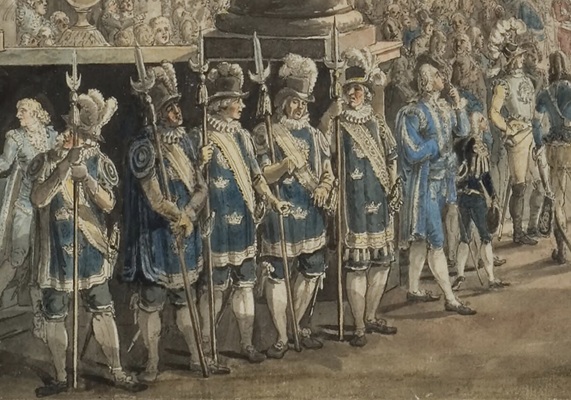
Stånddrabants in 1797 with costumes they wore until
1844 (painting by Martin Rudolf Heland)
Colonels
and Battles
(Green background represents victories, red
background defeats and grey background indecisive battles)
|
Gustav Vasa's Drabant Corps |
|
Johan III's Drabant Corps |
|
1526-1528 |
Meinhard von der Lippe |
1569 |
Jurgen Klingesmed |
|
1531-1532 |
Gert Friis |
1570-1571 |
Sten Hemmingsson |
|
1533 |
Robert von Andorf |
1571 |
Erik Grelson |
|
1534 |
Hans Friis |
1571 |
Sten Nilsson |
|
1535 |
Hans von der Lippe |
1572 |
Långe Göran |
|
1536-1537 |
Hans Friis |
1573-1574 |
Måns Nilsson |
|
1538-1539 |
Hans Persson |
1574 |
Jurgen Hanthoff |
|
1540-1541 |
Per Switzer |
1575-1580 |
Herman Nordhausen |
|
1541-1544 |
Hans Friis |
1581-1582 |
Olof Larsson |
|
1544-1548 |
Per Höös |
1583-1596 |
Jon Olsson |
|
1548-1549 |
Amund Kart |
The Drabant Fänika |
|
1549-1550 |
Hans Persson |
|
1550-1553 |
Hans Ditmarsk |
1597-1598 |
Nils Månsson |
|
1553 |
Hans Svenske |
1599-1601 |
Sven Björnsson |
|
1554-1555 |
Henrik von Wiborg |
1601-1602 |
Roger Kent |
|
1556-1558 |
Hans Beutler |
1602-1605 |
Daniel von Wochen |
|
1559-1560 |
Mårten Eriksson |
1605 |
Meinhard v. Hinkema |
|
Erik XIV's Drabant Corps |
1605-1606 |
Olof Jonsson |
|
1606-1607 |
Daniel von Wochen |
|
1560-1561 |
Per Bagge |
1608 |
Jakob Velamsson |
|
1561-1563 |
Per Olsson |
1609 |
Ivar Kristersson |
|
1563-1564 |
Grels Finne |
1610 |
Lars Brink |
|
1564-1565 |
Lars Andersson |
1610 |
Lars Svensson |
|
1565-1567 |
Olof Stensson |
1611-1614 |
Anders Larsson |
|
1567-1568 |
Hans Friis |
1615-1616 |
Erik Drake |
|
1568 |
Nils Eriksson |
1616-1617 |
Nils Ribbing |
Livgarde
(Hovregementet's colonel's company) |
|
1618-1621 |
Erik Hand (Captain of the "Second Drabant
Company") |
|
1618- (1624) |
Philipp Johan von Mansfeld |
1621 Riga |
|
1622-1625 |
Caspar Otto Sperling (Captain Lieutenant) |
|
1625-1627 |
Frans Bernhard von Thurn |
1626 Wallhof |
|
1627 Dirschau |
1627-1631
|
Maximilian von Teufel
(killed at Breitenfeld) |
1629 Gourzno |
|
1629 Honigfelde/Stuhm |
|
1631 Frankfurt an der Oder
1631 Breitenfeld |
1631-1632
|
Nils Brahe
(mortally wounded at Lützen) |
1632 Lech (Rain) |
|
1632 Alte Veste |
|
1632 Lützen |
|
1632-1633 |
Erik Stenbock (Captain Lieutenant) |
|
1633-1635 |
Thure Liljesparre (Captain Lieutenant, 1634
Lieutenant Colonel) |
|
1636-1638 |
Didrik Yxkull (Lieutenant Colonel) |
|
1638-1644 |
Caspar Otto Sperling (Colonel of Södermanland
Reg. 1629-47) |
|
1644-1652 |
Magnus Gabriel De la Gardie |
|
1652-1653 |
Jakob Casimir De la Gardie |
|
1653-1654 |
Christoffer Delphicus Dohna |
|
1654- (1656) |
Christoffer Carl Schlippenbach |
|
|
Garde du Corps (subordinate
to the Livgarde from 1657) |
|
1655-1657 |
Hans Georg Mörner |
1656 Warzaw |
|
1657-1660 |
Barthold de Mortaigne |
1658 March Across the Belts |
|
1659 Copenhagen |
|
|
Livgarde
(drabants included in the Colonel’s Company) |
|
(1656) -1660 |
Jakob Johan Taube |
1659 Copenhagen
1659 Nyborg |
|
Feb-Dec. 1660 |
Nils Brahe |
|
1660-1664 |
Gustaf Adam Banér |
|
Mars-sep.1664 |
Carl Larsson Sparre |
|
1664-1668 |
Axel Julius De la Gardie |
|
1668-1673 |
Gustaf Lillie |
|
1673- (1677) |
Christoffer Gyllenstierna |
|
|
Drabant Corps (subordinate
to the Livgarde until 1700) |
|
1675-1676 |
Hans Henrik Siegroth
(killed at Lund)) |
1676 Halmstad
1676 Lund |
|
1677-1679 |
Henrik Johan Naschert |
1677 Landskrona |
|
1679-1693 |
Jakob Spens |
|
1693-1695 |
Carl Gustaf Mörner |
|
1695-1700 |
Carl Nieroth |
|
1700-1705 |
Arvid Bernhard Horn |
1700 Narva
1701 Düna
1702 Kliszow
1703 Pultusk
1704 Punitz |
|
1706-1707 |
Carl Gustaf Wrangel |
|
1707-1708 |
Otto Magnus Wrangel |
1708 Holowczyn
(killed in battle) |
|
1708-1717 |
Carl Gustaf Hård
(acting 1708-10) |
1709 Krasnokutsk |
|
1709 Poltava
1715 Stresow |
|
1717-1732 |
Johan Gjerta |
|
1732-1737 |
Gustaf Sparre |
|
1737-1744 |
Carl August von Dohna |
|
1744-1762 |
Magnus Stjernros |
|
1762-1772 |
Samuel Wallenstjerna |
|
1772-1773 |
Fredrik Carl von Dohna |
|
1773-1775 |
Charles Emil Lewenhaupt |
|
1775-1780 |
Mauritz Casimir Lewenhaupt (Svea Company
1780-1781) |
|
Divided in 1780 into four companies,
from 1793 the oldest captain lieutenant had overall command. |
|
1793-1797 |
Hampus Stellan Mörner (Göta Company from 1780) |
|
1797-1802 |
Adam Ludvig Lewenhaupt (Svea Company from 1781) |
|
1802-1813 |
Claes Horn (Vendes Company from 1784) |
|
1813-1821 |
Hampus Elof Mörner |
|
|
Scanian
War
When the Scanian War began,
there were 40 private drabants and 3 drabant corporals who were part of the
Livgarde's Colonel’s Company. These were primarily foot soldiers, but the
drabants had 24 horses that were used by those who served as the royal
bodyguard when Charles XI travelled on horseback. At the end of August 1675,
the king decided to reorganise this force into a cavalry company consisting
of 200 private drabants and 12 officers. The recruitment of the new drabants
took place in Stockholm and was completed in October. The horses were
purchased in Scania and Halland where they also remained waiting for the
drabants' arrival. The drabant company was fully organised in December and
at the New Year 1676 it departed for Scania. The first muster took place on
3 June in Allerup north of Trolleholm after Charles XI had arrived in
Scania.
After the Danish landing at Råå
at the end of June 1676, the Drabants and the rest of the army carried out a
hasty retreat to Småland via Kristianstad. However, when the Danes divided
their field army into two parts, the Swedish army chose to go on the
counter-offensive and attack the smaller part, which was completely
destroyed in the Battle of Halmstad on 17 August. This was the first battle
for the new Drabant Corps, and they took the place of honour on the far
right in the Swedish order of battle, which they would continue to do in all
subsequent battles. The Drabants' losses in the Battle of Halmstad were two
killed and six wounded. Despite the victory, the Swedish army was still
smaller than the approaching Danish main army and they therefore retreated
further north in Halland to Syllinge.
In October 1676, a new Swedish
counter-offensive was launched, culminating in the bloody Battle of Lund on
4 December. The Drabants had a strength of 160 men when they left Syllinge
on October 6, and this had then dropped to 150 men when the Battle of Lund
began. Already at the beginning of the battle, the Drabants, together with
the Livregemente, distinguished themselves by attacking the enemy alone
after the rest of the cavalry had retreated. They managed to hold off the
enemy long enough for Swedish reinforcements to join in and defeat the
Danish left wing, which was then pursued for a long time. During this fight,
the Drabants' commander, Lieutenant Colonel Siegroth, fell. After the
Drabants and the rest of the Swedish right wing returned to the battlefield,
they rescued the hard-pressed Swedish army and defeated the rest of the
Danish army. However, the battle has gone down in history as Scandinavia's
bloodiest, and the Drabants suffered heavy losses. Only 50 men remained in
the saddle after the battle. The fallen Siegroth was replaced as unit
commander by Henrik Johan Naschert, even though he had lost an arm in the
battle.
The 1676 campaign ended with
the recapture of Helsingborg on 30 December, after which the drabants went
into winter quarters in Vä outside Kristianstad. While the drabants rested
there during the first half of 1677, the gaps in the ranks were to be filled
with recruitments. But this proved difficult and after a contingent of 34
recruits arrived in July 1677, the drabants had a strength of only slightly
over 150 men.
A new campaign was launched,
which soon resulted in the Battle of Landskrona on 14 July 1677. The Swedes
were victorious again, but this battle was also bloody. The Drabants
distinguished themselves by single-handedly resisting an attack by the
Danish cavalry until reinforcements arrived. Of a force of 142 men, 28 men
were killed and 50 were wounded.
In August, the drabants
participated in the pursuit of the Danish cavalry that had broken out of
Landskrona and made it to the Kristianstad area before returning to
Landskrona. In September, news came of a setback in Uddevalla, which
resulted in a cavalry force that included the drabants was ordered to march
there as reinforcements on 17 September. However, they did not get further
than Halmstad two days later before the march was interrupted. Instead, the
drabants were placed in winter quarters in (Trolle-) Ljungby near
Kristianstad.
Recruitment for the 1678
campaign season was considerably more successful than the previous year.
Already on 7 September, 48 new recruits arrived to the army, and at the
muster on 30 May, the Drabant Corps’ ranks had a surplus of 13 drabants.
However, 1678 was a more uneventful year, revolving around the siege of
Kristianstad. After the Danish garrison capitulated on 4 August, the
drabants were stationed in Höör before going into winter quarters in
Sölvesborg and Ronneby. The Drabant Corps still had a surplus of 7 drabants
at the muster in Sölvesborg on 24 October.
The 1679 campaign season was
even more uneventful. It began when the drabants left Fjälkinge in the
Kristianstad region on 9 July to head for the Rönneå area. The goal was to
retake Helsingborg, but news of the Norwegian army led to a march towards
Varberg on 11 August, which was called off on 17 August, after which they
returned to their old location at Rönneå on 25 August. After the armistice
had been signed in Lund on 1 September, the drabants were stationed in
Sireköping east of Landskrona. Peace was signed on 26 September, and on 26
October the drabants marched home via Asarum, Växjö and Värnamo. At the
latter location it was divided into two parts, which then travelled on
opposite sides of Lake Vättern before arriving in Arboga and Köping, where
they would be stationed during the coming peace period. |
|
Great Northern War
When the
Great Northern War broke out, the Drabant Corps was in the midst of a period
of reorganisation with "old" drabants in Arboga and Köping and "new"
drabants in Stockholm. Both groups left their camps on 30 April and marched
to Ystad, where they arrived on 8 and 15 June respectively. Once there, a
reorganisation was carried out on 18 July, separating the Drabant Corps from
the Livgarde and making it directly subordinate to the King. In practice,
this meant that Captain Lieutenant Arvid Horn became the commander of the
drabants.
The first
event of the war was the landing at Humlebæk where the then 198-strong
Drabant Corps was included in the second wave of troops which consisted of
cavalry. However, due to bad weather, they could not be shipped over until 3
August, which was eight days after the first wave which included the king
and the Livgarde. The Drabant Corps did fight in any battle because Denmark
made peace in Traventhal on 8 August. The drabants left Denmark on 22 August
and was transferred to Kristianstad where they were stationed for a month
before sailing to Pernau on 1 October.
|
Losses in the Battle of
Narva
The list only mentions 24 wounded,
four names are missing.
|
First Squadron |
|
Quartermaster Gustaf Horn – through the right arm and a
little in the side, but without danger. |
| Bengt Horn – badly wounded in the left arm
and side by gunshots.
(died later) |
| Johan Galle – in the arm,
no danger. |
| Axel Gyllenstierna – in the shoulder, badly
injured. |
| Axel Spens – minor injury
in the thigh. |
| Christer Horn – badly injured in his right
arm and side. |
| Börje Gyllenclou –
slightly injured in the foot. |
| Fabian Witting – through the arm and into
the torso
(according to Kuylenstierna) slightly
cut in the head (according to Ingesson). |
| Carl Horn – badly shot
through the right arm and out the left side. (died
later) |
| Didrich Roback – badly shot in the arm and
side. |
| Johan Blom – badly cut in
the head. |
| Axel Duvalt – slightly injured in the neck. |
| Lilligren – a little bit
stabbed. |
| Hindrich Granberg – badly shot in the thigh. |
|
Killed:
Adjutant Knut Leijonhuvud, Corporal Erik Abrahamsson and 6 privates:
Rehinholt Wrangel, Otto von Brandt, Michael Schröder, Fabian Yxkull,
Anders Nygren and Lorentz Bröms.
Second Squadron |
|
Lieutenant Otto Wrangel – slightly cut in the hand. |
| Anders Norling – minor bullet wound in the
arm. |
| Peter Gynterberg – thigh
bone shot off. (died later) |
| Anders Hultberg – minor bullet wound in the
arm. |
| Olof Colberg – badly shot
in the back. (died later) |
| Lars Fägerhielm – shot through the arm. |
| Göran Hinsing – badly shot
in the side. |
| Olof Haggren – badly shot in the arm. |
| Erik Markman – slightly
cut in the arm. |
|
Harald Ragge – slightly injured in the arm. |
|
Killed:
Anders Elgberg, Lars Carpelan and Johan Gordon |
|
The real
baptism of fire for Charles XII's Drabant Corps was the Battle of Narva on
20 November 1700. Of a force of 151 men, 11 were killed (1 adjutant, 1
corporal and 9 privates) and 28 were wounded, of whom five later died of
their injuries. 42 horses were killed or wounded.
A strength
report from 26 November states that 17 Drabants were sick and that only 95
men were fit for duty. This weakened Drabant Corps then participated in raids
into Russian territory, without encountering the enemy, before going into
winter quarters in Lais outside Dorpat in mid-December. There they remained
until mid-June when the army broke up and marched to Riga.
During the
stay in Lais, several Drabants were involved in duels and five were
dismissed because of this. This continued to be a significant problem, as
the Drabant Corps now consisted of officers who were class-conscious and
ambitious. During the war, the Corps lost 6% of its personnel due to duels,
while the war deaths was 17%.
The 1701
campaign began with the Battle of Düna on 9 July. The now 140-strong Drabant
Corps made an impressive effort when they, greatly outnumbered, protected
the infantry against attacks from the Saxon cavalry. The losses consisted of
2 killed and 19 wounded, one of whom later died of his injuries. Among the
wounded were Captain Lieutenant Arvid Horn, who was shot in the kneecap, and
Lieutenant Otto Wrangel, who was again wounded in the hand.
At the time
of the Battle of Kliszow on 9 July 1702, the Drabants had a strength of 147
men. However, this figure was not the effective strength, as there were
probably wounded Drabants who had not recovered. During the battle, three
Drabants took command of other squadrons whose commanders had been killed.
Losses were light and only one corporal was killed. The number of wounded is
not mentioned, but among these was again Arvid Horn. As a reward for the
Drabant Corps' efforts in the battle, six Drabants who had been dismissed
for duels were pardoned.
In the
following years, several smaller battles were fought with the participation
of the Drabant Corps. First, the Battle of Pultusk on 21 April 1703 (146
men). Then in 1704, both the storming of Lemberg on 28 August (159 men) and
the Battle of Punitz on 28 October (160 men).
A minor
skirmish took place on 15 January 1706 during the Grodno operation. A force
of 12 drabants led by a corporal who were supposed to clear a village of
enemies attacked and "massacred" a troop of 60 Russian foot soldiers. Only
the corporal was wounded.
The Polish
campaign ended with a year-long stay in Altranstädt in Saxony. During this
time, Arvid Horn resigned as captain lieutenant to become a royal councillor
in Stockholm instead. This was probably because he had been plagued by
frequent illnesses. His two successors, however, did not last long. Carl
Gustaf Wrangel died in Altranstädt of illness after barely six months. The
next captain lieutenant, Otto Wrangel, was killed in the Battle of Holowczyn
on 4 July 1708.
The Battle of
Holowczyn was a great success for the Swedish army, but the losses of the
Drabant Corps were the highest since the Battle of Narva. According to von
Schreeb, the Drabant Corps numbered 134 men, of whom 8 were killed (including
the captain lieutenant) and three were mortally wounded. Pihlström's diary
states 9 killed (including the captain lieutenant, the quartermaster, the
adjutant and a lance corporal) and 31 wounded. Kuylenstierna states even
higher losses and a lower strength (125 men, of whom 13 were killed and 33
wounded), but his figures is probably less credible.
At the end of
1708, the Drabant Corps consisted of 146 men. The established strength of
200 private drabants plus 17 officers had never been reached and the corps
had at most had 198 men during the summer of 1700. After that, there were
never more than 165 drabants on duty at any one time. At its lowest, the
Drabant Corps had 133 men (December 1706 and 1707) before shrinking to only
131 men in 1709 at the time of the Battle of Poltava (not all of them were
fit for duty, however). The average number during the period 1701-1708 was
147 drabants.
One drabant
was killed in a battle at Oposhna on 28 January 1709. Things got worse in
the battle of Krasnokutsk on 11 February. The battle itself was a Swedish
victory, but the drabant suffered badly when pursuing the fleeing enemy.
With exhausted horses, they chose to attack a too strong Russian force in
Gorodnoye on foot. This resulted in 10 drabants being killed, several
wounded and one captured.
In the Battle
of Poltava, 17 drabants were killed and 9 were captured. Another 4 were
captured at Perevolochna, while 101 men followed the king to Bender. During
their stay in the Ottoman Empire, 20 drabants died, 15 were promoted to
other units, 4 deserted, and 6 were dismissed for various crimes. The
remaining 54 drabants marched to Stralsund in September 1714, but only 50
drabants arrived there and were reunited with Charles XII in March 1715.
In the Battle
of Stresow on 5 November 1715, 2 drabants were killed and 2 were captured.
Two drabants were mortally wounded. When Stralsund capitulated on 12
December, the drabants were allowed to keep their weapons and were promised
safe passage home to Sweden. However, the journey home did not take place
until 4 June 1716, when 35 drabants and 3 civilian personnel left Lübeck and
arrived in Ystad the following day (the captain lieutenant and a corporal
had arrived in Sweden earlier in the year).
After
returning to Sweden in 1716, the Drabant Corps consisted of 37 men plus
three non-combatants, divided into the following categories: 1 captain
lieutenant, 1 quartermaster, 11 corporals, 7 lance corporals, 17 privates, 1
preacher, judge-advocate and 1 field surgeon. Eleven of these had been
members of the Drabant Corps since it left Sweden in October 1700 and two of
them had been drabants since the Scanian War. The corps was stationed in
Lund, where Charles XII had his headquarters.
The Drabant
Corps was now too small to function as an independent unit and there was a
shortage of officers to fill its ranks. As a replacement, the Life Squadron
was therefore formed from men from provincial cavalry regiments in November
1716 and the existing drabants served as its officers. In connection with
this, vacant command positions within the Drabant Corps were filled through
promotions of drabants. However, no new drabants were appointed during 1716
and 1717, and the corps' strength was reduced by ten Drabant corporals being
promoted to other regiments. To still have enough officers for the Drabant
Corps, 5 officers from other units were loaned to the Drabant Corps in 1717.
Further promotions took place in 1718 and it was not until October that the
shrinking corps received new drabants when five were hired.
The Life
Squadron participated in the Norwegian campaign of 1718 and set out from
Lund on 6 October. Unlike previous campaigns, the drabants did not follow
Charles XII's movements. They were instead stationed in Eidsberg parish,
eighty kilometres north of Fredrikshald, on 11 November. They cleared the
area east of Glommen of the enemy on 23–28 November, but no battles with the
Norwegians took place. After Charles XII's death, they left Eidsborg on 6
December in great haste and were stationed in Västmanland. There they
remained until the summer of 1721, except for a short stay in Stockholm to
attend Charles XII's funeral on 26 February 1719. However, a smaller force
consisting of five drabants and 13 men from the Life Squadron was always in
Stockholm. In July 1719, this force appears to have been involved in a
battle at Dalarö as eight men from the Life Squadron were captured by the
Russians.
What remained
of the Drabant Corps after the death of Charles XII was 33 men. Despite the
recruitment of four new drabants in 1719, the corps shrank to only 24 men in
1720, all but two of whom were nobles. The fact that the corps was now
dominated by nobles was a sharp contrast to how it had been during the time
of Charles XII.
After a stay
in Stockholm in the summer of 1721, the Life Squadron returned to
Västmanland and was disbanded there at the turn of the year. The Drabant
Corps was retained but its organisation was restored to the conditions that
had existed in 1696.
Of a total of
387 drabants who served during the reign of Charles XII, 64 men were killed
while 74 died of disease. |
|
Drabant Corps
Uniforms
The Drabant Corps represented the royal house and was always issued more
decorative uniforms than the other units. However, it would not have any
stable uniform colours until the 17th century when the Swedish blue-yellow
colours were established for the corps. During the 16th century, it seems
that the colours were changed every time they received new clothes, which
happened twice a year. Although, there was a long period during the reign of
Gustav II Adolf and Kristina when the drabants were dressed in yellow with
black decorations.
House of Vasa's
Drabants 1521-1654
(the drawings below are Göte Göransson's
interpretations of their clothes)

Drabant drawn by Göte Göransson and based
on a copy in the Royal Library of a now lost Gripsholm panel from
1546-47. |
During the
reign of Gustav Vasa, the drabants were apparently dressed in the same way
as German Landsknechts. That is, multi-coloured clothes with which were torn
so that the different colour of the lining was visible through the holes in
the jackets and breeches. The people of the province of Dalarna criticised
Gustav Vasa in 1526 because the court had adopted "foreign and alien ways
with cut and motley clothing". The king responded to the criticism by
saying that he did not want to be lectured by them in how he dressed his
drabants and that he had to conform to other potentates, emperors, kings and
princes because "we Swedes are no more pigs or goats than they are".
The first
notice of the drabant's clothing is a delivery of two dozen halberds and
scarlet hats (bonnets) in 1522. The first known drabant uniform is from 1532
and consisted of clothes that were liver-coloured (probably the breeches),
white (probably the jacket) and green (the lining). In 1534 the clothes were
also mainly liver-coloured and white but also had a smaller amount of blue
and yellow fabric. The lining was red. In 1540 the drabant wore
liver-coloured, parrot green and white clothes. The lining that was visible
in the cutouts was blue on the right sleeve and yellow on the left sleeve.
The hats were blue. For the meeting with the Danish king in Brömsebro in
1541 the drabant were issued their most expensive uniforms to date and these
consisted mostly of black velvet but also contained parrot green broadcloth. The
collar was adorned with black leather and yarn lace, and the hat was also
black. In 1546 the uniforms were also black, but the lining was sky blue,
and the collar was made of leather. Later in the year they received grey
jackets. In 1553 the coat was very colourful and consisted of green, red,
black and blue broadcloth. Breeches, waistcoats and under garments were blue and
black. In 1554 the cassock was black and the breeches were ash-coloured with
ash-coloured and black lining. In 1555 the coat and breeches were yellow,
blue and orange while the other clothes were green. In 1556 the royal
drabants wore brown clothes while Duke Erik's drabants wore blue, black and
white clothes. In 1559 the drabant clothes consisted of black velvet and
red, brown and white broadcloth. In 1560 the drabants wore clothes with black
velvet, white silk and gold embroidery.
The Drabant
clothes that were issued for Erik XIV's coronation consisted of black velvet
and red silk with silver decorations. In 1563, the clothes consisted of
white velvet as the outer fabric and blue silk as the inner fabric and
violet decorations. The summer clothes of 1564 and 1566 consisted mainly of
leather.

In 1579 the
drabant clothes were violet, in 1582 red, in 1586 blue, in 1591 black, in
1592 brown, in 1599 red with trim of an unknown colour, in 1603 blue with
yellow trim, in 1607 yellow with blue trim (reverse colours for the coat),
and in 1608 and 1609 blue with green trim. In 1610 the clothes were made of
wadmal of an unknown colour but had yellow trim. The trim was grey in 1613
but in 1614, 23 drabants received blue trim and 157 received yellow. As in
1607, the buttons were made of glass in 1614, but the number had increased
from 24 to 34.
In a letter
from March 1616, Gustav II Adolf ordered "shirts" for the drabants, half of
which could be yellow-brown and half red with trim in blue or another
suitable colour. New uniforms were purchased for Gustav II Adolf's
coronation in 1617 and the following year a drabant received yellow breeches
and a yellow jacket as well as a moose skin jacket "from the remaining
drabant clothing". Black clothes are mentioned when the king travelled to
Denmark in 1619, but they were probably only a temporary mourning outfit
because these drabants received yellow clothes somewhat later. In connection
with Gustav II Adolf's wedding in 1620, some drabants received red clothes
with silver decorations (Queen Maria Eleonora's Brandenburg colours) while
the majority still wore yellow clothes (with silver decorations). In 1622,
the yellow colour was combined with black for the adelsdrabants, while the
other drabants received grey clothes. In 1624 some drabants received yellow
uniforms (with yellow stockings) and others received black uniforms, with
gold and silk lace. The following year, clothes "of black and yellow" were
ordered for the Livgarde Company in preparation for a planned meeting with
the Danish king.

From
September 1627 in Dirschau we have a more detailed note about the uniforms
of the Livgarde Company. At that time the guardsmen paraded "with halberds
and dressed in yellow livery decorated with black silk and gold lace and
yellow cloaks lined with black velvet".
For the years
1628-1629, however, the king's drabant are stated to have grey clothes with
silver trim. The queen's drabants, on the other hand, had yellow clothes
with blue elements and grey hats (blue coat with yellow trim and yellow
jacket, breeches and stockings). These colours seem to have become permanent
during the last years of Gustav II Adolf and according to Brzezinski, grey
clothes and grey hats were delivered as late as January 1632. According to
the Livgarde' regimental history work, however, the yellow colour with black
decorations (and black hats) began to return to the king's drabants in 1632,
but after his death black mourning clothes were introduced for all drabants.
In 1628, the captain of the queen's drabant had red clothes with yellow trim
(gold lace according to Höglund) and in 1629 the officers had yellow
uniforms. According to Höglund, the captain of the king's drabants also had
red clothes (and buff coats) in 1628.
The black
mourning clothes of the Livgarde Company disappeared at the end of 1635 when
yellow clothes with black and yellow lace, buttons and straps and black hats
were produced. The pikemen had coats with three wide black and yellow
stripes and yellow lining while the musketeers were given cassocks with both
black and yellow baize as lining. The cassocks are mentioned here for the
first time and were an outer garment that, unlike the cloaks, had sleeves.
The drabant's stockings were yellow. In the following years, most drabants
retained this colour combination, although complaints were made in 1641
about a lack of uniformity when half of the drabants lacked livery.
Deviating colours were also mentioned as early as 1637 when eight drabants
had light brown livery with crimson and light brown plush.
For the
adelsdrabants, a transition to different "coloured" clothing with gold
buttons is noticeable in 1638. In 1640 they were issued red broadcloth and baize,
and some were given grey hats. For the period 1646-1648, all clothing was
red except for leather shirts (buff coats) and grey hats. In addition, the
clothes were decorated with gold lace and buttons. Small gold buttons were
on the shirt, sleeves and cloak collar. The gold lace was designed as six
stripes on the cloak, breeches and sleeves. The colours are the same at
Kristina's coronation in 1650 except for the buttons and lace, which were
then described as "silver in gold". The lace then consisted of two stripes
on the buff coat's sleeves and stockings and four stripes on the breeches,
while the number on the cloak is not mentioned. Immediately after the
coronation, the adelsdrabants temporarily changed to yellow-black clothing
with embroidery depicting the national coat of arms and the queen's
monogram. But they soon returned to the red clothes worn during the rest of
Kristina's reign.
The uniforms
of the ordinary drabants seem to have been stable and consisted at all times
of yellow coats (pikemen), cassocks (musketeers), shirts and breeches with
black-yellow laces of varying width and black-yellow buttons. At least the
non-commissioned officers had 1650 yellow stockings with 2 striped laces at
Kristina's coronation (4 on cloak and breeches). The hats were black. The "higher"
pikemen had at the same coronation cloaks with six striped laces of black
silk and gilded silver thread and a lining of black plush. The number of
striped laces was 4 on the breeches and 2 on the stockings. Their belt was
black with fringes in gold and black. The "lesser" pikemen had to make do
with half as many striped laces which were also yellow instead of gilded
silver. The musketeers only received one stripe of lace for their cassock,
which had a black lining, but, like the lesser pikemen, had 2 stripes on
their breeches and one stripe on their stockings.
Charles X Gustav's
Drabants
With the accession of Charles X Gustav to the throne in 1654, the Vasa House
was replaced by the Palatine House and the uniforms of the drabants were
immediately changed from the yellow and black livery of the Vasa House to
blue-yellow colours which were probably inspired by the Swedish flag and
national coat of arms. However, the shade of blue on the uniforms was
bleumerant which was a pale blue shade, and which was also described as sky
blue. After the death of Charles X Gustav, the colour is referred to
alternately as bleumerant or blue and it is not clear whether the two words
refer to the same light blue shade or whether the word "blue" refers to a
darker blue colour (which was what "blue" normally meant during the 17th
century). Sometime during the reign of Charles XI, however, a permanent
transition to a dark blue shade occurs.
|

Drawing by Erik Dahlberg depicting drabants
dressed in cassocks in 1662 (however, the appearance of the monogram
cannot be confirmed until 1669). |
At the
coronation on 6 June 1654, the drabants wore buff coats, bleumerant cloaks
and breeches of broadcloth, and yellow knitted stockings. The buff coat was made
of leather with bleumerant velvet sleeves and was provided with 6 ells thick
and 1 ell narrow lace of "gold in silver" (the latter probably for the
collar). The buff coat was also edged with silk ribbons. The cloak had
yellow velvet cuffs and yellow lining of “rask” (= fabric with a thin shiny
surface) as well as "cloak ribbon" and 40 ells of "gold in silver" lace.
Both the silk ribbons and the cloak ribbons were probably blue-yellow since
such ribbons are mentioned shortly afterwards together with yellow sleeves
and grey buttons on the cloak. The breeches had 32 ells of "gold in silver"
lace. The stockings were decorated with red "frissad". Each drabant also
received a dozen small "gold in silver" buttons, 6 ells of bleumerant silk
lace and 13 ells of narrow "gold in silver" lace with several decorations.
The hat had a ribbon and a feather bush. The belt had "gold in silver"
fringe. To avoid wear on the magnificent uniform, they also seem to have had
a kind of fatigue uniform, since "grey clothes with cloaks" are mentioned in
connection with a trip to deliver Charles X Gustav's queen in the autumn of
1654.
A bleumerant
cassock was introduced in 1656 with "4 royal names and crowns of gold and
silver". Then the cloak became solid grey instead while the buff coat was
made entirely of elkskin. Otherwise, the uniform seems to be largely the
same with a total of 71 ells of "gold and silver" lace and 48 ells of blue
and yellow ribbons and remained so for the coming years. However, this only
applies to the Stockholm-based drabants.
The drabants
who accompanied Charles X Gustav to Poland (Garde du Corps) were given black
clothes in Krakow in 1656, which is also confirmed by eyewitness accounts.
Erik Dahlberg wrote in his diary that the King's Life Guard were called the
black coats and the Guard Captain Gabriel Kurck tells in his memoirs about
the Battle of Warsaw where he mentions "The King's Guard on horse of its
black Rukova".
Charles XI's Drabants
1660-1675
When the
drabants were on guard duty during the peace years, they wore a conspicuous
cassock (see picture above). It was blue, adorned with the king's monogram
in gold and silver embroidery on the back, sides and chest, framed by edges
and lace in silver mixed with gold. But it was replaced by a blue coat at
the outbreak of war.
The
information mentioned below for the non-commissioned officers and corporals
only applies from 1667 and 1668 respectively, since that was when they had
their uniforms paid for by the crown.
|
|
NCOs & Corporals |
Privates |
|
Hat: |
Grey 1675. Hat ribbon, lace of "gold in
silver" and bow. |
Black 1662. Ribbon around the crown and edged with three ells of lace.
In 1672 it also had a bow. 1675: Black hat with
gold lace. |
|
Coat: |
Buff coat adorned with ½ ell of rask (= fabric
with a thin shiny surface), 12 ells of buff coat ribbons, 30 ells of
taffeta ribbons and one or a few dozen "gold in silver" buttons (and
silk buttons). |
Buff coat with leather sleeves and at least in
1670 long skirts and edged with silk ribbons. Fitted on the chest and
sleeves with yellow rask, lace and (silk) ribbons. The lace was
originally made of silk and later twisted silver thread mixed with gold
thread. |
|
Belt: |
Sword belt with 8 ½ ells of lace. |
The fringes of the sword belt were
replaced in 1662 by wide lace of "gold in silver" (8 ½ ell). The gloves
also initially had fringes. |
|
Breeches: |
Grey with 2 ½ dozen "gold in silver" buttons and 12-15 ells of "gold in
silver" lace. |
Blue decorated with goldwork lace. In 1668 the lace was arranged in
three lines in the lower part and three lines at the side (in addition
buttons of the same material). Probably also ribbons in 1671. |
|
Stockings: |
Grey (knitted or made from broadcloth)
1667-68 with 5-6 ell of "gold in silver" lace (yellow stockings in
1670). |
Blue broadcloth stockings and yellow
knitted stockings. Usually had a line of lace and probably also a ribbon
in 1671. The stockings were fitted with a collar in 1672. |
|
Cloak: |
Grey fitted with cloak ribbon at the front, 20 ells of "gold in silver"
lace and 1-2 dozen "gold in silver" buttons (and silk buttons). The
corporals' cloak ribbons were more expensive, and they had an additional
8 dozen "gold in silver" buttons. |
Grey (yellow 1673) adorned with yellow rask (= fabric with a thin
shiny surface) and cloak ribbon (front) and fitted with 4 dozen buttons,
and in 1671 with just over 21 ells of "gold in silver" lace and
apparently also other ribbons. |
|
Sources: black text = Tore Schreber von Schreeb (1936),
green text = Anders
Larsson. |
The provost was dressed
like a corporal. In the early 1660s, the musicians wore the same clothes
as the privates, but in the late 1670s they were given separate uniforms
consisting of blue over- and under-jackets, breeches and stockings. The
over-jacket was lined with yellow baize and the under-jacket with
ticking. The pipers' and drummers' uniforms were adorned with 1 ½ ells
of yellow rask (= fabric with a thin shiny surface), 1 ell of edging
lace, 50 ells of "gold and silver" lace, 10 ells of taffeta ribbon and 8
ells of ribbon on the sleeves, 4 dozen "gold and silver" buttons on the
jacket and 2 ½ dozen on the waistcoat, as well as a dozen silk buttons.
The hat was adorned with a hatband and a bow. The uniform of the
regimental piper, which was added in 1669, had grey broadcloth instead of
blue and more decorations.
Charles XI's Drabants
1676-1695
|
|
NCOs & Corporals |
Privates 1675-1679 |
Privates 1680-1695 |
|
Headgear: |
1676: Grey hat. Hatband, "gold in
silver" lace and bow.
1677: All
blue karpus with yellow fringes.
1678: Black hat with 2 ½ ell of "gold in
silver" lace and bow. |
1677: Karpus of blue broadcloth (3/8 ell)
with yellow rask lining and yellow velvet cuffs on the "flaps" and
adorned with 1 ell of yellow taffeta ribbon, 4 small "gold and silver"
buttons, 6 ells of livery lace and 1¼ ell of "edge".
1678: Was supposed to have a black hat
with "gold and silver" lace but these were
not available in Stockholm so white hats were ordered in Scania. |
1687 (latest): Hat with a flattened
relatively low crown, large brim that was slightly rolled up and edged
with silver lace. Hatband probably made of silver wire.
(silver = simplified description of "gold, silver in silk"?).
A karpus is also mentioned February 1694. Previously issued
karpuses are still recorded in 1696. |
|
Coat |
1675: Buff coat
1677: Blue coat with a line of "gold
in silver" lace on all seams, 27 ells of lace, and cuffs of yellow
velvet. |
1675: Buff coat
with two dozen silver buttons, and lace. Blue coat with yellow lining,
gilded buttons and gold lace.
1677: Blue coat (4 ½ ells long)
with yellow cuffs, collar and yellow baize lining. Decorated with 5
dozen "gold in silver" buttons (gilded silver
buttons) and 5 ells wide "gold in silver" lace
(gold lace). Breastplate and elkskin buff coat. |
1687 (latest):
Blue coat with blue lining, shoulder straps and brass buttons worn over
the elkskin coat (also with shoulder straps). |
|
Belts: |
Yellow leather sword belt with lace. |
Carbine belts and cartridge boxes covered with blue plush and edged with
lace and "gold in silver" lace. |
1695: Waistbelt of elkskin with gilded
buckles (previously laced) and carbine belt with gilded lining (previously
covered with blue schagg, i.e. velvet like wool). Iron carbine hook, and
cartridge box covered with yellow leather (formerly blue schagg) and a
gilded buckle on the strap. |
|
Breeches/ Stockings: |
1676: Grey stockings. |
1677:
Leather breeches. |
1687 (latest): Breeches made of elkskin. |
|
Cloak: |
1677: Blue cloak
with wide lace on the collar. |
1675: Grey with grey lining. 4 dozen
yarn buttons and decorated (on the front edge and along the collar) with
cloak ribbons
1677: Blue with yellow lining (seven
ells of broadcloth) and 8 ½ ells of sword belt lace. |
1695: Blue round-cut cloak with yellow
lining and gold lace along the collar and front edges (in 1682 it was
silver lace and it was also equipped with 4 dozen coat buttons, "cloak
ribbon" and 45 ells of taffeta ribbon). |
|
Shabraque and Pistol Covers: |
1677: Shabraques like the
privates' but with wide lace. |
1677: Blue shabraques. Those
for daily service with yellow wool fringes and the parade shabraques
with Charles XI's monogram in the back corners embroidered in blue and
yellow silk. |
1687 (latest): Blue pistol covers
embroidered with double C.
1695: Black pistol holsters. |
|
Sources: black text = Wernstedt
(volume IV),
röd text Höglund, .pink text = Tor Schreber von
Schreeb (1951) |
Höglund also states that trumpeters and drummers in 1677 wore blue jackets
with yellow lining, 4 dozen gilded silver buttons and 50 ells of gold lace,
as well as blue breeches and stockings. Wernstedt states that the Drabant
Corps had black hair bags in
1695.
After the death of Queen Ulrika Eleonora in 1693, the drabants were dressed
in mourning clothes consisting of black broadcloth, veils on their hats and at
the neck, belts and cartridge box covered with black broadcloth, shabraque made of
black broadcloth, and black gloves. This mourning dress was also introduced after
the death of Charles XI but was then limited to just the number of drabants
who were on duty.
Charles XII's
Drabants and Life Squadron
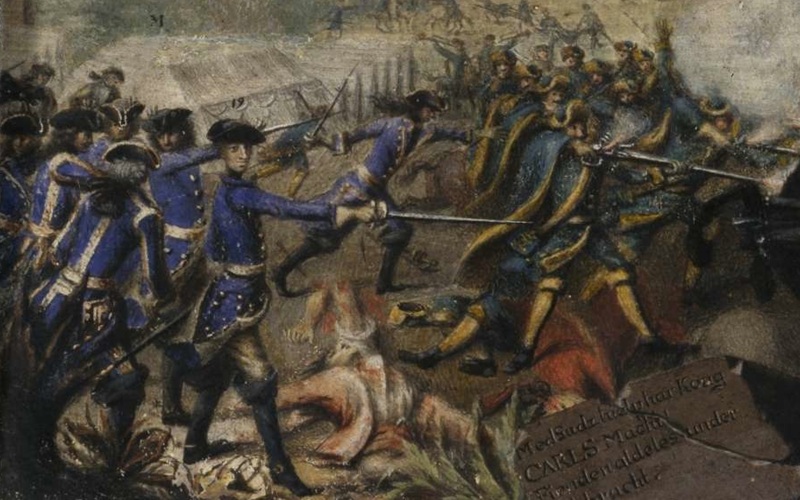
Drabants led by Charles XII on the left and
infantrymen on the right during the Battle of Düna in 1701.
Detail from a miniature
painting by Johan Henrik Schildt (1678-1732), probably painted during
the period 1701-1704.
In the early years of Charles XII's reign, the drabant uniforms had the same
appearance as during his father's reign. It was not until 20 April 1699,
that he decided to introduce a significantly more elaborate uniform, which
is the one seen on the left in the picture above.

Detail from a copper engraving showing drabants at
Charles XI's funeral on 24 November 1697. |
Some changes to the drabant uniform had already taken place before, however.
A new uniform was issued in 1696 (according to a specification from 21
December 1695) and the drabants were then given tricorne hats for the first
time. Another change was that the buff coat was abolished at the end of 1697
and was replaced by a leather waistcoat.
The new gold-laced m/1699 uniform was originally intended to be a parade
uniform that would be worn only when ordered to do so. Otherwise,
non-commissioned officers would instead wear a simpler coat without lace and
“schagg”, while the privates would wear their own clothes. This was the same
situation that had applied to the uniforms of the Drabants since at least
1695. But when Charles XII reorganised the Drabant Corps in 1700 so that all
men would have officer rank, this parade uniform instead became the corps'
everyday uniform. However, this uniform had not yet been issued on 27
January 1700 and, judging from Olof Stiernhöök's diary, it was on 30 August
1700 that the Drabant Corps wore the m/1699 uniform for the first time.
The officers also received new uniforms paid for by the crown when the
m/1699 uniform was ordered. However, this was a one-off event and in the
future all drabants would purchase new uniforms themselves when their old
ones became worn out. They had also received substantial salary increases in
1700 to be able to afford that expense. This unfortunately means that we
lack information about any changes to the drabant uniform during the Great
Northern War.
Drabant Uniforms 1696-1700
|
|
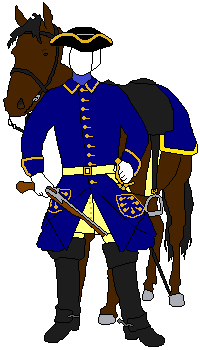
Private Drabants |
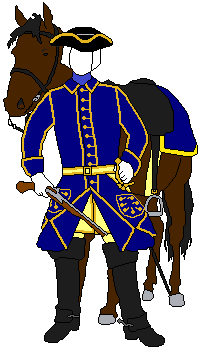
NCOs
(same as privates unless otherwise stated) |
|
Hat: |
Black hat with 2 ¼ ells of gold lace. Button and buckle.
The brim is folded up on three sides and possibly
attached to the crown.
Previously issued karpuses are still recorded in 1696. |
4 ½ lots of gold for the lace and hat band. Button and buckle. |
|
Neckcloth: |
Two white. In the field black.
The colour was changed from white fabric to blue silk
in 1696. |
|
|
Coat: |
Blue broadcloth with 43 flat gilded
buttons and gold lace on cuffs and pockets. The gold lace was partly
wide and partly narrow (4 ¾ and 6 ¼ ell respectively with a total weight
of 5 ¼ lots). The buttonholes were edged with ¾ lot twisted gold thread. |
34 ½ ells of gold lace (weight 22 ⅛ lots). 49 gilded brass buttons. |
|
Buff coat: |
Knee-length elkskin "shirt"
decorated with silk ribbons. Turn-down collar and shoulder straps for
belts. Instead of buttons, it was fastened with hooks and loops that
went down to the waist. The skirt could be folded up in the same way on
both the front and back. The inside was edged with 3.5 cm wide silk
ribbons. The end of the sleeves had small, knobby brass buttons.
Replaced at the end of 1697 by a waistcoat made of elkskin that was
edged with gold lace and had gold lace buttonholes. |
|
|
Waistcoat: |
A sleeveless leather vest lined with
ticking that reached to the groin at the front and was slightly shorter
at the back. It was fastened with hooks and loops on the left side from
the armpit. From the neck and 15 cm down the chest there was a slit that
was fastened in the same way. |
|
|
Waistbelt: |
Elkskin with gilded buckle |
4 ⁹⁄₁₆ ells wide gold lace. |
|
Breeches: |
Buckskin |
|
|
Boots: |
Soft, good waxed Russian leather
boots, the feet of which should be made of greased leather," spurs. |
|
|
Cloak: |
Blue broadcloth and lining of
yellow baize. Round collar with yellow and
blue mixed lace" (yellow linen with blue stripes),
gold lace on the collar and along the front. Gilded brass buckles. |
|
|
Gloves: |
Buckskin grip and elkskin collar. |
3 ⅛ ells of gold lace (weight 5 ½ lots). |
|
Sword knot: |
Blue and yellow
silk. |
|
|
Shabraque: |
Blue edged with yellow broadcloth. The
King's crowned monogram embroidered with silk in the corners. |
The king's monogram embroidered
in gold (the officers' shabraques also had a gold edge). |
|
Sources: black text = von
Schreeb (1936), pink text = von
Schreeb (1951), blue text = Wernstedt (volume
IV), green text = Anders Larsson. |
The 208 cloaks purchased in July 1695 were not replaced when the m/1699
uniform was issued in 1700. The material of the m/1699 uniform's
waistcoat and breeches is not mentioned, but Tor Schreber von Schreeb
assumes that they were made of leather, like the uniform from 1695 and
the one issued to the Life Squadron in 1717.
Drabant Uniform
m/1699
(the distribution of gold lace on the uniforms is very
uncertain, and the pictures below are just a suggestion)
|
|

Privates |
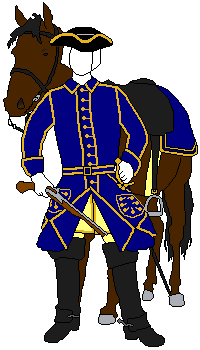
Lance Corporals |
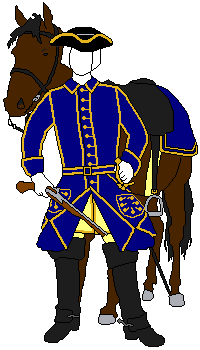
NCOs |
|
Hat: |
Hat with sweatband, button and 2 ½ wide lace. |
Hat with sweatband, gold button and 2 ½ ells of lace. |
A fine “Carbeck” hat with a gold button and 2 ½ ells of gold lace. |
|
Coat: |
5 ells of blue shrunken broadcloth. ⅝ ells of schagg for flaps, 6 ½ ells of
blue rask (= fabric with a thin shiny surface), 1 ½ of white rask,
1 ½ ells of canvas and 2 ½ lot of silk. 31 large and 10 small gilt brass
buttons. 8 ¾ ells wide lace, 11 ¾ ells of border lace and 17 ½ ell of
gold for buttonholes |
5 ¼ ells of blue broadcloth, ⅝ ells of schagg, 8 ells of rask, 1 ¼ of canvas,
3 lots of silk. 31 large gilded brass buttons. 8 ¾ ells wide gold lace,
14 ¾ ells of border lace and 21 ells wide buttonhole lace. |
5 ¼ ells of blue broadcloth, 8 ells of rask, 1 ½ ells of canvas, ⅝ ells of
schagg, 3 lots of silk. 31 large and 10 small gilt brass buttons. 27 ½
ells wide and 54 ell narrow gold lace, 15 ells of gold border lace and
17 ½ ells of gold lace for buttonholes. The corporals had no narrow gold
lace and the border lace was 16 ½ ells. |
|
Waistcoat: |
13 ½ ells of gold lace, the buttonholes weigh 3 ½ ,lots, 8 ells of
border lace. |
3 ⅞ ells wide lace, 8 ells of border lace, 14 ells of buttonhole lace. |
3 ⅞ ells wide gold lace, 8 ells of gold border lace and 14 ells of gold
lace for buttonholes. |
|
Waistbelt: |
Made of elkskin with a gilded buckle and
covered with blue schagg and 7 ¾
ells of lace. |
2 ⁷⁄₁₆ ell 6 laan and 1 ⅞ ell 7 laan gold lace. |
Covered with blue schagg and decorated with 2 ⁹⁄₁₆ ell of gold lace with
6 lan and 1 ⅞ ell of gold lace with 7 lan. The corporals had only 4 ½
ell of gold lace. |
|
Cartridge box and belts: |
Covered with schagg. The belt:
5 ½ ells wide and 2 ¾ ells narrow lace. The cartridge box: 2 ¾ ells lace. |
Covered with blue schagg and adorned with 3 ⅛ ells (belt) and 1 ⅞
ells of gold lace (cartridge box). |
Covered with blue schagg and adorned with 3 ⅛ ells wide and 1 ⅞
ells narrow gold laces. The corporals' narrow gold laces are 1 ¾ ells. |
|
Gloves: |
2 ½ ells of gold lace (weight 2 ½ lots). |
|
Elkskin collars and 2 ½ ells of gold lace. |
|
Shabraque & pistol covers: |
Blue broadcloth with 7 ¾ ells wide and 7 ¾
ells narrow gold lace. |
3 ⅞ ells wide
gold lace, 8 ells of border lace and 11 ells of buttonhole lace. |
Fine blue broadcloth adorned with 8 ells
wide and 16 ell narrow gold lace. The quartermaster and adjutant also
had 8 ells of gold fringe. |
|
|
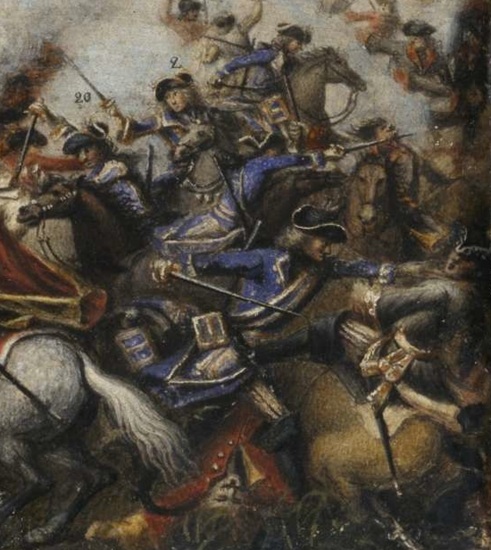 |
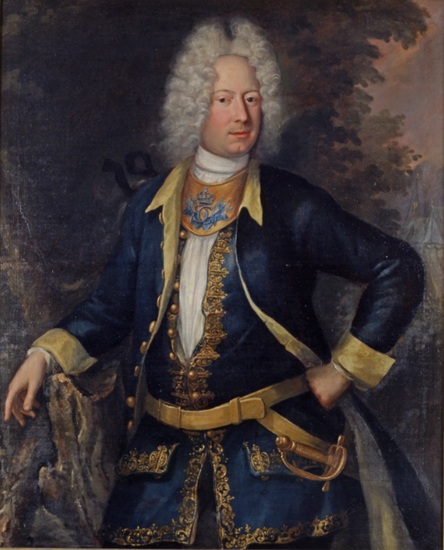 |
|
Two pictures of Arvid Horn who
was the Captain Lieutenant of the Drabant Corps 1695-1706.
On the left a detail from a miniature painting by Johan Henrik
Schildt (Arvid Horn is marked as number 2).
On the right a portrait from 1705 by Johan David Swartz (the coat is not the
m/1699 uniform described below).
|
|
|
|
|
|
Lieutenant Colonel
(Carl Nieroth) |
Captain Lieutenant
(Arvid
Horn) |
Lieutenant
(Adolf Johan Kruusbiörn) |
Lieutenant
(Carl Wrangel) |
|
Hat: |
Gold lace |
Of “carbeck”, 3 ⁵⁄₁₆ lots gold lace. |
|
“Wirgince” hat |
|
Coat: |
5 ells of blue broadcloth, 6 ½ ell of blue moiré. 3 ells of
canvas, 4 lots of silk, 1 ell of silk bast, 1 ell of "dwelck" (coarse
ticking). 104 lots of wide gold lace and 17 ½ lots of gold border lace
(= 1.6 kg).
Distributed over the entire uniform: 3 ells of silk bast, 5
ells of parkum, 2 ells of bomersin, 2 ells of canvas. Silk
for the vest, 1 ell of franst ticking, 4 ells of canvas.
|
5 ½ ell of blue broadcloth. 11 ¼ ell of blue canvas, 2 ½ ell
of blue parkum, 13 ¾ ell of blue moiré, ¾ ell of blue velvet. 4 ⁵⁄₁₆
loaves of gold lace. 27 large gold buttons, 60 small gold buttons, 7
lots of silk. Gold lace (ells): 36 ½ wide tråssar, 36
narrower tråssar, 36 + 6 + 18 + 5 ¾ wide tips, 34 narrower tips,
20 narrow tips, 6 ½ + 16 + 14 border. Total weight: 214 lots.
(= 2.8 kg). |
6 ells of blue broadcloth, 6 ½ ell of taffeta, 1 ½ ell of canvas, 2 ells of
shiny dvelck (coarse ticking).
4 ½ ell of leather coloured broadcloth, 3 ells of silk bast, 2 ells of
canvas, 2 ½ ells of ticking 2 ½ ells of parckum, 2 ½ ells of
bommersin.
195 lots (= 2.6 kg) gold lace (for coat,
waistcoat and breeches). |
6 ells of blue broadcloth, 6 ells of yellow broadcloth, 12 ells of lining fabric,
5 ells of parckum, 3 ells of canvas, 9 lots of silk. 290 ⅜ lots
of gold lace
(= 3.8 kg). |
|
Waistcoat: |
11 ½ ell of isabell-coloured velvet
and 4 lots of silk. 27 ⅛ lots of wide gold lace. 42 buttonholes of gold.
54 small gold buttons and one large button. 48 ½ lots of gold for
fringes
(0.64 kg). |
Portrait from 1705 (see image above)
shows a blue waistcoat with gold lace. |
|
|
|
Waistbelt: |
Gilded buckle and 43 ½ lots gold fringes (0.57 kg). |
Buckle, 7 ½ lots gold lace. |
|
Covered with 1 ell of blue velvet. Buckle. |
|
Breeches: |
9 ⅝ lots gold lace, 4 ³⁄₁₈ lots gold
for buttonholes. |
Leather for pockets. |
|
|
|
Gloves: |
Decorations and 18 ½ lots gold fringe. |
3 ⁹⁄₁₆ lots gold lace. |
32 lots gold fringes (0.42 kg). |
Deer leather with decorations. |
|
Sword knot: |
Gold |
|
|
|
|
Shabraque & pistol covers: |
47 lots gold fringes (0.62 kg). |
|
|
|
|
Sources: black text = Tore Schreber von Schreeb (1936),
green text = Anders
Larsson. |
On 13
February 1701, the Drabant Corps was reported to have had a drummer and 8
trumpeters whose uniforms were worn out. According to the accounts, their
coats were adorned with silver lace. The kettledrum banners were also worn
out, and new ones were ordered that were to be white with gold fringes
around the king's monogram with a crown and palm branches embroidered in
gold, and also provided with banners of blue and yellow silk adorned with
gold and silver thread and gold fringe around the (blue and yellow?)
tassels.
After these
notes, the sources are silent about the uniform of the drabants. However, at
the end of 1716, the remaining drabants became officers in the Life Squadron.
The following year, the uniforms for the privates and non-commissioned
officers of this squadron were established, which they then wore for the
rest of the Great Northern War.
|
Life Squadron 1717-1721
|
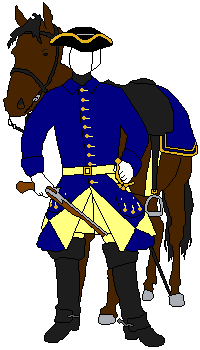
Private |
|
Hat: |
Black hat adorned with 11 quarters (163 cm) long and one-inch-wide gold
lace and a gilded button the same size as those on the coat. The
non-commissioned officers' lace was slightly wider
and the officers' slightly narrower. |
|
Neckcloth: |
Black silk crepe, 74 cm long and 26 cm wide, with 89 cm long half-silk
ribbons inserted. |
Coat: |
Blue broadcloth with blue collar and cuffs and lining of leather-coloured
baize. 28 gilded and turned brass buttons (the filemasters' with a
turned ring at the bottom along the edge, the vice filemasters' with a
turned pearl at the top of the button, the non-commissioned officers'
shiny and slightly smaller). The buttons were attached to the coat with
leather straps, and the buttonholes were lined with silk. The coat was
provided with hooks to fold up the skirt. |
|
Waistcoat: |
Buckskin waistcoat lined with ticking, that covered half the thigh and
with buttons like the coat, but slightly smaller and blind pocket flaps
(= false pocket flaps that were only marked on the waistcoat). 7 buttons
for privates and 24 for non-commissioned officers. |
Cloak: |
Blue collar and lined with leather-coloured baize on the back all the
way down to the slit or opening, but the skirts is lined even further. A
pair of brass cloak buckles and a smaller pair of brass buckles to
fasten the cloak on the back. |
|
Waistbelt |
Whole-cut
ox leather with pockets for both sword and bayonet and adorned with
ribbon under the edge. |
Cartridge box and belts: |
The carbine belt made of unlacquered ox leather with gilded brass
fittings (but not the carbine hook). The cartridge box is covered with
yellow leather and a black flap over the yellow. |
|
Breeches: |
Made of leather "without a seam between the thighs, narrow at the
knee, with a button to fasten below the knee”. The non-commissioned
officers had elkskin breeches that were fastened below the knees with 5
gilded buttons. |
Gloves: |
Thick ox leather collar with goatskin grip. |
|
Boots: |
Two types, stiff boots with collars and feet of Russian leather and
English soles in both the shafts and the soles of the feet, and soft
boots with “calfes after the manner, size and type, which His Royal
Majesty himself use". The spurs were polished blue. |
Shabraque: |
Blue broadcloth embroidered with 7 ¾ ells wide and equally narrow gold lace |
|
Sources: black text = Tore Schreber von
Schreeb (1936 and 1942), green text = Anders
Larsson. |
Later Drabant
Uniforms

Uniform depicted c. 1778 by an unknown artist. |

Uniform m/1779 depicted in 1783 by Carl Gustaf Roos. |
|
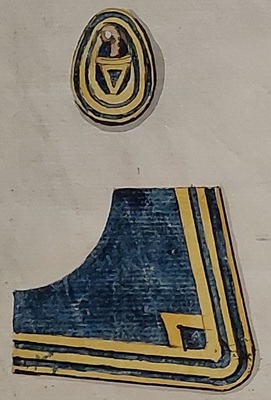
Shabraque and pistol covers m/1778 |
The uniforms
of the Livdrabant Corps during the period 1722-1765 have unfortunately not
been described in the literature and therefore I am completely lacking in
information about them. However, new uniforms were issued in 1725, so that
is the latest time when the uniforms from the Great Northern War may have
been replaced.
The uniform
that was decreed in 1765 was to consist of a blue coat lined with chalong.
The vest and breeches were yellow, and the hat was provided with gold lace.
The uniform also included a belt and égillette in blue and gold. The
officers' égillettes were entirely in gold. Procurement of such uniforms
took place both in 1765 and 1768. In the latter case, delivery was probably
delayed until 1771 and in connection with this, the cloaks that had been
issued in 1764 were also replaced. According to a drawing from around 1778,
the shabraque, pistol covers and hat were decorated with gold lace. The hat
also had a white feather plume and yellow silk cockade.
The next
uniform model that was based on Gustav III's national costume was probably
issued as early as 1778, although it is usually referred to as m/1779
because that was when the rest of the army was decreed to have such
uniforms. The exact appearance is not described in the sources, but it is
said to have looked like the picture above by Carl Gustaf Roos. That is, a
dark blue jacket with gold lace along the edges and lapels and a white
armband to show that the livdrabants had officer rank. Round hat with gold
lace, white and blue feather plume and yellow staff. Blue-yellow sash with
gold fringes, yellow breeches and collared boots. The officers were
distinguished by the fact that their jackets also had gold lace at the
buttonholes.
The shabraque
and pistol covers were given more lace in 1778, although it is not clear
from the model drawing whether they were gold or yellow. These were probably
used on parade and in the 1790s the livdrabants also wore buff coats and
cuirasses on parades. A yellow jacket also appears during the reign of
Gustav III and it is unclear whether it was a change to the uniform or a
parade garment. In any case, it became part of the uniform at the latest
when the m/1779 was replaced by the m/1792, which also introduced epaulettes
on the shoulders to show the rank insignia.
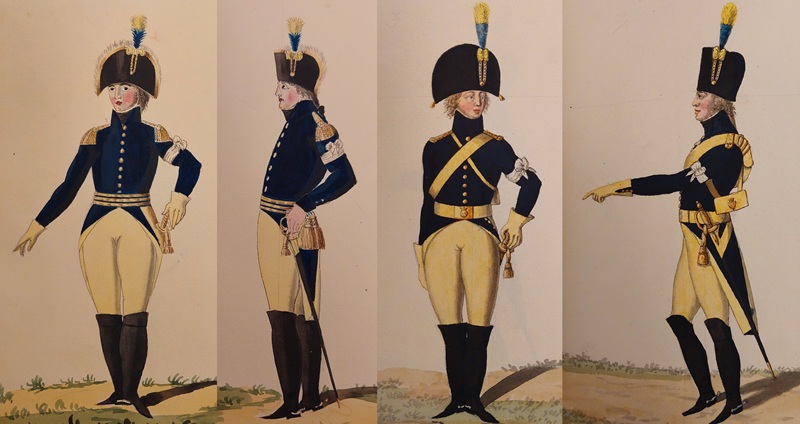
Livdrabant officer's and private's m/1801 uniforms
seen from the front and from the side (by Wilhelm von Runge ca. 1803)
On 14 December 1801, Gustav IV Adolf introduced a new uniform model for the
Livdrabant Corps, inspired by the simpler style of the Carolean uniform. The
tricorne hat also returned, although in accordance with contemporary fashion
it was higher and had a flattened front ("Bicorne"). In the pictures above,
the hat has a blue-yellow plume, but it seems to have soon turned white
instead. The white plume can be seen on a plate from 1808 plate from 1808,
which is kept at the Swedish Army Museum, and where the shabraque can also
be seen in the background.
The m/1801 uniform was used throughout the reign of Gustav IV Adolf, but for
the period after 1809 until the dissolution of the corps in 1821, I again
lack information about the uniforms of the Livdrabant Corps. In 1821, the
Livdrabants became officers of the Livbeväring Regiment, although when
necessary, they continued to serve as Livdrabants at the court until 1858.
The picture on the right is from the encyclopaedia Nordisk familjebok
and shows a "Livdrabant at the court of Charles XIV John 1844".
The Stånddrabant Corps seems to have been dressed in so-called "flaxar"
throughout their existence, which were sleeveless outer garments. Compare
the portrait of Drabant Petter Ljung from 1704
with the pictures below of Gustavian uniforms that were in use until the
Corps' dissolution in 1844.
Unlike the fashionable bicorne that was part of the livdrabants' m/1801
uniform, the stånddrabants were allowed to keep the so-called "Swedish hat".
The latter had been introduced by Gustav III in 1778 and was completely
abolished in the Swedish army in 1815 when the shako was introduced as
headgear instead. However, the stånddrabants wore them until 1844.
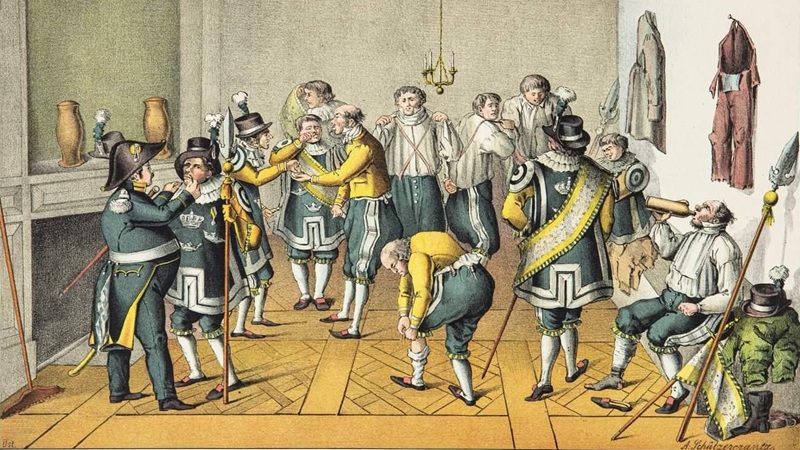
"The Stånddrabants’ Toilette ", lithograph by Adolf
Ulrik Schützercrants published in "Scener utur soldatlifvet"
(1831)
Two pictures by Adolf Ulrik Schützercrantz. On the
left, a picture from 1832 showing the corporal Anders Graak with a
partisan intended for command. On the right, a picture of a private
drabant from 1844. |
Not shown on
this page are the brand new Drabant uniforms that were purchased for Oscar
I's coronation on September 28, 1844. These were worn by commandeered
soldiers from the guards regiments. Instead of the Swedish hat, a
Prussian-style helmet was introduced, adorned with three crowns and a
yellow-painted cockade. Otherwise, the uniform consisted of a medium-blue
coat with yellow lining, trousers made of reindeer-hide, boots, waistbelt,
as well as cartridge box and gloves made of chamois leather. This uniform
was then in use throughout Oscar I's reign.
For the
coronation of Charles XV on 3 May 1860, Oscar I's Prussian-style Drabant
uniforms were replaced with two variants of national romantic uniforms that
were supposed to look exactly like the drabants of Charles XI and Charles
XII. However, due to insufficient knowledge, there were a number of
deviations from the originals. Among other things, they made the incorrect
assumption that the Drabant uniforms had the same simple and austere
appearance as Charles XII's preserved uniform. Although we now have better
knowledge, these anachronistic Drabant uniforms are still used today in
ceremonial contexts. |
|
Drabant Corps Colours

The colour of the Livgarde Company according to a watercolour painting by
Reginbaldus Möhner from 1632-1635.
The first record of a colour
for the drabants is from 1563 when Erik XIV went on campaign. The drabants
then received a so-called “fänika” with a yellow cross and fields in red,
green and violet. All troop units had yellow crosses at this time, but the
drabants distinguished themselves by having more colours on their fänika
than any other unit.
During the reign of Johan III,
the drabants stayed at home in Stockholm and there is no evidence that they
had a colour at this time. The Drabant Corps also did not have an ensign
employed, which was the person in charge of carrying a colour. An ensign was,
however, employed in 1600 when Charles IX went on campaign with his drabants
and in 1604 there is evidence that the corps was issued a colour that was
blue, yellow and red. A new yellow colour was issued in connection with
Charles IX's coronation in 1607. This colour possibly had decorations in
blue since the drabants' uniforms were yellow with blue details at the same
time. Additional colours with unknown colouration were issued in 1612, 1616
and 1617. However, we do know the colour issued in 1618, was yellow. In the
same year, the drabants became part of the Hovregemente and its colours were
then made up of varying mixtures of black and yellow fabric. The colours of
the Hovregemente and the Livgarde are described in more detail in the page
about the
Livgarde. It is worth mentioning, however, that the Livgarde Company
distinguished itself in the early 1630s by having an all-black colour with
the national coat of arms as a motif, while the other companies of the Royal
Regiment had yellow-white colours with geometric patterns as a motif.
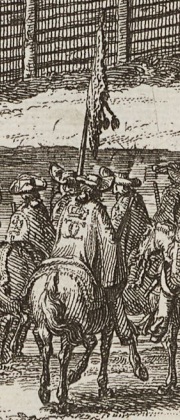
Detail from a copper engraving in Suecia
antiqua et hodierna. |
When the Drabants broke away from the Livgarde and formed independent
cavalry units – the Garde du Corps in 1655-1660 and the Drabant Corps from
1675 – these units do not seem to have been provided with any standards. The
sources do not mention any distribution of standards or details about what
they would have looked like. Furthermore, there was no cornet (= standard
bearer) in the organisations of these units. In Lemke's battle paintings of
the Scanian War, the Drabant Corps is also depicted without a standard,
unlike the other squadrons. The corps is also not mentioned in the
regulations on colours and standards that were issued in 1675, 1682 and
1686.
On the other hand, there is a copperplate engraving (part
III:54) in Suecia antiqua et hodierna that was engraved in 1694
and that depicts the Drabant Corps with no less than two standards even
though it only constituted one company (however, it was formed into two
squadrons during the Scanian War). There is also a drawing from 1695 among
the Drabant Corps' documents in the National Archives with the text "March
of the Royal Majesty’s Drabant Guard with standards" and which is signed
by Charles XI. This could indicate that the Drabant Corps had standards at
this time or that there were at least plans for them to have standards. But
if so, it has left no trace whatsoever in other sources.
A very late eyewitness account from a Polish noblewoman describes an event
from the Russian campaign when Charles XII was quartered in her estate. "One
evening an officer and 24 drabants arrived, who stationed at the gate 2
mounted guards and a blue and yellow colour with the Swedish coat of arms,
the latter as a sign that this was the king's quarters". It is clear
from the text that this was a so-called quarter colour and not a standard
carried in battle. If the Drabant Corps had had a standard, it would most
likely have been white with the national coat of arms or the king's monogram
as a motif, like the Livgarde, the Livregemente and the Liv-Dragoons. It is
possible that quarter colours have been misunderstood in the previously
mentioned cases.
The fact that the Drabant Corps did not carry standards during the Great
Northern War is also supported by the sketches of the Swedish cavalry
formation at the Battle of Poltava drawn by Major General Creutz. In them,
each squadron is shown as a rectangle and all but the drabants are provided
with standards on top of their rectangle. Not having field signs was indeed
unusual but not unique to the Drabant Corps since the Livgarde's Grenadier
Battalion did not have them either.
The Life Squadron did not receive a standard either, but perhaps it was
intended to receive one. Among the squadron's equipment is mentioned "a
Standard pipe and two straps out of it". |
|
Other
Equipment
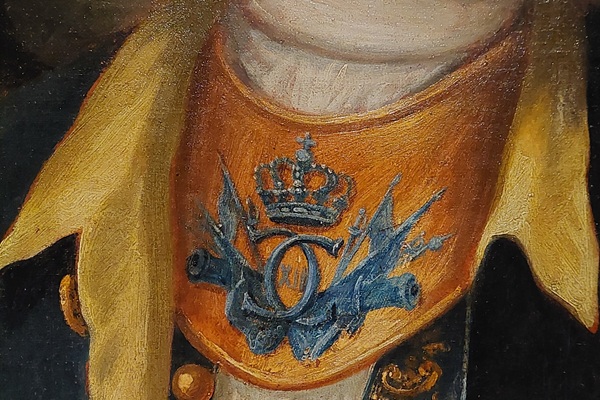
Gorget from a portrait
of
Arvid Horn who was the captain lieutenant of the Drabant Corps 1696-1706
Since the time of Gustav Vasa, the drabants had been armed with halberds, a
weapon that in Europe was strongly associated with the bodyguards of princes.
When the Drabant Corps served as a fighting unit, however, they had the same
weapons as the rest of the infantry. And in 1620, the halberds disappeared
altogether when partisans began to be used in ceremonial contexts instead.
However, there is information that the short-lived Nobility Company
(Adelskompani) had halberds in 1653.
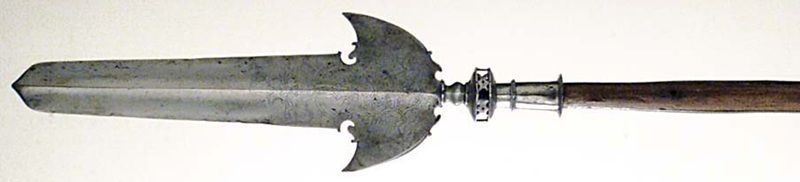
Partisan from 1626 with a length of 207 cm, of which
the blade is 48 cm. (5675_LRK)
The partisans that were issued in 1620 were made in Amsterdam and from there
another 60 partisans with the same design were issued in 1626. The first
batch had been ordered for the wedding of Gustav II Adolf on 25 November
1620. They consisted of both gilded and silvered partisans because they were
to have the black and yellow colours of the Vasa house and the red and white
Brandenburg colours of the queen. Under the partisan tip they had a tassel
of black silk with gold thread inserted and red silk with silver thread
inserted, respectively.
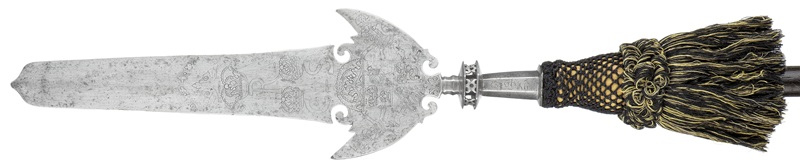
Partisan from 1649 with a tassel from 1965 in the
black and yellow colours of the Vasa house. The blade is 51.8 cm long. (5691_LRK)
Between 1626 and 1642, no new partisans seem to have been acquired. In the
latter year, it is said that most partisans were so worn out that the tips
could not be screwed onto the rod. Therefore, Queen Kristina ordered 24 new
partisans of unknown appearance, which were manufactured in Jäders bruk
outside Arboga. A further 48 gilded and 60 ungilded partisans were ordered
in 1645 from the same place and they were probably delivered the following
year. Their appearance was largely the same as those from the 1620s and they
were followed by additional similar partisans in 1648 and 1649.
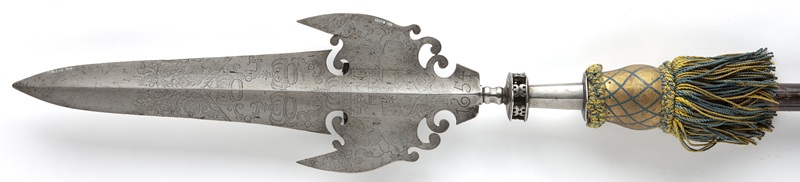
Partisan from 1654 with a blue-yellow tassel from the
19th century. Length: 212.5 cm, of which the blade is 66.5 cm. (24599_LRK)
Kristina's partisans were replaced as early as 1654 when Charles X Gustav
chose to acquire 60 gilded partisans with a different appearance for his
wedding (made in Garpström's mill, which was also located at Arboga).
Charles X Gustav's partisans were then in use until 1693 and had, like their
predecessors, ornamentations. At the funeral of Queen Ulrika Eleonora in
1693, however, Kristina's partisans were reintroduced, but with all the
ornamentations grinded away. Charles X Gustav's partisans do not seem to
have been used again until the Gustavian era, when they came to be used
together with Kristina's. At the same time, modified spoils of war from the
Seven Years' War also seem to have been introduced as commander's partisans.
All of these partisans fell out of use when the Stånddrabant Corps was
dissolved in 1844.

Carbine m/1699. Length 120.5 cm. (AM.031064)
When the
mounted Garde du Corps was formed by Charles X Gustav, they distinguished
themselves by also being armed with carbines. Other cavalry units at that
time were only armed with swords and pistols. The carbines had wheel locks
and this was also the case when the drabants were once again mounted in the
winter of 1675-1676. Flintlock carbines were issued for the first time at
the end of 1698. These were of German manufacture and had originally been
issued to Östgöta Cavalry Regiment. Completely new flintlock carbines
(m/1699) were not issued until 1703 and this model was then used during the
rest of the Great Northern War (although not by the rank and file of the
Life Squadron who received Dragoon muskets).
The pistols
also originally had wheel locks, and flintlocks were probably introduced at
the same time as the carbines. However, there does not seem to have been a
specific model for drabants. However, the Life Squadron received its own
model in 1717.

Pistol m/1717. Length 54.3 cm. (AM.034863)
The swords issued in 1675-76 had mounts of polished and blue-tanned steel
and a hilt twined with brass wire. This type of sword was used until Charles
XII's reform of the Drabant Corps in 1700. After that, all Drabants were
officers and then their swords would have gilded mounts. A new model for
Drabant swords was established in 1701 and a full set was manufactured the
same year, but they did not arrive at the Drabant Corps until November 1703
together with new carbines. A new full set of m/1701 swords was manufactured
in 1711 but was not issued until 1725. Instead, a completely new model with
a longer blade was established in 1717 and the following year it was issued
to the newly formed Life Squadron.

Drabant sword m/1701 manufactured in 1711. Length
114.8 cm of which the blade is 97.3 cm. (AM.049927)
The Drabants
had cuirasses from at least 1677 during the Scanian War. A document from
1695 mentions that the officers were to have cuirasses with both breast and
back plates as well as special parade cuirasses. In March 1701, Charles XII
decided that the entire Drabant Corps should have cuirasses with both breast
and back plates. 200 such cuirasses were then manufactured in Arboga and
were ready to be shipped over at the end of July. These were somewhat
stronger than the previous officer cuirasses in that the back plates stood
up to shots from carbines, while the officer cuirasses' back plates only
stopped pistol bullets. All breastplates stopped musket shots.
In the early
19th century, the captain lieutenants of the Livdrabant Corps wore cuirasses
adorned with the lesser national coat of arms. This model was also a "full
cuirass", meaning it had both a breastplate and a backplate.
|

Detail from Johann Heinrich Wedekind's portrait of
Charles XII at
the Battle of Düna.
It shows drabant soldiers wearing cuirasses under their coats. |
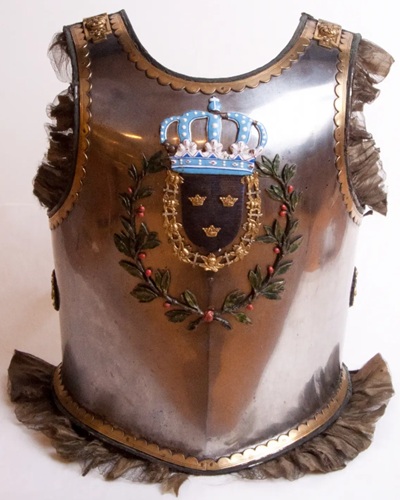
Cuirass for a captain lieutenant from the early
19th century.
(AM.061172) |
The picture above shows drabants with carbine belts and cartridge boxes
covered with blue velvet and gold lace. This was typical of the Drabant
Corps during both the Carolean and Gustavian periods making it hard to date
preserved item such as the carbine belt and cartridge box below that are
kept in Livrustkammaren in Stockholm. There is also a
waistbelt that may belong to these objects.
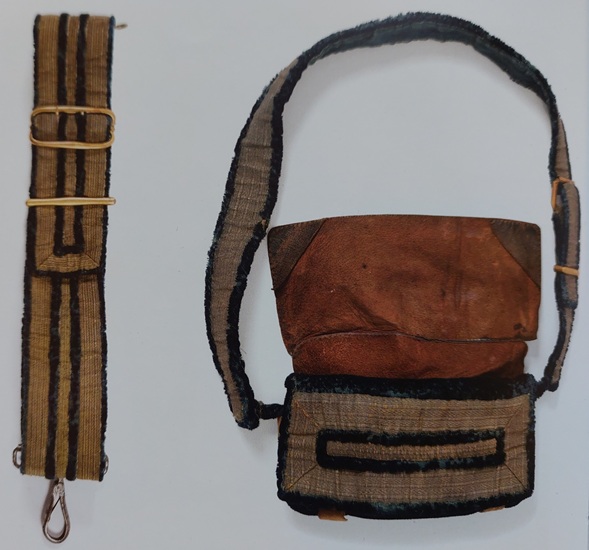
Carbine belt (25396_LRK)
and cartridge box (32228_LRK)
from an unknown date.
The cartridge box has an extra leather cover that would protect the velvet
in bad weather.
|
|
References
Drabanten och kaptenen vid Lifgardet Olof Stiernhööks journal
1700-1703. published by Samuel E. Bring (KFÅ 1912)
Brzezinski, Richard – Hook, Richard. The Army of Gustavus Adolphus – 1
Infantry. London (1991)
Göransson, Göte. Gustav II Adolf och hans folk. Stockholm
(1994)
Göransson, Göte. Gustav Vasa och hans folk. Stockholm
(1984)
Göransson, Göte –
Åberg, Alf. Karoliner.
Stockholm (1976)
Höglund, Lars-Eric. Från Karl Knutsson till Kristina. Karlstad
(2012)
Höglund, Lars-Eric. Skånska kriget 1675-79 - Fanor och uniformer.
Karlstad (1999)
Höglund, Lars-Eric – Sallnäs, Åke. Stora nordiska kriget 1700-1721 - Fanor och uniformer.
Karlstad (2000)
Ingesson, Stefan. Kungens män – Karl XII:s drabantkår. Lund
(2021)
Kuylenstierna, Oswald. Karl XII:s drabanter. Stockholm (1910).
Mankell, Julius. Anteckningar rörande svenska regementenas historia.
Örebro (1866)
Markelius, Martin. Gustav III:s armé. Stockholm (2020)
Schreeb, Tor Schreber von. Carl XII:s Drabantkår – Historik jämte
personförteckning 1700-1721. Stockholm (1942)
Schreeb, Tor Schreber von. Drabantromantik – Carl XV:s
drabanter, deras mundering och beväpning Stockholm (1951)
Schreeb, Tor Schreber von. Kongl. Maij:ttz drabanter – Deras
organisation, beväpning och mundering. Stockholm (1936)
Schreeb, Tor Schreber von. Lifgardets beklädnad och beväpning från Christina till Carl XII
(article in MAM 7). (1945)
Schreeb, Tor Schreber von. Lifskvadronens historia. Stockholm (1942)
Seitz, Heribert. Bardisanen som svenskt drabant- och befälsvapen.
Stockholm (1942)
Wernstedt, Folke – Cson Barkman, Bertil med flera. Kungl. Svea livgardes historia,
volume I-V.
Stockholm (1937-1976) |
|