|
Örjan Martinsson
| |
|



With 1,674 men, Närke-Värmland was the
largest regiment in the Swedish army and easily recognisable by the red
colour on their uniform. Not many regiments participated in more battles
during Sweden’s age of greatness than Närke-Värmland. They were involved in
the greatest triumphs such as Breitenfeld, the march across the Belt, Narva,
Fraustadt and Gadebusch. But it was also present in the greatest disasters
such as Poltava and Tönningen, which meant that during the Great Northern
War it had to be restored twice with great difficulty.
|
|
Organisational History
Närke-Värmland Regiment trace its origin in the so called “fänikor” that
were organised within the duchy ruled by the future Charles IX, specifically
Södermanland, Närke and Värmland as well as parts of Dalsland and
Västergötland. These formed a separate part of the Swedish army and had a
joint command from 1577. When Charles IX's younger son Karl Filip died in
1622, the duchy was annexed to the crown and the following year Gustav II
Adolf carried out a major army reform (the so called “Older Allotment
System”). This resulted in the former duchy's troops being organised into a
"land regiment" which was divided into two "field regiments" (the
Södermanland and Närke-Värmland regiments respectively). The division of the
Swedish army into land regiments was not to last, however, and in practice
the field regiments very soon became completely independent units, which was
confirmed in the constitution of 1634 where Närke-Värmland was ranked as
regiment number 19. At the same time, the men from the Västergötland and
Dalsland parts of the former duchy were transferred to other regiments.
During the
time of the Older Allotment System, soldiers were recruited through
conscription and the size of the regiments varied according to the need for
men. The regular organisation that applied to Närke-Värmland was nine
companies (three from Närke and six from Värmland) but extra companies were
raised during each war in the 17th century, and the company size was also
irregular, both over time and within the regiment.
In
preparation for Charles X Gustav's Polish War of 1655-1660, four new
companies were recruited in 1654 and then two more in 1658. However, no
redistribution of the men took place during these expansions, so the men in
the new companies came from completely different parts of the regiment's
recruitment district. In 1656, the regiment consisted of 1,369 men (plus 260
officers). But despite three conscriptions that replaced losses and formed
two new companies, the regiment was only 975 strong at the end of 1658. A
strength that was not to be expanded but rather Decreased slightly during
the following peace period when the regiment went back to nine companies.
During the
Scanian War, a tenth company was added, and a redistribution of the men had
the result that there were now four Närke companies and six Värmland
companies. During the winter of 1676-77, the number of soldiers from
Närke-Värmland was greatly increased by an extra conscription that created "Närke's
10-männings" and "Värmland's 6-männings”. These men formed their own
companies but came to be mixed with the regular regiment in a way that
sometimes made the distinction very unclear. After the end of the war, the
regiment returned to the old peacetime organisation, but already in 1681, a
tenth company was added again, this time a weak Värmland company.
After the
Scanian War, it became necessary to reform the Swedish military
organisation. Instead of conscription that occurred irregularly, the
peasants in each province were to be responsible for recruiting and
maintaining a certain number of soldiers (the “Younger Allotment System” or
the “Permanent Force” is it was actually called). The peasants of Närke were
among the first group to agree to the reform on 27 October 1682 (confirmed
by the king on 5 December), while the Värmland peasants were more hesitant
and waited until the end of 1686 to give their approval. The final contracts
for the allotting of soldiers in the provinces were concluded on 11 May 1686
for Närke (confirmed by the king on 5 August) and on 25 June 1688 for
Värmland (royal confirmation on 18 November). The fact that the Värmland
peasants took longer to agree to the reform may be due to the
disproportionately large burden imposed on them. It proved to be
particularly difficult to organise the Younger Allotment System in Värmland,
and during the Great Northern War the province would also take longer to
restore lost companies.
According to
the contracts, the peasants in Närke were to provide three companies with a
total of 474 men, while the peasants in Värmland were to provide seven
companies with a total of 1200 men. The provinces were divided into “rotar”,
each of them responsible for recruiting and maintaining one soldier. The
economically important Bergslagen was exempt from recruiting soldiers in
peacetime. Bergslagen included the Lekeberg district and the parishes of
Axberg, Kil, Hovsta and Lerbäck in Närke, and in Värmland: the Karlskoga,
Nyed and Filipstad districts and the parish of Gunnarskog in Jösse district.
|
Company |
Strength |
Districts (rotar) |

This map of Närke-Värmland County gives a rough
idea of the regiment's geographical distribution. The Bergslagen
districts in grey were not included in the Allotment System. Fellingsbro
district in white recruited to Västmanland Regiment. |
|
Colonel’s |
158 |
Asker (78), Sköllersta (72), Örebro (8) |
| Örebro |
158 |
Glanshammar (66), Örebro (41), Kumla
(36), Hardemo (15) |
| Major's
|
158 |
Hardemo (11), Grimsten (57), Sundbo
(24), Edsberg (66) |
|
Kristinehamn |
172 |
Visnum (105), Ölme (67) |
| Karlstad |
171 |
Ölme (22), Väse (84),
Karlstad (42), Kil (1) |
| Näs |
171 |
Grums (11), Näs (138), Gillberg (11) |
| Nordmark |
172 |
Nordmark (116), Gillberg (56) |
| Jösse härad |
171 |
Jösse (96), Gillberg (75) |
| Lieutenant Colonel's |
172 |
Nedre Fryksdal (97), Jösse (29), Kil
(17), Grums (29) |
|
Älvdal |
171 |
Älvdal (84), Övre Frykdal (23), Nedre Frykdal (9)
Kil (50), Karlstad (5) |
The
above-described organisation from 1688 would remain unchanged until 1812
when the regiment was divided in the middle along the Klarälven River. The
new Närke regiment then consisted of Närke's 474 rotar and 292 Värmland
rotar while the new Värmland regiment received the remaining 908 rotar. The
company organisation was also changed so that both regiments were divided
into eight companies. There were more organisational changes at the same
time, but these and the following reforms are not discussed here. It can be
mentioned, however, that Närke Regiment merged with the Life Regiment's
Grenadier Corps in 1893 and formed the Life Regiment on Foot, which already
changed its name to the Life Regiment's Grenadiers in 1904. Both this
regiment and the Värmland Regiment were disbanded in 2000.
Within the
Närke-Värmland area, the towns recruited sailors for the navy. These
so-called boatsmen were distributed in peacetime as follows: Örebro (13),
Nora (8), Lindesberg (6), Askersund (8), Karlstad (11), Kristinehamn (7),
Filipstad (5). In wartime, the number of boatsmen was doubled.
Additional Troops in the
Scanian War
During the
Scanian War, the army's need for soldiers surged. In addition to the regular
regiment, an extra conscription was carried out in both Närke and Värmland.
The procedure differed in the two provinces, but in both cases the military
service was conditional on only lasting for the duration of the war.
In Värmland,
every sixth man was conscripted, and these soldiers were called 6-männings.
The border districts were exempt from this extra conscription because they
were to a larger extent burdened to assist the army with peasant levies. The
conscription of the 6-männings seems to have taken place in at least two
rounds. Already at the end of 1676, six-männings arrived at Eda redoubt
where at the beginning of 1677 there were six companies of 6-männings with a
total of 700 men. The last round of 6-männings (410 men) were mustered in
Kristinehamn on 14–16 May 1677. In the same month, four companies (600 men)
"Värmland's 6-männings of 1677" were included in the Västergötland
army which was stationed in Gothenburg.
In Närke,
every tenth man was conscripted in October 1676 by dividing the province
into rotar that made no distinction between land-owning peasants and the
nobility’s peasants. A total of 447 men were recruited in this way, and they
came to be called 10-männings. "Närke's 6-männings" are also mentioned,
while the term 10-männings gradually disappears. But this change in
terminology is most likely a misunderstanding and both terms ought to refer
to the same group of soldiers and not to separate rounds of conscripts.
In early
1677, the Livgarde was given the 6-männings from Örebro County as
replacements for losses during the previous year. These 6-männings had first
been sent to the Eda redoubt but were so undisciplined that many of them
deserted and returned to Närke. The number of 6-männings that had been added
to the Livgarde in May 1677 was no more than 19 men. But at the end of June
the Livgarde received in Scania a contingent of 121 recruits, which
consisted entirely or mostly of the 6-männings. However, not all 6-männings
were incorporated into the Livgarde, since 150 men of "Närke's 6-männings"
are stated to have been garrisoned in Bohus from October 1677 onwards.
The
distinction between the 6- & 10-männings and the regular regiment seems to
have gradually become blurred as men from each category were mixed in the
same companies. During the second half of the war their special companies
seem to have been limited to two companies of Värmland 6-männings in Eda
redoubt and one company of Närke "6-männings" in Västra Götaland.
At the same
time as the 6-mmännings were conscripted, two dragoon companies (150 men)
were also raised in Värmland. This was done at the suggestion of the
governor and, as usual, the peasants paid for their clothing and horses,
while the crown provided for their armament. Both companies were initially
stationed in Dalsland but returned to Eda at the end of 1677. At that time,
they consisted of 6 officers and 136 NCOs and privates, of whom 18 men
lacked horses. But the condition of these companies was so poor that they
were barely fit for service.
Additional Troops in the Great Northern War
The same part
of the allotment system that recruited Närke-Värmland Regiment was given the
task of raising another regiment at the outbreak of war in 1700. This was
done by bringing the rotar together into groups of three who would recruit
an extra soldier, a so-called 3-männing. The new Närke-Värmland 3-männing
Regiment thus consisted of 158 men from Närke and 314 men from Värmland (there
should actually have been 400 men from Värmland, but the rotar along the
border were exempted from recruiting 3-männings). In addition, 551 men from
Bergslagen were added through conscription. Together with the Bergslagen
soldiers, the regiment thus reached a strength of 1023 men. Unlike the
regular regiment, however, the 3-männing regiment was a one-off recruitment
and their rotar did not have to replace losses. However, 4- and 5-männings
were added in 1703. These were recruited in a similar way so that the rotar
whose soldiers were on campaign were brought together into groups of five,
while the rotar of the companies at home were given a slightly higher burden
by forming groups of four that would field an extra soldier. A total of 369
four- and five-männings were recruited in Närke-Värmland, which together
with their colleagues from Västergötland formed a full regiment consisting
of 1209 men. This was also a one-off recruitment of the rotar.
The first
incarnation of the 3-männing regiment was disbanded in 1708 because of the
Battle of Lesnaya and its men were transferred to the Livgarde. However, in
1711, Charles XII Decided to raise a new 3-männing regiment, which was done
the following year. This time, however, it did not include any conscripts
from Bergslagen and more rotar along the border were exempt from recruiting
3-männings. The second 3-männing regiment was therefore no larger than a
battalion when it was raised (158 men from Närke and 300 from Värmland).
However, through recruitment of enlisted soldiers it was later increased to
over 700 men, although the plan for a complete regiment consisting of 1200
men was not achieved. This unit participated in the Battle of Hangöudd (Gangut) in
1714, where they lost about a hundred men. It was disbanded in 1720 and the
men, who then numbered only 481, were transferred to the Livgarde (261 men),
the Artillery Regiment (86 men) and the Östgöta 3-männing Regiment (134
men). The 4- and 5-männing regiment was also disbanded in 1720 and its men
were used to form a garrison regiment in Stralsund.
Wartime Organisation in the Great Northern War
On 11 November 1700, the 4 ½ companies that were part of the main army in
Wesenberg were reorganised into ten field companies in order to increase the
officer density. However, on 8 January 1701, the company organisation was
restored to the old one. Instead, a higher officer density was achieved by
doubling the number of officers in each company. In April, three extra
non-commissioned officers were added to each company (an extra fältväbel,
sergeant and förare) so that these companies had eight non-commissioned
officers instead of the normal five. Only the companies that were on
campaign received extra officers and NCOs, and they were paid with cash
salaries instead of being funded by the allotment system as the regular
personnel.
Nordensvan's regimental history does not mention what the wartime
organisation was like for the restored regiment after the Battle of Poltava,
but it probably followed the same pattern as the
Dal Regiment's wartime organisation. The regimental history also
mentions very little about the time before 1709, and the above information
comes from Nordensvan's article in Karolinska förbundets årsbok 1916
(page 126).
Colonels
and Battles
(Green background indicates victories, red background
defeats and grey background indecisive battles)
|
|
The Duchy's Fänikor |
|
1577-1598 |
Jürgen Ladow
von Berlin |
|
1598-1602 |
Samuel Nilsson till Hessle (Ross) |
1598 Stångebro |
|
1602-? |
Mårten Buller |
1605 Kirkholm
1612 Älvsborg |
|
?-1622 |
Hertig Karl Filip |
|
1622 |
Konrad Teckelberg |
|
1622-1628 |
Alexander Leslie |
|
|
Närke-Värmland Regiment |
|
1623-1628 |
Alexander
Leslie |
1627 Dirschau |
|
1628 |
Johan Kinninmunth |
|
1629 |
Matthias Kagg |
|
1629-1631 |
Axel Lillie |
|
1631-1643 |
Thomas Thomsson |
1631
Breitenfeld
1636 Wittstock
1642 Leipzig |
|
1643-1653 |
Johan Gordon |
|
1653-1661 |
Johan von Essen |
1657 Frederiksodde
1658 March Across the Belts |
|
1659 Copenhagen
1659 Nyborg |
|
1661-1669 |
Nils Posse |
|
1669-1678 |
Jonas Hansson Gyllenspetz |
1676 Lund
1677 Landskrona |
|
1678 |
Carl Hård af Segerstad |
|
1678-1701 |
Reinhold Rehbinder (led the home companies
1700-1701) |
1701-1721
|
Carl Gustaf Roos
(led the field companies 1700-1701)
(in Russian captivity 1709-21) |
1700 Narva
1701 Düna
1702 Kliszow
1706 Fraustadt
1708 Malatitze |
|
1709 Poltava |
|
May-Oct.
1710 |
Magnus Cronberg (acting) |
|
1712-1717 |
Pehr Adlerfelt (acting) |
1712 Gadebusch |
|
1713 Tönningen |
|
1717-1723 |
Carl Ulrik Torstensson (acting to 1721) |
|
1723-1728 |
Johan
Carl Strömfelt |
|
1728-1737 |
Carl Knutsson Posse |
|
1737-1738 |
Gustaf Gadde |
|
1738-1743 |
Henric Magnus von Buddenbrock |
1742 Helsingfors |
|
1743-1748 |
Carl Henrik Wrangel |
|
1748-1765 |
Pehr Kalling |
|
1765-1779 |
Gabriel Spens |
|
1779-1791 |
Johan August Meijerfeldt |
|
1791-1793 |
Gustaf Mauritz Armfeldt |
|
1793-1813 |
Carl Johan Leijonstedt |
|
1812-1840 |
Carl Cederström (Värmland Regiment) |
|
Feb.-Aug. 1813 |
Carl Henric Anckarsvärd |
|
1813-1816 |
Gustaf von Otter |
|
1816-1849 |
Christer Mörner |
Närke-Värmland Regiment was
partitioned into Närke Regiment and Värmland Regiment in 1812.
Both regiments were disbanded in 2000, but Närke Regiment was called the
Life Regiment’s Grenadiers from 1904.
Soldiers from Närke-Värmland Regiment participated in the Battle of Lützen
in 1632 as part of Erik Hand's combined regiment which also included
soldiers from Östergötland, Jönköping, Uppland and the Dal Regiment. |
|
Scanian War
The
Närke-Värmland Regiment was split up in several different theatres of war
during the Scanian War. Troop movements within the regiment between the
different theatres of war were common, and men from both regular and extra
companies were often split up and merged during the course of the war. This
and the lack of sources make it very difficult to give a clear picture of
the regiment's movements and total strength during the Scanian War.
As an example
of what it could look like, the general muster in May 1677 reported that
there were 4 Närke companies and 2 Värmland companies in Scania with a total
of 767 privates. In the Västgöta army located at Gothenburg, there were 146
men divided between two Värmland companies and in Eda redoubt there were two
Värmland companies with 158 men. The number of “sick and paralyzed” was 107
and the number of “prisoners and missing” etc. was 63. However, the men were
so mixed up after constant relocations that each company had men at all
three places.
At the end of
April 1679, the regiment was divided into four companies in the home
districts, one in Eda, three in Eda redoubt (of which two were 6-männings)
and five companies in Gothenburg and Nya Älvsborg (of which one was
6-männings). No regular companies existed in Scania, although there were men
there who were part of a composite unit (1 officer and 100 men). In total,
the regiment then reported a strength of 27 officers and 1386 men, of which
208 were sick.
Bremen-Verden
In 1672, two Närke-Värmland
companies were transferred to Bremen-Verden. There they were part of a
regiment composed of contingents from various provincial regiments under the
command of Jean Mell. In January 1673, the two Närke-Värmland companies had
a strength of 248 men (the part of the regiment that stayed at home
consisted of 817 men). These companies were stationed in the fortress of
Carlsburg in western Bremen-Verden, which in the autumn of 1675 was
subjected to a blockade by troops from Denmark, Münster and Lüneburg. The
Swedish garrison, which suffered from a lack of food and shoes, was weakened
by disease and chose to capitulate on 12 January 1676. The Swedish-born
soldiers (four companies) were allowed to be shipped over to Gothenburg. But
of them, no more than 200 healthy men remained.
Värmland
Immediately after Denmark
Declared war on Sweden in September 1675, five companies of the
Närke-Värmland Regiment were garrisoned in the Eda redoubt on the Norwegian
border. These companies consisted of a total of 15 officers, 74
non-commissioned officers and 740 privates. They were also reinforced with
two cavalry companies from the Livregemente. Since the redoubt was
dilapidated, they immediately began to work to refit it together with levied
peasants. This could be done relatively undisturbed since the only activity
from the Norwegian side during 1675 was that a cavalry force showed up at
the end of October. However, it turned back without a fight when it saw that
the redoubt was too strongly defended. The Swedes also crossed the border in
early December when they made a foray towards the Kongsvinger area, and they
too turned back without being involved in any fighting.
Even during the continuation of
the war, Värmland's border with Norway was relatively calm. Only minor raids
were carried out by both sides to gather intelligence or plunder.
Insufficient provisions and disease were a bigger problem for the garrison
in Eda redoubt than the Norwegian enemy.
At the beginning of 1676, the
troops in Värmland and Eda consisted of 900 men from Närke-Värmland Regiment
as well as 7–8 thousand levied peasants and 300 cavalrymen from the
Livregemente and 118 Värmland dragoons.
At the beginning of 1677, there
were two companies of 200 men in Eda redoubt, along with 300 men from the
“brigades” on campaign. In addition, there were 6 companies of 6-männings
(700 men), two of which were soon sent to Bohuslän. In Eda itself, there
were 4 companies with 400 men. At the end of February, the strength in Eda
was 250 men from the regular regiment, as well as 400 six-männings and 350
ten-männings. In May, the corresponding figures were 500, 600 and 400 men.
However, the general muster in May only reports two regular companies (158
men) at Eda. The troops were plagued by a lack of suitable clothing and
provisions, which led to high levels of sickness. In August, the
Närke-Värmland regiment had six companies at Eda and it was reported that
216 men were sick. The number of 6-männings was then 390 men.
It was planned to rebuild the
Eda redoubt during the summer of 1677 so that it could be defended by a
smaller garrison. However, it is unclear whether this was carried out. To
guard the long border, 1 officer and 50 men were sent to Nordmarken and the
same number to Gunnarskog. 1 non-commissioned officer and 25 men were sent
to Morast, 15 men to Ås and 12 men to Kortlanda.
On 20 January 1678, the Eda
garrison consisted of 5 companies, one of which consisted of 6-männings. A
total of 14 officers and 385 healthy and 217 sick NCOs & privates.
6-männings were in all companies and constituted the majority of the force.
Since a Norwegian attack on
Värmland was feared, Lieutenant Colonel Sparre was ordered to reinforce Eda
by sending all the people in Västergötland who belonged to the regiment.
Sparre replied that there were no more people left in Västergötland, but he
would gather all the people who had been sent home from Scania due to
illness. The result was 1 captain, 1 ensign, 3 non-commissioned officers, 6
corporals, 1 healthy drummer and 1 sick drummer, 43 privates who were fit
for duty, 20 sick, 4 paralyzed and 6 who had the Royal Maj.'s passport.
The Norwegian attack did not
come, however, and when a battalion was sent to relieve Bohus, the garrison
in Eda redoubt was reduced to one regular company and two companies of
6-männings (a total of 300 men). This force constituted the garrison of Eda
redoubt for the rest of the year. Because when the siege of Bohus was lifted
in July, the Värmland battalion was ordered home and remained in its home
districts throughout the winter of 1678-79.
In February 1679 the Norwegians
attacked both Eda, which was subjected to shelling, and the southern part of
Värmland and Dalsland. However, the Eda redoubt was judged to be too strong,
so the Norwegians instead bypassed it and captured Morast redoubt, where 15
Swedes were killed and 40 were captured. After destroying this redoubt, they
returned to Norway.
At the end of April, the part
of Närke-Värmland Regiment that had been sent to its home districts was
mustered in Brunskog parish. It then consisted of four companies with 14
officers and 520 men, who were then sent to Gothenburg. In Eda there was a
company that included contingents from other companies and therefore
consisted of 4 officers and 200 men. In Eda redoubt there were also three
companies with 8 officers and 229 men (two of these companies were
6-männings).
While the regular regiment was
away, the commandant of Eda redoubt carried out a raid into Norway with the
help of levied peasants from Finnmarken to burn and plunder. However, the
roads were so well defended that only the farms closest to the border were
exposed to the ravages of the Värmland Finns, and with this the Scanian War
ended for Värmland.
After peace was made on
September 26, the regular regiment was sent home in October, but 3 officers
and 58 men remained in Eda redoubt and were still there in February 1680.
Västra
Götaland
The Swedish war plan for 1676
was to carry out a campaign against Norway and in January an army was
assembled in Vänersborg under the king's command, which included a battalion
from Närke-Värmland Regiment. This consisted of 12 officers (including the
colonel, lieutenant colonel and major) and 408 NCOs and privates. Due to a
too mild winter, the campaign could not be launched and in May Charles XI
was forced to head to Scania with the larger part of the army to meet a
threatening Danish landing. Närke-Värmland Regiment was among the troops
left behind in western Sweden.
In June 1676, the Norwegian
army advanced through Bohuslän and captured Vänersborg, after which the main
force continued towards Gothenburg. Närke-Värmland Regiment, reinforced with
levied Värmland peasants, marched towards Vänersborg, but thirty kilometres
from the city the regiment was abandoned by the peasants who returned home.
Vänersborg remained in Norwegian hands until September, when the Norwegian
army called off the campaign and returned to Norway.
In May 1677 there were two
regular Värmland companies (146 men) in Gothenburg. But in addition to these,
the Västgöta army also had four companies of Närke's 10-männings (400 men)
and four companies of Värmland's 6-männings (600 men). In October there were
two companies from Värmland at Göta älv river and 150 Närke's "6-männings" in
Bohus. The latter remained there when the fortress was besieged by the
Norwegians in 1678.
In July 1678, the three Närke
companies arrived in Gothenburg. During the winter of 1677–78, they seem to
have been at home, and they remained there until June, during which time a
new conscription of 319 men took place. On arrival in Gothenburg, they
consisted mostly of new recruits who were considered to be in good condition
but untrained. Their commander Sparre therefore requested that the part of
the regiment that was in Nya Älvsborg should join the Närke battalion. That
part consisted of 2 officers, 5 non-commissioned officers and 70 “old
soldiers”. When these had arrived in Nya Älvsborg is unclear, but Nordensvan
writes that they possibly came during the summer of 1676 (perhaps from
Bremen-Verden, whose companies Nordensvan was not aware of). However, Sparre
had been ordered at the beginning of 1678 to send all the men in
Västergötland to Eda redoubt but replied that there was nothing to send.
When a Norwegian attack on
Dalsland was feared, Major Lüttke was sent there with the “Värmland
Squadron”, but he was soon allowed to continue to Gothenburg, where in
July the regiment was part of the army that was assembled to relieve Bohus
from a Norwegian siege. The regiment's strength in that army consisted of
seven companies with 639 men. During a battle on Hisingen, the regiment lost
5 dead and 14 wounded. The Norwegian siege was lifted the same month. The
Värmland companies returned home while the Närke companies were stationed in
Gothenburg.
At the end of April 1679, there
were five companies in Gothenburg and Nya Älvsborg (one of which consisted
of six-männingss) with a strength of 8 officers and 358 men. In May, four
more Värmland companies arrived with 14 officers and 520 men who became part
of a field army that in July made an unsuccessful attempt to take Uddevalla.
After peace was concluded on 26 September, the Närke-Värmland regiment was
returned to its home districts, but one company of Närke's "6-männings"
remained in Gothenburg for some time.
Scania
The Danes probably captured one
of Närke-Värmland's colours when Helsingborg capitulated on 3 July 1676. The
colour belonged to Lieutenant Colonel Thomson's company. Nordensvan's
regimental history has no information that Närke-Värmland was in Scania at
the time, but it is possible that part of Närke-Värmland Regiment
accompanied Charles XI when he left Vänersborg in May and went to Scania.
In October, Charles XI gathered
an army in Ljungby in Småland to launch a counter-offensive in Scania. This
included a Närke-Värmland battalion of 260 men under the command of
Lieutenant Colonel Thomson. The campaign was conducted under difficult
conditions and the soldiers suffered from cold and hardship. Before the
Battle of Lund on 4 December, the Närke-Värmland battalion had shrunk to
only 117 men, and after the bloody battle, so few remained that they were
merged with another (unknown) regiment.
On 26 January 1677, however,
the main army in Scania once again had a Närke-Värmland battalion, whose
strength consisted of 14 officers and 390 NCOs and privates. In May, the
strength was 767 privates divided into six companies.
The major war event of 1677 was
the Battle of Landskrona on 14 July. Närke-Värmland Regiment participated
with two battalions and its losses consisted of 2 officers and 41 men killed
as well as 4 officers, 3 non-commissioned officers and 106 men sick and
wounded.
In 1678 Kristianstad was
besieged by the main Swedish army and the Värmlanders who were still part of
it had been merged into a battalion that also consisted of men from Småland
and Västerbotten. At the end of 1678 the Värmlanders consisted of 1
lieutenant and 54 men. At the end of April 1679 they consisted of 1 officer
and 100 men. |
|
Great Northern War
When the
Great Northern War broke out, the entire Närke-Värmland Regiment was tasked
with defending the Norwegian border. But already in the autumn, the Närke
companies, Kristinehamn Company and 54 men from Karlstad Company were
transferred to Pernau from where they marched east. They then participated
in the Battle of Narva with a strength of 26 corporals and 674 privates. In
the spring of 1701, the remaining 117 men from Karlstad Company were
transferred together with 328 recruits to replace losses. In the autumn, Näs
Company was also transferred to the main army. This resulted in a division
of the regiment that would largely remain in effect until 1716 and also
resulted in differences in uniforms and colours.
The four
companies that stayed home (686 men) were tasked with guarding the Norwegian
border and only participated in battles in 1711. Three of these companies
were in Scania from September 1714 to February 1715 (Jösse Company stayed
home), but otherwise they were near their home districts the whole time. The
other six companies formed a "field regiment" consisting of 988 men and they
belonged to the main army until the Battle of Poltava and the capitulation
at Perevolotchna in 1709. They were restored in 1709 and separated again
from the "home" companies when they were sent to Germany in 1712 to
participate in Stenbock's campaign, which resulted in another capitulation
in 1713. Restored again, the "field regiment" was in Roslagen in the summer
of 1715. Thereafter, the entire regiment was assembled, and it participated
in the Norwegian campaigns of 1716 and 1718 and spent the summers of 1719-21
in Uppland.
Field Regiment 1700-1709
|
1700 |
1701 |
1702 |
|
September |
March to Stockholm |
Jan.-June |
Winter quarters in Estonia |
Jan.-June |
The invasion of Poland |
|
Oct.-Nov. |
Campaign in Estonia |
9 July |
Battle of Düna |
9 July |
Battle of Kliszow |
|
20 November |
Battle of Narva |
July |
March to Bauske |
Aug.-Sep. |
Stay in Krakow |
|
December |
Stay in Narva |
Aug.-Dec. |
Operations in Courland |
Oct.-Dec. |
March Krakow-Sandomierz |
In the Battle
of Narva, 59 men were killed and another 35 died later from their injuries.
In addition, 4 officers were killed. An alternative source mentions 100
killed and 200 wounded. The period after the battle resulted in a continued
high casualty rate due to cold and lack of food in the country that had been
severely ravaged by the Russians. No less than 328 recruits (238 from Närke
and 90 from Värmland) left Örebro in April 1701 to replace the losses in the
field regiment, which was then only supposed to consist of 700 men. After
that, the losses seem to have become lighter for the field regiment, which
during the summer of 1701 had a nominal strength of 817 men and then with
the arrival of Näs Company in the autumn reached its "ordinary" field
strength of 988 men. However, the last reinforcements were mostly missing
weapons when they arrived. Of the 171 men in Näs Company, only 30 had
muskets and none of them had pikes. The recruits had no weapons at all.
In the Battle
of Düna on 9 July 1701, eleven men were killed. Another ten men died the
next day in the Cobron redoubt after a mine left by the fleeing Saxons
exploded. In addition, eleven men are said to have died that same month
during a raid on the Russian border. A year later in the Battle of Kliszow
on 9 July 1702, only one man was killed.
A second
round of recruits arrived at the regiment's winter quarters in Würgen in
Courland in the autumn of 1701 (together with Näs Company), but after that
recruits only arrived once a year. The table below shows the number of
recruits for each shipment and gives an idea of the regiment's losses.
Note, however, that not all recruits replaced fallen soldiers. Even
seriously injured or too old soldiers who were granted a discharge are
included in these figures. For example, there is a list from the stay in
Thorn in 1703 of 26 non-commissioned officers, corporals and privates who
requested a discharge. The age range for these was 40 to 64 years and a
third gave "pain" as the reason. The reasons for the others were evenly
distributed between the categories hernia, unfitness to march and war
injuries.
| |
Recruits |
|
| Spring 1701 |
328 * |
* = The number of recruits for the
spring of 1701 is taken from Gustav Jonasson's article in "Närkingar
i krig och fred" from 1989. Nordensvan has two different figures
on the number of recruits. In his book on the history of the Värmland
regiment from 1904 he stated that they consisted of 218 men and in an
article in KFÅ in 1916 he stated the number to be 188 men. |
| Late autumn 1701 |
Over 90 |
| Late autumn 1702 |
88 |
| Summer 1703 |
? |
| Early summer 1704 |
233 |
| Summer 1705 |
162 |
| Summer 1706 |
104 |
| August 1707 |
43 |
| 1708
contingents |
50 + 17 |
From July 1705 to August 1706, the Närke-Värmland field regiment was part of
the army division under Rehnsköld's command that had been left behind on the
border with Silesia. As a result, they participated in the Battle of
Fraustadt in February, where the regiment's losses amounted to seven killed
and 40 wounded. After reuniting with the main army, a year-long stay in
Saxony followed, with low casualties as a result.
|
1703 |
1704 |
1705-1707 |
|
Jan.-March |
Winter quarters in Little Poland |
Jan.-May |
Winter quarters in West Prussia |
Jan -05 till Aug. -06 |
Stay in Greater Poland |
|
March-May |
March to Thorn |
June-Aug. |
March to Lemberg |
3 February 1706 |
Battle of Fraustadt |
|
May-Oct. |
Siege of Thorn |
Sep.-Nov. |
March to Greater Poland |
August |
March to Saxony |
|
Oct.-Dec. |
Winter quarters in West Prussia |
Nov-Dec. |
Winter quarters in Greater Poland |
Aug. -06 till Aug. -07 |
Stay in Saxony |
The news of
the comfortable life in Saxony spread through letters to the homeland, so
that the rote-peasants had an easy task of finding willing recruits. The
result was the 1707 contingent consisting of 43 men who left in August. The
following two rounds of recruits for the year of 1708 (50 in May and 17 in
August) did not get further than Riga, however. Together with recruits for
other regiments and refugees from the Battle of Lesnaya (including from
Närke-Värmland 3-männing Regiment), they formed a new regiment in October
1709 under the command of H. G. von Buddenbrock. However, this and a similar
regiment were disbanded in 1710 when all national Swedish soldiers were
recalled to the homeland to join the restored regiments.
For the years
1707-1709, we have unusually detailed information for Närke-Värmland
Regiment about how its manpower changed month by month. During the stay in
Saxony from January to August 1707, the departures among the rank and file
were 29 men, which was divided into 3 promoted, 18 dismissed, 1 "sentenced
from service", 1 executed, 3 escaped (deserters) and 3 dead. In September,
the march from Saxony to Thorn (450 km) began and that month one soldier
died and six were dismissed. The next month another soldier died but after
that there were no more departures for the rest of the year.
|
1708 |
Strength |
Killed
&
Promoted |
|
1709 |
Strength |
Killed
& Promoted |
|
|
January |
954 |
6 |
|
March from Thorn to Smorgon (500 km) |
January |
693 |
17 |
|
|
March from Hadjatj to Poltava (350 km) |
|
February |
948 |
6 |
|
Stay in Smorgon and Radashkovichy |
February |
676 |
3 |
|
|
|
March |
942 |
9 |
|
March |
673 |
3 |
|
|
|
April |
933 |
5 |
|
April |
670 |
9 |
|
|
|
May |
928 |
2 |
1 |
May |
661 |
23 |
|
|
Battle of Oposhna |
|
June |
925 |
4 |
|
March to Mogilev (300 km) |
June |
638 |
180 |
7 |
1 |
Battle of Poltava |
|
July |
921 |
3 |
|
Stay in Mogilev |
July |
450 |
22 |
|
|
Captivity in Russia.
(red text = soldiers who entered Russian service) |
|
August |
918 |
60 |
|
Tatarsk operation, battle of Malatitze, March to
Severia (300 km), |
August |
428 |
9 |
|
1 |
|
September |
858 |
59 |
|
September |
418 |
12 |
|
4 |
|
October |
799 |
51 |
7 |
March fom Kostenichi via Romny to Hadjatj (350 km) |
October |
402 |
9 |
|
|
|
November |
741 |
32 |
|
November |
393 |
5 |
|
|
|
December |
709 |
16 |
|
December |
388 |
7 |
|
|
|
Sum: |
|
253 |
8 |
|
299 |
7 |
6 |
|
The table
above does not include officers and non-commissioned officers. The number of
the latter was at a stable level of about 35 men until the Battle of
Poltava. The musicians are also not included and their number fell during
the period from 18 men to 15.
On 1 June
1709, the field regiment consisted of 638 men (+ 20 officers and 33
non-commissioned officers and 15 musicians). Since the beginning of the
campaign, the regiment had thus lost 328 men. Those who were killed in the
Battle of Poltava consisted of 4 officers, 5 non-commissioned officers, 1
musician and about 175 of the rank and file. Just over 400 men were taken
prisoner by the Russians at Poltava and Perevolochna.
An important
note is, however, that after the Battle of Lesnaya, Närke-Värmland Regiment
was reinforced with Finnish soldiers who are not included in the figures
above. Since the soldiers in Lewenhaupt's army left all equipment that they
could not carry in Lesnaya, they could no longer function as independent
units. Therefore, they were temporarily assigned to other regiments in the
main army. Exactly who ended up in Närke-Värmland is unclear, as two sources
have conflicting information. According to Lieutenant von Weihe's diary, it
was Nyland Regiment (311 men) and the Finnish 3-männings (354 men). However,
according to Ensign Petre's diary, it was Österbotten Regiment (336 men). In
any case, the Närke-Värmland Regiment participated in the Battle of Poltava
with two battalions and may well have had more men than when they began the
campaign two years earlier.
Närke-Värmland Regiment
1709-1721
When news of the disaster in Ukraine reached Sweden, the rote-peasants were
ordered to restore the six field companies. These were to be ready for
departure on 15 January 1710, but the governor announced that the lack of
equipment made this impossible. The entire regiment instead stayed at home
as a border guard and in 1711 made a minor incursion into Norway. This was
to relieve the pressure on the troops defending Bohuslän against the
Norwegians. The next year, however, the division of the regiment into two
parts was re-established when the same six companies as before on 30 April
were ordered to march to Karlskrona to join Stenbock's field army. The plan
was that these companies would be reinforced with 53 men each from the four
companies that stayed at home so that the field regiment would reach a
strength of 1200 men, but this was not carried out.
The field
regiment arrived in Germany in mid-September 1712 and on 15 October had a
strength of 823 present, 88 sick, 15 vacancies and 62 men left in Karlshamn
to prepare for the next transport. Unfortunately, the field companies still
had major deficiencies in equipment (including 79 men missing coats and as
many as 469 men missing uniform hats). The last delivery of equipment was
not handed out from the manufacturers in Stockholm until January 1713 and
never arrived before the field regiment surrendered in Tönningen. Before
that, it had participated in the Battle of Gadebusch in December where two
officers and eleven privates were killed (three officers and 25 privates
were wounded). Those who were wounded in the Battle of Gadebusch were sent
to Wismar together with other personnel so that 83 soldiers from
Närke-Värmland Regiment escaped the fate that befell Stenbock's army after
Gadebusch. When Stenbock's army capitulated in Tönningen on 22 May 1713, 768
men from Närke-Värmland regiment became prisoners of war. The 83 soldiers in
Wismar were then part of a composite regiment and they too became prisoners
of war when Stralsund capitulated on 12 December 1715. Even the 62 men who
were left behind in Karlshamn were not too lucky, as about ten of them died
from hardship by May 1713, after which they were sent to better quarters in
Kalmar.
The second
restoration took longer than the first. The Värmland peasants had been very
reluctant to restore the 3-männing regiment, which was only completed in the
spring of 1713 (the king's order to this effect was written in July 1711 and
repeated in the spring of 1712). The restoration of the regular regiment
began in the autumn of 1713, but at the general muster on 21 February 1715,
207 rotar were still vacant. At a separate general muster of the three home
companies that were in Scania that winter, 75 men were discharged. The
situation does not seem to have improved when the "field regiment" was sent
to Roslagen in the spring, since it only counted 661 men present on 25 July
1715 (out of a nominal strength of 988 men). At the beginning of the
Norwegian campaign in 1716, however, the regiment was almost at full
strength, as on 18 January 1716 it counted 82 commissioned officers, 7
"absent without leave", 153 sick, 62 vacant and 1370 present. After that,
the manpower situation was stable and, unlike other regiments (the
Livgarde), they did not suffer high losses after the retreat from the second
Norwegian campaign in 1718. During the summer stays in Uppland in 1719-21,
the strength reports indicate that the regiment was almost at full strength,
albeit with high sickness numbers.
During the
Norwegian campaign of 1716, Närke-Värmland was part of the main force in
Holmedal led by Charles XII. It crossed the border on 25 February and
arrived in Kristiania on 10 March where a siege of Akershus began. However,
the siege was broken off on 19 April and the army marched to Svinesund
instead, which effectively ended the campaign for Närke-Värmland, who
returned home during the summer.
During the
1718 Norwegian campaign, Närke-Värmland was part of an independent force
that set out from Töcksmark on 4 November and arrived at Blaker redoubt at
Glommen on 24 November. The redoubt was then blockaded until word of Charles
XII's death arrived on 6 December. The regiment broke up and crossed the
border on 11 December. As a border defence, 600 men were placed in Eda
redoubt. On 31 March 1720, there were still 200 men from Närke-Värmland
Regiment in Eda redoubt, but the border was calm that year and peace was
made with Denmark-Norway on 3 July 1720. |
|
Närke-Värmland
Uniforms

Charles X Gustav's War |
Scanian War |

Great Northern War |

Seven Years' War |
Närke-Värmland Regiment stands out as a Swedish regiment that has never worn
a blue-yellow uniform. Its traditional regimental colour is red and that
colour has appeared in various combinations ever since the first uniform
regulation in 1655. During the time of Charles X Gustav, it was combined
with green, which was also the colour of the colours (flags) at that time.
Red-green uniforms were issued until 1675, but during the Scanian War,
Närke-Värmland fought in red-white uniforms. After the Scanian War, the
white colour was replaced with blue, and then in the mid-18th century it
returned as a third colour in Närke-Värmland's blue-red-white uniforms.
Närke-Värmland's
Oldest Uniforms
1655 |

1675 |

Eda Redoubt 1676 |
1676-1681 |

1683-1691 |
A source from
1624 states that the Närke-Värmland officers were to have coloured clothing
while the men's uniforms were to consist of uncoloured grey clothes. This
was probably a typical uniform for Swedish regiments during the first half
of the 17th century. However, we do not have any more information than that
about Närke-Värmland until Sweden received its first uniform regulation in
1655. According to this, the Närke-Värmland uniforms were to consist of
green jackets and red breeches. Even though this regulation only applied to
the procurement of uniforms that was carried out before the war against
Poland in 1655, it is likely that the green colour was retained during
Charles X Gustav's war. This is because the regiment ordered green colours
(= flags) in 1658.
During the
rule of the Regency Council of Charles XI, we have no information about the
uniforms of Närke-Värmland, so the next uniform source is an undated list
from 1672 or 1673. According to this, Närke-Värmland was to have red clothes.
In 1674, two companies that were in Bremen-Verden also received red coats,
and on 17 December a uniform regulation determined that Närke-Värmland was
to have red clothes with green cuffs and edges. However, this uniform
regulation was replaced on 15 March 1675, by a new regulation that removed
the green colour. Instead, Närke-Värmland was to have red coats with white
cuffs and edges, which was also confirmed in a royal decree a month later
in which the colour of the stockings is stated as white.
The uniforms
that were issued to Närke-Värmland Regiment in June 1675, however, did not
follow m/1675 but consisted of red coats with green cuffs and edges as well
as green stockings. They also received hats and the non-commissioned officers
received grey coats with green cuffs. However, according to Höglund, this
uniform was only issued to a limited number.
For the year
1676, Höglund states that the field regiment had the m/1675 uniform with a
red coat and white cuffs and edges. He also writes that the garrison in Eda
redoubt (two companies) had a black karpus and a grey coat with black cuffs.
The latter uniform is also said to have been worn by the 6-männings in Eda
redoubt. The Närke 10-männings are also said to have had grey coats in 1676,
but otherwise their uniform is unknown.
In 1678 the
men still wore the red and white m/1675 uniform, and the non-commissioned
officers wore grey coats with red cuffs. The same uniform information is
mentioned for 1679 but now the colour of the breeches is also mentioned, red
for the privates and grey for the non-commissioned officers.
Broadcloth for new
uniforms was possibly issued as early as the autumn of 1681, and their
uniforms were stated in 1683 to have consisted of red clothes with blue
cuffs.
Närke-Värmland's Carolean
Uniforms
|

1691-1704
Narva, Düna, Kliszow |

1705-1706
Fraustadt |

1707-1709
Malatitze, Poltava |
1710-1713
Gadebusch |
Närke-Värmland received its first Carolean uniforms in the summer of 1691,
replacing the earlier red coats with blue cuffs that the regiment wore
according to a list from 1683. These were to be worn until 1704 and 1705,
when first the companies at home and then the field companies were issued
new uniforms. Since Närke-Värmland Regiment was de facto divided into two
parts, their uniforms became different during the war, and it was not until
1727-28 they once again received a common uniform.
The fact that
the uniforms had red cuffs instead of yellow is a very clear characteristic
of the Närke-Värmland regiment. But the metal details also distinguished
Närke-Värmland from the other regiments during at least the first half of
the war. Colours that were made in 1682 and lost in 1709 (possibly two
different sets) had silver-plated finials and nails (the normal thing was
that they were gilded). The coats that were made in 1696 had iron buckles
that were tinned (the normal thing was that they were made of brass). Then
there is a source from 1708 stating that the sword mounts were tinned
instead of the usual procedure of them being blackened (Larsson page 248).
The uniform buttons were also always made of tin (which was not unusual).
What can be observed is that every time metal details are mentioned, they
are made of silver/tin before 1709. After Poltava, however, the regiment no
longer seems to distinguish itself in that regard, as finials & nails are
gilded and all buckles are made of brass when those details are mentioned.
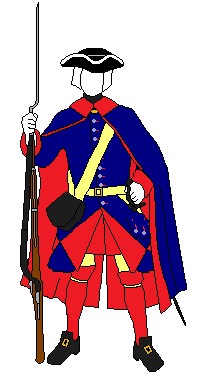
First Carolean Uniform 1691-1704/05
|
|
Privates |
Drummers |
NCOs |
|
Headgear: |
Information about the karpus is missing, but it was probably blue with
red lining. In 1701 the cap was blue with red
lining. 19 blue grenadier caps were sent to Örebro the same year. |
Karpus that cost as much as the privates. |
Karpus of unknown appearance.
1700: Blue karpus with red lining and silver lace. |
|
Coat: |
4 ¼ ells of blue broadcloth and three ells of red baize for lining and ¼ ell
of red broadcloth for the cuffs. 3 ½ dozen pewter buttons for privates and 4
½ dozen for corporals. The coat had no collar (unless it was blue). |
4 ¼ ells of blue broadcloth and 3 ells of red baize for
lining and ¼ ell of red broadcloth for the cuffs. At least 3 ½ dozen pewter
buttons. The coat was adorned with lace of unknown appearance. |
4 ½ ells of blue broadcloth and 3 ells of red baize for lining. The cuffs
must have been blue as no red broadcloth is mentioned. Pewter buttons (unknown
number). |
|
Sword belt |
It is unclear whether they received the waist belt or shoulder belt (Dal
Regiment and Västmanland Regiment had received shoulder belts the year
before). |
Received belts at the same time as the
rank and file. |
|
|
Waistcoat: |
Leather. |
Leather (probably pewter buttons). |
Probably elkskin buff coats. |
|
Breeches: |
Leather. |
Leather. |
Leather. |
|
Stockings: |
Red according to Erik Bellander (page 196, but without footnote). The
uniforms issued in 1704 and 1705 had that colour. |
|
Not mentioned, but the uniforms issued in 1704 and 1705 were blue.
1700: Blue stockings. |
|
Shoes: |
There is no information for 1691, but before the 1698 muster, new shoes
made of Russian leather were issued. |
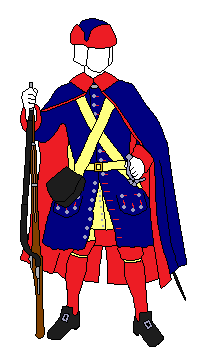
Private soldier with cloak made in 1696 |
|
Cloak: |
Piecoats existed in 1691 but are not described. Cloaks were made in 1696
and at the general muster in 1698 they were of blue broadcloth and lined with
red baize on both fronts and a part on the back. The collar was also "dressed".
Each coat had a good tinned iron buckle. |
|
Neckcloth: |
1701: A neckcloth made of ticking with a black
ribbon. |
|
Gloves: |
1701: 112 pairs of leather gloves. |
|
Sources: black text = Björn Asker,
red text = Lars-Eric Höglund,
purple text = Anders Larsson. |
|
Field
Companies 1705-1713
The 988 men from Närke-Värmland Regiment who participated in Charles
XII's campaign began the war with the uniforms that had been issued in
1691. To replace worn-out equipment, they received coats, cloaks and
karpuses that belonged to the companies that remained in the homeland in
the autumn of 1701. It was not until 1705 that they received completely
new uniforms (during the summer according to Asker and during the autumn
according to Nordensvan). More precisely, 758 sets of uniforms had been
ordered on 6 March 1705 to be delivered as soon as possible (Bellander,
page 225). Exempt from this order were 232 recruits who had arrived the
year before with new uniforms. However, the colonel complained that
their clothes were so worn out when the new uniforms were delivered that
they also needed new uniforms. Supplementary uniforms for them were
therefore ordered on 21 February 1706, which included 232 black-red
karpuses of the same type that had been issued in 1705. However, these
karpuses were not collected in May 1707 because hats had been ordered
for the entire regiment in Saxony.
The field regiment
apparently received new uniforms with hats during their stay in Saxony,
which unfortunately have not been described. One clue, however, is the
uniforms worn by recruits who arrived in 1707 (although they strangely
have yellow linings on their coats, which was probably due to some
coincidence).
When the field companies
were restored after the disaster in Ukraine, an order was placed for 921
sets of uniforms (the 67 recruits from 1708 who did not get further than
Riga did not need new uniforms). However, the manufacturers refused to
release the uniforms until they had been paid, so the uniforms were
delivered in portions until January 1713. However, the last delivery did
not reach the field regiment and its 466 karpuses were instead issued to
the companies at home. |
|
|
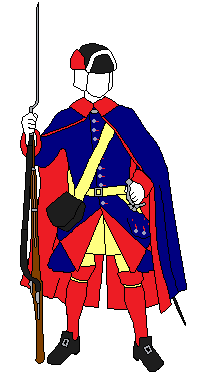
Issued in 1705
(did not include 232 recruits) |
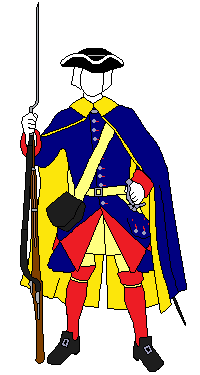
Recruits in 1707
(43
men) |
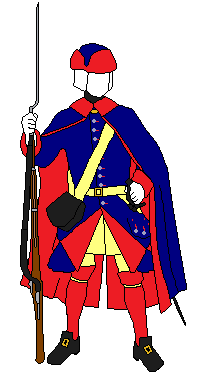
Ordered in 1709
(921 sets delivered in portions until 1713) |
|
Headgear: |
"The hat crown and “snibben” (peak or tip) shall
be ... black in colour, without broadcloth, the brim framed with a two-finger
wide cord and white camel hair and wool yarn, but the flap of red
broadcloth". |
Hat
("hats are ordered for the entire regiment in
Saxony"). |
Blue karpus with red flaps (466 were not issued to the field companies
but were instead issued to the home companies during the restoration
after Tönning). |
|
Neckcloth: |
|
|
One black and one white. |
|
Coat: |
Blue coat with
red lining and cuffs. (Höglund states that the field regiment was issued
a new uniform in 1704, but this is probably a misunderstanding). |
Blue coat with
red lining and cuffs and pewter buttons. |
Blue |
|
Waistcoat: |
|
Leather |
Leather |
|
Breeches: |
|
Leather |
Leather |
|
Stockings: |
Red
(Björn Asker specifies red for privates and blue for non-commissioned
officers). |
|
Red stockings and knee straps with brass buckles. |
|
Cloak: |
|
Blue coat with
yellow lining. |
Blue |
|
Other: |
|
|
Soldier shoes. Leather belts and gloves. Two pairs of shirts, a copper
flask and a knapsack each. 621 bandoleers with accessories such as brass
buckles, powder horns, grease horns, ball puller and nipple picks. 450
sets of musket holsters. |
|
Sources: black text = Nordensvan,
red text = Höglund,
blue text: Bellander (page 206),
green text =
Bengt
Nilsson. |
|
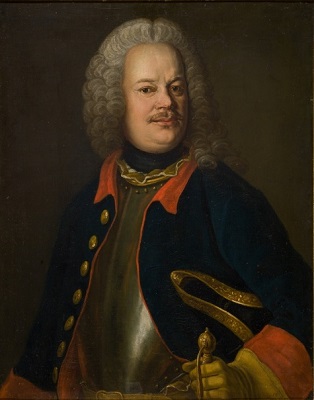
Anders Möller
Ensign 1709, lieutenant 1712, captain 1713, captured at
Tönning, returned home 1714, died in Norway 1716. |
In May 1712, the field regiment's 988
men (plus officers like Anders Möller in the picture opposite)
left their home districts for further transport to Germany. But
the regiment, which at that time consisted only of musketeers, had
very serious deficiencies in its equipment. The following items
were missing:
469 uniform hats (= the ordered
karpuses)
67 cloaks
79 coats
500 men had neither leather waistcoats nor leather breeches
286 pairs of gloves
162 shirts
73 pairs of stockings
288 pairs of shoes
386 swords
381 bandoleers
362 powder pouches
471 knapsacks
988 copper bottles
168 copper cauldrons
225 tents |
In addition, there were no
medical equipment, ambulances, ammunition or baggage wagons. It was not
until 28 January 1713 that the last of the missing equipment was
accounted for. But it is unlikely that it was delivered before the field
regiment surrendered in Tönning on 22 May.
Home
Companies and the Period
1713-1727
After the home companies
(686 men) were issued new uniforms in 1704, no new uniforms were issued
again for the rest of the war. The troops that were not on campaign were
given low priority and the regiment had great problems in obtaining
equipment for the field companies when they were to be restored in 1709
and 1713. Some equipment that was intended for the field regiment but
that had not been issued before the capitulation in Tönning was, however,
handed over to the home companies. This included 466 karpuses that were
given to the home companies because it was decided that the field
companies would receive hats when they were restored for the second
time. Hats were cheaper than karpuses. In addition, broadcloth was cheaper
than leather and the field companies had waistcoats and breeches made of
the cheaper material in 1717. Since the field regiment had lacked
leather waistcoats and breeches for 500 men in May 1712, it is possible
that these too were later issued to the home companies instead.
The first time it is
possible to discern that the field companies had received all their
equipment was at the general muster on 26 May 1717. The field companies
are said to have largely served without uniforms in Roslagen during the
summer of 1715. There is information from January 1716 that all
remaining equipment could be delivered during the month of April if
money was granted for this (Nordensvan page 103). However, even if this
happened, it means that the regiment participated in the first half of
the Norwegian campaign of 1716 with inadequate equipment.
For both the field and home
companies, the lack of uniforms must have meant that the soldiers wore
clothes they had obtained on their own. Grey “wadmal” coats must
therefore have been a common sight. |
|
|
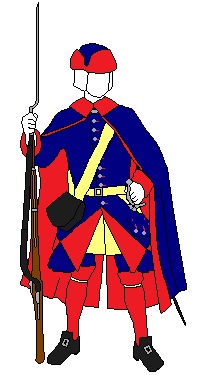
Issued in 1704
(home companies) |
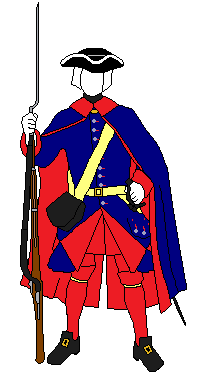
General Muster
26
May 1717
(field companies) |
Issued in
1727-28
(entire regiment) |
|
Headgear: |
Privates: blue karpus (after Tönning, they
received 466 blue karpuses with red flaps that had been intended for the
field regiment). Non-commissioned officers: blue
karpus with blue and red lace. |
Hats with white lace and buttons. Non-commissioned officers had silver
lace.
Drummer: hat with white lace. |
Hat with white lace. |
|
Neckcloth: |
|
Black (both black and white neckcloths had been ordered at for the
restoration). 1715: Drummers wore red flag cloth
neckclothes. |
|
|
Coat: |
Privates & NCOs: Coat of blue broadcloth with red
collar and red lining and pewter buttons.
Privates & drummers had flat pewter buttons while
the NCOs had round pewter buttons. The drummers had blue and red lace on
the seams. |
Blue coat with red lining, red cuffs and collar and pewter buttons.
Corporals had embroidered buttonholes. Drummer:
Blue coat with red lining, cuffs and collar and pewter buttons.
Drummer had three-finger wide lace on the seams, sleeves and around the
bottom made of blue, white and red camel yarn.
Non-commissioned officers: blue coat with pewter buttons, red lining,
cuffs and collar. The buttonholes were sewn with silver thread. |
Blue coat with red lining and collar. Flat pewter buttons. |
|
Waistcoat: |
|
Red broadcloth lined with ticking. Non-commissioned
officers and drummers: red broadcloth. |
Red broadcloth. |
|
Waist belt: |
|
Ox leather. 1715: Drummers had deer catcher belts.
1721: Privates had ox leather belts with buckles. |
|
|
|
Breeches: |
Blue. |
Red broadcloth. Non-commissioned officers and drummers:
red broadcloth. |
Leather. |
|
Stockings: |
Red wool stockings for privates and blue for
non-commissioned officers. |
Red wool stockings.
Non-commissioned officers and drummers: red wool
stockings. |
Red wool stockings. 1725: Privates had knee straps
made of yellow ox leather. |
|
Shoes: |
|
Shoes with brass buckles. 1721: Privates had waxed
leather shoes. |
|
Cloak: |
Privates & NCOs: Blue broadcloth lined with red baize
on both front sides and a part on the back, and with a red collar. |
Blue broadcloth with red lining and buckle. The
non-commissioned officers had in 1719 white lace around their collars. |
Blue broadcloth with red collar and two pairs of buckles (issued in 1724). |
|
Gloves: |
|
Ox leather collar. Drummers in 1719 and privates
in 1721 had goatskin gloves with ox leather collars. |
|
Sources: black text = Carl Otto
Nordensvan,
red text = Lars-Eric Höglund,
blue text: Erik Bellander
(page 230-231, 265),
purple text = Anders Larsson (it is not
clear whether this refers to the field or home companies). |
Liberty Age Uniforms
|

1728-1750 |

1750-1759 |
1759-1770 |
1770-1780 |
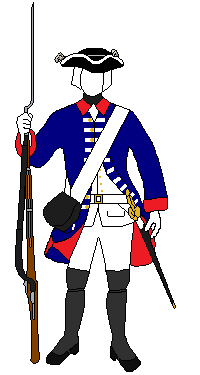
In 1727 and
1728, new uniforms were finally issued to the entire regiment, which for the
first time since 1705 was dressed uniformly (the cloaks had already been
issued in 1724). The appearance was the same as the field companies'
previous uniforms, but with leather breeches instead of red broadcloth breeches,
as described in more detail in the table above. A regimental order from 1728
also included the instruction that soldiers who could grow beards should
have moustaches with black beard wax.
Next time new
uniforms were issued was in 1741, at least for the companies sent to Finland
(no cloaks were issued this time). However, these uniforms were worn out
during the 1741-1743 war against Russia and were replaced in 1746 and 1750
by completely new uniforms. These had the same appearance as the previous
ones, except for the leather breeches which were partly replaced with red
broadcloth breeches in 1750. Due to a work assignment in 1751-1753 to build the
fortress of Sveaborg, the uniforms were subjected to a lot of wear and tear.
At the general muster in 1754, a third of the uniforms were judged to be in
such poor condition that they should be discarded. However, this did not
happen, and Närke-Värmland Regiment was had to participate in the Seven
Years War with these uniforms.
A regimental
order from 29 April 1744 stipulated that the “släpmundering” would consist
of grey wadmal coats with red cuffs and collars and flat tin buttons. On 6
November 1753, the men were ordered to obtain a “släpmundering” that would
have the same cut as the regular uniform and consist of a hat with white
lace, a coat and waistcoat of wadmal with white ticking as lining, red cuffs,
collar and buttonholes and flat tin buttons, leather breeches, white
stockings and good shoes.
In the roll
for the general muster in 1761, it was noted that grenadier decorations
acquired in the 1750s were still in usable condition.
The uniform
regulation from 1756 stipulated that Närke-Värmland Regiment should have the
same uniforms as the other regiments, that is, yellow instead of red. But
even though most of the clothing were replaced during the Seven Years War
1757-1762, the regiment retained its red distinctive colour. The uniforms
issued in 1759 were Närke-Värmland's last of the Carolean model and
consisted of a blue coat with a red collar and red cuffs, as well as a white
waistcoat and white breeches. These were considered to be completely worn
out at the general muster in 1767. By that time a new uniform regulation had
come into force in 1765 that was inspired by the decorative uniforms of the
Prussian army. Among other things, the hats were to have tassels.
Närke-Värmland had its first and only set of m/1765 uniforms issued in
August 1770 (see picture below).

Non-commissioned officer, musketeer and drummer with
uniform m/1765
Gustavian Uniforms
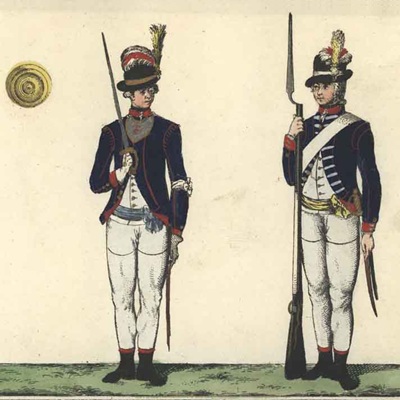
Officer and musketeer with uniform m/1779

Grenadier with uniform m/1792
(never issued but the old m/1779 uniform was re-sewn as
best as possible to resemble it) |
A radical
change to the army's uniforms came into effect in 1779 and, like the other
regiments, Närke-Värmland chose to re-sew their old m/1765 coats from 1770
into m/1779 jackets, which happened shortly after the general muster in
1780. The cylinder-shaped hat that was part of the new uniform model was
provided with decorations (plumes and lace) that the soldiers had to pay for
themselves. In 1784, new neckcloths, stockings and boots were issued.
At the
general muster in 1785, the re-sewn jackets were judged to be in such poor
condition that they were discarded. However, for financial reasons, the
distribution of new jackets was delayed until the summer of 1788 when war
with Russia broke out. The war meant that the uniforms quickly wore out and
a new m/1779 uniform was issued in 1792. This uniform was then re-sewn as
the uniform regulations were changed until it was discarded at the general
muster in 1806.
Grey m/1807
uniforms began to be manufactured in August 1807 and were thus issued just
before the Finnish War began in February 1808. As in the previous war, these
uniforms wore out quickly and were therefore discarded in December 1809. The
following year they were replaced by a new uniform model that had mainly the
same cut as the m/1807 but with the colours that had previously been used by
the regiment. This uniform was in use by the Värmland Regiment until 1816,
albeit with some additions. This uniform was also replaced by a completely
new uniform model (m/1816 with a shako as a headdress).
Since 1771,
officers wore a white armband as a reminder of Gustav III's coup d'état. It
was removed after the coup d'état in 1809. The gorget that was used as a
rank insignia for officers had previously been replaced by epaulettes on the
shoulders with m/1792. Epaulettes were also introduced on the
non-commissioned officer uniform in July 1795, with the colonel paying for
them. Insignia for corporals are mentioned in 1787 when the colonel selected
one that would then be purchased in Stockholm through a joint order.
As a
regimental symbol, the officers had a special design on the button, which is
depicted in the m/1779 picture above. Most regiments used the provincial
coat of arms as a symbol on the buttons, but it was probably because
Närke-Värmland was recruited in two provinces that they did not choose that
option. When the regiment was divided in 1812, it was Närke Regiment that
took over the button symbol.
There were
also company badges consisting of a button with different colour
combinations in blue and yellow. These had been introduced in 1783 on the
initiative of the colonel. In 1807, a regimental symbol was introduced on
the hats by royal decree, consisting of a two-coloured cross on a white
background. The crosses were blue vertically and red horizontally.
|
|
1780-1792
(re-sewn m/1765 uniform until 1788) |
1792-1806
(re-sewn m/1779 uniform) |
1807-1809 |
|
Hat: |
Hat (a half-high cylinder) with a narrow brim, fastened on the left side
with a button, to which a small yellow, white and red plume was attached.
The hat was surrounded by a white hatband (of silver for officers).
The hat would have a black woollen edging cord 1 ⅝ ell long, 1 ½ ells of
thread lace around the crown, 9 inches of button lace, and a brass
button.
The grenadiers (+ 2 non-commissioned officers and 2 drummers) had in
1775 received high pointed grenadier caps with front plates and with
cases, bandoleer badges and blue and white sword knot. Their drummers
had hats with lace and tassels. Each company also had a pioneer dressed
in a high cap and a leather apron. |
Hat with 8-inch-high crown and 3-inch-wide brim, fastened on the left
side with a button, the hat band made of brass (gold lace for the
officers) and a 9-inch yellow woollen plume attached to an upper button.
The plumes had been paid for by the privates themselves. |
The hat had a plate indicating regimental affiliation.
The symbol of Närke-Värmland Regiment was a
two-coloured cross with a white background. The cross was blue
vertically and red horizontally. |
|
Neckcloth: |
Black wool crepe (5 quarter ells long, including the
fold, with 9 inches wide and ½ ell of black Paduan bands at each end. |
Red |
|
|
Jacket: |
Dark blue (2 ½ ells of broadcloth). ⅜ ell
of red broadcloth was used for the jacket’s and waistcoat’s cuffs, stand-up
collar, edges and shoulder decorations. The jacket was open at the
bottom and had blue lapels with double pairs of white (silver) lace
across. The lining consisted of 1 ¾ ells of red baize and 3 ells of
broadcloth. 4 ells of thread lace and 17 small brass buttons. |
According to m/1792, the skirt of the dark blue jacket was to be
extended to 9 inches and folded up at the front so that the red lining
was visible. The colour of the lapels was changed to red (they were
removed in 1806, however) and the jacket was now buttoned all the way to
the waist. |
Grey jacket without lapels and one row of buttons. Dark blue collar,
cuffs and turnbacks. |
|
Waistcoat: |
White (1 ⅞ ell broadcloth) red collar and cuffs. Blue lapels
and 13 small brass buttons. Lined with 3 ¾ ells of fabric ("väv"). |
White |
Grey |
|
Sash: |
The privates had yellow sashes made
of flag broadcloth. The officers' were made of silk (also
blue according to the m/1779 picture above). |
"The belt as before" according to Nordensvan, but
m/1792 had a blue-yellow striped sash and m/1802 abolished the sash. |
5-inch-wide sash with blue-yellow stripes. |
|
Breeches: |
White breeches (1 ⅛ ell of broadcloth) with 2 ½ ells of
fabric ("väv") as lining and 7 small brass buttons. |
White breeches (there were also blue breeches, but they were discarded
in 1797 and not replaced). Officers also wore black breeches. |
In March 1806, a royal order was issued to immediately procure
medium-grey trousers with an inch-wide blue stripe (the stripe was
removed shortly afterwards, however). |
|
Leg clothes: |
Wool stockings that were an ell long
from the heel and had a red border at the top. |
Gaiters of the same model as m/1765 were reintroduced
(= black). |
Black gaiters that ended below the knees. |
|
Shoes: |
Boots made of oiled leather with a red wool yarn border
on the top of the shaft and loose soles. |
Shoes replaced the boots for the privates. The officers would also wear
boots made of polished leather that reached the knees. |
Shoes |
|
Other: |
Two shirts made of yarn. According to
an order from 1771, the grenadiers were to have dark hair and be no
shorter than "3 ells with the shoe" (178 cm). |
In 1799, it was decided that the privates would procure their own shirts,
stockings, shoes and soles for a small compensation. |
|
|
Source (black text):
Nordensvan, Carl Otto. Värmlands regementes historia. Stockholm (1904) |
Already at
the general muster in 1771, the existing cloaks had been deemed unusable,
but it was not until 1789, when war with Russia had broken out, that new
cloaks were issued. The old cloaks had continued to be used in the meantime,
although in fewer and fewer numbers. The privates had provided themselves
with their own overcoats made of “buldan” instead of the defective cloaks.
The musicians had never had cloaks but instead wore surtouts, which the
officers were also allowed to wear. The cloaks from 1789 were of the same
model that had been used throughout the 18th century and were worn until
1807, when they were replaced by so-called “kapotter”, which were grey with
sleeves and had a large turn-down collar that covered the shoulders and
reached down to the elbow. The grey colour of the kapotter was also retained
when new ones were issued after the Finnish War.
According to
a royal letter from 28 August 1793, the “släpmundering” was to have the same
cut as the regular uniform but consist of dark grey “wadmal” with a light
blue collar and cuffs, lapels and turnbacks of dark grey cotton and a lining
of dark grey fabric ("väv"). The hat was not to have a plume. However, the neckcloth
was to be red like the regular uniform because the colonel thought it would
brighten up the dark uniform. Sashes could also be included in the ”släpmundering” if the rote-peasants were willing to pay for them. In 1806,
it was decided that the jackets of the “släpmundering” would be slightly
longer when new ones were manufactured. Gustav IV Adolf also ordered that
the “släpmundering” be made of the same grey fabric that had recently been
introduced for the regular uniform’s waistcoat and trousers.
|
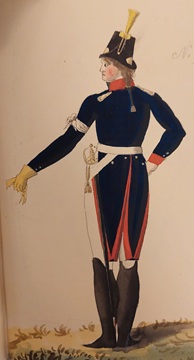
Officer uniform m/1802
(the front side can be
seen
here) |

Non-commissioned officer and two musketeers in
uniform m/1802
(never issued but the old m/1779 uniform was re-sewn as
best as possible to resemble it) |
|

Uniform m/1807 |
Since the
mid-18th century, soldiers' hairstyles were to include a pigtail, and
instructions on soldiers' hairstyles were something that officers spent a
surprising amount of time on during the Gustavian Age. For example, in 1792,
the curls at the ears and the pigtail were regulated so that: "the
measurement of the ear curls is that the lead sits below the earlobe and the
hair underneath is cut off a good inch below the ear, the pigtails on the
soldiers is wound 4 inches, the hair below 2 inches is cut off sharply, the
ribbon must not be tied but fastened". Five days later, the instruction
was supplemented by an amendment stating that until further notice, the men
were not allowed to cut the ear curls or the back of the hair. The following
year, the instructions were changed so that the hair whip was greatly
lengthened: "The hair is powdered, tied 2 inches from the head, the
pigtail is made of 14-inch ribbon with 2-inch long hair at the end, the hair
band is tied with two loops of the band and the hair is dressed with a curl
at each ear". To achieve this hairstyle, the captain of Näs Company gave
a supplementary instruction: "To change the pigtail, each man procures
for the company meeting three and a quarter ells of black wide Paduan ribbon,
4-inch long false hair similar to his own to the thickness of a finger, a
thin piece of leather the size of a hand and a ball of coarse thread or sail
twine, the size of a hen's egg. For each corporalship, half a pound of linen
or hemp, the corporals are to take care of the procurement of which, when
they then receive their compensation from the privates". He continues
the instruction with: "Each soldier procures for the company meeting a
hook ring and a piece of lead 4 inches long and 1 inch wide. Powder, pomade
and everything that belongs to the decorum, no man may be without for fear
of punishment".
After the
turn of the century, Gustav IV Adolf too began to issue instructions about
the soldiers' hairstyles. In 1801, he ordered the infantry and artillery to
get moustaches that should not be longer than covering the upper lip. In
1802, he ordered the soldiers to get sideburns that started at the ear and
then followed the jawbone so that they were at the height of the outer
corner of the eye and went under the neckcloth. The top of the sideburns
should be just under an inch wide and the bottom should be 1 ¼ inches wide.
In addition, they were to have side braids at the ears that were wrapped
with thin lead sheeting half an inch high. Below the lead there was to be a
one-inch-high tuft of hair. On 26 June 1805, the king ordered that the
braids and the pigtail be removed so that the hair was cut short around the
head. This applied to the entire army, but the officers were allowed to keep
their pigtails if they wished. This change in hairstyle meant that the
existing model drawing for m/1802 was corrected afterwards (the one with the
non-commissioned officer and musketeers). |
|
Närke-Värmland Colours

Olof Hoffman's model drawings of Närke-Värmland’s
colonel’s and company colour m/1686
The oldest
evidence of Närke-Värmland colours is from 1626 when they are said to have
had eight colours of red and ash-grey taffeta. Höglund, from whom the
information comes, has interpreted it as consisting of six horizontal
stripes in red-black-grey.
Otherwise,
the oldest known colours from Närke-Värmland are probably the white
colonel’s colour and two green company colours that were taken by the Danes
in the Battle of Nyborg on 14 November 1659. They are said to have been part
of a set of five colours that were made in 1655. All the colours have the
same motif consisting of a crowned golden lion standing on a green stone and
holding a silver sword and a pointed green palm wreath that is tied with a
blue ribbon and inside a black field with the letters CGRS in gold under a
closed crown. Above the lion a blue ribbon with tassels at each end and in
gold the text "HOC NOMINE VICTOR" (In this name you shall win). Everything
is surrounded by a green laurel wreath with green berries and black grenades
in the corners.

Colonel’s colour that was probably in use 1655-1659.
The company colours were green but with the same motif and were in use to
1674.
Even before Närke-Värmland lost its colours on Funen, a set consisting of a
colonel’s colour and seven parrot green colours had been made by Peter Blohm
in Hamburg in 1658. However, they were never issued due to non-payment and
remained in Hamburg until 1677. Some of these company colours were then
issued to Västmanland Regiment in 1679 and are described in the section on
Västmanland's colours. The colonel’s colour was issued to the
Närke-Värmland 3-männing Regiment in 1713 and is preserved in the
Swedish Army Museum's collections. The colonel’s colour is interesting
because it has the coats of arms of Närke one side of the colour and
Värmland on the other side, and it may have been the first time that the
provincial coats of arms were painted on Närke-Värmland’s colours.
|

Black and white photo of a red company colour of
m/1673 that was in use from 1674 to 1682. However, this particular
colour was captured by the Danes in 1676. |
In both 1665 and 1666, Närke-Värmland’s colonel requested new colours "since
the old ones are worn out and most of them were lost on Funen". Both
times he was refused, the second time with the note: "When other get them".
New colours were delayed until the autumn of 1674 when nine colours painted
by Baltzar Friedrich were issued. One was a white colonel’s colour and the
others were crimson company colours. All had the Närke provincial coat of
arms as a motif (two crossed arrows in gold and four roses in silver) and at
least the company colours lacked other details. Another red company colour
by the same painter was issued in 1675. One of the company colours was
probably lost when Helsingborg capitulated on 3 July 1676 and two more
company colours were lost in the Battle of Lund the same year. Two unpainted
colours of crimson taffeta and with silver-plated finials were issued on 17
May 1677.
A new colour
regulation came into force in 1682, and Närke-Värmland Regiment received a
complete set of ten colours that same year, painted by Baltzar Friedrich in
accordance with the new regulation. The colonel’s colour now had the large
national coat of arms as the main motif in the middle and the provincial
coat of arms in the upper inner corner. The company colours had Närke’s
provincial coat of arms surrounded by a green laurel wreath and four
grenades in the corners. When the much more famous colour regulation from
1686 came into force, the four grenades were removed from the company
colours and the national coat of arms on the colonel’s colour was given lion
supporters. However, it is unclear when Närke-Värmland received its first
m/1686 colours.
When the
Great Northern War broke out, the regiment still had its m/1682 colours with
grenades in the corners. The field companies may have carried these until
the Battle of Poltava, while the home companies kept them until 1732. When
the field companies were restored in 1709-10, they received five red company
colours and a white colonel’s colour of m/1686, but these were already lost
in 1713 when the field regiment capitulated in Tönning. When the field
companies were restored for the second time, they had to wait until 1717
before they received new colours. A completely new set of m/1686 colours for
the entire regiment was not issued until 1732, and this was then in use
until 1766, when a new colour regulation came into force.
The field
company colours from 1682 may have been replaced at some point before the
Battle of Poltava. This is not mentioned in any source, but the same applies
to the Skaraborg colours, which were definitely replaced, since the
descriptions of the Skaraborg colours lost in Poltava do not match the
appearance of the last known colours issued in 1689. Some of Uppland
Regiment’s colours had also probably been replaced before Poltava, since
three company colours were still red, while the other four had faded so much
that they had become sand-coloured, which made the Russians believe that
they belonged to a different regiment. The last known Närke-Värmland colours
were clearly older than the colours of these two regiments, and the
Närke-Värmland colonel had already requested new colours in 1700, citing the
fact that the old ones were worn out. The Russian descriptions of
Närke-Värmland’s colours taken at Poltava also do not mention the grenades
that were on the colours from 1682. However, there are some details that
correspond to the set from 1682. The colours were nailed with silver nails
and had silver-plated finials, which was unusual since it was standard for
the metal to be gilded on Swedish colours. However, until 1709,
Närke-Värmland seems to have distinguished itself by having metal details in
silver/tin on its equipment where brass was otherwise standard.
The set that
was issued in 1710 is in Danish and Russian custody. The descriptions of
them in Rudolf Cederström's book (no. 748-753) indicate that they had
finials of gilded brass and unpainted staffs. These colours were either made
by Johan Wikman or Daniel Stawert. If it was the latter, they should have
looked like Olof Hoffman's model drawings because he followed them more
closely than Wikman.

Company colour in use 1717-1732
Of the set from 1717, which was probably made by Johan Wikman, two colours
remain and are kept in the Swedish Army Museum. These too have gilded
finials while the staffs are made of blue-painted pine. Interestingly, the
colours are attached with different types of nails, one has gilded nails
while the other has tinned nails, which may indicate that at least one of
them was remounted at a later time.

Company colour in use 1732-1766
The set from 1732 also had gilded finials and gilded nails. This set was
definitely made by Johan Wikman. Of the four preserved colours in the
Swedish Army Museum, two have brown-painted staffs and two have white-painted
staffs. The white-painted staffs, however, do not appear to be original but of
a model used during the time of Charles XIV. This set was made by Johan Wikman and had been ordered as early as 1718. However, due to disputes over
payment, it was not until 1732 that it was delivered.
|

Company colour in use 1766-1812 |
The set from
1732 was the last one of the m/1686 design and when it was replaced in 1766
the new colours had a completely different appearance. The motif was smaller
and the green laurel wreath had been replaced by stylised palm leaves and a
crown in gold. The field was no longer solid red but now diagonally
quartered in red and white. In addition, the number of colours had been
reduced to only two per battalion (i.e. one colonel’s colour and five "company
colours"). The set, which had been made by Tobias Leij the Younger, was in
use until the partition of the regiment in 1812 when new colours needed to
be purchased. The remains of one of these colours from 1766 still exist and
can be seen in the picture on the left.
The new Närke
regiment received in 1813-1814 a colonel’s colour embroidered by Hedvig
Carolina Wrangel and two company colours embroidered by her sister Inga
Christina Meck. These followed the m/1766 and the regiments apparently
reused one of the company colours from the old 1766 set. Three more company
colours were issued in 1815, and these colours were embroidered by Abigael
Ulrika Rahmn. One of them should have replaced the colour from 1766 that was
still in use, while the other two were intended for a newly formed battalion
consisting of conscripts. These were also intended to follow the m/1766
design, but the red and white fields had been reversed during production so
that the white fields ended up on the sides while the red fields ended up at
the top and bottom. All these m/1766 colours were replaced by two battalion
colours of m/1819 embroidered by Abigael Ulrika Rahmn. These were identical
for the entire army and consisted of the Swedish flag.
|

Company colour of Närke Regiment in use 1813-1821
(Inga Christina Meck) |

Company colour of Närke Regiment in use 1815-1821
(Abigael Ulrika Rahmn) |
In 1813, Värmland Regiment received a colonel’s colour and three company
colours. Two more company colours for the new conscription battalion were
added in 1814. All colours were embroidered by Inga Christina Meck. These
colours had the Värmland provincial coat of arms as a motif, but the
colouring follows an older variant that differs from the one used today. The
eagle was black on a yellow field. It was also more than just the provincial
coat of arms that differed from their old m/1766 colours. The company
colours were blue and had a completely new type of design that most closely
resembled the colours that had been issued to Västgöta-Dal Regiment in 1804.
The motif consisted of the provincial coat of arms in a crowned shield above
two green laurel branches that were tied together with a red bow and had red
berries. Why individual regiments received a different design while the rest
continued to receive m/1766 colours has not been explained in the sources.
But Värmland Regiment too had its colours from 1813-1814 replaced by two
m/1819 colours in 1821.

Unknown colonel’s colour from the reign of Charles
XIII.
All regiments' colonel’s colours were then identical. |

Company colour of Värmland Regiment from either
1813 or 1814 and which was in use until 1821 |
Like the
other regiments in the early 19th century, the Närke and Värmland regiments
received colonel’s colours that lacked the provincial coat of arms in the
upper inner corner. Instead, they had crowns in each corner. But this means
that all regiments had identical colonel’s colours and it is therefore not
possible to determine which of the preserved colonel’s colours belonged to
which regiment.
|
|
Other equipment
According to
Anders Larsson, the drums from 1715-1719 were painted blue and red, with a
gilded crown, the king's coat of arms and monogram. The exception was the
drums of the colonel’s company, which were white with a gilded royal coat of
arms and gilded crowns. In 1720-1721, the colonel’s company had
white-painted drums with the coat of arms of Sweden and a gilded crown and
monogram. Anders Larsson uses a symbol in his description that looks like
Charles XII's mirrored monogram, which I translate as monogram. However,
since the monogram looked different after Charles XII's death, both
descriptions of the colonel’s company seem to refer to the same drums (the
king's and Sweden's coats of arms are then identical).
Nordensvan
states in his regimental history that the regiment was armed with pikes
throughout the reign of Charles XII and that these did not disappear until
the 1730s. However, this is not the whole picture. The companies that were
restored after Poltava only received muskets and the acting colonel
requested in 1710 that the pikes of the companies at home should also be
replaced because he considered "pikes unsuitable here in this terrain".
I do not know how that request went, but in any case, the field regiment
still lacked pikes at the Battle of Gadebusch. Charles XII was a strong
supporter of pikes and after his return to Sweden he ordered that all
regiments should re-introduce this weapon. Gustaf Jonasson also mentions
(page 228) that before the Norwegian campaign in 1718 the six restored field
companies had been issued new weapons, of which a third received pikes and
the rest received muskets. After the death of Charles XII, however, the
proportion of pikemen in each regiment was reduced from one third to one
quarter. |
|
References
Asker, Björn. Om svenska fotfolkets nybeklädnad (article in MAM 40). Stockholm (1983)
Bellander, Erik. Dräkt och uniform. Stockholm (1973)
Cederström, Rudolf. Svenska kungliga hufvudbanér. Stockholm (1900)
Fredriksson Berndt. Slaget vid Lund – en förstudie i karolinsk taktik (article in Närkingar i krig och fred). Kumla (1989)
Fredriksson Berndt. Utskott och skatteuttag – närkingar under skånska kriget (article in Närkingar i krig och fred). Kumla (1989)
Grill, C. Statistiskt sammandrag af svenska indelningsverket. (Facsimile edition 1988)
Höglund, Lars-Eric. Från Karl Knutsson till Kristina. Karlstad (2012)
Höglund, Lars-Eric. Skånska kriget 1675-79 - Fanor och uniformer. Karlstad (1999)
Höglund, Lars-Eric – Sallnäs, Åke. Stora nordiska kriget 1700-1721 - Fanor och uniformer. Karlstad (2000)
Jensen, Niels Peder. Den skaanske krig 1675-1679. Copenhagen (1900)
Jonasson, Gustaf. Närkesregementena under stora nordiska kriget 1700-1721 (article in Närkingar i krig och fred). Kumla (1989)
Larsson, Anders. Karolinska uniformer och munderingar åren 1700-1721. Östersund (2022)
Markelius, Martin. Gustav III:s armé. Stockholm (2020)
Nordensvan, Carl Otto. Värmlands regementes historia. Stockholm (1904)
Tuxen, A. P. – With-Seidelin C. L. Bidrag til den store nordiske krigs historie volume 6.
Copenhagen (1920)
Törnquist, Leif. Infanteriets fanor m/1686 (article in SVSS-NS XXX). Stockholm (2015)
Törnquist, Leif. Infanteriets fanor 1761-1900 (article in SVSS-NS XXXIII). Stockholm (2018)
Wennerholm, J Bertil R. Emporterade troféer. Bohus (2000)
Wernstedt, Folke. Bidrag till kännedomen om den svenska huvudarméns styrka under fälttåget mot Ryssland. (article in KFÅ 1931). Lund (1932)
Wernstedt, Folke. Svenska standar och fanor 1654-1686 (article in Meddelanden från Riksheraldikerämbetet X). Malmö (1945)
Wimarson, Nils. Sveriges krig i Tyskland 1675-1679. Lund (1897-1912) |
|