|
Örjan Martinsson
| |
|

(Royal Majesty's Life Guards on Foot)

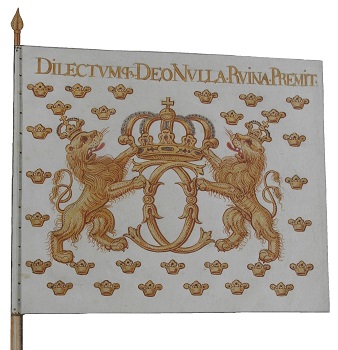

The Swedish infantry celebrated many triumphs during
Sweden’s Age of Greatness, and the most prominent of its regiments was the
Livgarde. This unit's elite status was marked by higher pay and more
expensive uniforms. During the Great Northern War, it was also by far the
largest regiment in the Swedish army, with first 1,800 men and then 2,600
men. In every battle, the Livgarde took the lead and in the order of battle
they always held the place of honour on the far right.
The Livgarde has won numerous victories in most of
Sweden's war but there is no doubt that its heydays were during the Great
Northern War. During this war it took part in the landing at Humlebæk in
1700, the battle of Narva in 1700, the crossing of the Düna in 1701, the
battle of Kliszow in 1702, the siege of Thorn in 1703 and the battle of
Holowczyn in 1708. However, after all these successes they suffered a
crushing defeat at Poltava in 1709 and only half of the Livgarde remained
when the Swedish army surrendered at Perevolochna three days later. The
Livgarde was restored after the disaster, but the new guard would not
experience any triumphs as the old one had done. Recruitment problems kept
it as a garrison regiment in Stockholm until 1718 when it participated with
almost full strength in Charles XII's last campaign in Norway. |
|
Organisational History
The main
function of the Livgarde (= Life Guards) was to act as a bodyguard for the
king and because kings have always had bodyguards, the Livgarde's ancestry
can be traced back to Gustav Vasa's rebellion in 1521. In practice, however,
there have been several different Livgarde that for various reasons
disappeared and were replaced by newly established regiments. More
specifically, there were six incarnations of the Livgarde during the Age of
Greatness. Created in turn by Gustav II Adolf (2 incarnations), Kristina,
Charles X Gustav, Charles XI and Charles XII. The continuity that exists
between these regiments consists of the small force that was always left
behind in Stockholm as a palace guard while the regiment was on campaign.
Before the
Livgarde got its dual role as the king’s bodyguard and the most prestigious
combat unit, there were several predecessors that had the second role of
elite combat unit. These were Gustav Vasa's Stockholmsfänika and his
sons' various Gårdsfänikor. These units and Gustav II Adolf's
Konungens livregemente (the King's Life Regiment) that existed in 1613,
however, lack continuity with the regiment that was formed in 1618 and would
become the Livgarde. It was then that the Drabant Corps that had protected
the Vasa kings was converted into a company in a new combat unit called Hovregementet (=
the Court Regiment). Below is a summary of
its early history, but a more detailed account of the history up to 1676 can
be found on the page about the Drabant Corps.
The
Hovregemente from 1618 was replaced in 1621 by a new regiment with the same
name, where the Drabant Company was the only continuity. Later, this unit also
became known as the Yellow Regiment after the colour of its uniforms.
However, the original drabants retained a special position in both Hovregemente
units in that it consisted of Swedes and was called the King's
Livgarde. The other companies were mostly made up of Germans. After
participating in Gustav II Adolf's campaigns in Livonia, Prussia and
Germany, the regiment was split up after the Battle of Lützen in 1632. The
Livgarde escorted the king's corpse to Stockholm and remained there as a
palace guard. The remnants, which now increasingly came to be called the
Yellow Regiment, continued to fight in Germany and in 1635 went into French
service when its commander Bernhard of Weimar defected from the Swedish
army. This regiment was then disbanded in 1648.
The Livgarde Company in Stockholm was expanded during the Danish War of
1643-45 to a new regiment consisting of 20 companies. However, this
incarnation of the Livgarde was almost never assembled in one place but was
usually distributed among several different garrison towns and theatres of
war. This situation did not change after the Peace of Westphalia, when the
Livgarde were reduced to 8 companies in Riga and 4 companies in Stockholm.
When Charles X Gustav set the army on a war footing in 1655, a comprehensive
reorganisation took place so that all companies except the Life Company were
transferred to other enlisted regiments. The Life Company then became the
basis for a completely new Livgarde, while the Drabants were converted into
an independent cavalry company called the Garde de Corps. Together with
another cavalry company (Livgarde on Horse), it again became part of the
Livgarde in 1657, which was now called the Livgarde on Horse and Foot. After
Charles Gustav's death in 1660, the cavalry companies were disbanded, but
the Drabant Corps remained in the organisation of the Livgarde. When the
Scanian War broke out in 1675, the Drabants again formed a separate mounted
company that was in practice an independent unit. This organisation was
maintained until July 1700, when Charles XII reorganised the Drabant Corps
and made it completely independent from the Livgarde.
The death of Charles X Gustav also affected the infantry part of the
Livgarde, which was split in a manner like what had happened in 1632 and
1648. It was then reduced to one company that became the palace guard in
Stockholm and eight companies that were garrisoned in Riga (from 1672 in
Pomerania). The latter part, called the German Livgarde, came to live its
own life, and from 1680 it was not formally part of the Livgarde either. It
was then garrisoned in Scania and Halland under the name “Tyska livregementet” (German Life Regiment). In 1709, this regiment was
transferred to Sweden’s German possessions and disbanded when these fell to
the enemy in 1715.
The company that guarded the royal palace in Stockholm after 1660 formed the
basis of the fifth incarnation of the Livgarde. When Charles XI came of age
in 1672, his Livgarde in Stockholm was expanded to four companies and a
second expansion to 12 companies occurred in 1676 after the outbreak of the
Scanian War. This organisation (ten companies of 150 men and two companies
of 200 men, a total of 1,900 men, excluding drabants) would remain in effect
until the outbreak of the Great Northern War. All companies then became 150
men strong, as 100 men were left behind in Stockholm as palace guards when
the Livgarde went on campaign in April 1700. However, in September of the
same year, another reorganisation took place when Charles XII wanted to
increase the officer density by redistributing the privates into 18
companies of 100 men each. This organisation included for the first time
special grenadier companies, namely three that under the command of a
grenadier major also formed a grenadier battalion. Ever since 1684, the
Livgarde had had an increasing number of grenadiers and in 1703 these
companies were doubled to six (read The Livgarde's Grenadiers for more
information). In 1702, the Livgarde had also been reinforced with three
regular companies and since 1701 each company had consisted of 108 men. From
August 1703, the Livgarde therefore consisted of 24 companies with 108 men
each and forming four battalions (of which one was a grenadier battalion).
When the Livgarde was at full strength, it had a field strength of 2,592
men. In addition to the field strength, the palace guard in Stockholm had
been increased to 120 men in 1702.
| |
Rank-and-File in
the Field Regiment |
Number of Companies |
Officers & NCOs |
Palace Guard
(officers/NCOs + Rank-and-File) |
|
April 1700 |
1,800 |
12 with 150 men each |
106 |
7 + 100 |
| Sept. 1700 |
1,800 |
18 with 100 men each |
150 |
7 + 100 |
| 1701 |
1,944 |
18 with 108 men each |
169 |
7 + 100 |
| 1702 |
2,268 |
21 with 108 men each |
196 |
9 + 120 |
| 1703 |
2,592 |
24 with 108 men each |
223 |
9 + 120 |
| 1707 |
2,592 |
24 with 108 men each |
247 |
9 + 120 |
|
1714 |
2,736 |
24 with 114 men each |
296 |
12 + 126 |
|
In addition each company had two drummers and one piper. |
After the Livgarde had been annihilated in Ukraine 1709, Charles XII ordered that it
be restored to its former strength and also augmented by having six mounted
"furirskyttar" in each company (a total of 2,736 men, not including
the palace guard). But for various reasons the recruitment for this fourth
incarnation was very slow (read more about this below) and it was only after
Charles XII's return to Sweden in December 1715 that it took off. Although
this work came to nothing due to catastrophic losses during the poorly
executed retreat from Norway after the death of Charles XII.
The ambition
level of the reconstructed Livgarde was lowered in May 1722 to 18 companies
(of which three were grenadier companies) with a total strength of 1,800
rank-and-file. Although this established strength was not reached until
1728. The year before, however, the Parliament had decided that the Livgarde
would return to the establishment of 1696 and that the manpower would thus
be divided into only twelve companies. This meant fewer officers, but the
reduction of the officer corps was to be gradual by not hiring replacements
for those who left on their own accord. And the companies were withdrawn
only when their captain had left his post. This would take a very long time
as the Livgarde already had a large number of redundant officers as a result
of the previous reduction in regimental strength and the wartime doubling of
officers. However, the organisation with 18 companies was restored in 1737
and it would then remain in place until 1790.
In 1788, the
strength was increased to 113 men per company and two years later it was
further increased to 120 men. Although in 1790 a Second Guards Regiment was
also created, which meant that the Livgarde, which was now called the First
Guards Regiment, was reduced to ten companies. The total strength was thus
only 1200 men for the regiment, which in 1792 changed its name again to
Svea Livgarde. Cost-cutting measures in 1797 shrank the regiment to 1000
men by having each company keep 20 numbers vacant. However, just five years
later, Svea Livgarde was given back its previous strength, and it was
decided that the newly added 200 soldiers would form a special jäger
battalion if necessary. Although this was also short-lived and a more
extensive reduction took place in 1806 when more than half of Svea Livgarde'
rank-and-file were dismissed. Only 534 men remained, and in 1808 they
experienced another severe setback when a disgruntled Gustav IV Adolf
demoted Svea Livgarde to a regular enlisted regiment called Fleetwood’s
Regiment. Its strength was, however, increased to 760 men by receiving men
from another guard regiment that was disbanded altogether. After Gustav IV
Adolf was deposed in a coup d'état in 1809, the regiment was restored to its
old status and the name Svea Livgarde. The number of companies had not
changed during this time, remaining ten until 1830, and then eight for the
rest of the 19th century.
Salaries and Recruitment Area
Together with the Artillery Regiment and the Adelsfana, the Livgarde was one
of the few truly national regiments which collected its recruits from all
over Sweden.
However, the Livgarde consisted almost exclusively of ethnic Swedes. The
guardsmen who came from Finland were for example concentrated to its Swedish
speaking regions. And despite of the strong national character, the main
recruitment area can be localised to the central portions of Sweden (Svealand
and Östergötland) from where about 75 % of the recruits came.
The number of Stockholmers in the ranks was high, but since most Swedes at
this time lived in rural areas, their share was not higher than 9 %.
A guardsman had a wage of 36 daler in silver the year 1696
(to be compared with the 33 daler which soldiers received in other enlisted
infantry regiments in proper Sweden). If he was promoted to underrotmästare
(= vice filemaster) he would get 41 daler. A rotmästare (filemaster)
received 50 and corporals got 63-66
daler. The lower NCO ranks (förare, furir &
rustmästare) received 90 daler in silver as their yearly wage while the
higher NCO ranks (fältväbel & sergeant) got 108. Lieutenants &
ensigns earned 378 daler, captains 556, the major 1,242, the lieutenant
colonel 1,306
and the colonel
2,056 daler. The income differences were enormous and even though the
private guardsmen earned more than their colleagues they could not support a
family on that wage. It was almost required that the soldier had a second
job and/or a wife who also worked. Because the burdens of military service
were light during peace time these second jobs could very well be the
soldiers' primary occupation.
Colonels
and Battles
Green
colour represents victories, red colour defeats
and
black colour indecisive battles.
|
|
Hovregementet (Yellow Regiment) |
|
1618-1624 |
Philipp
Johan von Mansfeld |
1621
Riga |
|
1625-1627 |
Frans Bernhard von Thurn |
1626 Wallhof |
|
1627 Dirschau |
1627-1631
|
Maximilian von Teufel
(killed at Breitenfeld) |
1629 Gorzno |
|
1629 Honigfelde/Stuhm |
|
1631 Frankfurt an der Oder
1631
Breitenfeld |
1631-1632
|
Nils Brahe
(mortally wounded at Lützen) |
1632 Lech (Rain) |
|
1632 Alte Veste |
|
1632
Lützen |
|
1632-1634 |
Lars Kagg |
1633 Oldendorf |
|
1634-1635 |
Wulf von
Schönbeck |
1634 Nördlingen |
|
|
Kunglig Majestäts livgarde |
|
1635-1635 |
Thure Liljesparre |
|
1636-1638 |
Didrik Yxkull |
|
1638-1644 |
Caspar Otto Sperling (colonel of Södermanland Reg.
1629-47) |
|
1644-1652 |
Magnus Gabriel De la Gardie |
|
1652-1653 |
Jakob Casimir De la Gardie |
|
1653-1654 |
Christoffer Delphicus Dohna |
|
1654-1656 |
Christoffer Carl Schlippenbach |
1656
Warszawa |
|
1656-1660 |
Jakob Johan Taube |
1658 March Across the Belts |
|
1659
Copenhagen
1659 Nyborg |
|
Feb.-Dec. 1660 |
Nils Brahe |
|
1660-1664 |
Gustaf Adam Banér |
|
March-Sep.1664 |
Carl Larsson Sparre |
|
1664-1668 |
Axel Julius De la Gardie |
|
1668-1673 |
Gustaf Lillie |
|
1673-1677 |
Christoffer Gyllenstierna |
1676
Halmstad
1676 Lund
1677 Landskrona |
|
1677-1686 |
Jakob Johan Hastfer |
|
1686-1696 |
Bernhard von Liewen |
|
1696-1706 |
Knut Posse |
1700
Humlebæk
1700 Narva
1701 Düna
1702 Kliszow |
|
1706-1712 |
Carl Posse
(in Russian captivity from 1709) |
1708 Holowczyn |
|
1709
Poltava |
|
1712-1717 |
Gabriel Ribbing (in Danish captivity 1711-1713) |
|
1717-1727 |
Michael Törnflycht |
|
1727-1739 |
Arvid Posse |
|
1739-1744 |
Otto Reinhold Wrangel af Sauss |
1742 Helsinki |
|
1744-1751 |
Adolf Fredrik av Holstein-Gottorp |
|
1751-1756 |
Per Gustaf Pfeiff (forced to resign due to
attempted coup d'état) |
|
1756-1772 |
Fredrik Axel von Fersen |
|
1772-1792 |
Gustav III |
1790
Svensksund |
|
|
Svea livgarde (Fleetwood’s
Regiment
1808-09) |
|
1792-1808 |
Gustav IV Adolf |
|
1808-1809 |
Carl Johan Fleetwood |
|
1809-1818 |
Charles XIII |
Note that of
the battles fought during the period 1621 -1635, only Lech and Lützen are
recognised as official victory names for the Livgarde. The landing at
Humlebæk is also not included among the official victory names. On the other
hand, there are official victory names for which it is more doubtful whether
they should be counted. The Battle of Warsaw and the march across the Belts
were carried out without the participation of the Livgarde infantry
regiment. There were only two company-sized mounted detachments that
participated in the former battle and in the march across the Belts the
Livgarde was represented by only 16 drabants who formed the king's
bodyguard. |
|
Scanian War
When Denmark
joined Sweden's enemies in September 1675, it was decided to expand the
Livgarde from four companies to twelve companies. These companies did not
include the drabants, who were reorganised into a 200-man cavalry corps. It
functioned as a completely independent unit during the war and is therefore
reported on its own page. The recruitment of the
first four new companies was completed in December and this battalion then
marched to Lidköping. The recruitment of the last four companies, however,
took longer. Upon arrival in Gothenburg in March 1676, they still had 10%
vacancies. This even though they picked 100 men from the Stockholm City
militia just before the march and then received a further 30 men from
Änkedrottningens livregemente till fot (Dowager Queen's Life Regiment on
foot) in Gothenburg.
The original
battalion of the Livgarde participated in the coronation of Charles XI in
Uppsala on 28 September 1675. It then marched to Jönköping via Stockholm and
Vingåker. From there, it marched in November first to Vänersborg and then to
Gothenburg before returning to Vänersborg at the turn of the year. The plan
was for the Swedish army to carry out a campaign against Norway, but bad
weather thwarted this. In March, all three Livgarde battalions gathered in
Gothenburg.
Before that,
200 guardsmen had been commanded to the unsuccessful naval expedition in the
autumn of 1675 to relieve the besieged Wismar but which never got further
than Gotland before bad weather and disease forced it to return. The
Livgarde' losses during the command consisted of 8 dead and about 40 sick.
In May 1676,
the Livgarde arrived in Malmö where, depending on how the naval war
developed, they were to either participate in a landing on Zealand or defend
Scania against a Danish landing. It was the latter, and after a mock landing
in Ystad where 200 guardsmen were sent, the real landing took place at Råå
south of Helsingborg. The Swedish army was outnumbered and had its planned
retreat route cut off. In what was almost a wild flight, the Swedes
retreated to Kristianstad instead, where lack of provisions and disease
meant that only two-thirds of the army was in a fighting condition. After a
continued retreat to Växjö, Charles XI was able to carry out a
counteroffensive when the Danish army split up. The smaller part of the
Danish army was annihilated in the Battle of Halmstad on 17 August. The
Livgarde's losses in the Battle of Halmstad were 9 non-commissioned officers
and privates killed and 15 wounded. Of the officers, two were wounded
(including the colonel). After the battle, 43 prisoners of war were enlisted
in the Livgarde.
Despite the
victory, the Swedes were forced to retreat to Syllinge north of Viskan
because the rest of the Danish army arrived in Halland. In Syllinge, on 3
October 1676, the Livgarde had an effective strength of 1,337 men (excluding
officers). 260 men were sick and were transferred to Alingsås. The next day,
the Livgarde marched towards Hamneda south of Ljungby in Småland, where the
main army assembled on 21 October. Once there, the Livgarde was reinforced
with a weak battalion of Västernorrland and Jämtland 3-männings. However,
the high level of sickness meant that despite this reinforcement, the
Livgarde only numbered 1,200 men. Another 30 or so recruits arrived from
Stockholm in mid-November, but the loss of men due to illness continued so
that the Livgarde only had an effective strength of 600 men at the Battle of
Lund and 200 men were sick.
The Battle of
Lund on 4 December was a great victory, but also a very bloody battle for
both sides who saw their fortunes shift several times during the fighting. A
Livgarde battalion lost all four of its colours, but these were recaptured.
That battalion merged with another battalion during the battle, after which
the merged battalion lost five of its eight colours, but this time they were
also recaptured. The Livgarde's colonel was again wounded and the lieutenant
colonel who led the Drabant Corps was killed. Another 2 officers were killed
and 5 were wounded. Of the rank and file, 80 men were killed and 78 were
wounded. 2 non-commissioned officers and 4 drummers were killed, and 5
non-commissioned officers were wounded. In total, the Livgarde lost 26% of
its strength, which was lighter than for the army as a whole.
The last
battle of 1676 was the recapture of Helsingborg on December 15, where 4
guardsmen were killed and 11 wounded.
|
1676 |
|
1677 |
|
Jan.-March |
Vänersborg, Lidköping, Stockholm |
Jan.-April |
Winter quarters in Jönköping, Gränna, Eksjö. |
|
March-May |
Stay in Gothenburg |
11 April |
March to Scania begins |
|
3-18 May |
March to Malmö |
May-Sep. |
Campaign in Scania |
|
May-June |
Stay in Malmö |
14 July |
Battle of Landskrona |
|
July |
Stay in Kristianstad |
Oct.-Dec. |
Winter quarters in north Halland |
|
23 juli-6 Aug. |
March to Växjö via Karlshamn |
1678 |
|
11-16 Aug. |
March from Växjö to Halland |
|
17 August |
Battle of Halmstad |
Jan.-April |
Winter quarters in north Halland |
|
September |
Stay in north Halland. |
April-Aug. |
Siege of Kristianstad |
|
Oct.-Dec. |
Counter-offensive in Scania |
September |
Stay in Höör |
|
4 December |
Battle of Lund |
Oct.-dec. |
Winter quarters in north Halland |
The greatly
reduced Livgarde was sent to Småland to be reorganised and recruitment took
place throughout the kingdom. However, the recruitment did not bring the
desired results and in addition, 98 recruits were captured by the Danes in
May before they could join the Livgarde, which since the end of April was
again in Scania (at Trollenäs). On June 26, 1677, the Livgarde counted only
1,275 men present and a week later it had dropped to about 1,200 men.
The 1677
campaign began for the Swedish side on 17 May and culminated in the Battle
of Landskrona on 14 July. The Livgarde participated with 1,111 men and its
casualties among the privates and musicians were 86 killed and 58 wounded,
while a captain and a non-commissioned officer were killed and only one
non-commissioned officer was wounded.
The
recruitment during the winter of 1677-78 resulted in the Livgarde being
almost at full strength at the muster in May-June with only 32 vacancies.
The 1678 campaign was mainly devoted to a successful siege of Kristianstad
and compared to the previous year, casualties were moderate (289 vacancies).
The new recruitment during the winter of 1678-79 thus resulted in the
Livgarde having a surplus of 12 men.
The 1679
campaign was uneventful. In mid-April, the Livgarde left their winter
quarters in northern Halland and were stationed in Halmstad. However, the
actual campaign did not begin until July, and the focus was once again on
recapturing Helsingborg. Before that could happen, however, peace was
concluded on 16 September, and the Livgarde began their march to Stockholm
on 3 November, arriving on 30 December. |
|
Great Northern War
For the
Livgarde, the Great Northern War started on 25 April 1700 when they left
Stockholm and began a march to Malmö where they arrived on 11 June. They
then became a part of the main army and remained so until the Battle of
Poltava in 1709 and distinguished themselves as an elite regiment. After the
capitulation at Perevolotjna, however, its glory days were over and the
great difficulties with restoring the Livgarde meant that for a long time it
was not an unit fit for fight. Instead of campaigning against Sweden's
enemies, it had to stay at home in Stockholm as a garrison unit until
Charles XII's return to Sweden resulted in much more forceful recruitment.
It was a very capable Livgarde, albeit poorly dressed, which then took part
in Charles XII's Norwegian campaign in 1718. However, the retreat from
Norway was another death blow for the Livgarde which had to be reconstructed
again while it remained at home as a garrison in Stockholm.
The table below gives a detailed picture of the Livgarde's movements during
the war and its losses in the various battles:
|
1700 |
|
During the landing at
Humlebæk on 25 July 1700, three guardsmen were killed and 18 were wounded.
In addition a lieutenant was also killed and two NCOs were wounded.
In the battle of Narva on 20 November, 132 privates and NCOs were
killed, 170 men were wounded. The officer's casualties were six killed
and 15 wounded. In both battles, the Livgarde were almost at full
strength with only a handful of vacancies (the nominal strength was
1,800 men). In the battle of Düna on 9
July 1701, 19 privates were killed and 73 were wounded. The casualties for
officers and NCOs were 4
killed and 8 wounded. A week before the battle, the Livgarde had had a
strength of 1,672 rank and file (272 vacancies). In the battle of Kliszow
on 9 July 1702, 54 privates and 12 officers and NCOs were killed. It
was reported that 6 officers were wounded. The week before the battle,
the Livgarde had 1,834 rank and file (434 vacancies).
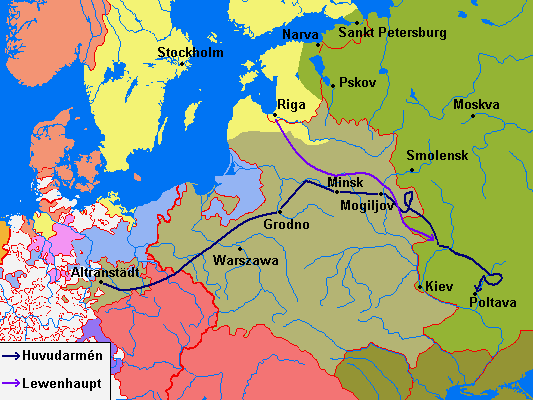
The map above shows
the movements of the Swedish armies during the Russian campaign
1707-1709. The Livgarde was part of the main army, but Lewenhaupt's
corps contained 3-männing soldiers and these were used to fill the
ranks of the Livgarde when they joined the main army.
In the battle of Holowczyn
on 4 July 1708, 69 NCOs and privates were killed. The wounded were 485.
Officer casualties were 40 men. The high number of wounded in relation
to the killed is said to have been due to the Livgarde wading across
a river. This resulted in wet uniforms making it more difficult for
bullets to penetrate and thus fewer injuries that became fatal. The
effective strength of the Livgarde at the battle is unknown, but
calculations indicate that it may have been about 2,100 men. The
nominal strength at this time was 2,592 men. In the battle of Poltava
on 28 June 1709, 24 officers were killed, which was almost a quarter of the
corps. In addition, 59 officers were captured (19 at Poltava, 30 at
Perevolochna and 10 at an unknown location). Of these, 25-33% were
wounded. Two Russian sources, which are not entirely reliable, state
that either 1,350 NCOs and privates, or alternatively 121 NCOs and
1,196 privates were captured at Perevolochna. Since the Livgarde
probably had a strength of about 2,500 men before the battle, this
would mean that half were killed or captured on the battlefield at
Poltava. |
|
April-June |
March Stockholm-Malmö |
|
July-Aug. |
Campaign in Zealand |
|
Aug.-Sep. |
Scania-Blekinge |
|
Oct.-Nov. |
Campaign in Estonia |
|
December |
Winter quarters in Estonia |
1701 |
|
Jan.-June |
Winter quarters in Estonia |
|
July |
The crossing of the Düna |
|
Aug.-Dec. |
Operations in Courland |
1702 |
|
Jan.-June |
The invasion of Poland |
|
July |
Battle of Kliszow |
|
Aug.-Sep. |
Stay at Krakow |
|
Oct.-Dec. |
March to Sandomierz |
1703 |
|
Jan.-May |
Winter quarters at Sandomierz |
|
May-Oct. |
The siege of Thorn |
|
Oct.-Dec. |
Winter quarters in West Prussia |
1704 |
|
Jan.-May |
Winter quarters in West Prussia |
|
June-Sep. |
March to Lemberg |
|
Sep.-Dec. |
March to Jutrosin |
1705 |
|
Jan.-July |
Winter quarters at Jutrosin |
|
July-Aug. |
March Jutrosin-Błonie |
|
Aug.-Dec. |
Stay at Błonie |
1706 |
|
Jan.--March |
The blockade of Grodno |
|
April |
March to Pinsk |
|
May |
March to Jarosławiec |
|
June |
Stay at Jarosławiec |
|
July-Aug. |
March to Saxony |
|
Sep.-Dec. |
Winter quarters in Saxony |
1707 |
|
|
Jan.-Aug. |
Stay in Saxony |
|
September |
March to Sokolnik |
|
October |
Stay at Sokolnik |
|
November |
March to Wlosawek |
|
December |
Stay at Wlosawek |
1708 |
|
|
Jan.-Feb. |
March to Smorgon |
|
Feb.-May |
Stay in Lithuania |
|
June |
March to Holowczyn |
|
July |
Holowczyn & stay in Mogilev |
|
Aug.-Sep. |
Tatarsk, march to Severia |
|
Oct.-Dec. |
March Kostenitji-Romny-Hadjatj |
1709 |
|
|
Jan.-April |
March Hadjatj-Poltava |
|
April-June |
Siege of Poltava |
|
June |
Battle of Poltava |
1709-18 |
Garrison in Stockholm |
1718 |
|
|
Sep.-Oct. |
March to Dalsland |
|
Nov-Dec. |
Campaign in Noway |
|
December |
Return march to Sweden |
Recruitment of the Livgarde
When the Guard was overseas during the Great Northern War it was intended
that the recruitment was to be managed in such a way that each provincial
governor had a quota which they should recruit and send to the Livgarde. But
the first contingent of the governors recruits was far from the desired size
and not all of them met the requirement for service in the Livgarde.
Of the 510 men which the governors were to recruit only 250 of them were
actually added to the ranks in 1701 and not rejected at arrival. The
recruitment was thereafter centralised and this task was given to lieutenant
colonel Åke Rålamb. But the numbers did not increase and in 1702 only 285 recruits
arrived, followed by 190 men in 1703, 118 men in 1704 and 156 men in 1705.
The 1706 contingent (which arrived in
1707) consisted of 117 men and the 1707 contingent was 203 men strong. The 1708
contingent which arrived too late to Riga to join the main army consisted of 332 men
which were called back to Sweden in 1709. Rålamb managed to recruit 79 men to the
1709 contingent before he lost this assignment to the interim commander of
the restored Livgarde.
Since the recruits were not sufficient to fill the ranks of the growing
Livgarde, the King arranged for soldiers to be transferred from other
regiments. One company each from Tyska, Svenska and Drottningens
livregemente were ordered by the King in October 1701 to be transferred
to the Livgarde (these regiments garrisoned fortresses in Scania and the
Swedish west coast). In 1703
one battalion each from Uppland and Östgöta-Södermanland 3-männing regiments
were merged with the Livgarde (the former also included soldiers from the
provinces of Dalarna and Västmanland. An additional company each from
Svenska and Drottningens
livregemente were added the same year and in the next year 150 men from
Jämtland's Regiment was added to the Livgarde. Finally during the Russian campaign in
1708 the rest of these 3-männing regiments together with Småland and
Närke-Värmlands 3-männing regiments were merged with the Livgarde (altogether
approx. 1,000 men). Småland's 3-männing regiment had contributed 72
men to the Livgarde as early as September 1700, when a sharp increase in the
number of officers through promotions within the Livgarde had resulted in
vacancies.
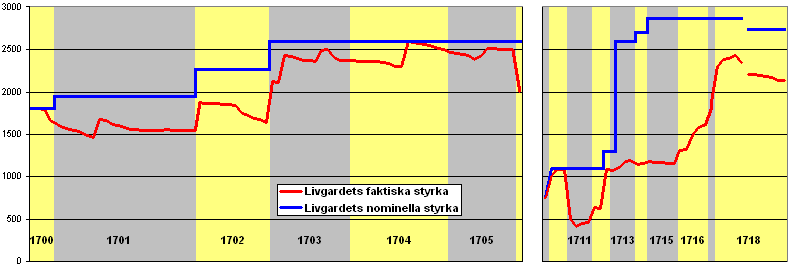
Strength of the Livgarde during the Great Northern War.
Nominal strength in blue and effective strength in red.
The period 1707-09 is missing because
the source material was lost in the capitulation at Perevolochna. The lines are
broken for the year 1718 because the company that was left in Stockholm is not included in the second
half of that year.
When the remnants of the Livgarde field regiment capitulated in at Perevolochna 1709
there were, counting the palace guard (120 men strong since 1702) and the
existing recruits, a force of about 600 guardsmen in Stockholm. These were
organised into new companies and the work to restore the Livgarde began.
However, the recruitment progressed at a slow pace and the organisation
consisted of just twelve companies for a long time. An important reason why
things went slowly in the beginning was a lack of initiative on the part of
the elderly governor of Stockholm, Knut Posse, who was most responsible for
the Livgarde's recruitment. It certainly did not
help either that the plague in 1710 killed 60 % of the then 1,000 men strong Guard.
Only 419 men remained at the muster in June 1711, and among them there
were several
palace guards who had been to old for field service already in 1700 (these
men included a 90-year old man who was discharged the following year).
Conscription of men from the mining region of Bergslagen (previously exempt
from recruitment) helped to recover the Livgarde's strength but then for a
long period the strength stood still at 1,000 men.
Some of the difficulties with the recruitment can be explained by the fact
the lega (the amount of money the recruit was given directly when he
signed the contract) was only 20 daler of silver,
which made the Livgarde less attractive compared to other regiments. The men
who recruited for the Livgarde had to compete with all the rotebönder
(farmers tasked with recruiting one infantry soldier) and rusthållare
(men tasked with recruiting one cavalryman and horse) who at the same time
were searching for recruits to restore the provincial regiments. The
conditions in the soldiers market thus required (according the regimental
commander Ribbing) a lega of at least 33.33 daler in silver.
This request of raising the lega was however rejected by the royal
council on the ground of the poor financial state of the Crown. The
troubling economy also meant that salary payments were very irregular and
that the guardsmen often lived in misery. This, of course, made it even more
difficult to attract recruits to the Livgarde.
All this changed when Charles XII returned to Sweden in December 1715 and
could now personally deal with the restoration of his Livgarde. The
Livgarde's recruiters had already made themselves known for their hard-line
persuasion methods before then. But now a determined hunt began for men who
lacked employment, students who did not study diligently, and occupational
categories that were considered non-essential in time of war. The notion
that recruits were supposed to be volunteers was set aside and, without
sacrificing quality, the Livgarde's manpower increased so rapidly that it
was 2,200 strong when the Norwegian campaign began in 1718. But even this
work came to naught as a result of external circumstances. The king's death
led to an unplanned retreat to Sweden in the middle of winter. The Livgarde
also had the misfortune of marching last, so that those food storages that
did exist along the march route were empty when the Livgarde got there. The
result was a disaster and of the only 795 remaining guardsmen who were
mustered in Stockholm in 1719, half had to be discarded as unfit for
continued service.
By disbanding temporary regiments and transferring the men to the Livgarde,
its strength was able to recover so that in October 1720 it numbered 1,644
men. But even though the nominal strength of the Livgarde was reduced to
1,800 men in 1722, it would take until 1728 before that was achieved.
|
|
Livgarde Uniforms

Charles X Gustav's War |
Scanian War |

Great Northern War |

Seven Years' War |
During the
first half of the 17th century, the Livgarde and its predecessors wore
yellow uniforms with black decorations. These were the colours of the house
of Vasa, and when the house Palatine-Zweibrücken ascended the throne in
1654, they were replaced by the blue and yellow colours of the Swedish flag
and coat of arms. Initially, the blue colour was light blue, but it was
replaced by dark blue during the reign of Charles XI. Exactly when this
change took place is unknown, and we cannot therefore be completely sure
what shade of blue the Livgarde fought in during the Scanian War.
Another
detail that distinguished the Livgarde uniforms was that they had more
elaborate decorations than the rest of the army. These decorations consisted
in the early Carolean Age of a rich amount of blue and yellow ribbons which
were gradually replaced by a more limited amount of ”gold and silver in
silk" lace, which had previously appeared on the uniforms of men of
higher rank (drabants & pikemen). During the Liberty Age (1719-1771), the
gold disappeared but instead yellow lapels and plumes on the hat were added
as a characteristic of the Livgarde.
Although the
appearance of the ribbons and the lace is also unclear. Both ribbons and
buttons were blue-yellow during the reign of Charles X Gustav, but during
the reign of Charles XI the ribbons are described as yellow while the colour
of the buttons is at one point described as blue. Possibly the colours of
the decorations had been simplified, or it was only the description of them
that had been simplified. After the Scanian War, the Livgarde received
identical uniforms for all privates and then the ribbons disappeared as
decorations and metal buttons were introduced for all. But lace made of ”gold
and silver in silk" were retained. The colour of the silk is not
mentioned, but preserved court costumes from the 1670s have lace of gold and
silver thread mixed with yellow and grey-white silk. On these, each lace
consists of three stripes with gold/yellow on the outer sides and
silver/white in the middle (with the proportions 2:3:2). Simplified
descriptions from eyewitnesses mention that the drabants had gold lace in
1671 (the Danish envoy Corfitz Braem) and silver lace in 1674 (the Italian
Lorenzo Magolotti), and in the 1695 muster rolls the lace was stated to be
made of silver. However, judging from the photographs of the preserved court
costumes, the same lace can be perceived as either golden or silver
depending on the lighting conditions. In the 1720s, the lace was changed to
consist only of silver thread and white silk.
Oldest Uniforms 1618-1688
After the Hovregemente was created in 1618, it and its successors
were long split into two parts that did not necessarily have the same
uniforms. On the one hand, there was the actual Livgarde, which was a newer
name for the Drabant Corps that had been the king's bodyguard since the time
of Gustav Vasa. Then there was a larger part that constituted a regular
infantry regiment, albeit with elite status. The drabants usually received
more expensive uniforms than the rest of the regiment, and the colours
between different personnel categories could also differ. The uniforms of
the rest of the regiment are not as well described in the sources, but they
seem to have had colours that matched those of the drabants. But to prevent this
page from becoming too long, the drabant uniforms are described on
a separate page.
The Hovregemente/Yellow Regiment
When the
Hovregemente was created, the drabants had switched to yellow clothes
and one of the regular companies of the regiment was also issued yellow
broadcloth in 1620. According to the Livgarde' regimental history work, at least
some officers received yellow broadcloth in 1622 (Höglund mentions 3000 ells of
yellow broadcloth and plain pewter buttons). In 1624, the musketeers received
broadcloth of an unknown colour while the non-commissioned officers received blue
broadcloth and the officers had different colours (red, blue and white). In the
following years, unfortunately, we have hardly any information at all about
the Hovregemente’s uniforms because these were purchased locally by the
colonel and are therefore not mentioned in the records.
However, we
have clues from eyewitness accounts. In 1626 we encounter the term "Yellow
Regiment" for the first time, and it should refer to the uniforms since the
colours (= flags) had until then been mostly black. In January 1627 the
soldiers of the regiment are also called "yellow coats" by Hoppe who repeats
the term in August 1629 for a regiment that is most likely the
Hovregemente. In the Battle of Breitenfeld in 1631 yellow cassocks are
mentioned. New clothes of an unknown colour are said to have been ready for
delivery in Nuremberg shortly before the Battle of Lützen in 1632 and may
have been worn in this battle. In any case, the soldiers of the
Hovregemente were again called yellow coats ("gelbröckeln") by
the imperial side during the battle. We are completely lacking information
about the uniforms of the Hovregemente during the period after the
devastating losses in Lützen until September 1635 when the regiment went
into French service. But after 1632, the name "Yellow Regiment" continued to
appear and from the second half of 1634 onwards it became an increasingly
common name for the regiment.
The Livgarde
A new field
regiment was raised during the Torstensson War of 1643-1645, but its
uniforms are completely unknown during Kristina's reign. If they were not
dressed in grey for cost reasons, they probably had the same colours as
Christina's drabants, who were dressed in yellow with black and yellow trim
and black lining.
A new field
regiment was raised during the Torstensson War of 1643-1645 with unknown
uniforms. But unless they were dressed in grey for cost reasons, they
probably had the same colours as Christina's drabants, who were dressed in
yellow with black and yellow trim and black lining. The parade uniform that
was issued to the Livgarde for Kristina's coronation in 1650 also
had those colours (see table below).
|
|
Non-commissioned officers
(22 men) |
"Fine yellow pikemen"
(48 men) |
"Lesser pikemen"
(168 men) |
Corporals, musketeers & musicians
(344 men) |
|
Hat: |
Black hat with round high crown and wide brim. Decorations not
specified, but it probably had a hat band in yellow and black and edged
with lace in the same colours. |
Black hats with lace of the same material as the rest of the dress. |
Black hats with lace of black and yellow silk. |
Black hats with lace of black and yellow silk. |
Cloak/
cassock: |
Cloak of fine yellow broadcloth that went down to the
hips. Decorated with wide silk lace (half black and half yellow) on the
collar, the front and back in the folds. |
Cloak of fine yellow broadcloth with a lining of black
plush. Decorated with six lines of lace (half gilded silver and half
black silk). |
Cloak of yellow broadcloth decorated with three lines
of wide lace of yellow and black silk. |
Cassock of yellow broadcloth with lining of fine black
baize. Decorated with one line of black and yellow silk lace (25 ells). |
|
Buff coat/ doublet: |
Buff coat of elk skin with collar and
sleeves of yellow silk. The silk on four buff coats was "atlask"
and on the other 18 it was "bloomerat tobin". The buff coats were edged
with ribbons and adorned with narrow yellow and black silk lace in 4
stripes on the sleeves (11 ells) and thick yellow and black silk lace
("silkeslitzkorn") on the chest (5 ells). In addition, so-called "favörer"
were added which consisted of 9 ells of silk ribbons (at the waist,
sleeves and one shoulder etc.). |
Doublet of fine yellow broadcloth
that was fitted at the waist and had a skirt lined with "cron rask".
Decorated with 44 ells of narrow lace of the same type as the cloak and
which ran in two lines. |
Doublet of yellow broadcloth with the skirt lined with black common
"rask". Decorated with one line of narrow lace (22 ells). |
Doublet of yellow broadcloth which was decorated with one line of lace of the same type as the cassock (22
ells). The skirt was lined with coloured "rask". |
|
Breeches/ Stockings: |
Fine yellow broadcloth with lines consisting of yellow and black silk
lace. The breeches, which were wide and reached the knees or just
below, were decorated with four lines along the sides and below the
knees. The stockings were decorated with two lines. |
Fine yellow broadcloth with 23 ½ ells of lines consisting of wide lace.
4 lines on the breeches and two lines on the stockings. |
Yellow broadcloth decorated with wide lace of yellow and black silk. Two
lines on the breeches and one line on the stockings. |
Yellow broadcloth with 10 ells wide
lace of the same type as the cassock, distributed over two lines
on the breeches and one line on the stockings. |
|
Buttons: |
30 buttons covered with yellow and black silk. |
The entire dress had 42 black-yellow buttons, half covered with gilded
silver thread and the other half with black silk. |
36 buttons covered with black-yellow silk. |
36 buttons covered with black-yellow silk. |
|
Source: Tor Schreber von Schreeb (pages
28-30). The red dresses of the 60 nobility drabants have been omitted from this table. |
When Charles
X Gustav became king in 1654, the colours of the drabant uniform were
immediately changed to blue and yellow. The new blue colour, however, was a
sky blue/pale blue shade called bleumerant. The
Livgarde also received these colours, but they probably were not changed to
black as happened in 1656 for the part of the drabant corps that was in the
field. The first piece of information about the Livgarde' uniform colours
during Charles X Gustav's reign colours is from the summer of 1655
when they received new uniforms in Stralsund which consisted of blue
broadcloth, yellow “varp”, blue “packlakan” and yellow baize. The coat was
apparently blue and the breeches yellow while the cloak was blue with yellow
lining.
For the
company that was left behind in Stockholm, it is mentioned in 1658 that its
uniform consisted of a jacket, breeches and stockings of bleumerant (pale
blue) broadcloth with blue-yellow buttons, trims and ribbons, etc.
The condition
of the Livgarde' uniforms was, however, a recurring problem during Charles X
Gustav's wars. In Thorn it was reported in the autumn of 1656 that the
Livgarde lacked clothing and the king therefore ordered that each guardsman
should receive 6 ells of blue broadcloth and for the lining a sufficient amount
of yellow baize. Also, in 1658 in Frederiksodde it was reported that the
Livgarde needed clothing "because they from top to bottom walk completely
naked and barefoot". Similar complaints also came from other places
where the Livgarde had men such as Thorn in December 1658 and Pomerania in
1659. The poor clothing of the Livgarde was seen as a reason why recruitment
was so slow at home in Sweden during the autumn of 1658 because the Livgarde
suffered “great cold through their nakedness".
| Lorenzo Magalotti's description
of the Livgarde in 1674 "The king has no guard on horse
for his court, but rather a regiment of guards on foot, armed with
muskets. Two companies of this sort keep watch. He also has a kind of
civil guard, which carries halberds. Both of these guards are dressed in
the usual uniform of dark blue broadcloth with silver lace. The monogram
adorned with a crown that is on the uniform coats of the aforementioned
guard corps is also of silver."
The description is not correct as the
Livgarde consisted of 4 companies and the "civil guard" (the drabants)
was not independent but was part of the colonel’s company. He also seems
to have misunderstood the uniforms as only the drabants had the king's
monogram on the coat. "Silver lace" (gold and silver in silk) were worn
by drabants and pikemen, but not by musketeers.
Note that the Italian language
considers light blue and dark blue as separate primary colours and not
as shades of the same colour, which means they have different words for
them. The now obsolete word that Magalotti used for the darker variety
of blue ("turchino") may have referred to a medium blue shade that some
perceived as light and others as dark. |
During the reign of Charles XI, there was a transition from light blue to
dark blue uniform colour. However, the timing is unclear because it is not
possible to determine which shade is meant when the clothes are "blue".
However, a dark blue shade was introduced for the entire infantry in 1687,
so this must be considered the absolute latest time when the Livgarde'
uniform colour was changed. Clothes issued to the Livgarde during this time
were referred to alternately as bleumerant or blue. According to Folke
Wernstedt, the word "blue" normally referred to a medium blue shade during
the 17th century, and he seems to believe that the two words describe two
different shades for the Livgarde' uniforms, although he cannot rule out
that they are used as synonyms. In 1661, the Livgarde' clothes were stated
to be sky blue, but when the Italian diplomat Lorenzo Magalotti visited
Sweden in 1674, he described the uniform colour as "turchino", which
was then a word used for darker shades of blue than sky blue. But this
clashes with Höglund who for the same year has information that the
musketeers had bleumerant coats. In addition, Bellander (page 142) has
information from 1670 about bleumerant broadcloth for the drabants.
Magalotti's description, however, contains
several inaccuracies (see the quote with comments on the right).
Various
eyewitnesses (Corfitz Braem and Lorenzo Magalotti) mentioned that the
Livgarde' uniforms had gold and silver lace, respectively. However, the
clothing accounts show that the uniforms during this period were not only
adorned with gold and silver, but also with yellow along the seams and
edges, and that the buttonholes were trimmed with yellow silk. Furthermore,
the gold was not pure gold but gilded silver.
After the
death of Charles X Gustav, there was also a transition from the old short
jackets to knee-length coats of the French model ("justaucorps"). The term
jacket (and “tröja”) remained for a long time, however. In 1661, the
musketeers received long jackets and in 1663, the pikemen received “tröjor”
with a skirt ("large skirt" in 1664).
Musketeers
and pikemen had different uniforms and also completely different outerwear,
at least during the time of Charles XI. On top of their jacket/coat, the
pikemen wore a cloak, while the musketeers instead wore a “flax” (= tabard)
until 1688. The flax corresponded to the drabants' cassock and was a
sleeveless outerwear that had buttons along the sides with openings for the
arms. The difference was that the cassock at this time was buttoned at the
front. The pikemen also had more lavish decorations. While the musketeers'
flax and jacket had 20-25 ells of lace, the pikemen's cloak and jacket had
50 ells of silk ribbon, which in 1665 was replaced by "gold and silver"
lace.

Detail from Johan Philip Lemke's painting of the
Battle of Halmstad in 1676 (painted around 1684).
Two Livgarde battalions in front of a battalion of Dal men. The Dal
regiment’s colours (= flags) were supposed to be bleumerant.
|
|
Musketeers
1660-1679 |
Pikemen
1660-1679 |
|
Hat: |
The hat had ribbons around
the crown and was, at least since 1665, adorned with a bow of yellow
silk ribbons ("favör"). Black hat 1674.
Grey hat 1679. |
|
Cloak/flax: |
Blue flax (= tabard) with yellow lining and 11 dozen buttons
covered with wool. Decorated with yellow baize or “rask” (=
fabric with a thin shiny surface) and lace. |
Blue coat, the upper part of which was lined with
yellow baize. A dozen buttons (of silk in 1671). Decorated with yellow
baize or “rask” and lace, and silk ribbons which in 1665 were replaced
by "gold and silver" lace. The coats had in 1679 round collars edged
with "gold and silver" lace. |
|
Jacket/Coat: |
Blue jacket or coat with 3 dozen wool
buttons and black lining, which was changed to yellow not later than
1671. It was adorned with yellow baize or rask, and lace.
Bleumerant coat 1674. |
Blue jacket or coat with 2 dozen
buttons which in 1671 were made in goldwork with silver thread mixed
with gold. Decorated with yellow baize or rask and lace, and silk ribbon
which in 1665 was replaced by "gold in silver" lace. When Charles XI
came of age, the "tröjor" were replaced by buff coats which in turn were
replaced in 1675 by blue coats with yellow edges and 4 dozen silk
buttons (blue buttons in 1679). |
|
Breeches/ Stockings: |
Blue breeches and
stockings. They were adorned with about 10 ells of yellow or blue-yellow
silk ribbons. Possibly along the knees or as two or one line
respectively along the side seams of the breeches and stockings. The
pikemen's had broadcloth stockings with collars in 1672. |
|
Belts: |
The sword belt and
bandolier lacked decorations. |
|
Sources: black text = Folke Wernstedt (Livgardets
historia, volume IV), red text = Lars-Eric Höglund
(1999) |
The non-commissioned officers wore grey cloaks, breeches and stockings which
became blue in 1679. They wore buff coats until 1695. Their uniforms also
had gold and silver embroidery which disappeared in 1679. A blue coat with a
blue collar, cuffs and lining and yellow buttonholes was included in the
uniform in 1680 when the blue cloak was to have a yellow collar and lining.
In 1675, the
oboists and drummers wore hats, grey coats with grey linings, gilded
buttons, silver and silk lace. Breeches and stockings were grey. In 1680,
their uniforms would consist of a blue coat with blue collar, yellow cuffs,
buttonholes and lining, as well as a blue waistcoat, blue breeches and
yellow stockings. They would also wear a blue piecoat with yellow lining.
In October
1676, the Livgarde were reinforced with a weak 3-männing battalion from
Västernorrland and Jämtland. These soldiers were called "white coats"
because they wore white wadmal coats. Shortly before, the Livgarde had also
been allocated 300 pairs of stockings and shoes. A new set of uniforms was
delivered in batches during the first half of 1677 (431 in February, a
couple of hundred in March, 135 in April and the remaining 874 at the end of
June). 1200 hats were sent from Stockholm in mid-April. New uniforms were
also issued during 1678, but the number is not mentioned. For the next
campaign season, 1000 uniforms were ready before the end of the year and the
rest were to be ready in January 1679. The broadcloth in these uniforms was
judged by the colonel to be better than in 1677 but not as good as before.
However, the hats delivered in February 1679 were completely unusable. It
was decided to make karpuses instead from the broadcloth from the older uniforms.
However, Charles XI considered the karpus model that was demonstrated to him
to be too soft and needed to be made stiffer to keep its shape. The regiment
also received new sword belts prematurely in 1679 because the old ones were
worn out.
The
differences between the pikemen's and musketeers' coats disappeared
completely in 1680 when all privates received plain blue coats with brass
buttons and a yellow collar, cuffs and lining. The breeches were still blue,
but the stockings became yellow. Previous decorations such as edges, ribbons
and laces were now gone from the coat, but the buttonholes were still
decorated with yellow silk. From 1688 the coat had pewter buttons and then
the musketeers' tabards ("flaxar") were also replaced with cloaks, thus eliminating the
last difference between musketeers and pikemen. The cloak had lace of
"gold and silver in silk". The yellow stockings were of broadcloth in 1680 but
were replaced by knitted wool in 1688.
The German Guard
The part of the Livgarde that had been stationed in Riga since 1660 had in
practice become a separate regiment already during the reign of Charles Gustav
X, although it was nt formally separated until after the Scanian War. The
Livgarde's regimental history work therefore does not deal with its uniforms.
However, according to Höglund, they were made up of blue coats in 1673. They
lacked uniforms in 1677 and in 1678/79 had grey coats with pewter buttons,
which in 1679 were replaced by a blue coat with yellow cuffs.
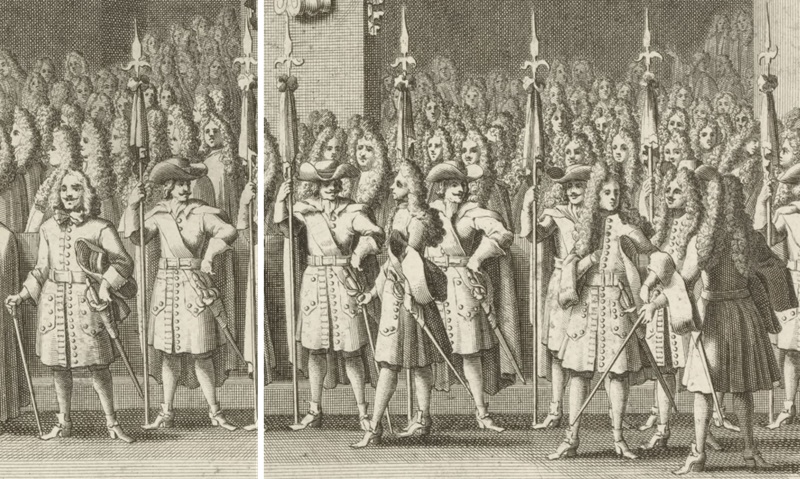
The Livgarde in mourning clothes (no lace) at the
Queen's funeral in 1693. The number of buttons on the pocket flaps indicates
rank.
On the left: a non-commissioned officer with 7 buttons (and a neckcloth tied
into a cravat) and a private with 3 buttons.
On the right: officers with 9 buttons (and large cuffs) and corporals with 5
buttons.
Carolean Uniforms 1688-1718
|

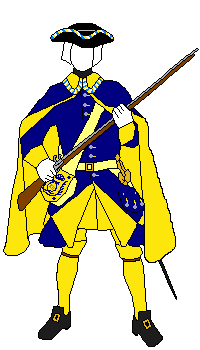
1699-1704
Narva, Düna, Kliszow |

1704-1707 |

1707-1709
Holowczyn, Poltava |
1710-1718 |
When
the Livgarde marched to war in April 1700 they wore uniforms that had been
issued in 1695. Although Charles XII had decreed a new uniform for his Guard
in 1699 it would not be until 1704 before the first
model 1699 uniforms were issued to the Livgarde. Then at last could the
3-männing soldiers, who had been added to the Guard in 1703, receive new
proper Livgarde uniforms instead of the red Saxon coats (captured in the
battle of Kliszow) which they had been forced to wear because of a shortage
of uniforms. As a part of the preparations for
the Russian campaign a second set of model 1699 uniforms were made in Saxony and
issued in April 1707.
But when the Livgarde was to be restored after the
battle of Poltava, the War College decided for a less expensive uniform. The
model 1709 uniform was then worn by the Livgarde for the remainder of the
war. Charles XII did however decree a new uniform model in 1716, similar to
the one from 1699. But due to delays it could not be delivered to the
Livgarde in time for the Norwegian campaign in 1718. During this campaign
the Livgarde was therefore among the worst dressed units. The lucky ones had
old worn uniforms from 1713, which was the last time the regiment had been
issued new uniforms. But since then the Livgarde's strength had more than
doubled, so roughly half of the guardsmen had not received any proper
uniforms at all. As an emergency solution, the Livgarde had been given 5,000
ells of wadmal (coarse wool) at the beginning of 1718 to remedy the
worst deficiencies. This should have been enough for coats, but the soldiers
complained in September 1718 especially about insufficient shoes and
stockings.
Since 1684 the Swedish army had grenadiers, but the
Livgarde grenadiers did
not have any special grenadier caps, they had instead the same hats as the
rest of the guardsmen with the typical "gold and silver in silk" lace of the
Livgarde. After Poltava, the gold and silver in the Livgarde uniforms may
have disappeared for cost reasons. Only "silk lace" on the cloak are
mentioned. I have made a guess that the gold and silver were replaced with
yellow and white thread, but it is also possible that they were completely
white.
|
Rank and File |
|
 |
 |
 |
 |
 |
|
1688 – 1704 |
m/1699
(issued in January 1704 and April 1707) |
m/1709
(issued until October 1713) |
m/1716
(was not issued in time for the Norwegian campaign in 1718) |
|
Hat: |
Black, decorated with hat band and lace of gold
and silver in silk. The drabants received tricornes in 1695. |
Lace and hat band of gold and silver in silk. |
Decoration not mentioned. |
Lace of silver and gold in silk. Hat band of "yellow and white
thread". |
|
Neckcloth: |
White, tied at the front with a
blue ribbon until 1697. The drabants then received blue neckcloths, and
this may have also been the case for the rest of the Livgarde. |
Partly of yellow and black crepe, and partly of white ticking.
Made of black fabric in 1706. |
|
One made of black and yellow crepe, one made of white ticking. |
|
Coat: |
Blue broadcloth lined with yellow baize.
Pewter buttons. In 1693, corporals had five buttons on each pocket flap and privates had
three buttons. |
Blue regular broadcloth "with yellow baize for
lining and fine [yellow]
baize for cuffs and collar".
Corporals: "Button holes with leaf work [likely acanthus
leaves] and double silk holes [yellow silk lace]".
One row of buttonholes was false. 31 large "flat"
pewter buttons and 6 smaller ones, the latter on the sleeves.
Privates: Single lace along the button holes (¾ lot yellow
silk instead of the corporals' 2 ½ lot). 26 large flat pewter buttons
and 6 smaller on the sleeves.
Corporals had five buttons on each pocket flap
while privates only had three. In 1707 the total amount of buttons for
privates were 19 or 20 large buttons (depending on the length of the
soldier) and 6 small buttons. |
Blue broadcloth with collar and cuffs of "friserad"
(= surface made uneven) yellow baize, lined with baize of lesser quality.
Along the button holes, yellow lace of camel hair yarn (2 lots). 19 "three-stamped
pewter buttons". |
Blue broadcloth with collar and cuffs of yellow broadcloth. Lined with "friserad"
(= surface made uneven) yellow baize.
24 large buttons "of three-stamped pewter and lathed with edge""
and 6 smaller ones on the sleeves. Corporals: "Double
button holes [lace] of twisted yellow camel hair yarn" with "leaf
work of yellow
silk [2 lots]".
Privates: had no lace or leaf work along the button holes. |
|
Cartridge Box: |
Had in the mid-1690s lids
covered with yellow broadcloth, from 1699 with yellow and blue
broadcloth. |
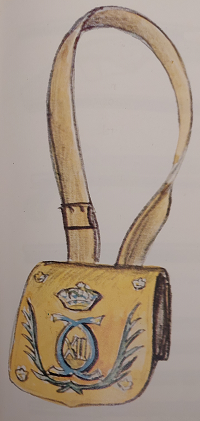 Lid made of yellow
broadcloth "with palm branches around the name [the royal
cipher] sewn and a small crown in all four corners".
Cartridge box model 1716 interpreted by Göte
Göransson
Grenadier lids "with grenades and other
ornaments", they do not seem to have had palm branches and crowns like
the musketeers. |
|
Waistcoat: |
Not mentioned. |
Not mentioned.
Yellow broadcloth in 1707. |
Yellow broadcloth. 18 smaller buttons like the coat. |
Yellow broadcloth lined with fabric ("väv"). 17 smaller buttons like
the coat. |
|
Waist belt: |
Waist belts replaced shoulder belts in 1699. |
Made of ox leather with brass buckle. |
Made of ox leather with brass buckle. |
Made of ox leather with brass buckle. |
|
Breeches: |
Blue broadcloth. |
Blue broadcloth in 1704
Yellow broadcloth in 1707. |
Yellow broadcloth. |
Yellow broadcloth. |
|
Stockings: |
Yellow knitted stockings. |
Yellow knitted stockings. |
Yellow. |
Yellow. |
|
Cloak: |
Blue broadcloth lined with yellow baize. |
Blue broadcloth with "collar of fine [yellow] English
baize,
lined with lesser yellow baize; around the collar lace of gold and
silver in silk" (2 ells). Brass buckles with crowned royal name cipher. |
Blue broadcloth with a collar of "friserad" (=
surface made uneven) yellow baize and decorated with 2 ells "silk
lace". Lined with lesser yellow baize. |
Blue broadcloth with collar of yellow broadcloth, decorated with 2 ⅛ ells "lace of
silver and gold in silk". Lined with "friserad" (= surface
made uneven) yellow baize. |
|
Gloves: |
|
Elkskin collars and buckskin grips. |
Collars made of ox leather. |
Collars made of ox leather. |
|
Sword knot: |
|
|
Leather ("smorläder"). |
Leather ("smorläder"). |
|
Officers
The officers had to procure their own uniforms, and therefore information
about officer uniforms is rare. The information below comes from a
regulation from 1695, but it should have been valid for the rest of the
Carolean Age. Probably both the amount and the width of the gold lace varied
between the different officer ranks.
|
|
Hat:
|
Made of camel hair felt. Hat
band and wide lace of gold (gold lace = gilded silver). |
 |
|
Coat: |
Of finest blue broadcloth, cuffs of
blue velvet, pocket flaps decorated with the same; lining of blue
"rask" (= fabric with a thin shiny surface). "Framed"
(edged) with narrow gold lace and otherwise richly decorated with wide
lace and buttonhole lace in gold. "Gold thread buttons", after 1709
possibly gilded brass buttons. Nine buttons on each
pocket flap in 1693. |
|
Waistcoat: |
Of broadcloth like the coat
and decorated in the same manners. |
|
Waist belt: |
Covered with gold lace,
lined with blue ticking. Gilded buckle. |
|
Breeches: |
Blue broadcloth. |
|
Stockings: |
Made of blue yarn. Gilded
buckles on the knee straps. |
|
Cloak: |
Blue broadcloth with gold lace on the
collar, front and back at the slit. Gilded buckles with crowned royal
name cipher. |
|
Gloves: |
Reindeer skin. the collars
decorated with the gold lace. The regimental officers probably also had
gold fringes. |
|
Sword knot: |
Made of gold. |
|
Non-Commissioned Officers |
|
 |
 |
 |
 |
 |
|
1688 – 1704 |
m/1699
(issued in January 1704 and April 1707) |
m/1709
(issued until October 1713) |
m/1716
(was not issued in time for the Norwegian campaign in 1718) |
|
Hat: |
Black, decorated with hat band and lace of silver. |
Lace and hat band of silver. Silver plated button. |
Silver lace, one inch wide. Hat band of white thread. |
"With silver lace" |
|
Coat: |
Decorated with silver lace on the cuffs and pocket flaps.
Blue cuffs, collar and lining.
Yellow buttonholes.
Seven buttons on each pocket flap in 1693. |
Blue of fine broadcloth, 5 ½ ells "of which is also taken for
collar and cuffs. Lined with blue "rask" (= fabric with a thin
shiny surface). Edged with 11 ¾
ells narrow lace and otherwise decorated on collar, cuffs and pocket
flaps" with 8 ¾ ells wide lace and 14
ells button hole lace, all of genuine silver. 40
large "round" (lumpy) buttons of fine English pewter. |
Blue broadcloth lined with blue "friserad" (= surface
made uneven) baize. Decorated with one inch wide silver lace (on the
cloak collar and coat, all together 8 ¼ ells). The button holes "edged
with blue broadcloth". 22 silver plated brass buttons. |
Blue broadcloth lined with fine blue "friserad" (= surface made
uneven) baize. Decorated with silver lace (on the cloak and coat, all
together 14 ells) Button hole lace of blue silk. 26 large "double silver
plated brass buttons and 6 smaller ones on the sleeves. |
|
Waistcoat: |
Leather with lace of the same kind as the coat.
Buff coat before 1695. |
Made of buckskin (4 hides), lined with yellow "dwelck"
(coarse ticking). Edges (8 ells) and wide lace (5 ⅞ ells) of silver.
5 ½ dozen smaller pewter buttons. |
"Camisole of buckskin with yellow ticking
lining and English pewter buttons". |
Made of chamois-coloured broadcloth, lined with fabric (above the waist "väv""
and below with chamois-coloured ticking). 24 smaller buttons like
the coat. |
|
Waist belt: |
|
Decorated with wide silver lace and lined with blue
ticking. Silver
plated buckle. |
Plain made of elkskin with two sockets and silver plated buckles. |
Made of ox leather, decorated with 4 ½ ells silver lace and silver
plated buckle. |
|
Breeches: |
Blue broadcloth. |
Blue broadcloth. |
Blue broadcloth. |
Blue broadcloth. |
|
Stockings: |
Blue. |
Blue yarn ("redgarn") |
Blue-coloured "wool knit stockings" |
Blue yarn ("redgarn") |
|
Cloak: |
Blue broadcloth, lined with yellow baize,
and decorated with "silver in gold lace" (lace of silver thread
with interwoven threads of gilded silver). |
Blue broadcloth with fine yellow baize on the collar and
lesser baize for lining. Decorated with gold, silver in silk lace (8
ells)
on the front and and back on the slit as well as the collar. Silver
plated buckles with crowned royal name cipher. |
Blue broadcloth lined with blue "friserad" (= surface
made uneven) baize. One inch wide silver lace on the collar. "1 pair
of silver plated brass cloak buckles, 1 pair of small plain ones on the
back of the skirt". |
Blue broadcloth lined with fine blue "friserad" (= surface made
uneven) baize, decorated with
silver lace. "Silver plated brass buckles, large and small, with
Carolus". |
|
Gloves: |
|
Reindeer skin "with decorated small collars". |
Elkskin collars and buckskin grips. |
Elkskin collars and buckskin grips. |
|
Sword knot: |
|
Of blue silk with touches of silver. |
|
|
|
Drummers
and Pipers
The Livgarde drums were blue in 1699 but otherwise had the same
appearance as the colours. Even in this case, the drums of the Colonel’s
Company differed in having the greater national coat of arms instead of
the king's monogram.
It is unclear what is meant
by the "flaxar" mentioned on the m/1699 coat. It may be a
question of so-called "bjärmar" which consisted of a strip of
broadcloth decorated with yellow rask that hung down from each shoulder. It
is also possible that they consisted of one or more loosely hanging back
skirts. The flaxar may also have been decorated with buttons since the
m/1699 coat was supposed to have 48 buttons while the m/1709 only had
18. |
 |
 |
 |
 |
 |
|
1688 – 1704 |
m/1699
(issued in January 1704 and April 1707) |
m/1709
(issued until October 1713) |
m/1716
(was not issued in time for the Norwegian campaign in 1718) |
|
Hat: |
Black, decorated with hatband and lace, for the hautboists
and the regimental piper made of "gold" (gilt silver). |
Lace and hat band of gold and silver in silk. |
"With sweatband and set together with a hat band twice around the
hill with white and yellow thread, and silk lace along the edge." |
Lace of "silver and gold in silk. Hat band of yellow and white thread". |
|
Coat: |
Blue coat with blue collar, yellow cuffs and yellow lining.
The regimental piper's coat was decorated with "gold in silver lace",
the hautboists of such lace and velvet on the cuffs, drummers' and pipers' coats had "lace". |
"Coats of fine blue broadcloth, lined on the cuffs and the "flaxor" [fabric
hanging on the shoulders] with yellow "rask" [= fabric with a
thin shiny surface] and underneath with lesser yellow baize, with [48]
gold, silver in silk buttons, decorated with gold and silver i silk
lace" (on the coat and waistcoat, 54 ells in total).
Blue collar
and yellow cuffs. |
Coat of blue broadcloth with collar and cuffs covered with "friserad"
(= surface made uneven) yellow baize, lined with baize of lesser quality.
On the coat and waistcoat, 53 ells
"lace of gold, silver in silk" in total and "2 lots yellow twisted
camel hair yarn for the button holes". 18 "three-stamped pewter buttons
with stripe". |
Coat of blue broadcloth with collar and cuffs of yellow broadcloth, lined with "friserad"
(= surface made uneven) yellow baize.. On the coat and waistcoat, 30
ells "silver
and gold in silk lace" in total, 17 ½ ells edging lace of the
same kind and 2 lots camel hair yarn for button hole lace. 27 large and 6
smaller buttons "of three-stamped pewter and lathed with edge". |
|
Waistcoat: |
Blue broadcloth, decorated like the coat. |
Blue broadcloth, decorated like the coat. 36 smaller buttons like the coat. |
Blue broadcloth, lined under the waist with yellow baize; regular lace and
button hole lace (see the coat). 18 smaller buttons like the coat. |
Blue broadcloth lined under the waist with "friserad" (= surface made
uneven) yellow baize. Decorated like the coat. 23 smaller buttons like
the coat. |
|
Waist belt: |
|
Decorated with 7 ½ ells gold and silver in silk lace.
Drum strap decorated with wider lace of the same (5 ¼ ells). |
Made of ox leather with two sockets and a brass buckle. Drum strap of ox leather. |
Made of ox leather with two sockets and a brass buckle. |
|
Breeches: |
Blue broadcloth. |
Blue broadcloth. |
Blue broadcloth. |
Blue broadcloth. |
|
Stockings: |
Yellow. |
Yellow. |
Yellow. |
Yellow. |
|
Hair bag: |
|
|
Made of black "dwelck" (coarse ticking) with lace. |
|
|
Piecoat: |
Blue piecoat with yellow lining from 1690. |
Piecoat of blue broadcloth. "The cuffs and collar of fine yellow baize and
lined with yellow lining baize. Decorated with "1 ½ dozen camel hair "litser"
(lace made of blue and yellow camel hair yarn). 18 pewter buttons. |
Piecoat of blue broadcloth and lined with yellow baize. 18 pewter buttons
like the coat. |
Piecoat of blue broadcloth and lined with "friserad" (= surface made
uneven) yellow baize. 18 pewter buttons like the coat. |
|
Gloves: |
|
|
Collars of ox leather and buckskin grips. |
Collars of ox leather and buckskin grips. |
|
Sources: black text = Tor Schreber von
Schreeb, purple text = Folke Wernstedt (Livgardets
historia, volume IV). |
Liberty Age Uniforms 1719-1772
|
m/1716
(issued at the turn of the year 1718-19) |
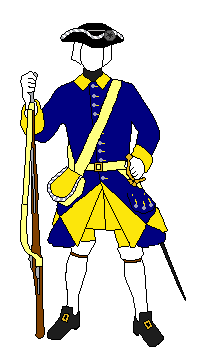
m/1724-1728
(issued in 1729) |
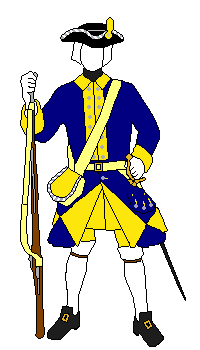
"m/1750s"
(was in use no later than 1759) |

m/1765
(issued in 1768) |
Charles XII’s
m/1716 uniforms (described in the tables above) were finally completed and
sent from Stockholm to the main army in two batches in early November and
early December 1718. By then, however, the king was dead and the campaign
was over. These thus became the Livgarde's first uniforms during the new era
that began in 1719. However, just a few years later the Livgarde received
uniforms that differed in several details from that worn during the reign of
Charles XII.
The "gold and
silver in silk" lace of the Carolean Age were replaced with lace that
consisted only of silver thread and white silk. In addition, the stockings
became white and the officers' and NCOs’ previous all-blue uniforms were
replaced with blue coats that had cuffs and linings of light-yellow chamois.
The most characteristic feature of the Livgarde' uniforms during the Liberty
Age, however, were the lapels that were introduced for officers and NCOs in
1728, but not for the privates until the 1750s. This detail was exclusive to
the Livgarde until the introduction of the m/1765 when more Swedish
regiments received lapels on their uniforms.
Further distinguishing details for the Livgarde were that the hat would have
a black cockade from 1724. However, in 1751 it seems to have been replaced
by tassels, which, like the lapels, spread to several other regiments when
the more decorative m/1765 uniform was introduced in the Swedish army.
|
The Livgarde' cartridge box also had extra decorations. The yellow
broadcloth lid
from the reign of Charles XII seems to have been retained, since one with
silver and silk lace is mentioned in 1744. I have made a guess on my
pictures that the lid was still decorated with the king's monogram as in the
reign of Charles XII. But from 1763 the cartridge box was completely black
and provided with a brass plate with a completely different motif.
Uniforms Issued in 1729 |

NCOs |
|
|

Privates |

Drummers |
|
Hat: |
Regular black hat with white lace with silver and round
pewter button. Cockade of black taffeta and sweatband.
Silver in silk lace. |
|
Two finger wide silver lace, one silver-plated brass
button for attachment and a cockade of double black taffeta with
sewn-on brass thread.
Silver lace and cockade as well as a black horse hair button. |
|
Cloak, piecoat: |
Cloak with silver in silk lace on the
collar and large white metal buckles and a pair of smaller brass buckles. |
Piecoat of blue broadcloth lined with yellow "friserad"
(= surface made uneven) baize. |
|
|
Coat: |
Blue regular broadcloth lined with yellow "friserad" (=
surface made uneven) baize both in the sleeves and under the waist. |
Blue regular broadcloth with yellow collar and cuffs.
Lace with silver edged silk (it is not clear if it is for the hat or the
coat). |
Blue with chamois collar and cuffs.
Blue lined with chamois "friserad" (= surface made uneven) baize. Chamois
cuffs and lapels and white buttons. |
|
Waistcoat: |
Yellow broadcloth lined with fabric ("väv"). |
Yellow regular broadcloth lined with fabric ("väv"). |
Chamois broadcloth underlined with "friserad" baize.
Chamois broadcloth lined with "friserad" baize
and fabric. |
|
Breeches: |
Yellow broadcloth lined with fabric ("väv"). |
Blue lined with fabric ("väv"). |
Chamois broadcloth lined with fabric.
Chamois broadcloth lined with fabric and pewter button. |
|
Stockings: |
White wool stockings. |

Drum from Fredrik I's reign
(AM.000836) |
White knitted yarn ("redgarn") stockings.
White yarn ("redgarn") stockings. |
|
Gloves: |
Regular gloves.
Two pair of grips made buck leather and reindeer leather respectively. |
Large pointed elk skin collars with reindeer skin grips. |
|
Source: Lars Ericson's
article in Meddelanden från Armémuseum 45-46 (black text = m/1724,
red text = m/1726,
purple text = m/1728) |
The
information above comes from Lars Ericson's article which only mentions
changes in the Livgarde uniform regulations and not when these items were
actually issued. However, in the Livgarde's regimental history work (volume 5,
page 835) it is stated that the yellow yarn stockings were replaced by white
knitted wool stockings in 1729. However, it seems strange that an enlisted
regiment that was constantly on duty had to wait five years for the decision
to change the colour of the stockings to be implemented. It is reasonable to
assume that worn-out stockings should have been replaced between 1724 and
1729, but perhaps the change was delayed until a complete set of new
uniforms were issued.
Bellander
states that both the non-commissioned officers and the musicians received
lapels in 1728 (page 303). Ericson, however, does not explicitly mention
that all musicians received lapels 1728, but only that hautboists received
them in the autumn of 1728 after the non-commissioned officers had received
them in July 1728. Hautboists were musicians who used to wear uniforms that
were similar to the non-commissioned officers, while the regular drummers'
uniforms were more similar to the privates.
Exactly when lapels were introduced on the privates' uniforms is also
unclear. The War College noted in 1759 "that for some time the Livgarde
coats had so-called lapels on the chest", which contradicted the
Parliament's ban on "all kinds of excesses and haughtiness occurring in
the army" and the King had also forbidden the Livgarde officers from
using lapels the year before. Despite this, the War College suggested that
all personnel should have lapels so that the Livgarde would distinguish
itself from the other regiments.
The officer portraits below, show that around 1728 the lapels had 2x12
buttons, which were placed in groups of four buttons each. The number of
buttons on the lapels then seems to have been halved around 1760, at least
on the lapels, which then only had groups of two buttons. This is how the
m/1765 uniform is depicted (with an additional 2x2 buttons under the
lapels). The portrait of Lieutenant Colonel Wrangel from 1762 is not very
clear, but his buttons seem to correspond to the m/1765 uniform and not the
one from 1728.
 |
 |
 |
 |
|
Captain Knut Gustaf Sparre (died 1733) |
Adolf
Fredrik
Colonel 1744-1751 and then king |
Lieutenant Colonel Johan Reinhold Wrangel af Sauss
(depicted in 1762) |
Captain Fredrik Cederström (depicted in 1770) |
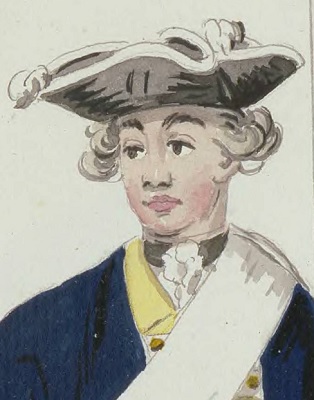
Close-up of the hat, from Jacob Gillberg's drawing of the Livgarde's
m/1765-uniform. |
The hats also
changed during the 1750s. In 1751, corporals received silver lace on their
hats, like the non-commissioned officers. In addition, both corporals and
privates were to have "tassels" on their hats (which were first introduced
in 1773 on the non-commissioned officers' hats). In 1762, it was decided
that the entire regiment would have silver lace around the brim. The
appearance of the tassels should have corresponded to those found on Jacob
Gillberg's model drawing of the m/1765 uniform. It was also noted in 1759
that the Livgarde' hats differed from the provincial regiments by having a
lower and pointed crown.
Note that the
officers have a gold cockade on their hats in at least portraits from 1762
and 1770. The latter officer, Fredrik Cederström, was one of only two
Livgarde officers who refused to swear allegiance to Gustav III after his
coup d'état in 1772.
|

Brass plate for the cartridge box lid from 1763 |
In 1762 it
was decided that the cartridge boxes should be decorated with a brass plate
and such boxes were issued the following year. The plate depicted the small
national coat of arms surrounded by the collar of the Order of the Seraphim
and colours, and below it a drum, crossed cannon barrels and other weapons
such as spontoons, bayonet muskets, cannonballs, etc. The non-commissioned
officers were to have silver-plated plates of the same type and at the same
time the non-commissioned officers of the Livgarde were the only regiment to
have their gloves paid for by the crown.
After the
Pomeranian War, a completely new uniform regulation was introduced for the
Swedish army in 1765. The cut of the coat was changed and black gaiters that
would cover the stockings became standard. For the Livgarde, the button
colour was also changed from pewter to brass. The first m/1765 uniform was
issued in 1768, but the black gaiters were not appreciated by the colonel.
and in 1772 he also requested white gaiters for use in parades because it
was "expected" that the Livgarde would be dressed in white ones. He got his
way and in the same year a white armband was also introduced on the officer
uniform as a symbol for supporters of Gustav III's coup d'état on 19 August
1772. With this coup d'état, the Liberty Age ended and the Gustavian Age
began, which would result in dramatic changes in the appearance of the
uniforms.
|
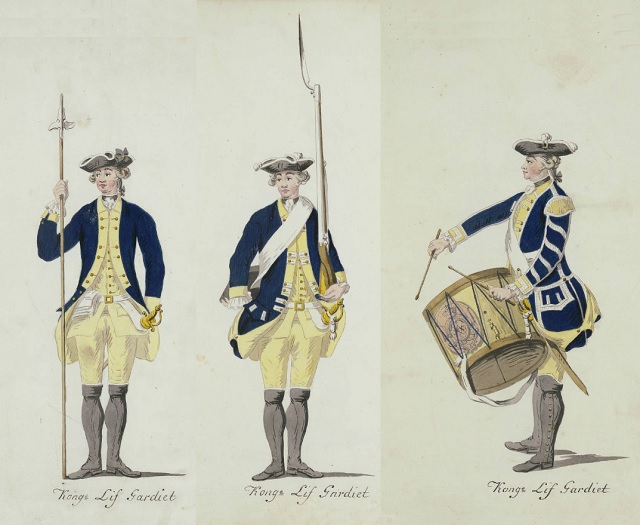 |
 |
|
NCO, private and drummer with uniform m/1765 (drawn by
Jacob Gillberg). |
Private c. 1778
(unknown artist) |
The yellow plume on the hat in the picture on the right was introduced in
the 1770s as a distinguishing feature of the Swedish army. The white gaiters
in the same picture were intended for parade, while black gaiters were to be
used in regular service.
Gustavian Uniforms 1772-1814

Officer and private soldier with uniform m/1779 (drawn
by Carl Gustaf Roos 1783)
As an enlisted regiment, the Livgarde were to receive new uniforms every
three years, and the first new uniforms during the Gustavian era were issued
in 1774. Their appearance still followed m/1765, but an order to purchase
boots in September 1778 indicates that the Livgarde may have already had
their uniforms changed to Gustav III's personally designed national costume
even though it did not become official for the entire army until 1779.
However, in that case, the new uniforms would have been re-sewn m/1765
uniforms, and it was not until 1780 that the first newly manufactured m/1779
uniforms were issued.
|
|
Privates |
Drummers |
NCOs
(same as privates unless otherwise stated) |
Officers |
|
Hat: |
Silver and silk lace around the crown (only silver for corporals) and a
blue yarn tassel. Additional yellow and blue
plumes were added in 1781, and the crown then became flat instead of
round. |
Silver and silk lace. |
Silver lace. |
|
|
Cloak, piecoat: |
Dark blue cloak made of broadcloth with a yellow collar and
white camel yarn lace. |
Dark blue surtout made of broadcloth and decorated with camel yarn lace. |
Dark blue surtout made of broadcloth with yellow collar and cuffs. |
|
|
Jacket: |
Blue with yellow collar and cuffs,
lapels and shoulder flaps, and lining of
yellow baize. Decorated with wide and narrow white camel yarn lace. |
Decorated with silk velvet and silver lace. |
Non-commissioned officer broadcloth
instead of soldier broadcloth. Lining of chalong instead of baize. Decorated
with silver lace. Also received a släpmundering of hautboist
broadcloth without decorations every year. |
Silver lace and tassels on the lapels. The buttons
were curved, fluted and adorned with three crowns. |
|
Waistcoat: |
Yellow broadcloth with blue collar and cuffs. |
Sleeveless waistcoat. |
|
|
|
Belt/Sash: |
Sash of blue and yellow flag
broadcloth.
The waist belt was replaced in 1788 by a shoulder belt. |
Sash made of flag broadcloth. |
Sash made of chalong. |
|
|
Breeches: |
Yellow broadcloth. |
|
|
|
|
Charivades: |
A pair of white charivads with blue
trim and a pair of blue charivads with white trim.
The charivads were made of wool yarn or felt with blue bands around the
thigh. |
White and blue charivades. |
Charivads of worsted yarn and the
blue pair edged with silver lace. |
|
|
Boots: |
Hungarian boots with
yellow trim. |
|
Gorget: |
Gilded with a light blue ribbon and with the
king's monogram in enamel as a motif. |
Kollet:
(short jacket) |
Yellow broadcloth with blue collar, cuffs
and piping. |
Adorned with silk velvet lace. |
|
Neckcloth: |
Red camlet. |
|
Gloves: |
White collared gloves. |
|
Sources: black text = Martin Markelius,
green text = Svante Ison Warfvinge (Kungl Svea
Livgardes historia, volume V). |
The Russian War of
1788-1790 took a heavy toll on the Livgarde' uniforms and a new set was
issued in 1789. This had loose lapels that could be buttoned over the
chest and thus an extra number of buttons compared to m/1779. A
battalion stationed in Gothenburg also had its worn-out charivades
replaced with stockings that same year. Further changes to the Livgarde'
uniform were made after the war and its uniform became the prototype for
the new uniform model that was introduced for the entire army in 1792.

Svea Livgarde m/1792 uniforms. From left:
grenadier officer, regular officer, grenadier and musketeer.
With m/1792, the charivades and
the boots were replaced with the gaiters and shoes that had been worn before
m/1779. In addition, the jacket was made longer. In 1794, the Livgarde were
given the right to be the only regiment to have cords. The officers thus
exchanged silver lace for silk cords, while the non-commissioned officers
and privates were to have cords made of thread. In 1798, the colour of the
breeches was changed from yellow to white, and in 1800, a command to
Strömsholm became the first to receive trousers.
When the m/1802 uniform was
introduced, the last remnants of the Gustav III’s m/1779 uniform disappeared
from the Swedish army. The only exception was the hat, but for the Livgarde
this detail was also replaced and instead they received a so-called tricorne
hat that followed the fashion of the time, that is, it was high with a
flattened front (more like a bicorne). Officers and non-commissioned
officers had silver lace on their hats while the men had yarn ribbons (the
corporals received silver lace in 1803). In addition, the hat was to be
decorated with a cord, plume and straw cockade or company badge. The
non-commissioned officers were also to have silver lace at the buttonholes,
lapels and cuffs. Further decorations introduced in 1803 were that
non-commissioned officers and corporals received tassels in the hat corners
and the waist belt plate was decorated with the lesser national coat of arms
in a blue enamel globe. The privates also then received yarn epaulettes, and
buttonholes on the collar. The Jäger Battalion, which was formed in 1802,
received a special green uniform established in 1803.
 |
|
Model
drawings of the Livgarde' m/1802 uniforms depicted by Carl Gustaf
Gillberg. From left: officer in parade uniform, officer in daily
uniform, non-commissioned officer and private soldier. However, the
trousers are stated to have been white by both Bellander (page 407) and
"Kungl. Svea Livgardes historia" (volume 5, page 837). All personnel
also seem to have worn white plumes on their hats since the king ordered
that these be replaced with yellow ones when the Livgarde were demoted
in 1808.
The
picture below on the right shows what a private Livgarde m/1802 uniform
looked like from the back. In regular regiments, only officers wore a
tailcoat with a skirt that went down to the knees, while ordinary
soldiers would have jackets that ended at the crotch. In addition,
regular regiments had all-black cartridge boxes without brass plates. |
 |
 |
|
The
green m/1803 uniforms of the Livgarde' jäger battalion depicted by Carl
Gustaf Gillberg. The battalion existed from 1802-1806 and the picture
shows from left: an officer, a non-commissioned officer and a private
hunter. |
The back of a private Livgarde uniform m/1802.
Drawing from a contemporary work by Wilhelm von Runge. |
In 1804, the privates were
given shirts and trousers for use at work and off duty. In the same year,
the men's yellow waistcoats were replaced with blue ones with sleeves and a
yellow stand-up collar.
A new, radical change to the
Livgarde uniform took place in 1807 when non-commissioned officers and
privates exchanged the bicorne hat for a “kask” with horsehair girdle and
brass plates. This would have a white feather plume on parade but a
horsehair plume on other duty. In addition, blue trousers made of broadcloth with
white cords along the thigh were introduced, which were to be worn in
parallel with the old white trousers made of broadcloth or leather. The
initiative for the new trousers came from the company commanders, who also
paid for them until 1815-16 when they became part of the regular clothing
establishment.
When the Svea Livgarde were
demoted to a regular enlisted regiment on 15 October 1808, this also had
consequences for the uniforms. The officers were to exchange their white
plumes for yellow. The uniform buttons were to be replaced with smooth,
curved white buttons. The non-commissioned officers and privates were to
likewise exchange their white plumes for yellow and the plates on their hats
were to be removed. After the deposition of Gustav IV Adolf on 29 March
1809, however, the uniform was restored to its previous appearance with one
exception. The white armband that the officers had worn since the coup
d'état in 1772 was removed.
 |
 |
 |
|
Drawing of an officer with private soldiers in the background. The image
is a detail from a plate published in Berlin around 1808. However, the
high-cut tailcoat that does not cover the stomach seems to have only
been issued in 1812. |
Model of a trumpeter with a
tailcoat from 1812 and a m/1807 hat.
The hat has a small national coat of arms on the brass plate. |
Drawing of a guardsman from 22 February 1814. The hat is from m/1807,
the jacket from m/1803 and the blue trousers of the type that since 1807
were used in parallel with the white trousers. |
The Svea Livgarde received a
new uniform in 1812, the tailcoat having a very high slanting cut that left
the stomach only covered by the waistcoat and shirt. Such a high cut proved
to be unsuitable in the field, and to protect the soldiers' health. A new
uniform model was established in 1816, where the tailcoat would have a
straight cut at the waist. However, this m/1816 uniform was not issued to
the Svea Livgarde until 1819.
It is not entirely clear to me
what type of jacket/tailcoat the Livgarde wore during the Finnish War of
1808-09 or the Napoleonic Wars of 1812-1814, as we have a plate from around
1808 showing a high-cut tailcoat, but both Bellander and the Livgarde's
regimental history work date that tailcoat to 1812. Then we have a drawing
from 1814 showing a guardsman wearing a jacket that the regimental history
work states is m/1803. I assume that it was the latter that was in use until
1812 and was reused shortly thereafter when the new tailcoat proved
unsuitable. The tailcoat from 1812 may have been established earlier in a
uniform regulation and therefore been depicted before it was issued.
For regular guardsmen, the last
remnant of the Gustavian uniforms disappeared when the m/1807 hat was
replaced as headgear by a shako in 1839. However, the grenadiers' caps would
be all the more durable.
Grenadier Caps
The very first evidence of
grenadier caps at the Livgarde is from 1774 when such were issued. However,
the Livgarde had probably had grenadier caps since the 1750s. In any case,
bearskin caps were issued in 1774 to 15 non-commissioned officers and 318
grenadiers. 10 officers also received grenadier caps, but their caps were
made of "Guenott Skinn", which ought to have been black cat skin. The
officers' caps were decorated with a plume of yellow feathers while the
non-commissioned officers had blue feathers. The caps were considered worn
out in 1781 when the king ordered that 300 new ones be purchased. These were
delivered in 1783 and became more expensive than the previous caps because
they were larger and had more decorations. After the Russian War of
1788-1790, the eight-year-old grenadier caps were in poor condition and some
of them were replaced in 1791 by 200 new caps. A new set of grenadier caps
was issued in 1797, but already in 1804 it was reported that the leather
brims on these had been badly damaged by moths. A new and considerably more
durable set of grenadier caps was therefore issued in 1805. This consisted
of 8 officers', 11 non-commissioned officers' and 222 soldiers' caps. This
set would be reduced over the years due to wear and tear, but thanks to
repairs in 1841, all officers' caps and 140 soldiers' caps would be in use
until 1874.
The caps issued in 1805 appear
to have had the same appearance as those issued in 1791 and 1797. The caps
are said to have been leather-brimmed and fitted with gold cords for
officers, silver for non-commissioned officers & the regimental drummer and
yarn for the men. Drummers and pipers also had yarn but they stopped using
grenadier caps in 1797. The privates' cords were red until the 1840s when
they became white. The old caps from 1783 lacked cords but instead had a
plate along the lower part of the cap. Both types of caps had a plume with
feathers. |
|
Livgarde Colours

Reconstruction of m/1686 colonel's colour
(no model drawing is preserved and the motto is likely incorrect) |
Olof Hoffman's model drawing of m/1686 company colour |
The Livgarde
has traditionally carried white colours with the king's monogram in gold as
a motif. However, this is a tradition that only began in 1672. During the
reign of Charles IX and Charles X Gustav, they appear to have had the
Swedish blue-yellow colours, while during the reign of Gustav II Adolf and
Kristina they had the black-yellow colours of the House of Vasa.
The Livgarde
originate from the 16th century Drabant Corps, whose oldest known colour
("fänika") from 1563 had a yellow cross in the style of the Swedish flag and
the other fields were coloured red, green and violet. It is unknown what
pattern the latter colours formed. During the reign of Johan III, the
Drabant Corps seems to have had no colour at all, and it was only when the
drabants was reorganised into the Drabant fänika in 1600 that it again
received an ensign (= colour bearer). But it is only from 1604 that we have
evidence that a colour was issued. This consisted of blue, yellow and red
silk and was possibly designed with a cross. For the occasion of Charles
IX’s coronation in 1607, the drabants received a new colour that consisted
of 90 ells of yellow silk. This colour possibly had decorations in blue
since the drabants' uniforms were yellow with blue details at the same time.
Black and
Yellow Colours until 1654

Yellow colour ("fänika") that was 330 cm high and at least
390 cm wide. From 1620 onwards, the size of colours was considerably
smaller, which means that this should be from the 1610s. |
The colour that could be the oldest surviving colour of the Livgarde is a yellow
"fänika" from the 1610s with Gustav II Adolf's monogram in black. It is
precisely the colour combination and the motif that suggest it could have belonged to
the predecessor of the Livgarde. Today only fragments of this colour remain,
but the picture on the right shows how it looked during the period 1690-1709
when it was depicted by Olof Hoffman.
From the written sources we know that the drabants (which in 1618 became the
colonel’s company of the Hovregemente) were issued a colour in the years
1612, 1616, 1617 and 1618. The first had silk fringes and the last was made
of yellow silk. Otherwise, we do not know any more details except that these
colours were still very large. The colour from 1618 consisted of 42 ells of
“kartek”, while in 1620 only 11 ells of taffeta were needed for a colour and
then reduced further. Both kartek and taffeta are silk, but the former is
thinner, which makes the colour less heavy. When the size of the colour was
reduced, the thicker and more wear-resistant taffeta could be used instead.
The colour issued in 1620 consisted of 9 ells of black taffeta and 2 ells of
yellow taffeta and 2 lots of silk. The following year it consisted of only 4
½ ells of black silk and 1 ell of yellow silk "for distribution" and 1 lot
of silk.
The first time the motif on the colours is mentioned is at the conquest of
Riga on 16 September 1621, when the eight colours of the Hovregemente were
described as black with lions and crowns in gold.
In May 1624, black and yellow taffeta was issued to the eight companies of
the Hovregemente, each of which received just over 6 ells of taffeta and a
load of silk. The Colonel’s Company was also given "14 books of fine gold"
to paint its colour with. The Colonel’s Company, which after the death of
Gustav II Adolf was simply called the Livgarde, received seven ells of black
taffeta in 1628, 1631 and 1635 to make a colour. On the latter occasion, 7 ½
lots of silk lace are also mentioned to adorn the colour.
In the mid-1620s, the Hovregemente began to be called the "Yellow Regiment"
and later there are notices of yellow colours in the sources. In July 1627,
two companies received yellow colours, and two more companies received such
colours in May 1630. In addition, an eyewitness description of a regiment
that in September 1631 carried "old white colours" has been identified with
the Hovregemente. These are believed to have originally been yellow colours
that had faded. Finally, there are contemporary depictions in the form of Reginbaldus Möhner's watercolours of Swedish colours belonging to regiments
in Augsburg in 1632-1635. According to these, the Livgarde Company had a
black colour with the national coat of arms as a motif, while the other
companies were represented by two pale yellow colours that together with
white had different patterns.


Modern depictions (Nordenfalk & Göransson) of Möhner's watercolours from
1632-1635 of the colonel’s colour and two company colours respectively
In 1642, the Livgarde once again received a new colour and for the sake of
rarity, the motif on it has been described. It consisted of the Swedish
national coat of arms in the middle and around it there were decorations in
silver and gold. However, the colour of this colour is unknown. Shortly
after, the Livgarde was expanded to a 20-company strong regiment and these
apparently received colours because its colonel complained in 1648 that they
were completely worn out. For Kristina's coronation in 1650, the Livgarde
received three new yellow colours with embroidered decorations.
Charles X Gustav's Blue and Yellow Colours
When Charles
X Gustav became king in 1654, the Livgarde's colonel’s company in Stockholm
received a new colour. The original idea was that it would be made of white
taffeta and have a motif that its commander would decide. However, the
taffeta used in the production was blue. The colour's decoration consisted
of yellow taffeta ribbons and painting by Jakob Elbfas. Two Livgarde
companies stationed in Bremen also received blue flags with yellow taffeta
ribbons in 1654. The blue shade should have been light blue if it was to
match the colour of the uniforms. Later, however, the colonel’s company
colour may have become white because Gabriel Kurck, who was its captain from
1656, described in his memoirs that the Colonel’s Company’s colour was
distinguished by being white and adorned with gold and silver embroidery. In
advance of Charles X Gustav's funeral in 1660, this company received a
temporary black mourning colour. Two regular colours of unknown appearance
were issued in 1659 and it was not until 1672 before the Stockholm part of
the Livgarde received any colours.
The part of
the Livgarde that was stationed in Riga in 1660 ("German Guard") received
eight colours when it was to participate in the Bremen War of 1665-1666.
These colours have an unknown appearance, so it is unclear when the change
from blue-yellow to white colours took place. When the German Guard was
transferred to Germany in 1672, they again received eight new colours, and
these seem to have been white. However, the German Guard lived its own life
and after the end of the Scanian War it was not even formally part of the
Livgarde and instead became its own regiment called the “Tyska
livregementet till fot” (German Life Regiment on Foot).
White Colours
from 1672
Ever since
1672, when the Livgarde Battalion in Stockholm received four colours of
white silk, the Livgarde' colours have always been white. When the Livgarde
in Stockholm was expanded to 12 companies in 1675, they received a new set
of 12 white colours with gold decorations. These colours were worn out after
the end of the Scanian War and were therefore replaced in 1680 by another
set of 12 colours.
The motif is
not mentioned at any time for these white colours. However, we can
indirectly figure out what the colours looked like based on the colours and
standards of other regiments. According to the regulation from 1673, the
Livregemente till häst (Life Regiment on Horse) was to have colours that
matched the colours of the Livgarde. The colours that were made in 1674 and
that the Livregemente lost to the Danes are said to have had the king's
monogram and a Latin motto above them. The German Guard, which was still
considered part of the Livgarde, also received eight new colours in 1672 and
three colours that were taken by the Danes in 1678 are believed to belong to
this set. The motif on all three colours consists of the king's monogram in
a laurel wreath and crowns in the corners, all in gold. The colonel’s colour
also had two lions holding up the crown in the monogram. The colours were
attached to white staffs.


Possibly a colonel’s and company colour (and finial)
that belonged to the German Guard 1672-1678. Both colours are white with
gold decoration, although the company colour appears dark in this black and
white photo. The company colour still has a crown left in one corner.
In 1682, the former German Guard received colours like those that the
Livgarde had received in 1680. According to the description, all colours
were white with crowns scattered across the colour. The colonel’s colour had
the national coat of arms as a motif and the company colours various "emblemata".
The high price of the colours also indicates that they had all the
decorations that the Livgarde m/1686 colours were supposed to have. The
design determined by the 1686 regulation for the Livgarde' colours was
therefore probably not a change but merely a confirmation of the prevailing
conditions.
According to the regulation from 1686, the Livgarde colours were white.
The motif of the company colours consisted of the
king's crowned mirrored monogram carried by two crowned lions in a white
field strewn with crowns. At the top was a motto written in Latin. The
colonel's colour was the same except that the royal monogram in the middle
was replaced by Sweden's greater coat of arms. The intent was probably that
each individual colour would have its own motto at the top, and that was
also the case with the colours manufactured at the end 17th
century. But in the set manufactured in 1710, all company colours had the
same motto as in Olof Hoffman's the model drawing (see picture further up).
The today fragmented colonel's colour, however, appear to have had a separate
motto, which is probably due to Olof Hoffman's unpreserved model drawing of
the colonel's colour likely did not have the same motto as the company colour.
The first
m/1686 set of twelve colours was issued in 1690 and the old colours were
then donated to the regimental commander Bernhard von Liewen. But in
September 1700 the Livgarde was reorganised from twelve to eighteen
companies and the new companies needed their own colours. Charles XII
therefore asked von Liewen to return the six older colours that were in the
best condition. These older colours were likely not delivered to the
Livgarde in time for the Battle of Narva on 20 November, but should have
been used during the Battle of Düna on 9 July 1701. It is written in Captain
Olof Stiernhöök's diary that his company received a colour on 26 December
1700.
|
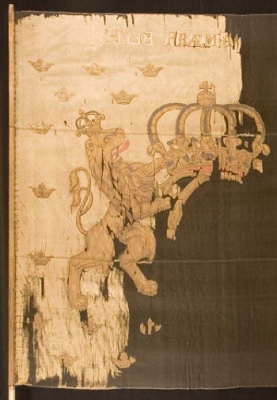 |
HINC PRÆMIA BELLI
(Hence the rewards of war)
A preserved company colour from either 1680 or 1690
(Rudolf Cederström's
description of it follows below)
295. Colour. Flag:
originally a height of 216 cm, present width 143 cm.; of white taffeta,
upon painted in gold, the same on both sides, Charles XI's cipher, large
double C underneath large closed crown with red lining; the cipher is
supported by two crowned lions with red tongues; on the bottom small
scattered open crowns; along the upper edge on the inner side HINC PRÆMIA
[BELLI •], on the outer [HINC] PRÆMIA
BELLI •; Attached with strongly domed, gilded nails and satin ribbon in
white and yellow, which continues tightly wound about the staff 38 cm. below,
attached with nails going in a spiral. Staff: length 265 cm.;
diameter
on the top 3
cm., below the flag 3,5 cm.; of pine, painted white.
Of the flag about half remains, relined on tulle;
painting well preserved; the flag taken from the staff, which is cut off
below;
finial is missing. Colour at the Livgarde, probably older than 1686. |
However, after a year of campaigning, the colours from the 17th century were
deemed to be worn out. In April 1701, a new set of 18 colours was therefore
ordered, painted by Olof Hoffman on canvases of "grein de Neapole croisse".
In this set, which was completed in October 1701, three colours were
decorated with grenades in the corners. These were intended for the three
grenadier companies that had been formed in September 1700, but they did not
come into use until November 1702 when the Livgarde was expanded with three
regular companies. Apparently the king had decided that grenadier companies
should not have colours. This was already the case when the colours were
completed since Charles XII wrote to the War College on 29 October 1701 and
mentioned that "in grenadier companies no colours are used", and this did
not change when three more grenadier companies were created in August 1703.
Olof Hoffman's set was lost to the Russians at Poltava and Perevolochna in
1709. Their descriptions mention that the finials were engraved and made of
gilded copper. All colours were taken to Moscow and destroyed in 1737 when
the Kremlin burned down.
In the Battle of Poltava, however, the Guard battalions did not only carry
the Livgarde colours. During the Russian campaign, men from disbanded
3-männing regiments had been used to fill vacancies in the Livgarde
companies. Their old 3-männing colours were carried alongside the 18
Livgarde colours. The exact number of 3-männing colours during this battle
is not known, but they were generally red with various central Swedish
provincial coat of arms in the upper inner corner. The only exception was
the Småland 3-männing regiment that had yellow colours (and at least two of
these had Jönköping's coat of arms in the upper inner corner).
|

Colonel's colour from 1710 with fragmentary motto
"...MATUM..." (Ultimatum?) |

DILECTUMQUE DEO NULLA RUINA PREMIT
(The one chosen by God fear no defeat) |
After the disaster in Ukraine, the Livgarde was to be restored to its former
strength. But recruitment was slow and the organisation stayed for a long
time at twelve companies and it was also this number of colours that were
produced in 1709-1710 (see picture above and below). All company colours had the
same motto as in the model drawing, but one deviation was that the gold text
had a silver background. The staffs were painted dark brown.
However, the quality of these colours may not have been the best as the
colonel ordered 19 colours made of Persian damask in 1716
(the nineteenth colour should have been intended for the company guarding
the palace). But it doesn't seem like any new colours were delivered. In
1719 the new colonel complained that the colours from 1710 were
worn out, and while waiting for new colours to be delivered, he requested as
a provisional solution the colours that had been used at Ulrika Eleonora's
coronation. That did happen, but only after Fredrik I's coronation the
following year.
These twelve "coronation colours" had been ordered from France as early as
1679 and were intended for the Livgarde, but the delivery took so long that
other colours were made instead. By 1703 at the latest, however, they must
have been stored in Stockholm. Fragments of one of these colours are
preserved in the Swedish Army Museum. They were never returned when a new set of
colours was issued and were probably used as so-called "sentry colours".
This type of colour was used in daily service to avoid wear and tear on the
ordinary colours and they were usually made of cheaper materials.
|
 |
A preserved colour from 1710
(Rudolf Cederström's
description of it follows below)
296 (86). Colour.
Flag: originally a height oh 178 cm., present width 136 cm.; of white
taffeta, upon painted in gold, the same on both sides. Charles XI's cipher,
large double C underneath large closed royal crown with pearls in silver and
red lining; the cipher is supported by two crowned double tailed lions with
red tongues; along the upper edge on silver base, on the inner side DIL[ECTUMQUE] DEO [NULLA RUINA PREMIT],
on the outer [DILECTUMQUE DEO NU]LLA [RUINA PRE]MIT; on the bottom
small scattered open crowns; attached with gold ribbon and gilded nails. Staff: length 350
cm.; diameter on the top 3,4 cm., below the flag 3,6 cm.; of pine, painted
dark brown;
right underneath the flag covered 18 cm. below with white taffeta, attached
with four rows of nails and gold ribbons.
The flag very broken, in older time patched; consists
only of loose pieces relined on tulle; of the inscription only two fragments
remain;
taken from the staff and again nailed to the same, but obliquely and with
longer flag than before, marks from the old nails still visible (and from
them have the measurements been taken); finial missing. Colour at the
Livgarde according to Charles XI's regulation of 17 March 1686. A deviation
from the model drawing kept in the War Archive is that the inscriptions has
been painted on a silver base and not directly on the flag. Those fragments
listed under the following number probably belonged to a colour of the same
set as this one. |
The Livgarde had to wait
until 1726 to receive brand new colours (12 plus two sentry
colours). However, the appearance of these did not follow m/1686 but had been
greatly simplified. Only the king's crowned monogram remained. The lions and
the scattered crowns were gone. New instead were three closed crowns in the
corners and a company symbol in the fourth corner. The company symbol is
said to have been in one of the upper corners. The appearance of the company
symbols is unknown, but Leif Törnquist has suggested that the zodiac signs
may have been used as symbols. A preserved Livgarde drum from the reign of
Fredric I, however, has an S-shaped arrow as a symbol and it does not appear
to have been a zodiac sign.
With this set from 1726, the manufacturing technique had also changed so
that the colours were henceforth embroidered and not painted. No colours in
this set have survived. The sentry colours were quickly worn out and three
new ones were issued in 1732-33 and another three in 1737.
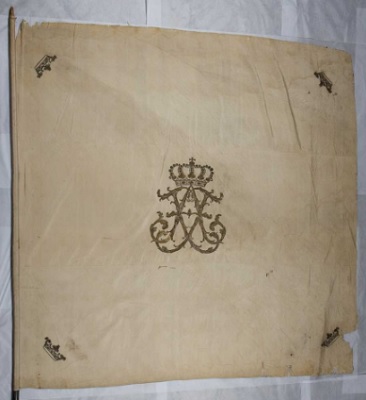
Company colour from 1748, modified in 1751 |
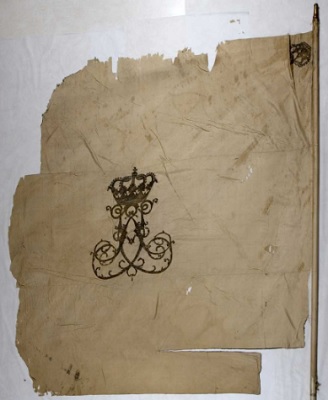
Company colour from 1762 or 1763 |
The 1726 set
was replaced in 1748 with fifteen new colours (no sentry colours were
issued so probably the old regular colours were used instead). This set had
no company symbols and instead there were crowns in all the corners. In
addition, the crowns were now open and not closed. In their original state,
they had Fredrik I's mirrored monogram as a motif, but after Adolf Fredrik
became king in 1751, the colours were modified so that an A was embroidered
over the mirrored F's.
In 1762, six new colours were embroidered (one of which was a colonel's
colour) and in addition two sentry colours. These were supplemented in 1763
with nine more company colours. The difference to the previous set was that
the crowns in the corners were now closed again.
|

Colonel’s colour from 1771 or 1787 |

Model drawing of a company colour from the reign
of Gustav III |
After Gustav III's accession to the throne, a new set of fourteen colours
was issued at the turn of the year 1771-72. The only difference from the
previous set was that Adolf Fredrik's monogram was replaced with Gustav
III's. New sentry colours had to wait until 1778-79 when two of them were
paid for by the colonel himself and in 1784 when the crown paid for two
sentry colours. A new set of only eight Livgarde colours was issued in 1787
and it supposedly had the same appearance as the previous set.


Colonel’s and company colours from the reign of Gustav
IV Adolf. It is not possible to determine whether these belonged to the Svea
Livgarde because all Guard and Household troops received identical colours
at this time.
The first and only set during the reign of Gustav IV Adolf was issued in
1798 (1 colonel’s colour, 9 company colours and 2 sentry colours). The two
sentry colours were discarded after two years but were not replaced until
1806. When the Livgarde were demoted in the autumn of 1808, it was intended
that they would lose their white colours and instead receive colours in the
same style as the regular enlisted regiments. A
model drawing
for this purpose was also made. However, the Livgarde managed
to regain its guard status in the spring of 1809 before such colours were
manufactured. The old colours were therefore retained until March 1810, when
a set of 1 colonel’s colour, 9 company colours and 2 sentry colours was
issued. The War College was in such a hurry to have the new colours with
Charles XIII's monogram delivered that the production was divided between
three people. In 1815, however, only one company colour of this set was
deemed to be in usable condition. The other eight company colours were to be
repaired while the colonel’s colour and the sentry colours were to be
replaced. The repair and manufacture of new sentry colours took place the
following year while the new colonel’s colour was delivered in 1817. The
repaired company colours had their monograms adjusted when Charles XIV Johan
became king so that "XIII" was changed to "XIV". But in 1820 they were
replaced together with the sentry colours by completely new colours. The
colonel’s colour remained until 1832 when the embroidery was transferred to
a new colour. This last remnant of the time before the House of Bernadotte
then disappeared when a completely new set was issued in 1850.
|

Colour from 1832 with embroidery from 1817 |

Company colour from 1810, corrected in 1818 |
Links to Preserved Colours
Colour sheets
|
The following images are free-to-use m/1686 colour sheets for those who want to
paint miniature figure to represent the Livgarde. The company colour below is identical
with Olof Hoffman's model drawing while the two to the right are my
reconstructions of the colonel's colour and the colours intended for
the grenadier.
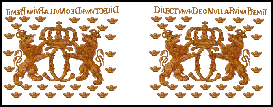 |
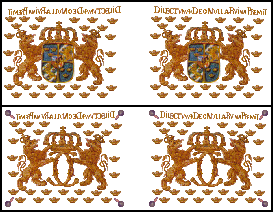 |
|
|
Other Equipment
In addition to the clothes themselves, the pikemen also wore cuirass and a
helmet while the musketeers only had a helmet. These were
initially made of blackened steel, but in 1645 Queen Kristina chose to
replace it with polished steel as was customary in foreign courts (the
Nobility Drabants were allowed to continue to wear blackened armour).
After the death of Charles X Gustav, helmets and cuirasses were mostly
used in parades and when the Scanian War began they fell out of use completely.
During the Scanian War, the Livgarde musketeers initially had matchlock
muskets, but they were in 1678 issued with 400 muskets with "Spanish
flintlocks" (i.e. "snaplocks"). A further 200 flintlock
muskets were recieved in 1679 from a dragoon regiment that could not use
them because they were too long. At the same time, 112 matchlock muskets
were also issued. During the following peace period, the Livgarde musketeers
continued to be armed with both matchlock and snaplock muskets. The former
constituted more than half of the muskets in 1696. All were replaced with
new flintlock muskets at the outbreak of war in 1700. However, the grenadiers
received special flintlock muskets that were adapted to have bayonets. The
grenadiers' bayonets proved so effective during the landing at Humlebæk that
Charles XII ordered that the musketeers should also have bayonets. At the
end of October, the Livgarde therefore replaced their muskets in Reval and were
thus able to fight with bayonets in the Battle of Narva a month later.
When the Great Northern War began, the officers were supposed to be armed
with 5 ells (= almost 3 metre) long half-pikes with brown shafts.
The non-commissioned officers were armed with spontoons with unpainted shafts.
There is no information about the colour of the privates' pikes during the Great Northern
War, although a source from 1667 state the colour as yellow. However, taking
into account the above, and the fact that the staffs of the colours from 1710 were
painted dark brown, the pikes were most likely brown, either because they were
painted brown or unpainted wood.
|
|
References
Drabanten och kaptenen vid Lifgardet Olof Stiernhööks journal 1700-1703. published by Samuel E. Bring (KFÅ 1912)
Lorenzo Magalotti – Sverige under år 1674. published by Carl Magnus Stenbock. Stockholm (1912)
Bellander, Erik. Dräkt och uniform. Stockholm (1973)
Brzezinski, Richard – Hook, Richard. The Army of Gustavus Adolphus – 1
Infantry. London (1991)
Cederström, Rudolf. Svenska kungliga hufvudbanér. Stockholm
(1900)
Ericson, Lars. Fastställda uniformsmodeller för svenska armén under 1720-talet
(article in MAM 45-46). Stockholm (1986)
Göransson, Göte. Gustav II Adolf och hans folk. Stockholm
(1994)
Höglund, Lars-Eric. Från Karl Knutsson till Kristina. Karlstad (2012)
Höglund, Lars-Eric. Skånska kriget 1675-79 - Fanor och uniformer. Karlstad (1999)
Markelius, Martin. Gustav III:s armé. Stockholm (2020)
Schreber von Schreeb, Tore. Lifgardets beklädnad och beväpning från Christina till Carl XII
(article in MAM 7). (1945)
Tessin, Georg. Die Regementer der europäischen Staaten im Ancien
Regime. Osnabrück (1986)
Törnquist, Leif. Fanorna vid de svenska liv- och hustrupperna (article in SVSS-NS XXI).
Stockholm (2006)
Wennerholm, J Bertil R. Emporterade troféer. Bohus (2000)
Wernstedt, Folke – Cson Barkman, Bertil et al. Kungl. Svea livgardes historia.
Stockholm (1937-1976) |
|