|
Örjan Martinsson
| |
|



Uppland Regiment was the highest-ranking
provincial infantry regiment and was used extensively during Sweden's Age of
Greatness. Some part of the regiment was almost always outside of Uppland
until 1680, when it was allowed to stay home until the outbreak of the Great
Northern War. During this war, Uppland Regiment participated in most major
battles and distinguished itself at Poltava, where it was completely wiped
out because it remained standing when the surrounding regiments fled.
|
|
Organisational History
Like the
other provincial regiments, Uppland Regiment can trace its origins to the
16th-century fänikor, which were recruited through conscription. A fänika
originally consisted of about 500 men, but their size shrank over time, and
in the early 17th century they were renamed companies and were combined into
larger units called regiments. Gustav II Adolf organised the army into "land
regiments" that were recruited from a designated geographical area. These
land regiments in turn usually formed three "field regiments" that were sent
out on campaigns. However, the field regiments quickly replaced the land
regiments entirely.
However, for
Uppland, development was slower than for most other provincial regiments. It
is true that there was already an Uppland regiment in 1613, which in 1617
formed the backbone of the Uppland Land Regiment (which also included
Västmanland and Dalarna). However, a stable organisation for an Uppland
provincial regiment would not become a reality until the 1630s. The
territory of the land regiment was in practice only a recruitment area, and
during the second half of the 1620s there were two Uppland field units that
lived their own lives, like the fänikor of the previous period. In fact, it
was not until 1630 that we can speak of a unified Uppland regiment, which
according to the constitution of 1634 was to consist of eight companies and
have the highest rank of all provincial regiments. However, the number of
companies and their strength varied during the 17th century depending on the
need for men. And it was still common for parts of the regiment to be in
different places. Except for queen Christina's coronation in 1650, the
entire regiment was never at home in Uppland during a period of 60 years
that extended until the end of the Scanian War.
At the time
of Kristina's coronation, Uppland Regiment had a peacetime strength of ten
companies. More companies were raised during the wars of Charles X Gustav,
but after the peace of 1660 the regiment was reorganised again into ten
companies, four of which were stationed as garrison troops in Pomerania and
six remained in Uppland. Further transfers of companies took place during
the interwar period of 1660-1674, but the regiment was mainly divided into a
German and an Uppland part. Companies in Germany merged when their manpower
declined, and redundant officers were then sent home to take over newly
raised companies in Uppland. When the Scanian War broke out in 1675, eight
companies were in Germany and two in Uppland. After almost four years of war,
what remained of the German part was captured by the Danes in 1678.
Continued recruitment in the homeland had however gradually expanded the
home part of the Uppland regiment, which eventually became eight companies
strong and replaced the field regiment in Germany entirely.
It took time
for the regiment to reach the desired peacetime strength of eight companies
of 150 men each (1,200 men in total). At the muster in August 1682, the
regiment consisted of only 875 men. However, the parliament (Riksdag)
decided that same year to reform the Swedish military organisation. Instead
of irregularly recurring conscriptions with uncertain results, the peasants
in each province would be responsible for recruiting and maintaining a
certain number of soldiers (the younger allotment system or "yngre
indelningsverket” in Swedish). The peasants of Uppland signed a contract
with the crown on 27 October 1682 (confirmed by the king on 5 December) to
divide the province into rotar, each responsible for one soldier. The work
of creating the rotar was completed in the spring of 1684. But since
Livregementet till häst also organised most of its rusthåll (= the cavalry
equivalent to rotar) in Uppland, an adjustment of Uppland Regiment’s rotar
became necessary to distribute the burden evenly. This was completed in
1692, although some work remained with the indelningar that would support
the officers’ economic compensation. From 1696 onwards, the companies were
given district names instead of being named after their commanders as before.
Thus, Uppland Regiment had the following organisation with 1,200 men divided
into eight companies that would apply throughout the 18th century.
|
Company |
Districts (rotar) |

The map shows the geographical distribution of
Uppland Regiment, and which parts of the province recruited for
Västmanland regiment (white) and the navy (dark grey). The light grey
Färentuna district (present day Ekerö municipality) was completely
outside the allotment system.The numbers
for sailors are for peacetime. In wartime they were doubled. |
|
Colonel's |
Örbyhus (114), Norunda (36) |
|
Major's (Olands) |
Oland (146), Frösåker (4) |
|
Rasbo |
Rasbo (52), Vaksala (47),
Närdinghundra (42), Norunda (6), Långhundra (3) |
|
Hundra härad |
Seminghundra (54), Långhundra (53),
Ärlinghundra (24), Sjuhundra (19) |
|
Sigtuna |
Håbo (46), Ärlinghundra (44), Lagunda
(27), Bro (23), Trögd (10) |
|
Lieutenant Colonel's
(Enköpings) |
Åsunda (80), Trögd (70) |
|
Hagunda |
Hagunda (62), Trögd (47), Lagunda
(41) |
|
Uppsala |
Bälinge (67), Ulleråker (43), Norunda
(37), Hagunda (2), Rasbo (1) |
|
Väsby and Salberg
(Västmanland Regiment) |
Torstuna (86), Våla (61), Simtuna
(97). |
North Roslagen Naval Company
(280 man) |
Örbyhus (28), Oland (33), Frösåker (74),
Öregrund (4), Östhammar (9), Häverö (20), Närdinghundra (11), Sjuhundra (19), Väddö (36), Lyhundra
(45), Frötuna (1), |
South Roslagen Naval Company
(269 man) |
Frötuna (59), Bro (20), Vätö (18), Åker
(33), Vallentuna (23), Långhundra (17), Sollentuna (27), Danderyd (26),
Värmdö (39). |
Stockholm Naval Company
(134 man) |
Stockholm (100), Södertälje (10),
Mariefred (4), Strängnäs (8), Torshälla (7), Eskilstuna (5) |
|
The Uppland cities also contributed sailors, but apart
from Öregrund and Östhammar it is not clear from my source which
companies they were allocated to (but if not the Roslagen companies,
they were included in the "Uppstädernas company"): Uppsala (25),
Enköping (10), Sigtuna (3), Norrtälje (10). |
Additional Troops in the Scanian War
When the
Scanian War broke out, there was a need to expand the army. In addition to
the regular regiment, additional men were therefore raised by conscripting
every sixth man in Uppland. These were called “sexmänningar” (six-men-ings)
and they were promised that their military service would only last for the
duration of the war. However, it took until January 1681, at the joint
muster with Uppland Regiment, before the then 329 six-men were discharged.
This happened despite a major shortage of men in the regular regiment, which
at that time only consisted of 454 men.
I have not
come across any further information about the Uppland six-men in the
literature and neither colours nor uniforms are known. Bergström, who has
written the history of Uppland regiment, mentions that Uppland men possibly
participated in the campaign in Blekinge in 1677, which resulted in the
recapture of Kristianopel and Karlshamn. The uncertainty in this information
could be interpreted as meaning that it was not the regular regiment but the
six-men who participated. Incidentally, the Västmanland six-men fought in
the same campaign without participation from their parent regiment.
Additional Troops in the Great Northern War
The same part
of the allotment system that recruited the Uppland regiment was given the
task of raising an additional 400 men in 1700. This was done by bringing the
rotar together into groups of three who would recruit an extra soldier, a
so-called tremänning (three-men-ing). These were then combined with
the 3-männings from Västmanland and the Dal Regiment to form the 1,200-man
Uppland 3-männing Regiment, whose colonel was the later famous general Adam
Ludvig Lewenhaupt. The recruitment took place in violation of the allotment
system’s contract, but the peasants were promised that the 3-männings would
not leave their homeland. However, this promise was also broken when the
3-männingg regiment was transferred to the Baltic at the same time as
Uppland regiment in April 1701. Once there, the regiment was split when one
battalion accompanied the main army to Poland in 1702 while the other
remained in the Baltic. A reorganisation then took place in 1703 when the
battalion in the main army was incorporated into the Livgarde (Life Guards) while the Uppland 3-männing Regiment was
compensated by receiving a battalion from the disbanded Östgöta-Södermanland
3-männing Regiment. Under Lewenhaupt's command, the latter participated in
the battles of Jakobstadt, Gemäuerthof and Lesnaya. The latter battle
resulted though in such a large loss of equipment that the regiment was
disbanded, and the men transferred to the Livgarde in 1708.
However, the
3-männings were not sufficient for the army's needs and in 1703 the peasants
were ordered to set up five-männing regiments by combining the rotar into
groups of five to provide an additional soldier. Uppland's 240 five-männings
were combined with the 5-männings from Västmanland, Dalarna and Södermanland
to form the 960-man Uppland 5-männing Regiment. This regiment was allowed to
remain in the homeland and participated in the Battle of Helsingborg in 1710
together with its parent regiment. It was converted into the Stralsund
Garrison Regiment in 1720.
The 3- and
5-männing regiments were a one-off recruitment and the peasants did not have
to replace their losses. However, this did not prevent them from being
forced to set up a new 3-männing regiment in 1712 in the same way as the
last time. Although, this time the regiment was allowed to remain in the
homeland until it was disbanded in 1719. The men were then transferred to
the Guard, the Östgöta-Södermanland 3-männing regiment and others.
Colonels
and Battles
(Green background indicates victories, red background
defeats and grey
background a Pyrrhic victory)
|
|
Uppland Land Regiment
(included Västmanland and Dalarna) |
|
1613-1622 |
Jesper
Andersson Cruus af Edeby |
|
1622-1628 |
Åke Eriksson Oxenstierna af Eka och Lindö |
|
|
Field Regiments from Uppland |
|
1626-1629 |
Jakob
Seton (field unit from Uppland) |
|
1628-1629 |
Nils Brahe (regiment from Uppland and
Västmanland) |
|
|
Uppland Regiment |
|
1630-1631 |
Nils Brahe |
|
1631-1633 |
Jakob Seton |
1632 Lützen |
|
1634-1635 |
Axel Gustavsson Lillie |
|
1635-1644 |
Gabriel Kyle |
|
1644-1645 |
Gabriel Gabrielsson Oxenstierna af Korsholm och Vasa |
|
1645-1651 |
Hugo Hamilton af Deserf |
|
1651-1657 |
Axel Lewenhaupt |
1656 Warsaw |
|
1657-1660 |
Nils Brahe |
1657 Frederiksodde
1658 March Across the Belts |
|
1660-1662 |
Axel Posse |
|
1662-1664 |
Gustav Cruus af Edeby |
|
1664-1665 |
Otto Reinhold Taube af Carlöö |
|
1665-1673 |
Gustav Helmer Lillie |
|
1673-1678 |
Gustav Carlsson |
1675 Wismar
1676 Öland
1677 Køge Bay |
|
1678 Rügen |
|
1678-1684 |
Gustav Tungel |
1678 Greifswald |
|
1684-1698 |
Georg Johan Wrangel |
|
1698-1705 |
Otto Vilhelm Löwen (Löwe) |
1700 Humlebæk
1701 Düna
1702 Kliszow
1705 Praga |
|
1705-1706 |
Johan Valentin von Daldorff |
|
1706 |
Nils Rosenstierna |
1706-1709
|
Georg Fredrik De Frietzcky
(† at Veprik) |
1708 Holowczyn |
|
1709 Veprik |
|
1709 |
Gustav Stiernhöök († at Poltava) |
1709 Poltava |
|
1709-1710 |
Johan Braun († at Helsingborg) |
1710 Helsingborg |
|
1710-1711 |
Claes Ekeblad |
|
1711 |
Gustav Ribbing af Zernava |
|
1711-1721 |
Georg Vilhelm Fleetwood |
1714 Hangöudd (Gangut) |
|
1721-1723 |
Gustav Gustavsson Oxenstierna af Korsholm och Vasa |
|
1723-1728 |
Otto Johan Koskull |
|
1728-1730 |
Otto Vilhelm Staël von Holstein |
|
1730-1737 |
Otto Magnus Wolffelt |
|
1737-1741 |
Vilhelm Ludvig Taube af Odenkat |
|
1741-1748 |
Carl Magnus de Laval |
1742 Helsingfors |
|
1748-1757 |
Fredrik Henrik Sparre |
|
1757-1759 |
Carl Johan Mörner af Morlanda |
|
1759-1772 |
Ture Gustav Rudbeck |
|
1772 |
Per Scheffer |
|
1772-1788 |
Fabian Casimir Wrede af Elimä |
|
1788-1791 |
Fabian Wrede af Elimä |
1790 Svensksund |
|
1791-1794 |
Adam Ludvig Lewenhaupt |
|
1794-1810 |
Adolf Ludvig von Schwerin |
1808 Oravais |
|
1810-1816 |
Gustav Olov Lagerbring |
|
1816-1825 |
Carl Alexander Hård |
Uppland Regiment was disbanded in 1957
Uppland Regiment also has Varberg 1565 and Narva 1581 as official victory
names.
|
|
Scanian War
Parts of Uppland Regiment had been garrisoned in Germany during the interwar
period 1660-1674. The Uppland force in Germany was reinforced in the summer
of 1673 so that it consisted of eight companies while two companies were
still at home in Uppland. The German part was cut off from the homeland
early on and did not receive any new recruits during the war. It therefore
steadily shrank until the remainder was captured by the Danes in December
1678. Instead, the part at home was expanded so that it finally consisted of
eight companies. However, neither the German nor the Swedish part of Uppland
regiment was usually concentrated in one place. During the Scanian War, the
Uppland men were scattered across several different garrison towns, naval
commands and field armies from Greifswald to Jämtland.
Germany
Since 1668,
the Uppland force in Germany had been stationed in Wismar and in the spring
of 1675, they consisted of 123 officers, 32 drummers and 788 privates
distributed into eight companies. Uppland Regiment did not participate in
the initial campaign in Brandenburg in the summer of 1675. Their first
action in the Scanian war was therefore the defence of Wismar, which from 6
November was besieged by Danish and Austrian troops. The fortress was forced
to capitulate on 13 December and Uppland Regiment was granted safe passage
to Stralsund, were it stayed for a while. When the regiment was mustered on
14 February 1676, it had a force consisting of 142 officers & NCOs and 331
privates. Its casualties consisted of 309 deserters, 210 killed and beaten,
21 captured and 3 sent home.
The German
part of the regiment seems to have been reduced to five companies during
1676. On 24 October 1676, four companies were stationed in Greifswald, while
a company with 18 officers and 77 privates was in the Neufehr redoubt on
Rügen. An ensign and 100 men had also participated in the siege of Wolgast.
In the autumn of 1677, all five companies were in Greifswald, which then
consisted of 59 officers, 16 enlisted men and 176 privates. The first two
personnel categories were stable, while the number of privates had fallen to
166 men at New Year 1678 and 162 men in March. In July 1678, the number of
officers & NCOs had increased to 93 and the number of musicians to 22 men,
while the number of privates had fallen to 150 men.
Uppland
Regiment participated in the Battle of Rügen on 6 January 1678, which
resulted in Sweden temporarily reconquering Rügen. But on 15 November,
Greifswald, which had been defended by the Uppland men, surrendered. Uppland
Regiment was granted safe passage to Sweden when they surrendered and after
a short stay on Usedom, they sailed from Peenemünde on 4 December.
Unfortunately, a storm caused the transport fleet to run aground on
Bornholm. The Uppland men who did not drown were captured by the Danes.
Sweden
The two
companies at home were mustered in Stockholm on 26 July 1675 with a strength
of 36 officers & NCOs and 250 privates, which were intended to be sent to
Germany. Only minor commands at various Uppland castles were to remain in
Sweden (an NCO and 30 men at Drottningholm Castle, 4 men at Uppsala Castle,
5 at Svartsjö and 2 at Danvik Castle). The naval expedition carrying
recruits to Germany set sails in October, but it did not get further than
Gotland before it was forced to return due to bad weather. The transport
fleet was also severely ravaged by disease and in the end only seven Uppland
men were healthy.
From 19 May
1676, 8 officers, 12 non-commissioned officers, 13 corporals, 7 drummers and
260 privates were commandeered to the navy and participated in the Battle of
Öland on 1 June.
In December
1676, the home-based part of the Uppland regiment formed a battalion that
joined the main army in Svenstorp a few days after the Battle of Lund. On 11
December, the Uppland men then marched with the main army via Södervidinge,
Vadensjö and Råå to Helsingborg, which was taken in December (the city on
the 13th and the fortress on the 30th). The Upland men were then stationed
in Bälteberga (between Helsingborg and Landskrona) from where they departed
on 9 January 1677. They followed the main army through Trolösa, Näs,
Stegehelgd over the ice of Ringsjön, Bosjökloster, Höör, Espinge and to Vä,
after which they blockaded Kristianstad. Possibly the Upland men
participated in the campaign in Blekinge where Kristianopel and Karlshamn
were recaptured. After that, it seems that the Upland men returned home to
recruit more men.
On 18-21 May
1677, six companies were mustered in Märsta (109 officers & NCOs and 792
privates). In addition to these, there were then 174 men in Scania and 55
men in Kalmar. The force in Märsta marched to Stockholm where it arrived on
31 May. On 2 June it went to Dalarö and boarded the ships on 6 and 7 June.
They left behind 44 men who were sick, and the troops commandeered to the
navy then consisted of 89 officers & NCOs, 11 drummers and 690 privates. The
navy then participated in the unfortunate battle of Køge Bay on 1 July and
returned to Dalarö on 9 July where the Uppland med disembarked. The losses
in the battle must have been considerable. The six companies were mustered
in Stockholm on 24 September and then had a strength of just 33 officers &
NCOs and 142 privates (19 men were commandeered and 12 were sick).
In Kalmar
there were also remnants of an Uppland company that was supposed to have
been sent to Pomerania. According to a roll from 30 July 1677, there were 5
healthy and 72 sick in several places, one non-commissioned officer and 31
privates are said to have fallen in the "battle". These were still in Kalmar
in January 1678. On 11 April of the same year, there were 53 Uppland men
from five different companies in Kalmar. On the same day, 1 officer, 4
non-commissioned officers, 4 corporals and 88 privates were mustered in
Stockholm and sent to Vaxholm from where they returned to Stockholm on 18
November.
In the summer
of 1678, three companies were commandeered to the navy. They were mustered
in Uppsala on 7 May and consisted of 258 privates. Some of the Uppland men
disembarked in Kalmar from where they marched to Asarum on 4 August. The
Uppland men were then stationed at Karlshamn to both defend the coast and
prevent Snapphan activity. In November, the Uppland men were garrisoned in
Kristianstad where they remained until 22 June 1679.
During 1678,
the regiment also had troops in Jämtland (two companies), Kalmar and
Vaxholm. The force in Jämtland had marched there from Stockholm in October
1677 and numbered 6 officers, 12 non-commissioned officers, 5 corporals, 1
drummer and 188 privates. They were part of the force that reconquered
Jämtland in November. The Uppland men remained there in February 1679 and
probably participated in the march against the Røros copper works in
Trondheim County in July.
On 5-9 May
1679, three companies were mustered in Uppsala with 54 officers & NCOs and
263 privates. These, together with the older soldiers, were to appear in
Kalmar and be commandeered to the navy. 180 conscripts arrived there and on
22 June the garrison in Kristianstad also arrived. After the naval
assignment, the Uppland men returned to Kristianstad where in November 1679
they are reported to have had a force of 18 non-commissioned officers and
219 privates. At the same time, 2 non-commissioned officers and 18 privates
were sick in Asarum, 3 non-commissioned officers and 31 privates were sick
in Kalmar and 8 non-commissioned officers and 84 privates were sick in
Ronneby and Lyckeby.
After the end
of the war, all Uppland men returned to Uppland. However, a command of 3
non-commissioned officers, 2 corporals and 150 privates was sent to
Landskrona on 24 February 1680 for fortification work. |
|
Great Northern War
Uppland Regiment participated in most of the major battles during the Great
Northern War. Uppland men landed with Charles XII at Humlebæk in 1700 and
dug trenches at Halden on the same evening that Charles XII fell in 1718. In
between, they were victorious at Düna, Kliszow, Praga, Holowczyn and
Helsingborg. The regiment was completely wiped out at Poltava, where it
remained on the battlefield while others fled. The second half of the war
was unfortunately less glorious. The restored regiment stood out by having
inadequate equipment and many of the soldiers had to go barefoot. However,
by the time of the Norwegian campaign in 1718, the deficiencies had been
remedied and Uppland was counted among the best regiments in the Swedish
army.
From
Humlebæk to Poltava
When the war broke out, Uppland Regiment was sent to Karlskrona where it
embarked on the fleet on 14 June. Uppland regiment was part of the force
that landed at Humlebæk on 25 July and forced the Danes to sue for peace. On
19 August Uppland regiment left Denmark and was shipped over to Landskrona
from where they marched home again. The long period onboard naval ships had
resulted in high level of sickness which meant that the regiment was unable
to participate in the subsequent campaign in Estonia. The extent of the
sickness is illustrated by a company that reported on 22 September that its
losses were 3 dead and 41 sick.
|
1700 |
1701 |
1702 |
|
April-May |
March to Karlskrona |
April-May |
Transport Stockholm-Reval |
Jan.-June |
The invasion of Poland |
|
June-July |
On board the navy |
May-July |
March Reval-Dorpat-Düna |
9 July |
Battle of Kliszów |
|
25 July |
Landing at Humlebæk |
9 July |
Battle of Düna |
Aug.-Sep. |
Stay in Krakow |
|
August |
March to home province |
July-Sep. |
March to Grobin |
Oct.-Dec. |
March to Sandomierz |
Uppland regiment returned to the main army when it was transferred to the
Baltic in the spring of 1701 and was mustered by Charles XII in Dorpat on 16
June. The regiment then followed the king's marches across Poland and
participated in the battles of Düna and Kliszow and the siege of Thorn. In
the battle of Düna, one major, two non-commissioned officers, a drummer and
33 of the men rank-and-file were killed (three of the latter disappeared
without a trace on the battlefield). The wounded consisted of two ensigns, 6
non-commissioned officers and 86 corporals and privates. Unfortunately, no
loss figures for the battle of Kliszow are reported in Uppland's regimental
history, which, unlike those for other regiments, is not particularly
extensive. This is illustrated by how the number of recruits who arrived at
the regiment is reported in the incomplete table below, which is based on
Otto Bergström's book.
| |
Recruits |
|
November 1701 |
"a lot" (72 vacancies) |
| End of August 1703 |
"a shipment of recruits" |
| 8 June 1704 |
161 |
|
End of September 1707 |
"a quantity" |
Otto Bergström writes (p. 88) that a total of 239 recruits had filled
vacancies between April 1701 and March 1704. According to the allotment
system, vacancies were to be filled with new recruits at least once a year.
When the regiment was to be restored in 1709, there were 91 recruits in Riga
who had not been able to join the main army (the 1708 contingent), according
to Holm (p. 121).
|
1703 |
1704 |
1705 |
|
Jan.-March |
Winter quarters in Little Poland |
Jan.-May |
Winter quarters in West Prussia |
Jan -July |
Winter quarters in Greater Poland |
|
March-May |
March to Thorn |
June-Aug. |
March to Lemberg |
Aug-Oct. |
Garrison in Warsaw |
|
May-Oct. |
The Siege of Thorn |
Sep.-Nov. |
March to Greater Poland |
14 October |
Battle of Praga |
|
Oct.-Dec. |
Winter quarters in West Prussia |
Nov-Dec. |
Winter quarters in Greater Poland |
Oct.-Dec. |
Garrison in Warsaw |
In July 1705, Uppland Regiment
left the main army to join the garrison in Warsaw, where it arrived at the
end of the month. On 14 October, Uppland Regiment participated in the Battle
of Praga outside Warsaw, in which a force of 100 Uppland men under the
command of captain Axel Bure distinguished themselves by fending off enemy
attacks until reinforcements arrived. Bure was wounded and most of his force
were killed. In the battle, Valentin Daldorff was also wounded in the head (he
became the new colonel a month later) and an ensign was mortally wounded.
On New Year's Eve 1705, the regiment rejoined the main army that was
marching against the Russians in Grodno. After the threat from the Russian
army had been eliminated, the army slowly marched towards Saxony, which was
invaded at the end of August. The army remained there for a year, and the
Uppland regiment was stationed in Martin Luther's hometown of Wittenberg
until 23 August 1707.
|
1706 |
1707 |
1708 |
|
January |
March to Grodno |
Jan.- 23 Aug. |
Stationed in Wittenberg |
Jan.- Feb. |
March to Smorgon |
|
10 Feb.- 4 April |
Stationed in Saludek |
7 September |
Crossing the Oder River |
Feb.-June |
Stay in Lithuania |
|
April |
March to Pinsk |
Sep.-Oct. |
Stay in the Warta area |
7 June - 3 July |
March to Holowczyn |
|
24 April - 23 May |
Stay in Pinsk |
1-5 November |
March to Glogowa |
4 July |
Battle of Holowczyn |
|
May-Aug. |
March to Saxony |
5 Nov. - 18 Dec. |
Stay east of Glogowa |
July |
Stay in Mogilev |
|
Sep.-Dec. |
Stationed in Wittenberg |
December |
Crossing the Vistula River |
Aug.-Dec. |
March to Romny & Veprik |
|
1709 |
|
7 January |
The storming of Veprik |
|
Jan- April |
Stay in Lyutenka |
|
April-May |
Stay in Budishche |
|
May- June |
Siege of Poltava |
|
28 June |
Battle of Poltava |
|
During the
Russian campaign, the regiment participated in the Battle of Holowczyn where
a lieutenant was wounded in the head and "several of the regiment fell"
according to Bergström. Anders Pihlström's diary has more detailed
information and mentions that 5 privates were killed, and that the wounded
consisted of 5 officers, 4 non-commissioned officers and 44 privates.
The next war
event was the storming of the fortress of Veprik in Ukraine on 7 January
1709. This was led by Uppland's Colonel De Frietzcky, who was killed
together with his lieutenant colonel, with command passing to Skaraborg's
colonel. Veprik fell, but the regiment's losses were high. In addition to
the two staff officers, two more officers, six non-commissioned officers and
99 men were killed. The wounded consisted of 11 officers (one of whom was
mortally wounded) and 202 men.
Even worse
were the losses at the Battle of Poltava on 28 June 1709, where the regiment
stood firm while others fled and was therefore wiped out. Of the 600 men who
took part in the battle, none returned, and the only ones who surrendered at
Perevolochna were 70 men who had been at the baggage train. Of the
regiment's 52 officers, 32 were killed (62% of the total number and by a
good margin the highest percentage of deaths). Twelve wounded and three
uninjured officers were taken prisoner on the battlefield, while two were
missing after the battle. A lieutenant and an ensign who had stayed at the
baggage train managed to get to the Ottoman Empire with Charles XII and then
took part in the “kalabalik” at Bender. But these two were all that remained
of the regiment that had been victorious at Humlebæk, Düna, Kliszow, Praga
and Holowczyn.
The Restored Regiment
1709-1721
|
1710 |
|
January |
March to Växjö |
|
February |
Campaign in Scania |
|
28 February |
Battle of Helsingborg |
|
March-Dec. |
Stationed in Ystad |
1711 |
|
Jan.-Aug. |
Stationed in Trelleborg |
|
Aug. - ? |
Stationed in Bohuslän |
1712 |
|
April |
Stationed in Göteborg |
|
? - -July |
Stationed in Bohuslän |
|
28 July - ? |
March to Västergötland, Småland |
1713 |
|
Jan.-Dec. |
Stationed in Kronoberg county |
|
Sep.-Nov. |
One battalion in Stralsund |
1714 |
|
January |
March to Uppland |
|
? - aug |
In the home province |
|
Aug-Oct. |
Stationed in Norrtälje |
|
Oct.-Dec. |
In the home province |
1715 |
In the home province |
1716 |
|
Jan.-July |
In the home province |
|
Aug.-Nov. |
Stationed in Östergötland |
1717 |
Unknown |
1718 |
|
Sep.-Oct. |
Marsch Uppland-Norway |
|
November |
Siege of Fredriksten |
|
December |
March Norway-Uppland |
1719 |
|
Jan-May |
In the home province |
|
May-July |
Stationed in Stocksund, Uppland |
|
July |
Stationed in Åkers bruk, Sörmland |
|
Aug.- |
Stationed in Stocksund, Uppland |
|
When the army
was restored after Poltava, Uppland stood out by taking longer time to be
completed. The call to recruit the regiments was sent on 7 September 1709
and on 13 October the colonels were ordered to start training the men.
However, this was not possible for Uppland as only 300 men had been
recruited at that time. When it received the order to march to Scania on 17
January 1710, 1036 men had been recruited but much of the equipment was
still missing. In the Battle of Helsingborg, for example, it fought without
colours and almost no soldiers had swords. The lack of equipment, especially
shoes, was to be a long running problem for the regiment, which was in such
poor condition that it could not be included in the field army that was
transferred to Pomerania in 1712. Magnus Stenbock noted that "the men
resembled beggars more than soldiers".
The cause of
the delay and misery seems to have been primarily the governor of Uppland,
Johan Hoghusen, who showed too much consideration for the complaints of the
peasants about how their poverty prevented them from fulfilling their
obligations. However, there is nothing to suggest that Uppland were worse
off than other parts of the country, and yet the other governors managed to
carry out the restoration much quicker and smoother than Hoghusen.
In the Battle
of Helsingborg, the regiment participated with 976 men (including officers).
The major and the regimental quartermaster were killed, while the colonel
and a captain were mortally wounded. A further 5 officers and 5
non-commissioned officers were wounded. Of the men, 35 were killed and 101
were wounded. The care of the wounded was made more difficult by the fact
that the regiment did not yet have any field surgeons or field surgeon
assistants.
According to
a muster roll from 25 May 1710, the regiment reported that it had 275
vacancies. These were due to 197 soldiers having died, 16 being missing
after the Battle of Helsingborg, 6 having deserted and 56 rotar having been
vacant already at the time of the march from Uppland. At the muster in Ystad
on 25 August 1710, 411 men were listed as present. 97 men as being
commandeered to Riga (which had been captured by the Russians on 4 July!)
and 108 men commandeered near Ystad, 35 absent, 129 sick in Ystad and 326
sick elsewhere. 94 rotar were vacant. The vacancies rose during the autumn
of 1710 to 428 men, but only 230 men were recruited at the same time. A year
later at the beginning of 1712, 192 rotar were vacant and on 5 February
1713, there were 217 vacancies.
In 1713, 100
men were sent to Stralsund to join its garrison, which from September
included an entire Uppland battalion that was still there in November. But
apart from this and recurring contingents sent to serve on the navy, the
Uppland regiment remained at home in Sweden. Although, the time from
November 1716 and the whole of 1717 is unknown, since the regiment's
journals are completely missing for that period. It is likely that documents
in the regiment's archives were reused for some other purpose at some point.
The period of
misery seems to have passed, however, when a muster was held on 4 May 1715
and the colonel was praised for his well-trained men who "are now one of
the best regiments ready for His Royal Majestys service". The vacancies
were then only 68 men and at general muster in 1718 the regiment was 1182
strong so it was almost complete when the Norwegian campaign began (74 men
were, however, ordered to Åland from April to October where peace
negotiations with Russia were underway). On the evening of 30 November, 279
Uppland men were ordered to dig trenches at Fredriksten fortress, so it was
perhaps their work that Charles XII was supervising when he was killed that
day. The return journey to Sweden in the middle of winter was arduous and on
24 March 1719 only 619 men were fit for duty, 457 were sick and 177 rotar
were vacant (the total is 1253 because extra enlisted soldiers called
furirskyttar had been introduced into the war organisation). At the muster
on 14 September of the same year, 836 men were present, 16 were sick, 8 were
at Vaxholm, 1 was promoted, 1 remained in Värmland, 37 were dismissed, 3 had
deserted and 298 rotar were vacant.
After the
Norwegian campaign, the regiment was stationed near Stockholm until 8
September 1721, when they marched back to their homes. Thus, the Great
Northern War was over for the Uppland Regiment.
Naval
Service
In the autumn of 1710, a company under the command of Captain Ulf served on
the navy. On 20 August 1711, 150 were ordered to Halmstad to board the fleet,
but they were still in Halmstad in October when they were ordered to march
to Karlskrona. They sailed from there on 24 November as crew on a transport
fleet that landed several regiments in Pomerania. Another company left
Karlskrona on 23 August 1712 as crew on the transport fleet that transferred
10,000 men to Pomerania. These poorly dressed commandeered soldiers were hit
hard by a plague epidemic that broke out on the fleet. Possibly the entire
regiment was thereafter commandeered to the navy.
In February
1713, 87 men were commandeered to the navy and remained there until 5
December, fighting against the Russians in the Finnish archipelago. In April
1714, 358 men were commandeered to the navy, and these participated in the
Battle of Hangöudd (Gangut) on 27 July where 68 Uppland men were either
killed or captured.
In 1715 too,
Uppland contributed men to the navy since 222 men were at sea on 20 May and
participated in a battle against the Danes.
On 24 March
1720 the regiment received orders to march to Stockholm and in April 800 men
were on board the fleet. However, this seems to have been a temporary
command, as on 3 May the regiment participated in a parade during Frederick
I's coronation in Stockholm. |
|
Uppland Uniforms

Charles X Gustav's War |
Scanian War |

Great Northern War |

Seven Years' War |
The few pieces of information we have indicate that Uppland Regiment wore
grey uniforms during the first half of the 17th century, which was
apparently a common colour for Swedish regiments at the time. However, the
grey colour was abolished for all regiments when Sweden's first uniform
regulation was issued in 1655. At that time, Uppland Regiment was to have
red clothes, and their uniform probably also contained yellow so that they
wore the colours of their province. However, the yellow colour cannot be
confirmed until 1672 and in between Uppland had worn blue uniforms. The blue
colour replaced the red permanently in 1691 when the Carolean uniform was
introduced and after that Uppland Regiment was always dressed in the Swedish
blue and yellow colours.
Uppland's
Oldest Uniforms

Before 1655? |
1655 |

1666 |
1672-1683 |

1683-1691 |
The first
information about Uppland uniforms is from 1620 when soldiers from this
province were issued 250 jackets with yellow and black trim. The main colour
of the jackets is not mentioned, and this may be because they were made of
undyed wool (= grey) or that the colour varied between the companies.
Höglund mentions that Uppland regiment in 1630 was issued 8256 ells of grey
kersey to be used for uniforms. On 5 April 1645, it is mentioned that the
Uppland men "are so destitute of clothing that they will soon have
nothing to wear".
The next
notice is from Charles X Gustav's wedding in October 1654 when six Uppland
companies were part of a troop parade and had been issued new uniforms for
this event. These were either blue or grey, but the Uppland soldiers were
probably dressed in grey this time as well and it should have been the
Södermanland regiment that received the blue colour. A few months later,
Sweden received its first uniform regulation and Uppland was then to have
red jackets and breeches (Södermanland was to have blue, and no regiment was
to have a grey uniform). The uniforms that were issued in 1654 also had
edges, cuffs and lining in a different colour, which was not mentioned.
Four
companies that were to be sent to Stralsund for garrison duty were in 16664
issued broadcloth divided into three categories. The officers received 136 ells
of fine grey broadcloth, the non-commissioned officers received 373 ells of blue
broadcloth and the rank-and-file received 2204 ells of blue broadcloth.
The blue
uniform from 1666 was, however, temporary. During drills in Stockholm in
August 1672 it is mentioned that 200 Uppland soldiers had uniforms
consisting of red broadcloth and yellow baize. An undated letter from 1672 or
1673 also mentions that Uppland was to have red clothes. Furthermore, a song
from 1674 contains the lyrics that the Uppland soldiers "are dressed in
red and had been blue". Finally, the uniform regulation from 15 March
1675 states that Uppland was to have red clothes with yellow cuffs and edges.
Höglund
writes that Uppland had red coats with yellow cuffs and edges and red
breeches in 1675, 1676, 1678 and 1679. However, Bergström mentions (page
311) that the waistcoat and breeches were made of leather in 1675. Höglund
further writes that in 1676 the Uppland soldiers had a black hat and that
the drivers in 1678 had grey uniforms. In 1679, stockings made of sewn
wadmal or knitted wool are mentioned. The non-commissioned officers had grey
coats in the same year.
According to
a parliamentary decision from 1682, the regiment was to be raised to full
strength and receive new uniforms by May 1683 at the latest. A source from
March 1683 states that 300 men had not yet received their uniforms. However,
the entire regiment should have received uniforms by March 1684 at the
latest, as it was then mustered for the first time since the end of the war.
A list of the army's uniforms from June 1683 states red clothes with yellow
cuffs for Uppland. Other sources also confirm that the uniform issued at
this time was red with yellow. In addition, the Uppland regiments had hats
despite the current uniform regulation that all provincial regiments should
have karpus. Asker also states that the breeches were most likely made of
leather and that the woollen belts mentioned later were probably acquired at
this time.
Since the
colours (flags) that were issued in 1683 were supposed to be nacra-red
(light red, pink) according to m/1682, the uniforms that were issued at this
time may also have had that shade instead of the more common red shades. The
nacra shade may have been introduced earlier. Read more about this in the
section on colours.
Uppland's Carolean Uniforms
|

1691-1701
Humlebæk |

1701-
Düna, Kliszow |
-1709
Holowczyn, Poltava |

1710-1716
Helsingborg |
Uppland received its first Carolean uniforms in the summer of 1691,
replacing the previous red coats with yellow cuffs that the regiment
received in 1683/1684. The red coats were, however, still to be worn during
company and battalion drills and work assignments to spare the regular
uniforms. The new Carolean uniform was thus in peacetime only used at the
annual regimental drills and was still in use when the Great Northern War
broke out. Some items of clothing were replaced in April 1701, but the
ten-year-old coats were retained. Charles XII wrote a letter to Magnus
Stenbock in November 1702 in which he mentioned that Uppland was one of five
regiments in the main army that were "ill-equipped with clothing" and
wanted Stenbock to raise funds (contributions from the Poles) to be able to
remedy the worst deficiencies. New coats must therefore have been issued in
1703, since in June 1704 the regiment received new waistcoats and breeches to
replace those issued in 1701. The regiment was probably issued new uniforms
during its stay in Saxony in 1706-1707, but we lack evidence for this. The
descriptions of the recruits' uniforms in 1707 and 1708, however, are a clue
to what the uniforms might have looked like during the Russian campaign.
In the Battle of Poltava, Uppland Regiment was wiped out and thus everything
had to be procured anew when it was to be restored in the autumn of
1709-1710. Unfortunately, Uppland stood out by taking a very long time to be
completed and it participated in the Scanian campaign of 1710 with very
inadequate equipment. It would take several years before all the
deficiencies were addressed and although the uniforms were in relatively
good condition during the Norwegian campaign of 1718, the condition became
increasingly worse during the last years of the Great Northern War.
|
Uniforms 1691-1709 |
|
|
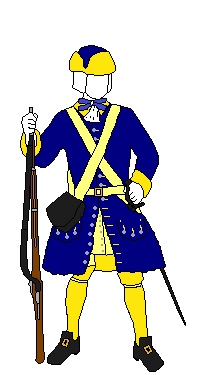
July 1691 |
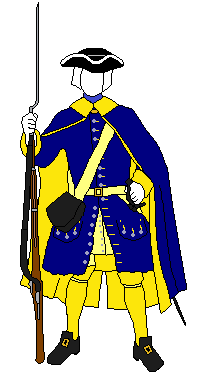
Issued April 1701
(and June 1704) |
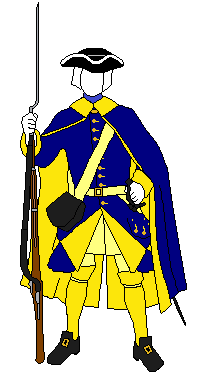
Recruits
1707,
1708 |
|
Headgear: |
Karpus, probably blue with yellow facing. |
Tricorne hats made of black felt that were edged with white lace around
the brim and crown. 1701/1702: Silver lace on NCO
hats. |
Hat with lace. |
|
Piecoat/Cloak: |
Piecoats were issued ca 1689. |
Blue cloak with yellow lining. |
Blue cloak with yellow lining. |
|
Coat: |
4½ ells (blue) broadcloth lined with 7
ells (yellow) baize. Three dozen pewter buttons. Drummer wore lace on
their "livery". In 1696, Charles XI complained that the NCOs
had too large cuffs. He was, however, satisfied with the officers' cuffs. |
The old coats from 1691 were retained.
The drummers' coats had yellow and blue lace.
1701/02: NCOs wore blue coats with silver-plated pewter buttons, blue
lining and blue cuffs. |
Blue coat with brass buttons, yellow lining and
cuffs. |
|
Waistcoat: |
Leather waistcoats from 1688. |
1701: Goatskin waistcoats,
(1704: 1133 leather waistcoats)
1701/02: NCOs wore leather camisoles |
Chamois-coloured waistcoat. |
|
Breeches: |
Leather. Three companies had not
received new leather breeches and a fourth had received ones of poorer
quality. |
1701: Goatskin breeches.
(1704: 1137 leather breeches)
1701/02: NCOs wore leather breeches. |
Chamois-coloured breeches made of broadcloth. |
|
Stockings: |
Dyed wool. Knee straps were still missing from two
companies at the end of 1696. |
Were yellow in 1702.
1701/02: NCOs wore blue stockings. |
Yellow broadcloth stockings. |
|
Shoes: |
Shoes issued in 1689. |
|
|
|
Neckcloth: |
? (Björn Asker guesses they were white or variegated) |
Was blue in 1702. |
|
|
Gloves: |
Gloves were issued at the earliest in
1692. |
(1704: 1167 pairs of gloves) |
(Undated information: Gloves with cowhide collar
or completely made of moose leather.) |
|
Other Equipment: |
Belts were issued around 1683. A number of woollen belts remained in
1691, which were to be replaced by waist belts, which were issued no
earlier than 1692. One hundred grenade bags were issued to the
grenadiers in 1688, and the following year fuse holders were obtained. |
Yellow ox leather bandoleer belt. |
Tinned copper bottle of 1 “kanna” size (2,6 litre)
with strap. Flintlock musket with bayonet. A musket holster with strap.
Wide buffalo bandoleer belt with brass ring for the fuse. Cartridge case
with powder measure and a small tin grease bottle. |
|
Sources: black text = Asker (1691-1696
and 1702) and Bergström (1701 and 1704-1705), red
text = Höglund , purple text = Larsson. |
|
Uniforms
1709-1721
When the regiments that had been lost in the Ukraine were to be restored,
the Defence Commission initially chose to save money by dressing them in
grey wadmal coats. The decision was widely criticised as it was
considered counterproductive as blue broadcloth lasted longer than
wadmal and
was better for the soldiers' health and morale. The Defence Commission
therefore backed down from its decision, but by then the Governor of
Uppland had already purchased wadmal on his own initiative and started
manufacturing coats. This was not appreciated by the Defence Commission,
which ordered him to procure blue broadcloth instead and to consult with the
colonel about such decisions in the future. The grey wadmal was to be
sold or used for something else. It may have been used as coats after
all, as the regiment lacked 411 blue broadcloth coats when it marched towards
Scania in January 1710. There was also a lot missing from other items of
clothing during the campaign in Scania.
After the Battle of
Helsingborg, the regiment was stationed in Ystad, where in March 1710 it
received a shipment of new uniforms, which probably included coats. But
even after this delivery, Uppland would stand out as a very poorly
dressed and equipped regiment. On 5 July, the colonel reported that
there were companies that were unfit for duty because they lacked shoes
and thus went barefoot. A company that had neither shoes nor stockings
had been ordered to do work in Kristianstad in 1710. The lack of
clothing became even more noticeable as winter approached. On 24
November, a request was made that the soldiers be housed in the hosts'
cottages, since they had hitherto been housed in barns, sheds and attics
and that they had now been affected by cold epidemics. When the regiment
was transferred to Trelleborg in early 1711, many were still barefoot (they
had to borrow wooden shoes from their hosts). The soldiers were still
living in misery in 1712 when Magnus Stenbock wrote that "the men
resembled beggars more than soldiers".
A more complete set of
uniforms were issued in 1716, which reintroduced cloaks instead of the
pie coats that had been issued since 1709. However, in 1716 only 500
leather breeches had been completed in time for the muster in July. The
following year, additional breeches and leather waistcoats that had been
ordered as early as 1711 were delivered. |
|
|
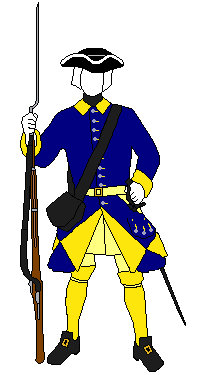
Specification 1709 |
New Uniforms 1716
(not later than July) |

1718-1721 |
|
Headgear: |
Hat with white lace. |
Hat with white lace. |
1719: Hat with white lace.
Drummer 1718: hat with yellow camel hair lace |
Piecoat,
Cloak: |
Piecoat of the same broadcloth as the
regular coat lined with baize.
1712: piecoat made of 5 ells of blue
broadcloth,
4 ¾ ells of yellow baize, 1 dozen pewter buttons and 1 ell of canvas. |
Cloak. Blue with yellow lining
and collar. |
1719: Cloak with yellow lining and yellow collar
and two pairs of buckles (Colonel’s Company).
1720: Blue cloaks made of broadcloth with grey lining |
|
Coat: |
Regular blue
broadcloth with yellow baize lining. Yellow
cuffs.
NCOs 1715: same as 1718. |
Blue with yellow lining and pewter
buttons. Yellow cuffs. |
NCOs 1718: Blue coat with blue "friserad"
(= surface made uneven) baize lining, flat English pewter buttons,
silver lace around the collar, cuffs and pockets. |
|
Waistcoat: |
Goatskin waistcoat.
1712: The peasants would provide breast pieces of leather lined
with ticking. |
Leather waistcoat or yellow broadcloth waistcoat. |
1719: Had 229 leather waistcoat and 818 yellow
broadcloth
waistcoats. |
|
Breeches: |
Goatskin and
reindeer skin breeches. |
Leather breeches. |
1719: Leather breeches. |
|
Stockings: |
Yellow broadcloth stockings. Buffalo
leather knee straps with buckles. |
|
1718: Yellow marching stockings.
June 1721: New yellow stockings. |
|
Shoes: |
Regular shoes with brass buckles. |
|
Train 1718: waxed leather shoes with buckles. |
|
Neckcloth: |
Two neckcloths,
black.
1715: Two black neckcloths |
|
1718: One white and two black per person.
1721: Two white and one black per person. |
|
Gloves: |
Ox leather collar with goatskin grip. |
Gloves |
1721: Grey finger gloves.
NCOs 1718: Goatskin grips and wide, large and stiff cowhide collars |
|
Work clothes: |
1715: Grey coat. |
|
1718: Grey wadmal coat with blue collar and cuffs.
Grey wadmal breeches. Swedish shoes.
Work clothes were missing in 1719-1720. |
|
Bandoleer and Boxes: |
96 grenade boxes and 1101 bandoleer boxes with
black belts. Bandoleer belts made of cowhide with all accessories such
as powder & grease horns, powder pouch with measure, screwdriver and
cleaning needles. |
New bandoleer belts with accessories. The old
cartridge and grenade boxes from 1709 were retained until 1718. |
800 grenadier boxes were ordered on 23 April 1718
because the existing 795 bandoleer and grenade boxes were too old and
too small. |
|
Belt: |
Belt with buckle and sword knot. |
Belts. Lace ("snörband") and buckles. |
1718: NCOs: A wide ox leather belt with a
silver-plated buckle |
|
Other Equipment: |
Fuse cover.
1712: Tinned bottle of the size of a “kanna” (2,6
litres). |
Three shirts per person. Knapsack and copper bottle. |
1718: Fuse covers for all musketeers. 48 pairs of
gaiters for “furirskyttar”.
1719: 3-pronged vent picks.
1721: Hair bag with lining, three shirts per person, hair comb with
lining that the soldier himself bought, knapsack of black leather,
gaiters of thin black leather. |
|
Sources: black text = Bergström, red
text = Höglund , purple text = Larsson, green
text comes from Holm (pp. 118-119, actually Sven Samuelsson is the
author), blue text: Erik Bellander. |
The table below gives an
idea of what Uppland's constant shortage of equipment looked like and
how deliveries of equipment came piece by piece during the 1710s.
Reported Deficiencies
and Delivered Equipment
| |
17 January 1710 |
25 May
1710 |
5 June
1710 |
13 January
1711 |
23 July
1711 |
4 August
1711 |
New Year
1713 |
| Hats
with lace |
|
|
|
685 |
|
|
|
| Piecoats |
553 |
33 |
|
|
|
|
412 |
|
Coats |
411 |
34 |
|
|
|
|
162 |
|
Leather waistcoats |
271 |
|
237 |
773 |
|
|
201 |
|
Leather breeches |
236 |
|
262 |
748 |
|
|
|
|
Stockings |
|
219 |
|
|
783 pairs |
|
447 pairs |
| German
shoes |
208 |
168 |
|
998 pairs |
783 pairs |
|
|
|
Neckcloths |
|
458 |
|
618 |
|
|
963 |
|
Gloves |
|
|
|
|
|
|
553 pairs |
|
Shirts |
|
|
|
2200 |
|
783 |
|
|
Leather straps & buckles |
|
|
|
1100 |
Belts |
247 |
|
Knapsacks |
491 |
167 |
|
|
|
|
405 |
|
Copper flasks |
|
|
|
279 |
|
|
|
| Musket
lock cover |
|
|
|
|
|
|
505 |
|
Powder horn |
492 |
|
230 |
25 August
1710 |
234 muskets and 272
bayonets were lost in the Battle of Helsingborg.
Colours and a variety
of clothes and swords were delivered on 22
March 1710. However, the swords were obviously not of the
right kind. |
| Powder
pouches |
|
168 |
|
|
Grease horn |
314 |
|
280 |
| Vent
picks |
|
191 |
|
|
Muskets |
|
143 |
|
230 |
|
Bayonets |
|
215 |
|
270 |
| Swords |
1061 |
3 |
|
Almost no one had regular swords |
Liberty Age Uniforms
In the last
years of the Great Northern War, the uniform was again worn out. In 1718, it
was mainly the cloaks that received complaints. At the muster in 1719, there
were only 312 cloaks left, and the uniform was generally considered worn
out. Work clothes (including two pairs of "Swedish shoes") that were
supposed to be issued each year had not been delivered that year. In 1720,
the uniforms were in very poor condition. Almost all the hats and more than
half of the coats were worn out. The 231 leather waistcoats were half worn out,
while the 870 yellow broadcloth waistcoats were in worse condition. A smaller part of
the leather breeches were "mostly worn out" while about half were unusable.
Five out of six stockings were worn out, which also applied to the "German"
shoes to a somewhat lesser extent. At this muster too, no work clothes had
been issued since 1718, but this would happen before the end of the year. In
1721 the condition was even worse, except for yellow stockings and a small
number of gloves which were new. The soldiers had previously bought with
their own money a pair of grey and a pair of yellow stockings each, as well
as gaiters of black leather which were now worn out.
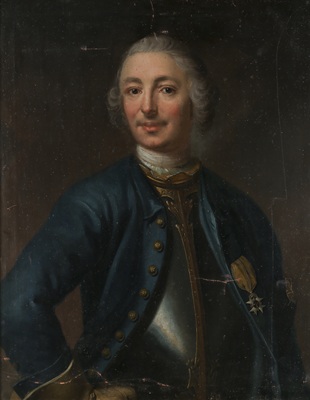
Didrik Henning Meijendorff von Yxkull, captain at
Uppland Regiment 1732-1736. He was granted a discharge in 1736 but
received the titular rank of lieutenant colonel in 1750. The portrait
cannot have been painted earlier than 1748 because he wears the badge of
the Royal Order of the Sword. |
The uniform
for Uppland's non-commissioned officers was simplified in 1721 so that they
would only have silver lace on their hats. Previously, they had also had
them around the cuffs, collar and pockets according to Bergström (page 312).
From 1735 onwards, the blue colour of the collar, cuffs and lining as well
as the waistcoat and breeches were changed to chamois yellow for the infantry's
non-commissioned officers (Bellander page 297). Information about officers is
missing, but the portrait on the right is from the mid-18th century and
shows an officer's coat without lace that was still all blue. The portrait
also has gold buttons (without the provincial coat of arms on them) but when
m/1765 was introduced, Uppland officers were allowed to have silver-plated
buttons if they so wished.
In August
1724, a uniform was decided for the ran and file of Uppland regiment, which was to
consist of a blue coat with yellow collar, cuffs and lining. The
small clothes consisted of a yellow waistcoat made of broadcloth and both goatskin
breeches and reindeer skin breeches. In addition, a hat with a white camel
hair lace and regulation shoes. The drummers were to have the reversed
colours so that the coat was yellow with blue collar, cuffs and lining and
a blue waistcoat. It is not mentioned in my source (Ericson) when or if this
uniform was issued, but the other regiments whose uniforms were decided
at the same time, received their uniforms in 1727-28.
The next time
Uppland's uniforms are described is in 1736 (Bergström, page 312). At that
time, the men's uniform consisted of a blue coat with yellow lining, yellow
waistcoat and breeches made of broadcloth, yellow stockings, shoes with buckles and
hats with white lace. In the 1730s, "night caps" are mentioned. These were
used at night when on guard duty. In January 1740, the regiment was granted
breeches made of reindeer skin. All soldiers were then required to wear
queues on their necks and have moustaches. Those with poor beard growth were
allowed to make moustaches out of beard wax. Bellander writes (page 316)
that in 1747 Uppland was one of five regiments that had worn their uniforms
for the longest time.
The regiment
received grenadier caps in 1748 when the king gave them the plates, while
the company commanders had to pay for the rest of the grenadier caps. The
plates were in use until 1795 and one of them has been preserved (see
picture below). The motif consists of a burning grenade at the top. In the
middle is the small national coat of arms in a crowned shield surrounded by
dragon wings, colours and trumpets. At the bottom is the coat of arms of
Uppland.
The uniforms
worn during the Seven Year's War (1757-1762) have not been described in the
literature. However, the uniform regulation from 1756 stipulated that all
infantry regiments should have an identical uniform consisting of a blue
cloak with a yellow collar and brass buckles, a blue coat with pewter
buttons, yellow broadcloth for the cuffs and collar, and yellow baize for the
lining. Waistcoat and breeches made of yellow broadcloth, hat with white lace, black neckcloth,
white wool stockings, and shoes with brass buckles.
When the war
ended, Uppland's uniforms were considered so worn out that they should be
discarded. Non-commissioned officers, professional drummers received new
uniforms paid for by the crown, the latter with white lace on the coats. But
the privates had to be content with the existing uniforms being repaired and
supplemented. Completely new uniforms were not issued until 1771, by which
time the uniform regulation from 1765 (see pictures below) had come into
force and replaced the classic Carolean uniform model. Uppland's uniform
colours remained blue and yellow, but a novelty was that the coat had yellow
lapels and double rows of buttons (made of brass). In addition, the cuffs
and lapels now had white lace as decorations. The officers' and NCO’s
uniforms did not have white lace, but at least the officers had buttons with
the coat of arms of Uppland (an orb). This is evident from the officer
portrait of Carl Johan Schultzenheim shown further down.
According to
Markelius, the provost sergeant (regementsväbel) received a new
uniform in 1762, which consisted of a blue coat with white lace and which
had the coat of arms of Uppland embroidered on both the chest and back.
Bergström has cited (p. 313) a journal describing the uniform of a
fältväbel (highest NCO rank) in 1758, but it is probably the provost
sergeant who is referred to. The uniform would in any case consist of a hat
with silver lace, a blue coat with cuffs, lining and collar in chamois,
silver-plated buttons, the Uppland coat of arms embroidered in gold and
cords on the chest and back, and both coat and vest adorned with lace of
yellow, white and red camel hair yarn. Vest and breeches were of chamois
colour. The provost sergeant was responsible for maintaining order and
carrying out punishments. His assistants were the provosts who, according to
Bergström's source, were supposed to look "terrifying" and therefore wore
bearskin caps with silver plates. With the exception of the embroidered
Uppland coat of arms, their uniforms were otherwise similar to the provost
sergeant's". Markelius mentions that the provost uniforms that were acquired
towards the end of the war were decorated with white and red lace. When new
uniforms were issued in 1771, the provost sergeant and the regimental
drummer received coats with silver lace instead of embroidery and camel hair
yarn. The provosts received caps made of yellow broadcloth and bearskin with
silver plate as well as white and red cords. Their coats were also adorned
with lace.
|

Plate for a grenadier cap that was in use
1748-1795 |

NCO and private with m/1765 uniform
(drawn by Jacob Gillberg in 1765) |
The pictures of m/1765 uniforms above and below show two variations of
gaiters. The black ones were used on campaign while the white ones were
intended for parades. Also note the differences in the hats, which show how
fashion changed during the 1770s. The front of the tricorne hats became
increasingly flatter as part of a development towards a bicorne. During the
1770s, a yellow plume was also added to the hat as a distinguishing trait of
the Swedish army.
Gustavian Uniforms
|
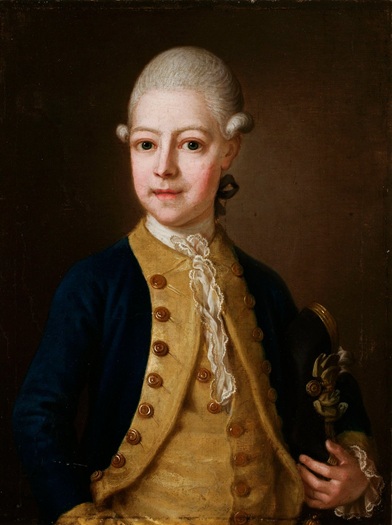
Carl Johan von Schultzenheim wearing Uppland’s officer
uniform m/1765. He was an ensign from 1777 to 1783. |
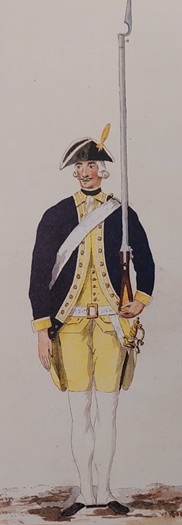
Musketeer wearing the m/1765 uniform
(drawn by an unknown artist around 1778) |
When the Gustavian age began in 1772, Uppland regiment had new m/1765
uniforms that had been issued the year before. However, the then
fourteen-year-old cloaks had not been replaced in 1771 and half of them were
now worn out. The grenadiers had received new caps that reused the plates
from 1748, which were of brass for the privates and silver-plated for the
non-commissioned officers. The grenadier caps also had cases of some kind,
which may indicate that they were of a new type with real bearskin or
imitation horsehair.
.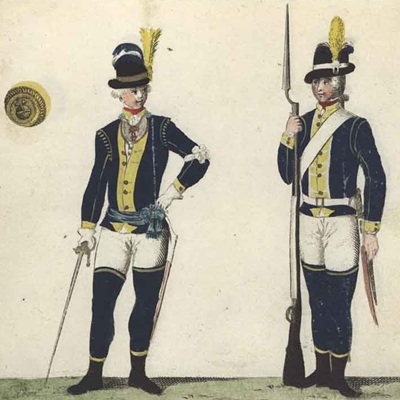
Officer and musketeer in uniform m/1779 (drawn by Carl
Gustaf Roos in 1783)
|

Grenadier in uniform m/1792
(issued in 1796) |
When Gustav III designed his
National Costume in 1778, the old m/1765 uniforms were soon after remade
into m/1779 uniforms, which were worn by the regiment at the muster in 1780.
The only colours that changed with m/1779 were that the neckcloth became red
and that the breeches became white. The reason that the yellow colour on the
breeches was replaced was because the Uppland uniform was considered too
similar to the Livgarde. The cut of the uniform, however, changed very
significantly with m/1779. The coat was shortened to a jacket, whose colour,
as mentioned, retained the dark blue color with yellow lapels, cuffs, collar
and piping, as well as the narrow white lace. Under the jacket was worn a
yellow vest with blue cuffs and collar.
At the general muster in 1780
it was noted that the pioneers had received caps with brass plates and
leather aprons that had been paid for by the regiment.
The 1779 model also meant that gaiters and shoes were to be replaced with
blue charivades and boots, both items with yellow edging. However, the boots
were not delivered until 1784 and the men had had to pay for the charivades
themselves. The m/1765 tricorne hat was to be replaced by a round hat with a
brim, but like the boots, new hats were not delivered until the autumn of
1784 and were issued to the men at the general muster the following year. At
that muster, the other garments were deemed worn out, but new uniforms did
not begin to be procured until November 1786, and the regiment was asked to
patch and repair the old uniforms as best they could until new ones were
delivered.
The first set of newly
manufactured m/1779 uniforms was issued in June 1788 in Stockholm, where the
regiment was waiting to be shipped over to Finland for the upcoming war
against Russia. The War College subsequently paid clothing allowances to
non-commissioned officers, drummers and corporals so that they too could
obtain new uniforms. Losses during the war meant that new soldiers were
recruited in the spring of 1789. These initially only received “släpmunderingar”,
and it is uncertain whether they received proper uniforms before being sent
to Finland. In the same year, a general muster was held where the regiment's
uniforms were largely deemed worn out. But new uniforms were not issued
until 1791, when the war had ended.
When Gustav IV Adolf came of
age in 1796, Uppland Regiment participated in a parade in Stockholm. For
this purpose, new m/1792 uniforms had been issued to the regiment and these
were intended to be used for twelve years. In addition to the general
changes to the uniforms that characterised m/1792, including a blue-yellow
sash, Uppland Regiment now received a white collar. New grenadier caps
replaced the remaining caps from 1771, which had been in such poor condition
that they were discarded in 1791.
|
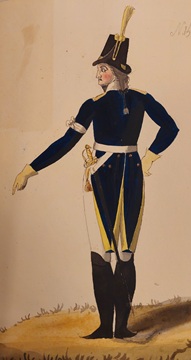
Officer uniform m/1802
(the front side can be
seen here) |

NCO and two musketeers in uniform m/1802
(worn 1803-1806) |
Another new uniform regulation was introduced already in 1802 and 240 new
uniforms were issued the following year. Since it is unlikely that the
regiment wore two different uniform models at the same time, we can assume
that the remaining 960 uniforms were old m/1792 uniforms that had been
re-sewn to match m/1802.
All uniforms were then re-sewn when yet another new uniform regulation was
decreed in the spring of 1806. The changes to the jacket were quite easy to
adjust because it meant that the lapels were removed and replaced with a
single row of buttons. But the older uniforms from 1796 were then so worn
that they were subjected to more extensive treatment. They were "turned" by
opening the seams and separating the lining and then sewing them back
together so that the worn outside of the jackets became the new inside,
which was hidden by the lining. The old inside became the new outside and
was then in such good condition that the planned replacement date of the
uniform was extended to 1815 (twelve years counting from 1803).
Since white broadcloth had already been delivered to the regiment, they were
given permission on 30 October 1806 to wear white waistcoats even though
these were supposed to be grey according to m/1806. However, the trousers
that had been issued before the general muster on 16 June 1806 were probably
the regulated grey colour. At the same muster, 1200 shirts were missing,
which meant that the soldiers lacked a change. In addition, there were only
605 old cloaks that were probably resewn to match the new model (that had
sleeves) since these were present at the battalion in Pomerania in 1807 and
there is no evidence in the sources that new cloaks had been delivered. This
means that these cloaks were likely blue instead of the regulated grey
colour. At the same time, the trousers are considered to have been "unfit",
but these may have been replaced with new white trousers made of ticking
because the king considered the grey broadcloth trousers to be too warm to wear
in Germany.
The blue-yellow sashes that had been part of the m/1792 uniform, but were
abolished in 1802, were reintroduced with m/1806. New sashes were purchased
in 1807 with the help of grants from the War College, which in 1808 also
contributed funds for new hat cords and brass plates.
The battalion that had been stationed in Pomerania returned to Sweden in
early 1808 and an inspection of its uniforms on 26 February resulted in all
the uniforms being discarded. They probably received new uniforms at the
same time. Documentation is missing for these, but Martin Markelius believes
that they received the same blue m/1806 uniforms as the battalion at home
and not the regulated grey m/1807 uniform. This should then mean that
Uppland regiment fought in the Finnish War dressed in blue jackets with a
single row of buttons, a white collar and yellow cuffs with white lace, a
blue-yellow sash, grey trousers and black gaiters that ended below the
knees. |
|
Uppland's Colours

Olof Hoffman's model drawings of Uppland's colonel’s and company colours
m/1686
The oldest
known colours for the Uppland part of Uppland Land Regiment are from 1621
when they received fabric in yellow and red. Höglund has interpreted these
colours as being red with a yellow St. Andrew's cross and the letters GARS
in each red field.
Four yellow colours for Uppland
Regiment are mentioned in 1651. Later, six colours were made for Charles X
Gustav's wedding in 1654. The colouration of them is unknown, but according
to Heribert Seitz, they "apparently" consisted of a white colonel’s colour
and five red company colours (Holm, page 412). The colonel’s colour is said
to have had the national coat of arms as a motif and the painting cost 28
daler copper coins. The painting of the company colours cost 20 daler copper
coins each and was done by the same painter as the colonel’s colour, Jakob
Elbfas. The following year, six more colours were made, which by all
accounts were made of red taffeta. On 28 June 1656, three more red colours
were delivered, which were intended for three newly formed companies.
For the
funeral of Charles X Gustav in November 1660, ten new colours were issued to
contingents from four regiments that were part of the troop parade. Uppland
Regiment was one of them and although the colour of its colours is unknown,
they were not red this time. The taffeta for the colours had the colours
bleumerant (pale blue), blue, green, white and yellow. Since the War College
requested funds for a yellow colour for a newly formed company in 1661,
yellow colours at the funeral can be considered most likely.
In 1671, the
War College unsuccessfully requested funds for red taffeta so that four
colours could be delivered in time for a muster. However, they chose to pay
for a colonel’s colour and four company colours with painted decoration that
same year. When the regiment transferred eight companies to Germany in 1673,
these received one white and seven red (incarnate red) colours with openwork
finials. These colours were unpainted because the regiment received cash to
provide them with painted decor upon arrival in Germany.


Company colours m/1675 that were in use 1675-1683 (and originally pink?)
According to the 1673 colour regulation, Uppland's colours were to have the
Uppland provincial coat of arms as a motif (a golden orb) on all colours and
a new regulation in 1675 added a laurel wreath and four grenades in the
corners. In 1675, Baltzar Friedrich painted two red colours according to
m/1673 and supplemented them later that year so that they corresponded to
m/1675. These were issued to the companies at home and in 1676 Baltzar
Friedrich painted another red m/1675 colour. Two of these colours have
survived and were described as early as 1685 as "red-pale", which has led
Heribert Seitz to believe that their original colour was the nacra-red
(light red or pink) shade that the Uppland colours were to have according to
m/1682 and not the darker red shades of incarnate and crimson that they were
to have in the other regulations (Holm, pages 413-414).
On 29 May
1677, four newly raised companies received unpainted colours "of red and
black taffeta sewn in flames" that had been manufactured for the Colony
Regiment in 1675, and which were provided with silver plated finials. One of
the four colours was probably a colonel’s colour. On 1 June 1678, the
companies that were commandeered to the navy received three unpainted
incarnate red colours with smooth (polished iron) finials.
In 1679,
Uppland Regiment received five colours that had already been made in 1658
for other regiments. First, a white colour that had been made for
Västgöta-Dal Regiment and which consisted of the national coat of arms in a
green laurel wreath and Charles X Gustav's monogram (CGRS) in the corners.
Each corner had one of the letters with a crown above it. The four company
colours were yellow and had originally been made for an unknown regiment.
Their motif was in gold and consisted of a laurel wreath with the letters
CGRS under a crown inside and a motto above the wreath.
 |
On the left, one of five yellow company
colours made by Peter Blohm in 1658 for an unknown regiment. Four of
them were carried by Uppland Regiment from 1679 to 1683. Each colour had
its own motto above the laurel wreath.
- ARMIS ÆQUISSIMIS (With impartial Arms)
- ROBORO JUSTO (With righteous strength)
- OMINE FAUSTO (Under happy omens)
- LEGE SERUATO (Under the sanctity of the law)
- VSQUE SEQUAMUR (We follow as far as it goes)
The staffs were made of unpainted pine and three of the colours
have been preserved. |
The colours
from 1679 were provisional and in 1683 Uppland Regiment received a set of
eight colours according to m/1682. The only difference compared to m/1675
was that the white colonel’s colour would now have the national coat of arms
as the main motif instead of the provincial coat of arms which was
henceforth placed in the upper inner corner. The colour of the company
colours was now specified in the regulation as nacra red which is more of a
pink colour. The finials on the issued flags were made of iron, but the
finial of the colonel’s colour was gilded and pierced with Charles XI's
monogram. The other finials were plain.
M/1682 was,
however, short-lived and was replaced four years later by the famous m/1686.
With this, the four grenades were abolished, and the red shade was changed
to crimson. The national coat of arms on the colonel’s colour would now also
have lion supporters (see the pictures of Olof Hoffman's model drawings
further up).
The first set
of m/1686 colours was received on 30 December 30, 1694 by the colonel and
was made by Helena Kräll in intarsia. These colours were supposedly carried
until the Battle of Poltava, after which they were lost to the Russians.
However, they may have been partially replaced before then. The Russians
noted that the company colours were of different colours and therefore
believed that they belonged to two separate regiments. Three company colours
were still red, while the other four had become so faded that they were
sand-coloured. No sources mention anything about new colours between 1694
and 1709, but this also applies to Skaraborg Regiment, which must have
received a new set of colours during that period. In any case, the colours
that were lost in Ukraine were taken to Moscow, where they were then
destroyed when the Kremlin burned down in 1737. The colours that were still
red at Poltava had white pine staffs.
The next set of m/1686 colours was painted in the winter of 1709-1710 by
either Daniel Stawert or Johan Wikman. This set was not issued until March
1710, which meant that the regiment fought in the Battle of Helsingborg
without colours. Once issued, the colours were carried for the rest of the
war and in 1720 they were described as "faded and worn". However, it
would be until 1727 before they received a new set of colours (painted by
Johan Wikman). Unlike the set from 1710, a colour from 1727 is known to
exist, but unfortunately I have no picture of it.


Colonel’s and company colours in use 1741-1771
|

Company colour use 1771-1796 |
A modified
version of m/1686 was probably issued before the turn of the year 1742 when
the regiment was in Finland during the Russian War of 1741-1743. Instead of
a painted decoration, the banners were embroidered by Christoffer Sergel,
which meant that the motif had been reduced in size so as not to make the
colour too heavy. The number of colours had also been limited to one
colonel’s colour and three company colours (i.e. two colours per battalion),
which had become the new standard in the Swedish army.
A new set of
colours was embroidered by Tobias Leij the Younger for the coronation of
Gustav III in 1771. This followed the regulation from 1766 which replaced
the laurel wreath with a frame consisting of palm leaves and a crown in gold.
These colours were discarded at the muster in 1793 and replaced by a new set
from 1796 (probably embroidered by Frans Oldenburg).
The last m/1766 set was
embroidered in 1814 by Anne-Marie Fellborg. It was a partial replacement for
the set from 1796 and consisted of a colonel’s colour and two company
colours. A company colour from Fellborg's set has been preserved and is in
good condition.
|

Unknown colonel's colour from the reign of Charles XIII
All regiments' colonel's colours were identical at that time |

Company colour in use
1814-1820
|
The custom of having the provincial coat of arms in the upper inner corner
was abandoned at the beginning of the 19th century for all regiments.
Instead, there was a closed crown in each corner. But this meant that all the
colonel’s colour s looked the same and that it is therefore not possible to
determine which of the preserved colonel’s colours may have belonged to the
Uppland regiment.
All m/1766 colours were replaced in 1820 by two m/1819 battalion colours
which consisted of the Swedish flag with the lesser national coat of arms in
the middle of the cross.
|
|
Other Equipment
Bayonets were delivered in 1696 from Vira bruk and differed from the other
regiments in that they were double-edged and fitted with pliers. They were
intended to be fitted with wooden shafts and springs, but were modified in
1701 and fitted with sockets so that they would fit the regiment's muskets.
A proposition for the baggage train from 8 February 1701 states that the
number of armoured wagons would be 15 for the staff (of which 2 were canteen
wagons) and 20 for the companies (plus 8 canteen wagons). The baggage on the
wagons would contain 21 officer tents, 258 private's tents (six men per
tent), 32 musket tents, 100 kettles, 10 hand mills, 32 gunpowder sacks and
40 baggage saddles (Nordensvan page 127).
|
"Main- and sidearms as well as
ammunition required for Uppland
Infantry Regiment"
(autumn 1709) |
|
10 |
"courtzgevär" (halberds?) |
|
1,200 |
bayonet muskets |
|
14,400 |
flints |
|
1,200 |
soldier's swords |
|
96 |
grenadier boxes |
|
1,101 |
cartridge boxes with black belts |
|
16 |
centner krut |
|
16 |
powder sacks |
|
36,000 |
bullets |
|
192 |
grenades |
|
16 |
drums |
|
16 |
drummer's swords |
|
8 |
revelry pipes |
|
8 |
marching pipes |
|
8 |
piper's sword's |
|
3 |
provost's swords |
|
4 |
oboist's swords |
|
When Uppland regiment was restored in 1709, the colonel received permission
from the Defence Commission to equip all men with flintlock muskets and
bayonets. It is unclear when a third of the men were again given pikes, but
it was probably in 1716 after Charles XII's return to Sweden. During the
Norwegian campaign in 1718, only 800 men were equipped as musketeers. After
Charles XII's death, the pikes seem to have been discontinued again. In a
letter to the War College on 5 July 1719, the Uppland colonel requested 102
new muskets, as the proportion of pikemen would be reduced from one third to
one quarter. In a new letter on 1 August, he requested an additional 213
muskets so that the remaining pikemen could also be rearmed. However,
already on 24 November 1719, a royal resolution was issued that determined
that one quarter of the men in each infantry regiment should have pikes.
Interestingly, in preparation for the Scanian campaign, the regiment
requested an amount of ammunition that was only enough to give each soldier
30 bullets and each grenadier two grenades. This allocation may have changed
in 1718 when the grenade and cartridge boxes from 1709 were to be replaced
because they were both too old and too small.
All soldiers were also supposed to have received swords in 1709, but their
delivery was delayed so that 1061 men were without swords during the Scanian
campaign. In March 1710 new swords were issued so that only three were
without them in May. However, these cannot have been swords in accordance
with regulations since the regiment was mustered in August the same year and
it was noted that almost no one had regular swords.
On March 10, 1711, 200 Danish tents were issued to the regiment. These had
become Swedish spoils of war after the Battle of Helsingborg.
The regiment's 16 drums were in 1717 "evenly painted and the Uppland coat
of arms gilded on them". The drummers were armed with deer catchers in
1719 and had covered drum straps in 1721.
In 1718, officers were armed with half-pikes and "studsare" (shortened
muskets), and also had a gorget. The grenadier NCO:s had 8 "kurzgevär" (literally
"short weapons" and usually refers to NCO halberds but might in this case be
some form of short musket).
In 1721, there were 8 wagon covers in Uppsala Castle "which are painted
with blue oil paint. Ditto 8 wagon bodies made of boards, painted black
".
|
|
References
Anders Pihlström's diary 1708–1723.
Stockholm (1903)
Asker, Björn. Svenska uniformsförteckningar 1655-1683 (article in MAM 37). Stockholm (1978)
Asker, Björn. Upplands regemente och Karl XI:s uniformsreformer (article in MAM 39). Stockholm (1981)
Bellander, Erik. Dräkt och uniform. Stockholm (1973)
Bergström, Otto. Bidrag till Kongl. Uplands regementes historia. Stockholm (1882)
Cederström, Rudolf. Svenska kungliga hufvudbanér. Stockholm (1900)
Ericson, Lars. Fastställda uniformsmodeller för svenska armén under 1720-talet (article in MAM 45-46). Stockholm (1986)
Grill, C. Statistiskt sammandrag af svenska indelningsverket. (Facsimile edition 1988)
Gillgren, Sten. Kungl. Upplands regementets officerare. Enköping (2008)
Holm, Torsten – Nilsson, Sven A. med flera. Kungl. Upplands regementes historia. Uppsala (1958)
Höglund, Lars-Eric. Från Karl Knutsson till Kristina. Karlstad (2012)
Höglund, Lars-Eric. Skånska kriget 1675-79 - Fanor och uniformer. Karlstad (1999)
Höglund, Lars-Eric – Sallnäs, Åke. Stora nordiska kriget 1700-1721 - Fanor och uniformer. Karlstad (2000)
Larsson, Anders. Karolinska uniformer och munderingar åren 1700-1721. Östersund (2022)
Markelius, Martin. Bestämmelser och verklighet – uniformeringen i von Vegesacks kår (article in MAM 69). Stockholm (2010)
Markelius, Martin. Gustav III:s armé. Stockholm (2020)
Nordensvan, Otto. Svenska armén åren 1700–1709. (article in KFÅ 1916). Lund (1917)
Schreeb, Tor Schreber von. Karolinska bajonetter och deras föregångare på kontinenten (article in MAM 4). Stockholm (1941)
Stille, Arthur. Kriget i Skåne 1709-1710. Stockholm (1903)
Törnquist, Leif. Infanteriets fanor m/1686 (article in SVSS-NS XXX). Stockholm (2015)
Törnquist, Leif. Infanteriets fanor 1761-1900 (SVSS-NS XXXIII). Stockholm (2018)
Wennerholm, J Bertil R. Emporterade troféer. Bohus (2000)
Wimarson, Nils. Sveriges krig i Tyskland 1675-1679. Lund (1897-1912)
Wernstedt, Folke. Svenska standar och fanor 1654-1686 (article in Meddelanden från Riksheraldikerämbetet X). Malmö (1945) |
|