|

|
 |
 |
 |
 |
|
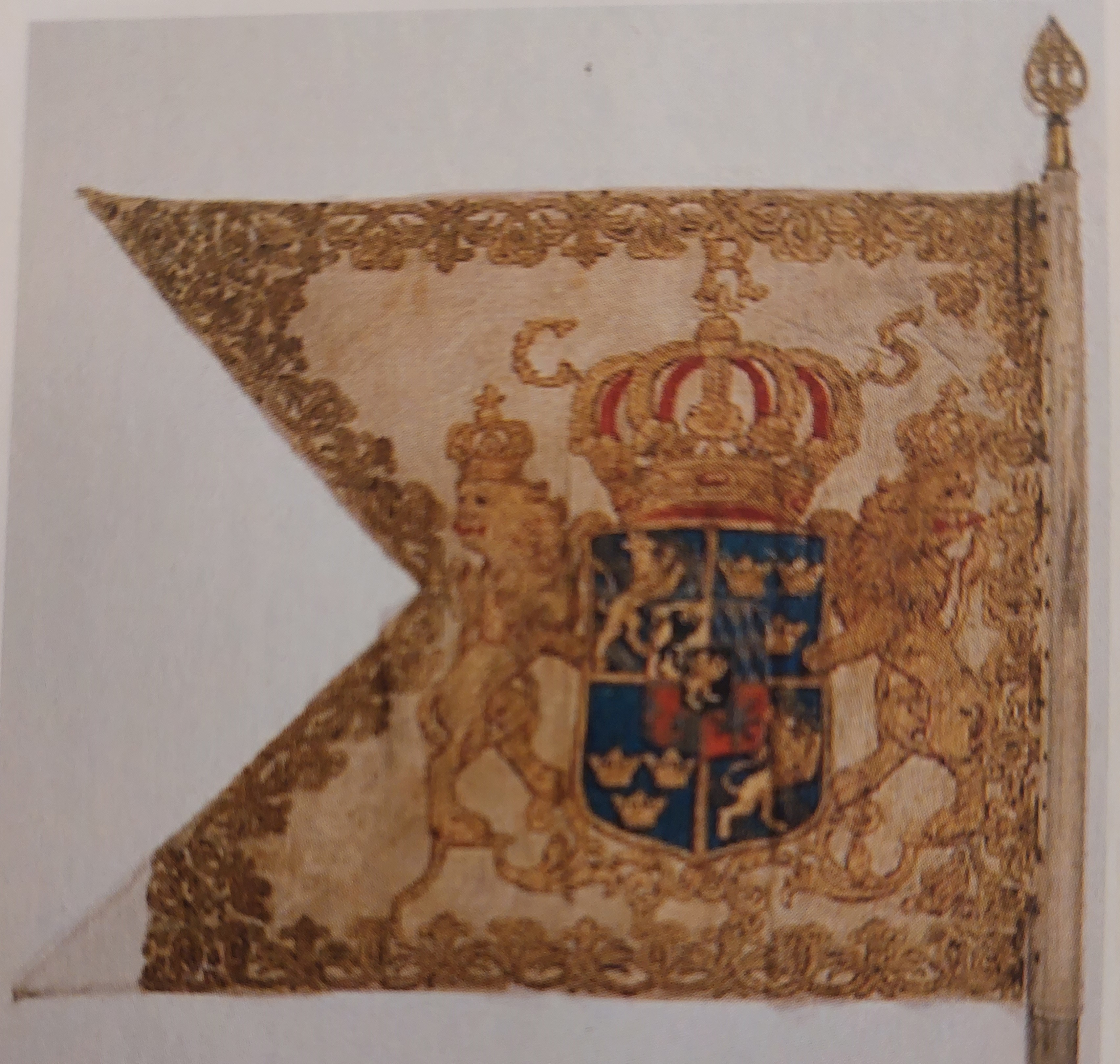
Colonel's colour m/1686
(Skaraborg) |
Dragoon Colonel's colour
(Liv-dragoons) |
Company standard m/1686 reverse (Västgöta) |
Company standard m/1686 obverse (Västgöta) |
The most valuable possessions a
regiment owned were their colours which were carried in every battle and
marked the place of each unit in the battlefield. The colours were made with
expensive material and artistic decorations in order to show the status of
the regiment. To lose the colours was a great shame and conquering the
enemy's colours was a great honour. For this reason it was usually near the
colours where the hardest fighting occurred and soldiers were required to
swear an oath to never abandon the colours.
Depending on troop type the colours had different shape and size. The
infantry colours were very large. In the Swedish army during the Great
Northern War, these were on average 1.84 metre high and 2.16 metre wide. The
cavalry colours were square shaped and considerably smaller, each side of
the square just little more than a half metre long. The Swedish cavalry also
usually had two different motifs on the obverse and reverse side of the
standards, i.e. a provincial coat of arms on the obverse and the royal
cipher on the reverse side. This arrangement was also true for the dragoons
who officially were mounted infantry but in practise functioned as cavalry.
The dragoon colours had however a different shape and size of their colours.
These were swallow tailed and had a height of about a metre and a slightly
longer width.
Regardless of troop type, each Swedish company had their own colour during
the Great Northern War, which meant that a typical regiment would have eight
colours or standards. Seven of these were called company colours or company
standards while the colonel's company had a colonel's colour or standard
which was always white. After the Great Northern War
the number of colours was reduced to two per battalion (which consisted of
four companies) while the cavalry and dragoons continued to have one colour
for each company. Then in the 19th century the number of infantry colours
was yet again cut in half so that each battalion would carry just one
colour. Later it was decided that all regiments would only have one colour
each, but at that time the colours had for a long time only had symbolic
importance.
However, during the Great Northern War the colours were still of great
importance. And in an age where it was hard to find reliable information
about the outcome of a battle, the number of conquered colours were
compelling evidence of victory which were presented to the people and
foreign ambassadors. Likewise, it was hard to conceal defeat when an army
had lost many colours.
During the earlier part of the 17th century, colonels had a great influence
over the appearance of their field signs, but starting in the 1670s this was
determined at a central level in a series of regulations, whereby the
provincial coat arms came to adorn the colours and standards of the Swedish
army. The table below describes the development of the infantry colours. The
cavalry standard had the national arms as a motif on the standard from the
very beginning and m/1675 had numbers indicating the year they were
manufactured instead of the infantry's flaming grenades. m/1686 then became
the regulation in force for the cavalry throughout the 18th century.
|
 |
 |
 |
 |
Company colour m/1675
(a faded Uppland colour) |
Company colour m/1686
(Dal Regiment) |
Company colour m/1686B
(Dal Regiment) |
Company colour m/1766
(an unfaded Uppland colour) |
| |
Motif of the Colonel's Colour |
Motif of the Company
Colour |
|
m/1673 |
The provincial coat of arms surrounded by palm leaves or
a laurel wreath. According to the regulation the provincial coat of arms
should have been in a shield (with a crown on top)) but there is only
one example of such a colonel’s colour being issued. |
The provincial coat of arms. |
m/1675
(de facto introduced 1674) |
The
provincial coat of arms. From 1682 it was instead the greater national
coat of arms (without lion supporters) with the provincial coat of arms
in the upper inner corner. |
The provincial coat of arms surrounded by a laurel wreath
and a flaming grenade in each corner. |
|
m/1686 |
The greater national coat ofaArms (with lion supporters)
in the middle with the provincial coat of arms in the upper inner
corner. |
The provincial coat of arms surrounded by a laurel wreath. |
|
m1686B |
Same as
before, but the motif was made smaller so that the colour would not
become too heavy when the manufacturing technique was changed from
painted to embroidered decorations in 1731. |
|
m/1761 |
Same as before. |
The provincial coat of arms in a crowned shield framed by
gold seashell ornaments. |
|
m/1766
(valid until 1819) |
Same as before. |
The provincial coat of arms in a crowned shield framed by
gold palm branches. |
In cases where several
regiments came from the same province, there were variants with striped
flags with the coat of arms of the provincial capital in the middle or a
roundel and corner flames instead of a laurel wreath. The latter also
applied to those provinces whose coats of arms had a field colour that was
considered less suitable for company colours of ordinary regiments (white,
which was reserved for high-status regiments, or black, which was a mourning
colour).
By far the best-known of the
regulations in the table is the one from 1686, which largely remained in
effect until 1766. In connection with its introduction,
model drawings of colours and standards
were painted, which were then to be followed when new field signs were
manufactured. However, the model drawings were not always followed to the
letter, so one should also study the preserved
colours and standards that remain today.
There is also a page on
infantry colours during the 18th century.
|